Monday, 6 July 2020

PRACTICALLY PERFECT

A nice addition to my Walt Disney Disney/Mary Poppins collection: the programme – in near mint condition – from the film's World Premiere at Grauman's Chinese Theatre in Hollywood fifty-six years ago on 27 August 1964. 

Here's the programme's cover with the iconic (uncredited) art by Disney studio artist Paul Wenzel that was also memorably featured on the early Poppins posters and the LP soundtrack recording.  


Although I don't think I was conscious of it back in 1964, I'm intrigued by the use of the 'neon marquee-light-bulb' lettering that suggests 'theatre' and 'musical' yet doesn't quite fit with the film's Edwardian setting.

As for the likenesses themselves, Wenzel's artwork is stunning, although I wonder whether, at the time of painting, the studio had still to finalise Julie's Poppins wig since the colour and styling are very obviously 'Julie' and not 'Mary'.

Here is Paul Wenzel's original artist's 'rough' for the double-portrait: bought in auction in December 2018 – not by me! –  for $5,520!


Below is a small selection of the interior pages, beginning with one focusing on the collaboration between Mr. Disney and Mrs. Travers...

Click image to enlarge

I do wonder what P.L.T. thought when she read: "Mrs Travers was invited to Burbank for story conferences. Elated with the treatment her beloved heroine was receiving, the authoress signed the formal contracts"   

ELATED? I'm not so sure about that!

 Click all images to enlarge


POST-SCRIPT
(One Day Later...)

I couldn't have guessed that posting details on Facebook of my having acquired this delightful collectable was just the beginning of a story...  

After posting these images, my Facebook friend and noted Poppins collector Mat Plendl posted the following images of an early Poppins LP and a Songbook featuring photographs of Julie Andrews and Dick Van Dyke that obviously provided a significant part of the inspiration for Paul Wenzel's now iconic illustration...


Images courtesy of Mat Plendl

Mat commented: 
"Dick Sherman told me, years ago, that this was the first run (maybe a test?), and that Walt thought it looked too much like a kids' thing and so they decided to give it a more grown-up, Broadway look. Plus, this photo of Julie is none too flattering. Very nearly impossible to find (along with a songbook with similar cover sold at Disneyland for a short time), a few escaped out to radio stations but they only appear on super-rare occasions, usually when a collector has died!"  

POST-POSTSCRIPT
(Later the Same Day...)
And still the story continues! 

Another Facebook friend, Chris Tassin, adds:
"Great to see the rare early pressings! A couple of years ago, I found the actual photos of Julie and Dick used as reference for the illustration."


Images courtesy of Chris Tassin

So there's the final link! It's now clear why Julie's hair bears no resemblance to her 'Poppins' look and it also shows that Paul Wenzel was a truly gifted illustrator! 

Many thanks to Mat Plendl and Chris Tassin for helping to solve what has been (for me) a 56-year-long mystery!

Saturday, 4 July 2020

PEANUTS IN WONDERLAND

Across the years, Charles M. Schulz turned to Lewis Carroll's Alice in Wonderland for inspiration featuring Snoopy in the fantastical personification of the –– Cheshire Beagle!

Especially for Alice's Day 2020, here's a selection...


Alice herself made an appearance once accompanied by (or represented by) the Hatter-Beagle...


All cartoons (c) Peanuts Worldwide LLC

WONDERLAND'S INDEPENDENCE DAY

One hundred and fifty-eight years ago, today, the Reverend Charles Lutwidge Dodgson and an Oxford colleague, the Reverend Robinson Duckworth, took the three daughters of the Dean of Christ Church – Lorina, Alice and Edith Liddell – on a boating trip.

As they rowed along on that 'golden afternoon', Dodgson improvised a fantasy about the curious adventures of a little girl named (like one of the girls on the trip) 'Alice', who followed a White Rabbit in a waistcoat with a watch down a rabbit-hole and found herself in a true land of wonders...

At Alice’s request, Dodgson wrote out the story – first calling it Alice’s Adventures Under Ground – and added his own distinctively idiosyncratic illustrations.


By 1865, it had grown (like someone who had nibbled an EAT ME cake) into Alice’s Adventures in Wonderland and was published under the authorship of 'Lewis Carroll' with illustrations by the legendary Punch cartoonist, Sir John Tenniel.


The book was made Mr Dodgson’s alter ego one of the most famous men in Victorian England. It also revolutionised children’s literature by abandoning, at a stroke, the long and piously-held tradition of moral-and-improving tales for the young in favour of zany, witty nonsense that had no underlying message other than fun...

Across the succeeding years, Alice has been endlessly reinterpreted by illustrators and filmmakers...

Mervyn Peake (1946)

Tove Jansson (1966)

Salvador Dali (1969)

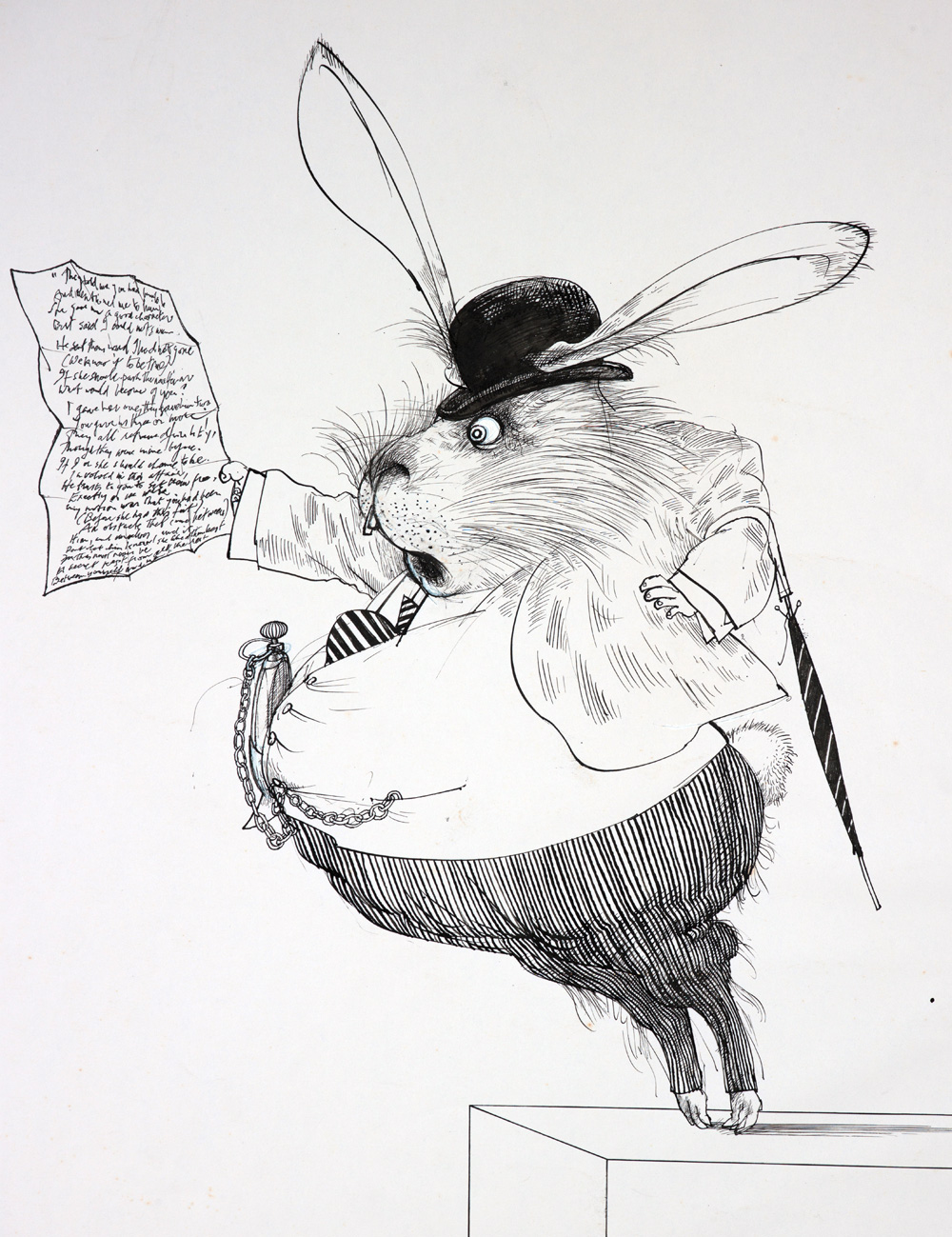
 Ralph Steadman (1973)

 Walt Disney (1951)

Walt Disney & Tim Burton (2010)

July the 4th is also, of course, American Independence Day and – apart from over fifty years of Disney influence – it is interesting to note how many true literary successors to Lewis Carroll have sprung up in America, among them: L Frank Baum, James Thurber, Ogden Nash and Maurice Sendak.

But then perhaps this shouldn’t really surprise us, since the Americans have always shown themselves to be far greater lovers and defenders of Wonderland (and Looking-glass World) than the English have ever been…

Maybe there are reasons for this affinity between the American sensibility and Carroll’s nonsense realm: for one thing, Alice is a highly independent and self-determining individual (a truly revolutionary notion for a child’s book of the 1800s); for another, the Wonderlanders with whom she mixes are a wildly disparate conglomeration of diverse species – animals, humans, animals-dressed-as-humans and humans-with-animal-masks – all of whom (for the most part) rub along together but who are, together, fiercely territorial!


I find it fascinating – and humbling – that, in 1948 (by which time the original manuscript of
Alice’s Adventures Under Ground
had been sold and was in the possession of an American collector), a group of US well-wishers, led by the Librarian of Congress, should have started a fund to raise the considerable sum of money required to buy back the manuscript and send it home to us!


That first foray into Carroll's underground wonderworld now resides in the British Library and maybe we should remember the American act of selfless generosity which made that possible the next time we look at, say, the Elgin Marbles…

Meanwhile, time to raise a cup of tea and join in the toast-----

Happy 158th Birthday, Alice!

Happy 244th Birthday, America!


This blog post is a edited reprint of a post from 2007

Thursday, 2 July 2020

MORE FROM THE JUNGLE

A couple more mementos (from way back in 1967) of my youthful passion for Walt Disney's last personally produced animated feature, The Jungle Book: these are the original Pan paperback movie-tie-in editions ('By special arrangement with MACMILLAN & CO. LTD.') of Rudyard Kipling's original two-volume story collections about Mowgli and other animals...


I already owned the original books (having first met Kipling through that wondrous collection of tales, The Just So Stories), so I knew that the Disney movie I was about to go to the cinema to see was not, as you might say, an entirely faithful filmic translation of the books! As a result I didn't really need the back-cover disclaimer: "Some by Kipling, some by Disney – the creatures that people the wonderful new Walt Disney dull-length cartoon"!


Of course I fell in love with the film and (despite my awareness of its being only loosely 'Kipled', as it were) I had soon committed the songs to memory and played and re-played the Disneyland Storyteller LP of The Jungle Book to my parents' total distraction!
 
Many years later, in 2014, David and I got together in London with song-writer Richard M. Sherman and his wife, Elizabeth, and I asked Dick – who was responsible, with his brother, Robert, for the songs not just in The Jungle Book but in Mary Poppins, Disney's 'Winnie the Pooh' films and Chitty Chitty Bang Bang among many, many others – to inscribe these much-treasured books.

Taking out his pen, Dick innocently asked: "Shall I put 'To Brian and David'?" and was, I would say, a tad taken aback when I (almost) screamed:

"NO!! -- Just BRIAN!" 
 

Well, I mean, having looked after those books for 47 years, I really wasn't about to share a dedication – even with my loving partner!

Thanks, Dick –– and sorry, David!


Saturday, 27 June 2020

ONE OF CHILDHOOD'S BARE NECESSITIES

I've just reclaimed a fragment of my youthful days and, in particular, my obsession with Walt Disney –– which, as you may know, I have never lost!

The release of The Jungle Book in 1967 was of enormous significance and emotional importance to myself and other young Disney fans who had seriously feared that, with Walt's death the preceding December, there would never be another new Disney animated movie.

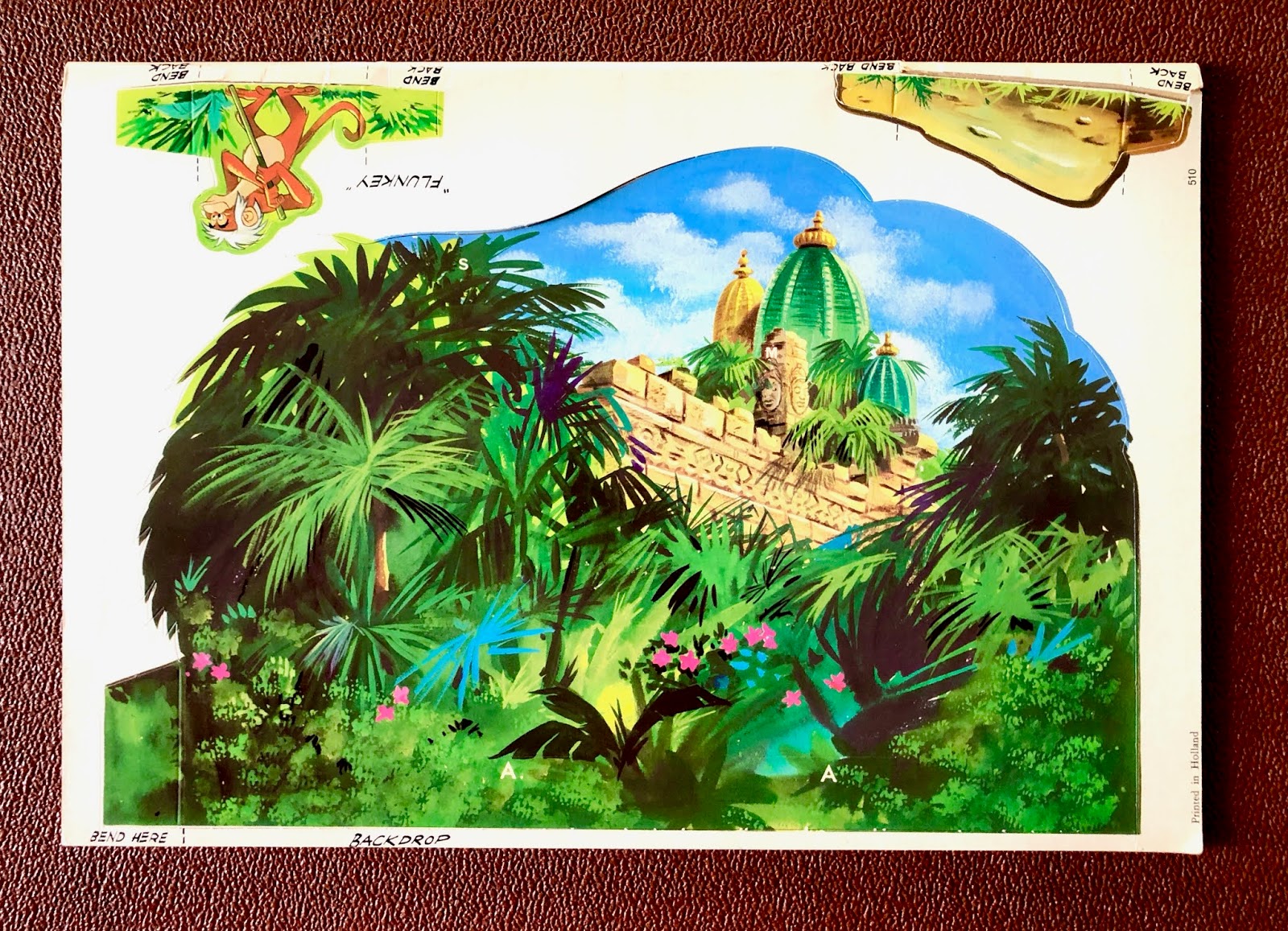
Such was my delight that – despite the paucity of my pocket-money – I grabbed as much Jungle Book merchandise as I could possibly afford, including this model-making book! Of course, back then, it wasn't enough to own this publication, I simply had to make up the model which also played to another of my obsessions – toy theatres.

Little did I think that putting together this Disney tableau was effectively destroying its future collectible value!

Oh, the impetuosity of youth!

Well, obviously I won't making the same mistake with this near-mint copy, found on ebay from a seller who retrieved it from the darkest recesses of a family attic...


Hang on mo...

DAVID!

What are you DOING??

No! No! 

NOOOOOOO!!!!

PUT DOWN THOSE SCISSORS......... 

Saturday, 21 December 2019

"WHO IS JOSEPH?"

A radio interviewer questioning me about my new book Joseph and the Three Gifts kept asking the same question over and over: "Who was Joseph?" I answered it three times and then gave up...


The reason for my inadequacy in addressing the question was that my book is a story – a 'fable', a meditative speculation...

Anyway, here's an article I wrote about how the story came to be written followed by an extract from the book...

CLICK on IMAGES to ENLARGE
 

Tuesday, 3 December 2019

A CHRISTMAS TALE


Here's all about my new book, Joseph and the Three Gifts: An Angel’s Story...


It was, quite simply, a gift – a Christmas gift – given to me in Venice in the festival days of last December. I was in that ancient and beautiful city, long known by the grandiloquent title of La Serenissima, in order to celebrate Christmas and New Year and, between whiles, to work on a book about Venice.

This was not a commission and, like many professional writers, the book I wanted to write (but for which I did not yet have a publisher) kept being postponed in favour of writing for bread. There are, of course, more than enough books about Venice already and mine was – and remains – a potentially difficult project to sell since it is neither a guidebook nor a history, art or cookbook but, rather, a collection of essays about people, places, themes and ideas.

Anyway, I had, to my great pleasure, succeeded in writing one or two new pieces when another idea came my way, suddenly and unbidden, elbowing the Venice book aside and insistently demanding to be considered. It all began in one of the great churches of Venice, the Basilica di Santa Maria Gloriosa dei Frari (more simply known as The Frari), celebrated for housing the monumental tomb of Antonio Canova and Titian’s ecstatic ‘Assumption of the Virgin’.

Every Christmas, the Frari displays a large-scale Christmas diorama of a Bethlehem village jam-packed with houses, inns, shops, wells and watermills with a cast of automata people and animals. Lighting effects continually transform the scene from day to night and back again to an accompanying soundtrack of sacred music. Finding the Holy Family was, at first, a challenge among the vista of blacksmiths hammering at their forges, potters hunched over their wheels, bread-makers busy at their ovens, children fishing in the stream and housewives hanging out their washing.

Then I saw them: Mary gently rocking her newborn baby and, every few minutes, rising to her feet to hold out the Christ Child for the adoration of a couple of kneeling shepherds. Just behind her, stood Joseph; unlike the animated Mary, he was simply an immobile figure from a nativity set – in attendance, but absolutely not the focus of attention.

This triggered a recollection, from a few weeks earlier, of a visit to an exhibition devoted to the work of Edward Burne-Jones, where I had sat for some time contemplating his elaborate tapestry, The Adoration of the Magi. Once again, Joseph was there – in the picture – but over to one side, approaching the stable with a bunch of kindling and bowing his head in awe before the glorious brilliance of a mid-air angel and the dazzling splendour of the three distinguished visitors.


These two experiences fidgeted in my brain until, one still and sleepless Venetian night, they formed themselves into a series of questions: why doesn’t Joseph figure more prominently in the story in the nativity – always present, even singled out with a halo to indicate his holiness – but for ever a marginal figure, glimpsed on the side-lines, left in the shadow cast by the radiance and wonder of the Incarnation.

What sort of man was he, this Joseph? What was it in the character of this humble carpenter from Nazareth that led to his being chosen as foster-father to the Son of God? What was his reaction to the discovery that his fiancé was pregnant and how did he cope with the inevitable shame and embarrassment? And, having endured that dishonour, how did he handle the many mysterious events attending that Nativity with which we are all so universally familiar from the greatest masterpieces of art down to the cards, carols and cribs of our annual Christmastides?

What were Joseph’s feelings observing the inexplicable adoration of shepherds and Magi? And what did he make of those three curious, portentous gifts that the Wise Men from the East laid at the feet of his wife and child?

And, very specifically, whatever became of those gifts? Even as I wrote down these and the other questions that were teeming through my brain, I was surprised to find a series of answers – or, at least, possible answers – bubbling to the surface of my mind, provided by someone who was intimately involved with the events of the first Christmas and who witnessed the following thirty-something years that eventually led to the passion and glory of Easter –– the Archangel Gabriel. Once this unexpected Venetian Christmas gift had been given, all that was left to do was to listen to the angel and write the story down.

Joseph and The Three Gifts: An Angel’s Story with decorations by Henry Martin is published in hardback by Darton, Longman & Todd, priced £9.99 

And here's an interview with me in this week's edition of The Church Times...


Photo of Brian Sibley by David Weeks