Showing posts with label Tolkien. Show all posts

Monday, 30 October 2023

ONE BOOK TO RULE THEM ALL


I recently unearthed this old paperback copy of The Lord of the Rings (cover art by Pauline Baynes): a volume that was the Bible for the youth of my generation. 

The edition is dated 1971 (when I was 22-years-old); fast-forward a decade, and this would be the copy that i used when adapting Tolkien's epic for the BBC's – now renowned – 1981 radio serialisation.

Sunday, 23 April 2023

AN AUDIENCE WITH THE GREAT GOBLIN

 Brian Sibley speaks with Barry Humphries


‘Delusional, brutal, totally lacking in empathy and, above all, hideous; he is one of the most unpleasant characters to have ever inhabited the cinema screen.’


The celebrated Australian actor and comedian, Barry Humphries is discussing his portrayal of the Great Goblin, King of Goblin Town in the Misty Mountains where Thorin and the Dwarves are taken prisoner and held captive. ‘He is a gigantic and repulsive figure, and yet, one of great charm, dignity, and erudition. We realize that, underneath it all, he is probably a New Zealand intellectual, fallen upon hard times.’  


Recalling how he came to be involved in the project, Barry says: ‘I had a telephone call from someone called Peter Jackson. I was in London, where I sometimes live, and was busy, so I asked him to ring later. Then a penny dropped. I thought, “Could he be related to one of the most gifted people in the entire history of film?” He was and he asked me if I would like to be in his film of The Hobbit?’


It was an invitation not to be declined: ‘I immediately agreed,’ he says, ‘for a ridiculously small fee. But the money was not important, it was the opportunity to explore the thing that I like most in life and art: the grotesque. Normality has never interested me. I am drawn to the paranormal, the extraordinary, the bizarre and the outlandish.’


That is certainly borne out by his close association with Dame Edna Everage, housewife, investigative journalist, social anthropologist, talk-show host, swami, spin-doctor, Megastar, and Icon and Sir Les Patterson Australia's outspoken cultural attaché to the Court of St James’s. 


For Peter Jackson, having Barry Humphries in the cast was both thrilling and, in anticipation, a source of some apprehension: ‘I’ve been a fan of Barry’s for over thirty years,’ he says, ‘I’d seen Dame Edna’s shows in the West End and when she toured New Zealand, but it’s always a bit nerve-wracking when you meet people you admire for the first time because you don’t want your heroes to disappoint you. Of course, Barry turned out to be everything I’d dreamed he would be: the sweetest, kindest, good-natured, funny, man who does really great work.’


For Barry’s part, he was understandably keen to know what his character looked like: ‘Jackson showed me a little plastic figurine of such ugliness that I really thought it was a part they should get someone else to play: perhaps Dan Aykroyd or possibly Danny DeVito in a fat suit. But they explained that the new techniques would make it possible for me to be extremely large, to begin with, and to conform to the ugliness of the figurine. And I think we’ve achieved that. People will shrink in horror, but then – to use a modish expression – embrace the character.’  


Asked whether he had contributed to the screen realisation of the character, Barry says: ‘It is possible that I made a contribution. Lately, when I’ve looked in the mirror, I can see that they based it loosely on my own appearance. I’ve been a little worried, as the years go on – I’m now in the November of my life – by my double chins, which seem to be growing.’


The goblins’ brutally monstrous monarch is not only given voice by Barry Humphries, but was acted out by him in motion-capture, a process which he found both intriguing and baffling: ‘You get covered with dots – sort of white measles suddenly appear all over you – and these, apparently, attract little lasers or beams or something in the camera. If I were a twelve-year-old, I would understand all the technology of this movie, but as I’m not, I just go with the flow and enjoy myself.’


The actor was much impressed set built for the scenes featuring the Great Goblin: ‘The studio was filled with an amazing edifice. Because the Goblin King is a scavenger on a huge scale, his throne room is entirely constructed of rubbish: old timber, terrible skeletons and human remains. It’s a forensic paradise. Dwarves are his foe and he is a cannibal, so he’s very fond of having them in various culinary experiments. His horrible inner sanctum is filled with the skulls and bones and, sometimes, even the entrails of Dwarves to an extent previously unseen in movies. In fact, I know of no other film where the entrails of Dwarves are examined in such detail, so it’s an educational film.’


Of the throne itself, Barry notes: ‘There’s a hole in the seat, so it is both a throne and also a toilet. The Goblin King is, among other things, grossly incontinent so if he hears the call of nature it doesn’t need to interrupt his conversation and, from time to time, a beautifully crafted urn beneath the throne receives a compliment of matter from the Goblin King, generally speaking of ill-digested dwarf.’ 


Barry was particularly gratified to discover that the Great Goblin has a song to sing: ‘I’m convinced that it will be a huge hit,’ he says, ‘It will top the charts, as the young folk would express it. It could even go platinum. It is a song of extreme aggression: a hate-filled number, which children will enjoy and senior citizens will appreciate. It’s entirely about destruction, death, and torture. But I try to do it in a sympathetic way. I’ve tried, as a matter of fact, to bring out the loveable side of my character – although this attempt has been a total failure.’ 


Barry is no stranger to musical performance: he was Mr Sowerberry the undertaker in the original 1960 production of Oliver! and later played Fagin. However, singing for the Great Goblin proved challenging: ‘My character is tone deaf, and so I had to do what is an extremely difficult thing for a person like me, who sings beautifully – I had to sing it badly. Having to act and sing badly is difficult for someone who is in the November of his life.’  


Of the Great Goblin’s eventual demise, Barry says: ‘I’ve never been disemboweled before, but it’s a pretty nasty death, and I think one that will be greeted by audiences with joy, but also dismay to think that they won’t see the character again. But, you know, in works of imaginative fiction, people do die and are reborn. They’re not really dead. And to me, this is an indestructible character.’ 


The Hobbit began life as a children’s book, so an obvious question is whether or not it has been translated into a children’s film? Barry is adamant: ‘The Hobbit is a film for children in the sense that it’s scary moments are the scary moments kids enjoy. Some tests have been made on young children, and they have enjoyed it, though they have not slept a wink since and some of them have also developed nervous tics that, apparently, will never go away. Otherwise, yes, it’s a children’s film, and it is also, not – as is often cornily said – for “the young in heart”, but for those who appreciate extravagance and imagination: qualities lacking in almost every movie you ever see these days.’


As a final reflection on his foray into Middle-earth, Barry Humphries says, ‘There’s much in this film for audiences of all ages, but I think what people will enjoy the most is my appearance as the Great Goblin. Although, as the years pass, you’ll forget most of it, my performance will be evergreen in your memory.’


Tuesday, 26 July 2022

THE RISE AND FALL OF NÚMENOR

If you're eagerly anticipating the September debut of Amazon Prime's The Lord of the Rings: The Rings of Power, then you may like to know of this forthcoming publication devoted to J.R.R. Tolkien.'s writing about the Second Age of Middle-earth...


J.R.R.Tolkien's
THE FALL OF NÚMENOR  
and Other Tales from the Second Age of Middle-earth
 
Edited by BRIAN SIBLEY
and Illustrated by ALAN LEE

Published by HarperCollins

HarperCollins is proud to announce the publication in November 2022 of THE FALL OF NÚMENOR by J.R.R. Tolkien, edited by writer and Tolkien expert, Brian Sibley, and illustrated by acclaimed artist, Alan Lee. The book will be published globally by HarperCollinsPublishers and in other languages by numerous Tolkien publishers worldwide.

Presenting for the first time in one volume the events of the Second Age as written by J.R.R. Tolkien and originally and masterfully edited for publication by Christopher Tolkien, this new volume will include pencil drawings and colour paintings by Alan Lee, who also illustrated The Lord of the Rings and The Hobbit and went on to win an Academy Award for his work on The Lord of the Rings film trilogy.

J.R.R. Tolkien famously described the Second Age of Middle-earth as a ‘dark age, and not very much of its history is (or need be) told’. And for many years readers would need to be content with the tantalizing glimpses of it found within the pages of The Lord of the Rings and its appendices.

It was not until Christopher Tolkien presented The Silmarillion for publication in 1977 that a fuller story could be told for, though much of its content concerned the First Age of Middle-earth, there were at its close two key works that revealed the tumultuous events concerning the rise and fall of the island-kingdom of Númenor, the Forging of the Rings of Power, the building of the Barad-dûr and the rise of Sauron, and the Last Alliance of Elves and Men.

Christopher Tolkien provided even greater insight into the Second Age in Unfinished Tales of Númenor and Middle-earth in 1980, and expanded upon this in his magisterial 12-volume History of Middle-earth, in which he presented and discussed a wealth of further tales written by his father, many in draft form.

Now, using ‘The Tale of Years’ in The Lord of the Rings as a starting point, Brian Sibley has assembled from the various published texts in a way that tells for the very first time in one volume the tale of the Second Age of Middle-earth, whose events would ultimately lead to the Third Age, and the War of the Ring, as told in The Lord of the Rings.

The Hobbit was first published in 1937 and The Lord of the Rings in 1954–5. Each has since gone on to become a beloved classic of literature and an international bestseller translated into more than 70 languages, collectively selling more than 150,000,000 copies worldwide. Published in 1977, The Silmarillion sold more than one million copies in its first year of publication and has gone on to be translated into almost 40 languages.

Brian Sibley says: ‘Since the first publication of The Silmarillion forty-five years ago, I have passionately followed Christopher Tolkien’s meticulous curation and scholarship in publishing a formidable history of his father’s writings on Middle-earth. I am honoured to be adding to that authoritative library with The Fall of Númenor. I hope that, in drawing together many of the threads from the tales of the Second Age into a single work, readers will discover – or rediscover – the rich tapestry of characters and events that are a prelude to the drama of the War of the Ring as is told in The Lord of the Rings.

Alan Lee says: ‘It is a pleasure to be able to explore the Second Age in more detail, and learn more about those shadowy and ancient events, alliances and disasters that eventually led to the Third Age stories we are more familiar with. Wherever I had the opportunity when working on The Lord of the Rings and The Hobbit, I tried to imbue pictures and designs with an appropriate antiquity, an overlayering of history and of echoes of those older stories, and The Fall of Númenor has proved a perfect opportunity to dig a little deeper into the rich history of Middle-earth.’
The Fall of Númenor will be published by HarperCollins with a simultaneous global publication date of November 2022, and subsequently in translation around the world.

The streaming series, The Rings of Power, set during the Second Age of Middle-earth, will be released by Amazon Prime in September 2022.


Monday, 25 July 2022

"NEVER LAUGH AT A LIVE DRAGON!"

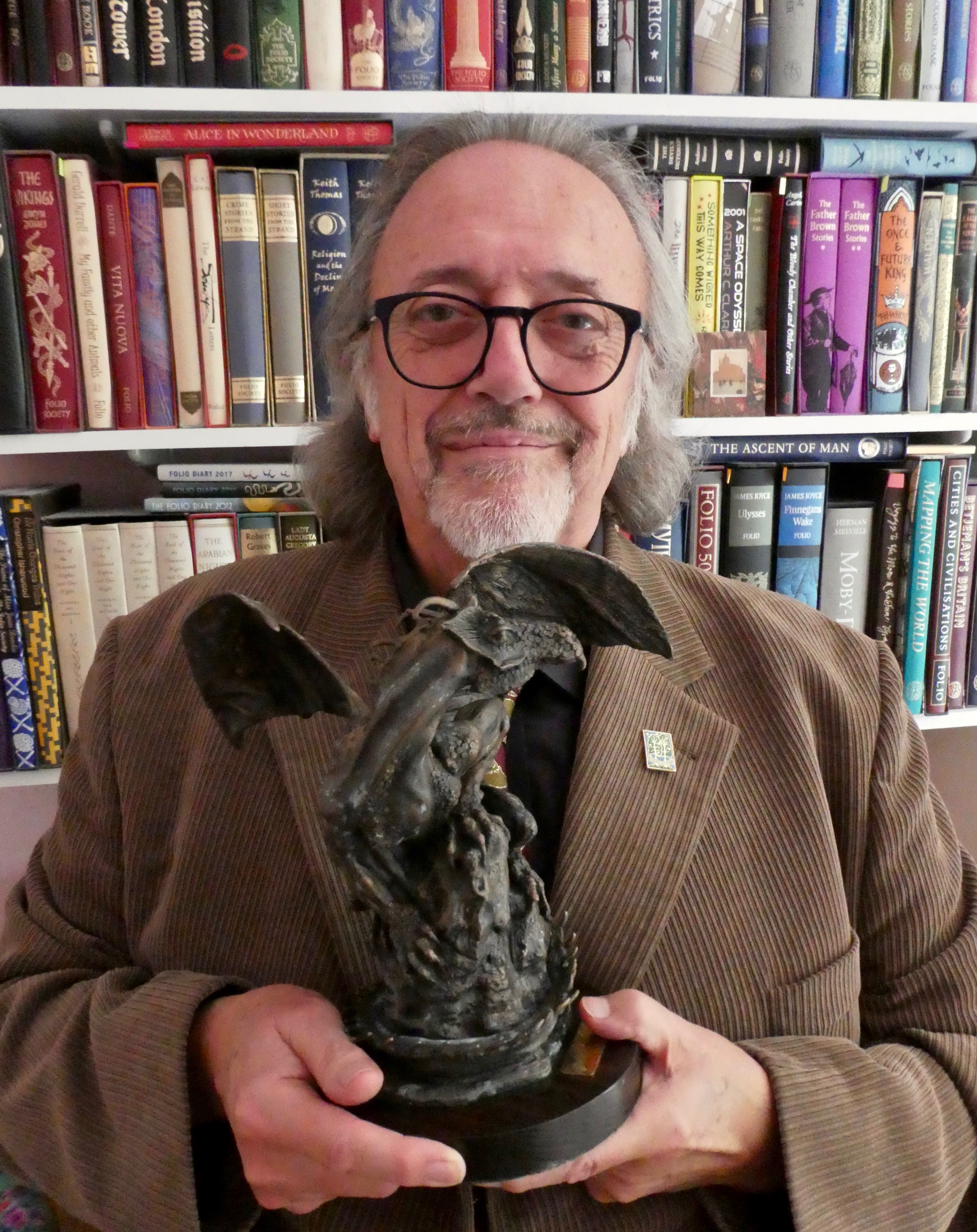
Today, I took possession of a DRAGON –– if, that is, a mortal ever CAN possess a dragon (myth and legend would suggests NOT).

He (if it is a 'he', I was away when they did "How to sex a dragon") represents The Tolkien Society's Outstanding Achievement Award for 2022. I am thrilled and indebted to the Society for honouring me with this amazing award and for the delightful lunch with many of my long-standing Tolkien friends at which this magnificent creature was entrusted to my care! 


Sunday, 5 September 2021

ERIC FRASER'S 'Radio Times' art for the BBC's THE LORD OF THE RINGS


This post is for all you aficionados of
the BBC 1981 radio serialisation of The Lord of the Rings who have been following my six-monthly Blog and Facebook journey across the original twenty-six weekly episodes as they were first broadcast on Sundays from 8 March to 30 August, forty years ago.

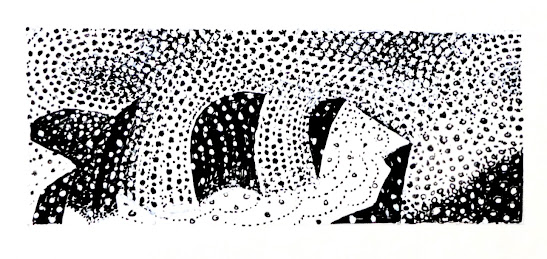
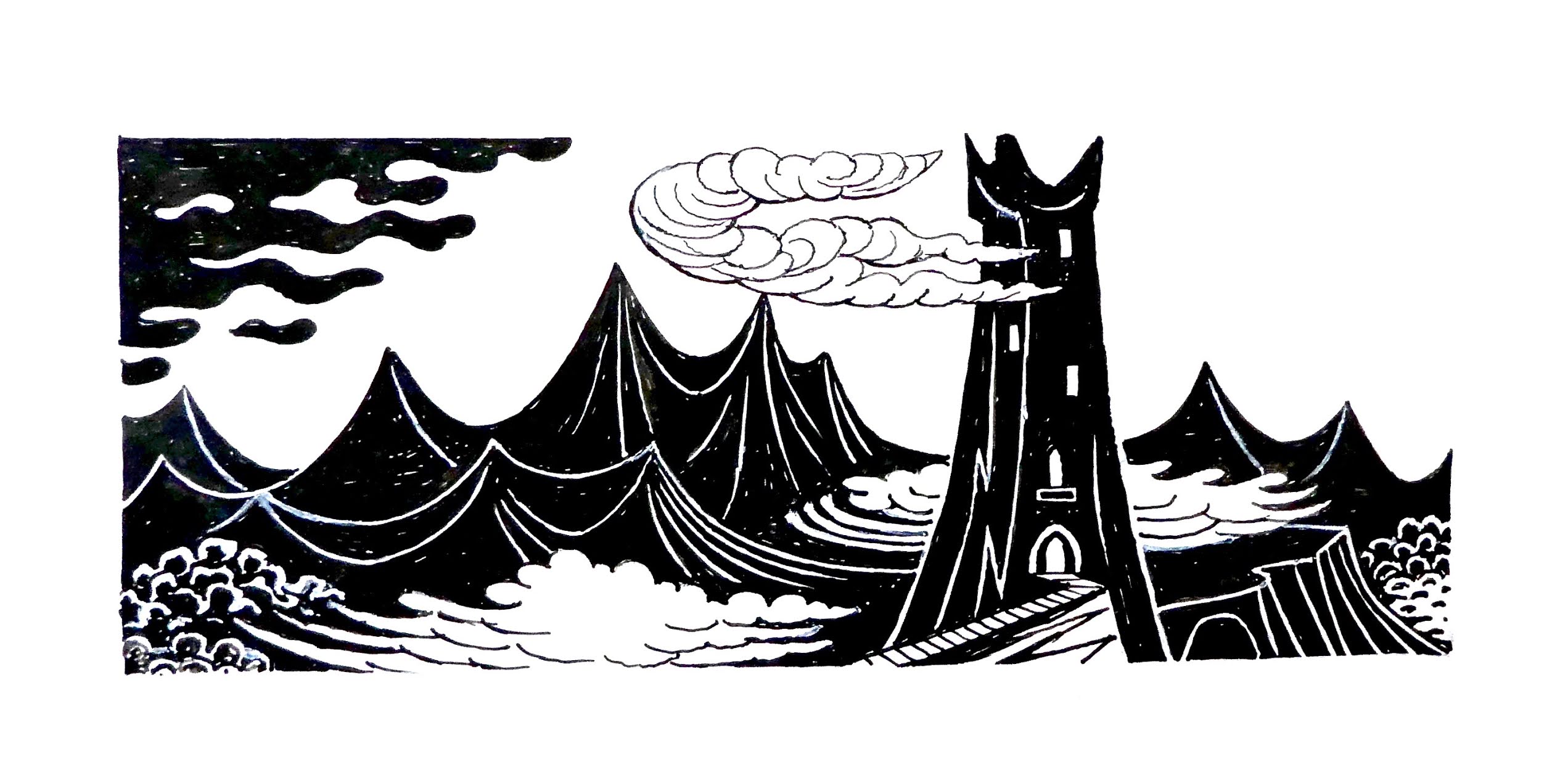
Here, all in one place, is the complete set of Eric Fraser's black-and-white illustrations made to accompany the credits to the weekly episodes in the BBC's listings magazine, Radio Times. 

All images, except that for the second episode ('The Shadow of the Past'), are reproduced from Fraser's original art now in my collection; in this one instance, the image used was scanned from its printed reproduction in Radio Times. (I would, incidentally, be grateful for any information about the ownership of this 'missing' piece!)

The three images made for episodes 15-17 ('The Voice of Saruman', 'The Black Gate is Closed' and 'The Window on the West') are published on this blog for the very first time since, during that three week period, there was an industrial dispute at the print-works responsible for producing Radio Times and the magazine was issued only in an slimmed-down emergency format with few, if any, illustrations. The additional image at the top of this post was a generic design Fraser made featuring Gandalf, Frodo and Sam which was used on the BBC souvenir poster for the series and, subsequently, as a decoration for the box containing the cassette-tape release of the recordings. 


1.  The Long-awaited Party


2.  The Shadow of the Past


3.  The Black Riders


4. Trouble at the Prancing Pony


5. The Knife in the Dark


6. The Council of Elrond


7. The Fellowship of the Ring


8. The Mines of Moria


9. The Mirror of Galadriel


10. The Breaking of the Fellowship


11. The Riders of Rohan


12. Treebeard of Fangorn


13. The King of the Golden Hall


14. Helm’s Deep


15. The Voice of Saruman


16. The Black Gate is Closed 


17. The Window on the West


18. Minas Tirith


19. Shelob’s Lair


20. The Siege of Gondor


21. The Battle of Pelennor Fields


22. The Houses of Healing


23. Mount Doom


24. The Return of the King


25. Homeward Bound


26. The Grey Havens


Sunday, 29 August 2021

FORTY YEARS ON... Eric Fraser's LORD OF THE RINGS radio art: Week 26


I wept writing this final episode of the BBC radio dramatisation of The Lord of the Rings, I wept again as the actors recorded it in the studio and I wept once more when I heard it first transmitted on this Sunday, forty years ago. I still weep every time I hear it...

My plan was always to include 'Bilbo's Last Song' in the final episode as the Ring-bearers sail into the West but – since it did not appear in the novel and Tolkien had gifted the copyright in the poem to Joy Hill, his secretary at George Allen & Unwin – the negotiations for its inclusion were long and tricksy. But it was finally achieved and Stephen Oliver's elegiac setting powered the closing moments of the dramatisation, representing not only the end of Frodo's journey but also that of everyone involved in writing, performing and producing the serial.

Eric Fraser's final illustration for the BBC's weekly listings magazine, Radio Times shows the bittersweet image of Sam, Merry and Pippin watching the boat slip from the harbour into the Firth of Lune...

"And the ship went out into the High Sea and passed into the West, until at last on a night of rain Frodo smelled a sweet fragrance on the air  and heard the sound of singing that came over the water. And then it seemed to him that ... the grey rain-curtain turned all to silver glass and was rolled back, and he beheld white shores and beyond them a far green country under a swift sunrise."

For the moment of Frodo's parting from Sam at the Grey Havens, I transferred a few lines from an earlier conversation in the book as a leave-taking valedictory:

"Do not be too sad, Sam. You cannot always be torn in two. You will have to be one and whole, for many years. You have so much to enjoy and to be, and to do."

Words that I used again, heard by Sam – as an echo in his memory – the moment before opening the door to Bag End and announcing to Rosie and baby Elanor: "Well, I'm back."

Thank you for sharing this pictorial journey with me across the six months and twenty-six illustrations by the magnificent, Eric Fraser. 


Sunday, 22 August 2021

FORTY YEARS ON... Eric Fraser's LORD OF THE RINGS radio art: Week 25


'Homeward Bound' was the title I gave to the penultimate episode of the 1981 BBC radio dramatisation of The Lord of the Rings, originally broadcast on this Sunday, forty years ago. 

The great challenge of the serialisation – after the crisis-after-crisis driven story that reaches its narrative peak in episodes twenty-three and twenty-four with the destruction of the One Ring and Sauron's power and the coronation of Gondor's returning King – is the lengthy and anticlimactic homeward journey with its serial partings and farewells.

All of this textual material had to be ruthlessly compressed to work within the tight structure of weekly half-hour episodes. Despite the demands of condensing Tolkien's rich text, I remained determined that – although heavily edited – the Scouring of the Shire and the Grima's murder of Saruman on the doorstep of Bag End – would be retained since, without those events, the whole drama would be less meaningful.

"The very end of the war, I hope," said Merry.

"I hope so," said Frodo and sighed. The very last stroke. But to think that it should fall here, at the very door of Bag End! Among all my hopes and fears at least I never expected that." 

But Tolkien knew that, in some way or another, battles – large and small – all end at our own front door... 

Eric Fraser's original illustration for Radio Times takes the sober, haunting image of the sadly despoiled Shire found by the heroes on their return from war. 


Sunday, 15 August 2021

FORTY YEARS ON... Eric Fraser's LORD OF THE RINGS radio art: Week 24


After the epic drama of Sauron's fall comes the triumphant and long-awaited coronation of Aragorn, King Elessar. So, for obvious reasons, the twenty-fourth episode of the BBC's 1981 dramatisation of The Lord of the Rings – first broadcast forty years ago today – was titled 'The Return of the King'.

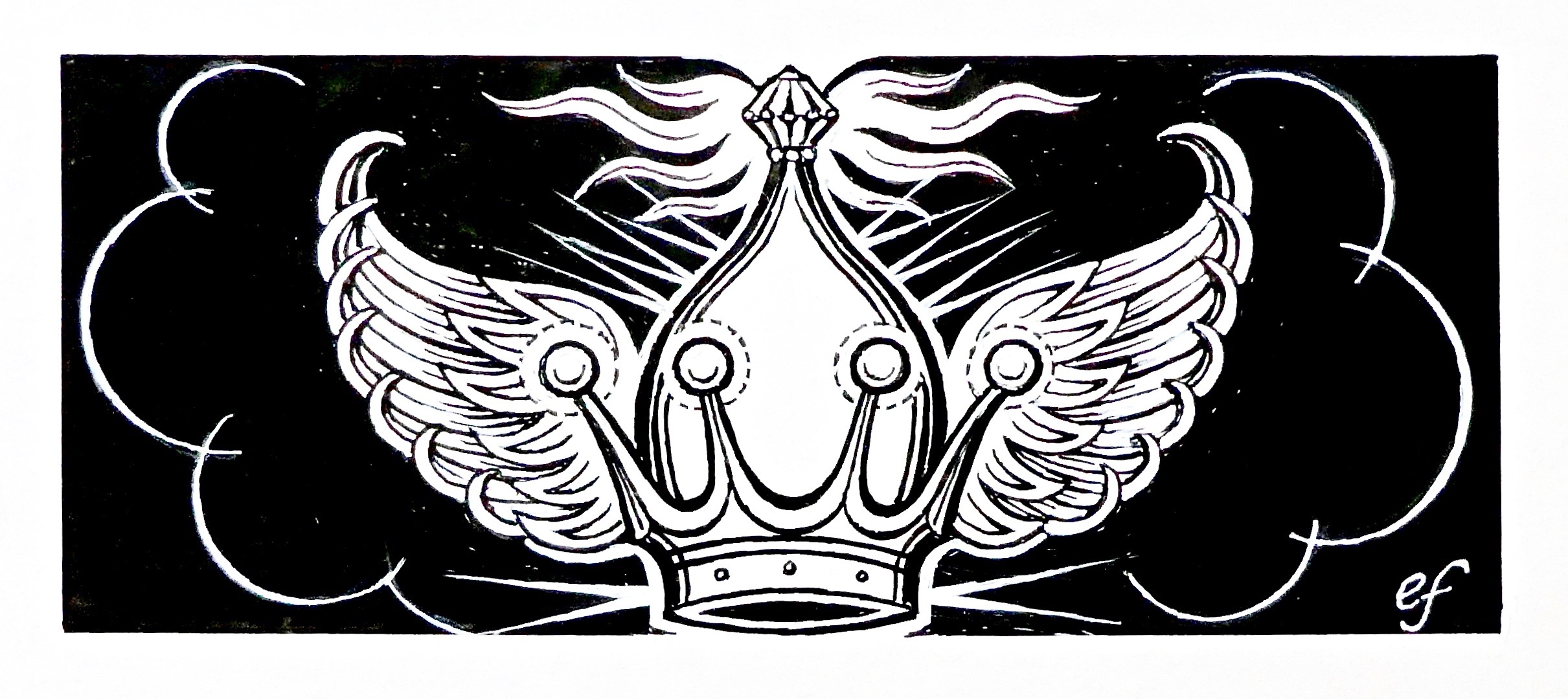
Equally obvious was Eric Fraser's choice of the Crown of Gondor as the subject for his illustration accompanying the episode-billing in Radio Times with a design based on Tolkien's description in the novel: 

"It was shaped like the helms of the Guards of the Citadel, save that it was loftier, and it was all white, and the wings at either side were wrought of pearl and silver in the likeness of the wings of a sea-bird, for it was the emblem of kings who came over the Sea; and seven gems of adamant were set in the circlet, and upon its summit was set a single jewel the light of which went up like a flame." 


Sunday, 8 August 2021

FORTY YEARS ON... Eric Fraser's LORD OF THE RINGS radio art: Week 23


And so we come to 'Mount Doom', the twenty-third episode of the 1981 BBC serialisation of J R R Tolkien's The Lord of the Rings, originally broadcast forty years ago this Sunday.

In so many ways this is the climax (although not the end) of the quest which began in Episode 6 when, at Rivendell, the Council of Elrond determined that the war with Sauron could only be won if the One Ring were to be returned to fires of Orodruin. 

This episode was the second of the final five episodes that I personally dramatised for the serialisation, taking over from Michael Bakewell's brilliant dramatisation of the epic battles that precede the intense, intimate drama that is played out by Frodo, Sam and Gollum on the very edge of the Cracks of Doom.

As a dramatist, this was one of my favourite episodes to have written and I have unforgettable memories of watching Ian Holm, Peter Woodthorpe and Bill Nighy, gathered around a radio microphone, act out their characters' desperate struggle on Sammath Naur, playing out the narrative device that Tolkien described as a 'eucatastrophe'. Writing in a letter to his son, Christopher, Tolkien explained: "I coined the word 'eucatastrophe': the sudden happy turn in a story which pierces you with a joy that brings tears (which I argued it is the highest function of fairy-stories to produce)."

This original piece of art created by Eric Fraser for the Sunday programme page in the BBC's weekly magazine, Radio Times, is, without question, my favourite of the twenty-six weekly illustrations the artist made to accompany the series: stunningly dramatic and powerfully cataclysmic.


Sunday, 1 August 2021

FORTY YEARS ON... Eric Fraser's LORD OF THE RINGS radio art: Week 22


'The Houses of Healing' was the title of the twenty-second episode of the BBC's 1981 radio dramatisation of The Lord of the Rings, broadcast forty years ago this Sunday. 

In this episode the chatterbox of Ioreth the wise-woman healer (a cameo appearance by Pauline Letts) tells Gandalf of the legend of Gondor that says: "The hands of the king are the hands of a healer, and so shall the rightful king be known," leading to the Christ-like verification of Aragorn as the true King.  

Eric Fraser's original art, created for the programme page in Radio Times shows a pair of leaves of the healing herb called athelas (or 'Kingsfoil') about to be crushed and steeped in boiling water. 


Sunday, 25 July 2021

FORTY YEARS ON... Eric Fraser's LORD OF THE RINGS radio art: Week 21


The confrontation between Éowyn and Merry and the Witch-king of Angmar is one of many dramatic highlights in 'The Battle of the Pelennor Fields', the twenty-first episode of the BBC radio dramatisation of The Lord of the Rings, first broadcast forty years ago this Sunday lunchtime.

Eric Fraser's original art to be published in The Radio Times alongside the weekly billing for the programme is, I think, a superb example of this artist's exceptional skill in graphic composition.  


Sunday, 18 July 2021

FORTY YEARS ON... Eric Fraser's LORD OF THE RINGS radio art: Week 20


The twentieth episode of the BBC's radio dramatisation of The Lord of the Rings was broadcast on this day, forty years ago, and the serialisation entered the home straight of its twenty-six parts with 'The Siege of Gondor'.

In publishing the original art of Eric Fraser's illustration to accompany the billing for this episode in The Radio Times, I want to comment on the discipline under which Fraser produced these small decorations.  

As a regular artist for the BBC's listings magazine, he was especially well-versed with the demand for illustrations required to fit within specific column-width dimensions and with the absolute requirement for his work having to "read" at a very small scale. 

The original art I have been reproducing here over the past five months were drawn 9.5 x 1.5 centimeters (3 x 1.5 inches) and were then reduced for reproduction in print to just 1.2 x 3.2 centimeters (or 1.5 x 0.5 inches). Bearing in mind the size of the art – and the size at which it was eventually published – I think of these little black-and-white drawings as mini-masterpieces.


Sunday, 11 July 2021

FORTY YEARS ON... Eric Fraser's LORD OF THE RINGS radio art: Week 19


On this Sunday, forty years ago, BBC Radio 4 broadcast 'Shelob's Lair', the nineteenth episode of its radio dramatisation of J R R Tolkien's The Lord of the Rings, in which Gollum leads Frodo and Sam into Cirith Ungol and the cobwebbed, labyrinthine lair of the monstrous spider, Shelob, the "last child of Ungoliant to trouble the unhappy world".

Eric Fraser's original art for the BBC's weekly listing magazine Radio Times, shown here, is a complex intersection of black and white spider-thread-lines giving the viewer, perhaps, a Shelob's-eye-view of the doomful entrance through which her prey will pass.

Sunday, 4 July 2021

FORTY YEARS ON... Eric Fraser's LORD OF THE RINGS radio art: Week 18


Broadcast forty years ago today, the eighteenth episode of the BBC's 1981 radio dramatisation of The Lord of the Rings was titled 'Minas Tirith' and that great city of Gondor was the subject of Eric Fraser's illustration for the programme page in the listings magazine, Radio Times. 

Although the drawing certainly evokes a quintessential 'fantasy' castle with its turrets and fluttering pennants, it seems to me to lacks much authenticity to Tolkien's description of the city – other than the rising circles of buildings within the walls.

Nevertheless, this is Fraser's original art from my collection of his work for the radio series –– and I love owning it!


Sunday, 27 June 2021

FORTY YEARS ON... Eric Fraser's LORD OF THE RINGS radio art: Week 17


Episode 17 of the 1981 BBC radio dramatisation of The Lord of the Rings was broadcast forty years ago on this day. In 'The Window on the West' Frodo and Sam meet Faramir and are taken to Henneth Annûn, the secret Gondorian outpost in North Ithilien, hidden in a cave behind the protecting veil of a great west-facing waterfall. Artist Eric Fraser featured this location in this original piece of art created for Radio Times; however, it never appeared in print.  

As with the last two week's illustrations, an industrial dispute at the Radio Times printing-works forced the magazine to edit this  issue to an 'emergency' issue with fewer illustrations and limited programme details. This is was the last week in which the magazine was impacted by the dispute and this is the third and final hitherto unseen Fraser illustrations to be belatedly published here.   


Sunday, 20 June 2021

FORTY YEARS ON... Eric Fraser's LORD OF THE RINGS radio art: Week 16


Forty years ago, on this Sunday, the 1981 BBC radio dramatisation of The Lord of the Rings arrived at its 16th episode, entitled 'The Black Gate is Closed'. Veteran illustrator,  Eric Fraser created this original piece of art for Radio Times inspired by the events described in the second chapter of The Two Towers 'Of Herbs and Stewed Rabbit' and featuring Sam Gamgee's culinary skills! 


However, Fraser's drawing went unpublished as a result of an industrial dispute at the printing works where Radio Times was produced, the magazine was scaled down to a slim-line 'emergency' issue with heavily edited programme details and few if any illustrations. This is the second of three previously unseen Fraser illustrations now published for the first time on this blog.


Sunday, 13 June 2021

FORTY YEARS ON... Eric Fraser's LORD OF THE RINGS radio art: Week 15


This Sunday, forty years ago, the BBC radio broadcast The Lord of the Rings, Episode 15: 'The Voice of Saruman', showcasing actor Peter Howell as the silver-tongued necromancer. Eric Fraser created this original piece of art for Radio Times featuring Isengard and the Tower of Orthanc, but it was never published. 

Due to an industrial dispute at the printing works where the magazine was produced, Radio Times was reduced to a slimmed-down 'emergency' issue with heavily edited programme details and fewer illustrations. This is the first of three previously unseen Fraser illustrations belatedly published on this blog.    


Sunday, 6 June 2021

FORTY YEARS ON... Eric Fraser's LORD OF THE RINGS radio art: Week 14


This Sunday, forty years ago, the BBC radio dramatisation of The Lord of the Rings began its second half-way point with Episode 14, 'Helm's Deep', centered on the great battle fought on the walls of the ancient stronghold, depicted here in Eric Fraser's original art for Radio Times.


It has been pointed out to me that there is something of a size-disparity-issue in relation to the figures of Legolas and Gimli on the far right side of the illustration.


Sunday, 30 May 2021

FORTY YEARS ON... Eric Fraser's LORD OF THE RINGS radio art: Week 13


Forty years ago this Sunday, the BBC radio's epic 1981 dramatisation of The Lord of the Rings reached its half-way point with Episode 13, 'The King of the Golden Hall', in which Gandalf, Aragon, Legolas and Gimli arrive at Meduseld and present themselves before King Théoden of the Mark.

Elsewhere in Middle-earth, Frodo, Sam and Gollum struggle on towards Mordor, traversing the dread-filled Dead Marshes, depicted here in Eric Fraser's original art for the accompanying programme-billing in Radio Times.


Sunday, 23 May 2021

FORTY YEARS ON... Eric Fraser's LORD OF THE RINGS radio art: Week 12


In 'Treebeard of Fangorn', Episode 12 of the BBC's radio dramatisation of The Lord of the Rings, first broadcast forty years ago this Sunday lunchtime, Merry and Pippin find themselves in the forbidding Forest of Fangorn and encounter Treebeard – stiff-limbed and with bark-like skin and leafy hair – the oldest of the Ents left in Middle-earth and depicted here in the original art for Eric Fraser's original art for the illustration published in the weekly listing's magazine, Radio Times.


In the series, Treebeard was played by Stephen Thorne, a towering, deep-voiced actor with whom I had worked on many occasions – his having previously been the voice of Jesus in some early plays I wrote for Schools Radio and had spoken for Aslan the Lion in my dramatisations of C S Lewis' 'The Chronicles of Narnia' –– which is more or less the same role as playing Jesus! As Treebeard, Stephen performed at the microphone draped in yards of gash recording tape so that he permanently 'rustled' in simulation of the Ent's great leaf-hung arms!