Showing posts with label Lewis Carroll. Show all posts

Friday, 4 July 2025

INDEPENDENCE DAY IN WONDERLAND


One hundred and sixty-three years ago, today, the Reverend Charles Lutwidge Dodgson and an Oxford colleague, the Reverend Robinson Duckworth, took the three daughters of the Dean of Christ Church – Lorina, Alice and Edith Liddell – on a boating trip.

As they rowed along on that 'golden afternoon', Dodgson improvised a fantasy about the curious adventures of a little girl named (like one of the girls on the trip) 'Alice', who followed a White Rabbit in a waistcoat with a watch down a rabbit-hole and found herself in a true land of wonders...

At Alice’s request, Dodgson wrote out the story – first calling it Alice’s Adventures Under Ground – and added his own distinctively idiosyncratic illustrations.


By 1865, it had grown (like someone who had nibbled an EAT ME cake) into Alice’s Adventures in Wonderland and was published under the authorship of 'Lewis Carroll' with illustrations by the legendary Punch cartoonist, Sir John Tenniel.


The book was made Mr Dodgson’s alter ego one of the most famous men in Victorian England. It also revolutionised children’s literature by abandoning, at a stroke, the long and piously-held tradition of moral-and-improving tales for the young in favour of zany, witty nonsense that had no underlying message other than fun...

Across the succeeding years, Alice has been endlessly reinterpreted by illustrators and filmmakers...

Mervyn Peake (1946)

Tove Jansson (1966)

Salvador Dali (1969)

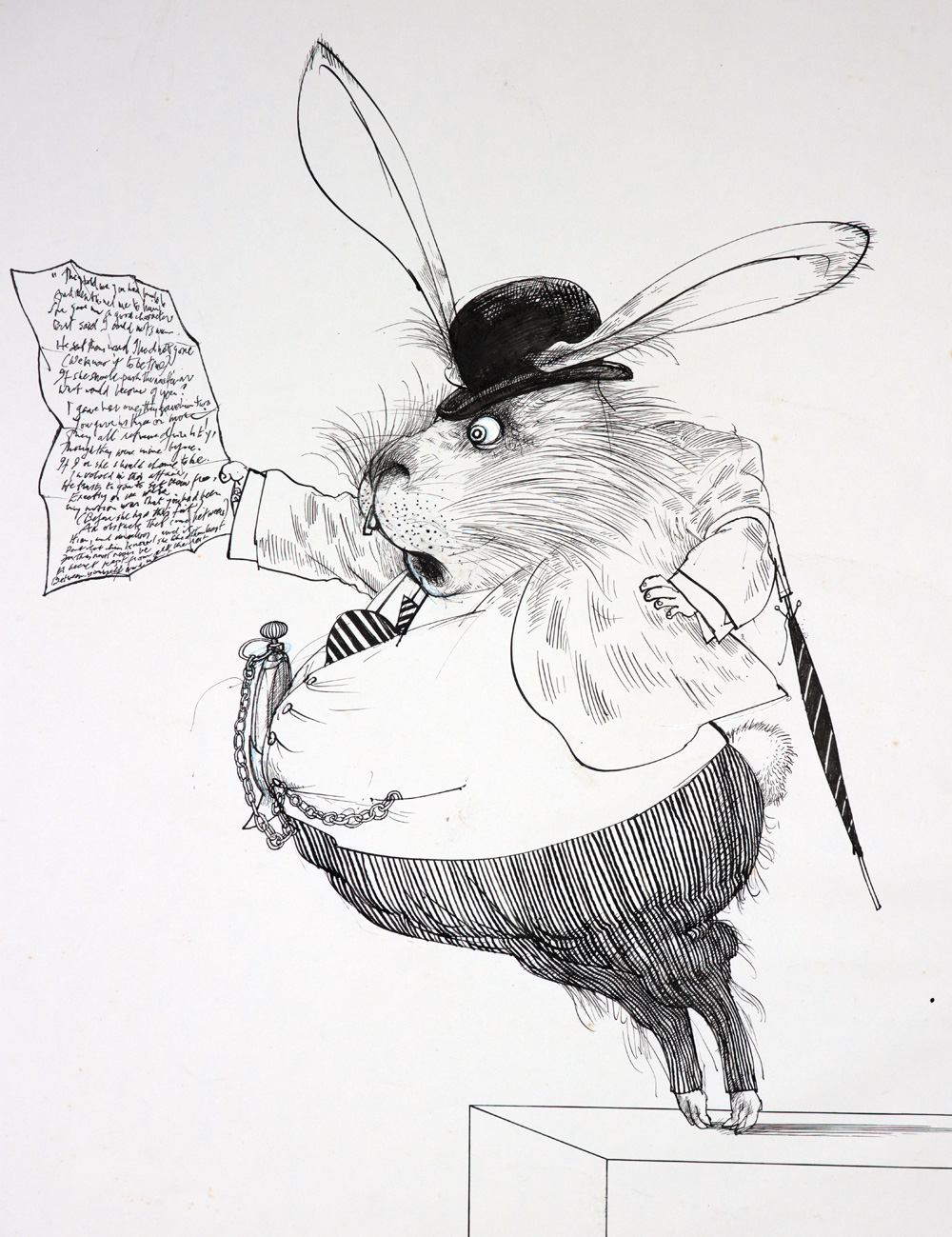
 Ralph Steadman (1973)

 Walt Disney (1951)

Walt Disney & Tim Burton (2010)

July the 4th is also, of course, American Independence Day and – apart from over fifty years of Disney influence – it is interesting to note how many true literary successors to Lewis Carroll have sprung up in America, among them: L Frank Baum, James Thurber, Ogden Nash and Maurice Sendak.

But then perhaps this shouldn’t really surprise us, since the Americans have always shown themselves to be far greater lovers and defenders of Wonderland (and Looking-glass World) than the English have ever been…

Maybe there are reasons for this affinity between the American sensibility and Carroll’s nonsense realm: for one thing, Alice is a highly independent and self-determining individual (a truly revolutionary notion for a child’s book of the 1800s); for another, the Wonderlanders with whom she mixes are a wildly disparate conglomeration of diverse species – animals, humans, animals-dressed-as-humans and humans-with-animal-masks – all of whom (for the most part) rub along together but who are, together, fiercely territorial!


I find it fascinating – and humbling – that, in 1948 (by which time the original manuscript of
Alice’s Adventures Under Ground
had been sold and was in the possession of an American collector), a group of US well-wishers, led by the Librarian of Congress, should have started a fund to raise the considerable sum of money required to buy back the manuscript and send it home to us!


That first foray into Carroll's underground wonderworld now resides in the British Library and maybe we should remember the American act of selfless generosity which made that possible the next time we look at, say, the Elgin Marbles…

Monday, 3 February 2025

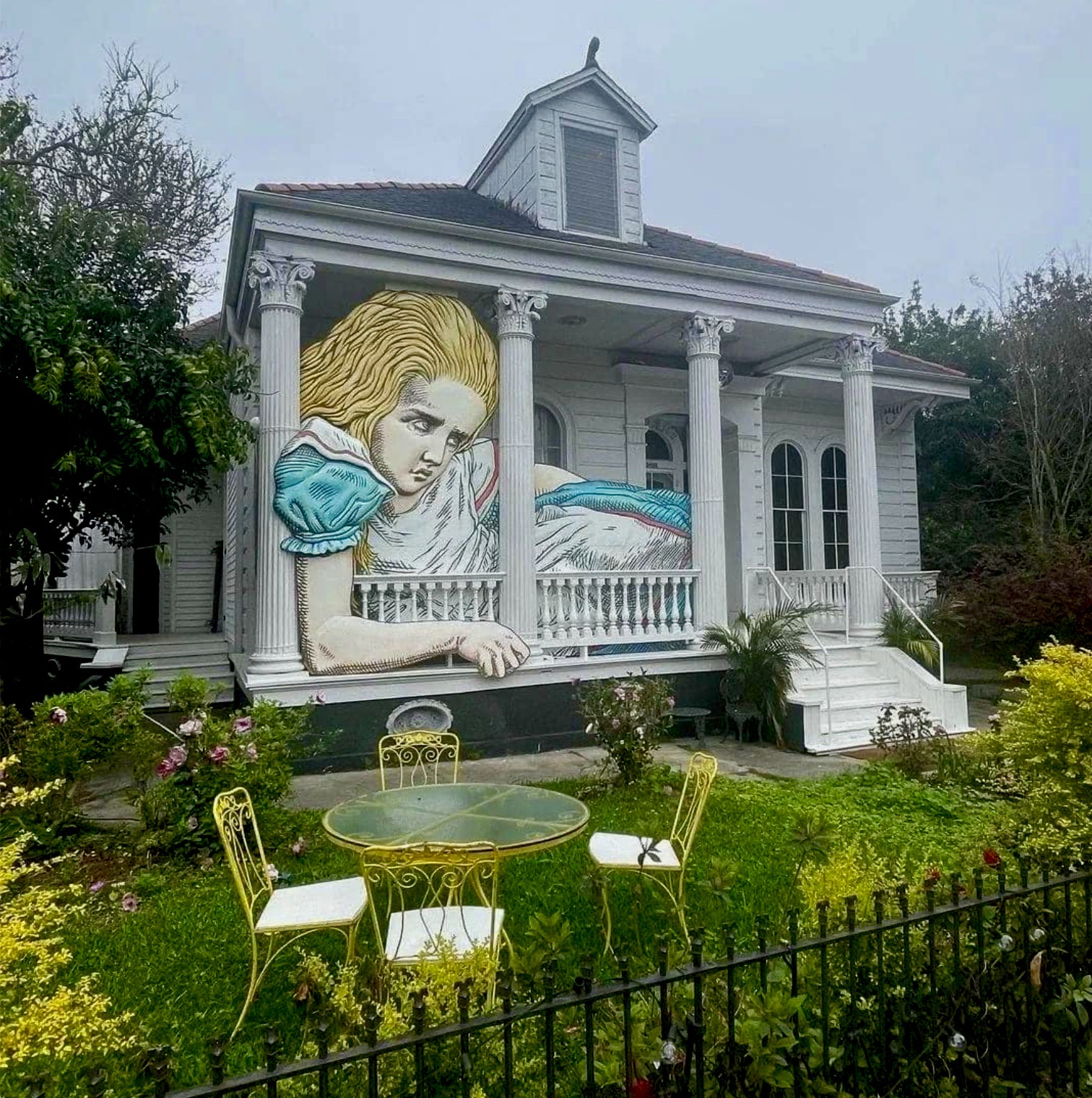
CURIOUSER AND CURIOUSER!

Totally astonishing, out-size, exterior house-decoration –– unless, of course, it's the White Rabbit's Incredible Shrinking House –– situated in that American wonderland that is New Orleans, Louisiana...

Tuesday, 26 November 2024

MR DODGSON'S GIFT!


On this day: 26 November, 1864 – one-hundred-and-sixty years ago –– Charles Lutwidge Dodgson (better known to us now as 'Lewis Carroll') presented an early Christmas present to his young friend, Alice Pleasance Liddell, daughter of Henry George Liddell, Dean of Christ Church, Oxford.

Mr Dodgson's gift was the hand-lettered and illustrated manuscript of Alice's Adventures Underground, a story he had to told to Alice and two of her sisters during a summer river expedition on the Isis on 4 July 1862. 
 
In 1865, the story, significantly expanded, was re-gifted – this time to the world – when the story was published, with illustrations by John Tenniel, under the title, Alice's Adventures in Wonderland.

Friday, 8 November 2024

FACING UP TO 'AI'


There is a lot of disquiet about the pros and cons of AI (Artificial Intelligence) and, specifically among artists, about ‘AI-generated art’, including strident protests that even the use of such a term is totally abhorrent! 


I am more ambiguous on the topic: partly because I have seen some highly original and inventive AI-imagery and because I think that, for millennia, art has always been subject to the vagaries of frauds and fakers as well as those who have a taken a broad perspective on such identifications as ‘after…’, ‘inspired by…’ and ‘in the style of…’


This liberality of accreditation can be seen in the output from the 'workshops' of the Old Masters; among those creating art with collage and photo-montage; and in Andy Warhol’s screen-prints featuring a ‘borrowed’ publicity-image of Marilyn Monroe from the 1953 film, Niagara, or that humdrum household staple, the Campbell’s Soup Can.


However, even I balked at finding an internet entry on Lewis Carroll featuring an AI likeness of the author of Alice in Wonderland and Through the Looking-Glass alongside genuine, well-attested photographic images of the man.


Arguably, it is the best of a less-than-brilliant bunch of imaginings which range from the patently risible to the truly creepy... 


Then, again, I tell myself, the National Portrait Gallery in London contains a variety of artworks variously portraying the well-known features of, say, her late majesty Queen Elizabeth II, so what the heck? Does it actually matter?


Perhaps, in the end, it just comes down to being able to identify, ‘What’s What and What’s Not’, between artefact and artifice.


**********


‘So [Alice] got up, and held out her hand. “Good-bye, till we meet again!” she said as cheerfully as she could.


‘“I shouldn't know you again if we did meet,” Humpty Dumpty replied in a discontented tone, giving her one of his fingers to shake: “you're so exactly like other people.”


‘“The face is what one goes by, generally,” Alice remarked in a thoughtful tone.


‘“That's just what I complain of,” said Humpty Dumpty. “Your face is the same as everybody has — the two eyes, so —” (marking their places in the air with his thumb) “nose in the middle, mouth under. It’s always the same. Now if you had the two eyes on the same side of the nose, for instance — or the mouth at the top — that would be some help.”


‘“It wouldn't look nice,” Alice objected. But Humpty Dumpty only shut his eyes, and said “Wait till you've tried.”’


**********


But we’d probably better not start a conversation on Pablo Picasso…


Saturday, 17 August 2024

"DOCTOR, WHO ARE YOU?"


Exciting news from the Whoniverse as Puffin publish the BBC book Doctor Who in Wonderland by Paul Magrs. A brilliant premise and excellent conceit: a new story in which the TARDIS deposits the Doctor in front of the gates to the Oxford university college, Christ Church, in what (in literary circles) would come to be regarded as a particularly notable year: 1862.


The Time Lord (to be specific, the Fifth Doctor, as portrayed by Peter Davidson) along with three of his companions from that era – Nyssa, Tegan and Turlough – are instantly swept into the milieu of Victorian Oxford where everything is going like a summer dream until, at a tea-party in the Deanery Garden, there’s a decidedly nightmarish twist… 


Paul Magrs skilfully and wittily interweaves many Whovian, Dodgsonian, Carrollian and Alician threads to create a memorable adventure that will be better enjoyed without ‘Spoilers’ from me. All that needs saying is that this excellent read is a loving tip-of-the-top-hat (‘In this style UK £9.99’) and, of course, a Panama Hat, to two great and enduring fantasy concepts, whose creative origins bridge a 100-year-span from 1862 to 1963.


Only one complaint from this reviewer: having read the book, it’s rather frustrating not being able to now reach for the DVD and watch this episode!

Saturday, 4 May 2024

"WHAT DAY OF THE MONTH IS IT?"


Today, May 4th, has been intergalactically hijacked by STAR WARS fans with the popular meme 'May the Fourth Be With You', but for fans of Lewis Carroll, the date has an entirely different significance.
 
Carrollians have long designated today as 'Wonderland Day', marking, as it does, the birthday of Alice Pleasance Liddell, born on May 4, 1852. 


Alice was the fourth of the ten children of Dr Henry Liddell, at the time of her birth, Headmaster of Westminster School and then (from 1855) Dean of Christ Church, Oxford. It was there that Alice, her family (and, in particular, her brother Harry and two of her sisters, Lorina and Edith), met a young mathematics don, Charles Lutwidge Dodgson who was an enthusiastic – and pioneering – champion of the new 'art' of photography and who wrote entertaining poems, puzzles and stories under the pseudonym, 'Lewis Carroll'. 


Alice Liddell – "Child of the pure unclouded brow. And dreaming eyes of wonder!" – would become Lewis Carroll's child-muse and provide the inspiration for a curious fantasy originally entitled, in manuscript, Alice's Adventures under Ground and, later and much amplified, published in 1865 as the book we now know as Alice's Adventures in Wonderland. 
 
'Hidden in plain sight' in the book are two date-specific allusions to Alice Liddell's birthday....
 
In the book's sixth chapter, 'Pig and Pepper', Alice encounters the Cheshire Cat...


******
 
[Alice asked] "What sort of people live about here?"
 
"In that direction," the Cat said, waving its right paw round, "lives a Hatter: and in that direction," waving the other paw, "lives a March Hare. Visit either you like: they're both mad."
 
"But I don't want to go among mad people," Alice remarked.
 
"Oh, you can't help that," said the Cat: "we're all mad here. I'm mad. You're mad."
 
"How do you know I'm mad?" said Alice.
 
"You must be," said the Cat, "or you wouldn't have come here."
 
******
 
Shortly after, the author tells us...
 
******
 
After a minute or two [Alice] walked on in the direction in which the March Hare was said to live. "I've seen hatters before," she said to herself; "the March Hare will be much the most interesting, and perhaps as this is May it won't be raving mad--at least not so mad as it was in March."
 
******
 
So, the month of the year is now established as being May.
 
Then, in the following chapter, 'A Mad Tea-Party', we find this exchange...
 
******
 
The Hatter was the first to break the silence. "What day of the month is it?" he said, turning to Alice: he had taken his watch out of his pocket, and was looking at it uneasily, shaking it every now and then, and holding it to his ear.
 
Alice considered a little, and then said "The fourth."
 
"Two days wrong!" sighed the Hatter. "I told you butter wouldn't suit the works!" he added looking angrily at the March Hare.
 
"It was the best butter," the March Hare meekly replied.
 
"Yes, but some crumbs must have got in as well," the Hatter grumbled: "you shouldn't have put it in with the bread-knife."
 
******
 
Thus it is established (if you put any credence in such nonsense!) that the 'day of the month' of May is, indeed, 'The Fourth'!
 
Whether it's YOUR birthday (or your UN-Birthday) I hope you have a WONDER-filled Wonderland Day!
 
 
[Photographs: Lewis Carroll; Illustration: John Tenniel (enlarged and coloured) from The Nursery "Alice" (1890)]

Saturday, 4 July 2020

PEANUTS IN WONDERLAND

Across the years, Charles M. Schulz turned to Lewis Carroll's Alice in Wonderland for inspiration featuring Snoopy in the fantastical personification of the –– Cheshire Beagle!

Especially for Alice's Day 2020, here's a selection...


Alice herself made an appearance once accompanied by (or represented by) the Hatter-Beagle...


All cartoons (c) Peanuts Worldwide LLC

Tuesday, 4 July 2017

ALL ON A GOLDEN AFTERNOON

One hundred and fifty-five years ago, today, the Reverend Charles Lutwidge Dodgson and an Oxford colleague, the Reverend Robinson Duckworth, took the three daughters of the Dean of Christ Church – Lorina, Alice and Edith Liddell – on a boating trip.

As they rowed along on that 'golden afternoon', Dodgson improvised a fantasy about the curious adventures of a little girl named (like one of the girls on the trip) 'Alice', who followed a White Rabbit in a waistcoat with a watch down a rabbit-hole and found herself in a true land of wonders...

At Alice’s request, Dodgson wrote out the story – first calling it Alice’s Adventures Under Ground – and added his own distinctively idiosyncratic illustrations.


By 1865, it had grown (like someone who had nibbled an EAT ME cake) into Alice’s Adventures in Wonderland and was published under the authorship of 'Lewis Carroll' with illustrations by the legendary Punch cartoonist, Sir John Tenniel.


The book was made Mr Dodgson’s alter ego one of the most famous men in Victorian England. It also revolutionised children’s literature by abandoning, at a stroke, the long and piously-held tradition of moral-and-improving tales for the young in favour of zany, witty nonsense that had no underlying message other than fun...

July the 4th is also, of course, American Independence Day and is interesting to note how many true literary successors to Lewis Carroll – among them L Frank Baum, James Thurber, Ogden Nash and Maurice Sendak – have sprung up in America.

But then perhaps this shouldn’t really surprise us, since the Americans have always shown themselves to be far greater lovers and defenders of Wonderland (and Looking-glass World) than the English have ever been…

Maybe there are reasons for this affinity between the American sensibility and Carroll’s nonsense realm: for one thing, Alice is a highly independent and self-determining individual (a truly revolutionary notion for a child’s book of the 1800s); for another, the Wonderlanders with whom she mixes are a wildly disparate conglomeration of diverse species – animals, humans, animals-dressed-as-humans and humans-with-animal-masks – all of whom (for the most part) rub along together but who are, together, fiercely territorial!


I find it fascinating – and humbling – that, in 1948 (by which time the original manuscript of
Alice’s Adventures Under Ground
had been sold and was in the possession of an American collector), a group of US well-wishers, led by the Librarian of Congress, should have started a fund to raise the considerable sum of money required to buy back the manuscript and send it home to us!


That first foray into Carroll's underground wonderworld now resides in the British Library and maybe we should remember the American act of selfless generosity which made that possible the next time we look at, say, the Elgin Marbles…

Meanwhile, time to raise a cup of tea and join in the toast-----

Happy 155th Birthday, Alice!

Happy 241st Birthday, America!


This blog post is a edited reprint of a post from 2007

Friday, 20 November 2015

ALICE AND THE ANGEL

One hundred and fifty years ago, Lewis Carroll gave a gift to the world in the form of little book entitled Alice’s Adventures in Wonderland.

It was a gift that not only transformed the future of literature for children, it gave us all – young and not so young, alike – a legacy of humorous prose and verse, rich in pun and parody, linguistic riddles and logical puzzlements.

Six years later, he gave us another gift: Through the Looking-Glass, and What Alice Found There. Arguably – for all the staggering originality of Wonderland – the story of Alice’s exploits in the realm beyond the Looking-Glass is even more accomplished.

I describe these books as a gift to the world as indeed they were. But they were a very special gift to the artists and illustrators of the world because, whilst Lewis Carroll creates dialogue that sparkles with wit and fizzes with the unexpected, he seldom describes a scene or a character beyond mere sketchiness. And that is a real gift to an illustrator: the passport for crossing the borders of invention and imagination.

The first beneficiary of this gift was, of course, John Tenniel, and he so significantly rose to the task that he virtually earned the right to be thought of as co-creator of Wonderland and Looking-Glass World. In so doing, however, he left a great many inky fingerprints upon the pages of those books as to seriously intimidate his successors.

Nevertheless, successors there have been – hundreds of them: from the hack to the genius… Some of their names live on and are greatly (and deservedly) admired from Rackham, Robinson and Rountree – via Peake and Dali – to Steadman, Oxenbury and Vernon Lord, to name but a few. And among the very best of the best is the artist whose work I am celebrating here – Angel Dominguez.

Brian Sibley with Angel Dominguez at the launch of 
Through the Looking-Glass, and What Alice Found There 

Many of us are familiar with Dominguez’s painstakingly crafted paintings from books such as Diary of a Victorian Mouse, Classic Animal Stories, and Kipling’s Just So Stories and The Jungle Book – all of them overflowing with wonderfully drawn birds and beasts that, like the creatures in all the best bestiaries, are really only humans in fur and feather.

It was in 1996 that Angel Dominguez tackled Lewis Carroll’s first gift and gave us an edition of Wonderland of graphic splendour, abundantly embellished with all sorts of sly little jokes and visual puns and a remarkable sense of the essence of Englishness.


Dominguez has now demonstrated his great love of Lewis Carroll and the characters in the Alice books with his latest illustrations to Carroll’s second gift: Through the Looking-Glass…


All the usual suspects are here: the Kings and Queens of the chessboard as well as Hatta and Haigha from Wonderland and those nursery rhymes characters that are reborn in this book as flesh-and-blood characters that immeasurably transcend their modest origins.


And they are joined – in this chequerboard-patterned world – by the book’s author himself, kitted-out in full armour as his Own Invention – the White Knight...


Dominguez justifies challenging Tenniel's original aging, bewhiskered knight by quoting Carroll's first biographer, Stuart Dodgson Collingwood, who reported that his uncle had (in vain) told Tenniel that: "The White Knight must not have whiskers, he must not be made to look old..."

He is not, of course, the first illustrator to knight Lewis Carroll (Ralph Steadman caricatured the author in that role in 1972) but there is a haunting, poetic melancholy about Dominguez' likeness that strikes an entirely different chord; rather than portraying him as a foolish chevalier similar to that depicted in Cervantes' Don Quixote, this is a glimpse of how the Don (or, in this case, the don) saw himself: noble, heroic and, in the true sense of the word, pathetic. 

And the decision to cast the author as surely the most intensely emotional character in either of the Alice books, then inspired another piece of role-playing: "It occurred to me," Dominguez writes in his Afterword, "to portray the Red Knight as myself and to create a bloodless medieval jousting match between author and illustrator."


Alice's exploits– as one might expect from an author who was an amateur conjuror and a lover of theatrical illusion – are filled with translations and transformations and this is something that Dominguez magically conveys in his illustrations showing the White Queen transmogrifying into the Old Sheep and, a few pages on, the egg in the her shop changing into Humpty Dumpty...


Then Dominguez adds a new puzzle of his own – the presence in the book of two Alices. As he explains: "One is a blonde like the character from the first book, and there is a brunette one in this book. Alice dreams, as many of us dreamed in our childhoods, to be the other and live adventures."


The book is, as one would expect, full of many such elaborations and extrapolations on Carroll's text – I particularly like the examples of Looking-Glass insectology (the elephant bees here being joined by rhino- and hippo-bees), the anthropomorphised blooms in the Garden of Live Flowers and (in the Humpty Dumpty rescue party), a contingent of Scottish drums drumming painfully on their own heads.


For all these expected – and unexpected – amusements, there is a new sensibility at work in these drawings. Dominguez has caught a quality of the original that is often overlooked. The sunny summer’s day adventures in Wonderland have given way to the misty, autumnal feel of Alice’s second dream, across which falls the lengthening shadow of life’s brevity and the fleeting nature of love.

The fact that these drawings were made as the artist battled with cancer, the effects of a stroke and impact of his mother’s death may explain the terrible darkness that hovers over many of these pictures like the Tweedle Brothers’ monstrous crow – itself depicted as a creature constructed from ancient tribal patterns.

And certainly no artist has ever before dared to grant the Jabberwock safe passage though the Looking-Glass to prey upon the dreaming Alice...


Dominguez has said that he has attempted to approach Carroll’s stories “with emotion”, which, as he rightly says, is "the goal of art." And it is a goal perfectly realised in this handsome volume – or, volumes if you chose the edition in which the suppressed (and once-lost) Wasp in a Wig chapter is also brought to book with an introduction by Carroll scholar Selwyn Goodacre and illustrations by Dominguez that disprove Tenniel's willful assertion that "A wasp in a wig is altogether beyond the appliances of art"!


There are those in our thought-to-be more sophisticated times who have no time for the dream narrative: "What a surprise!" they mock, "It was all just a dream!" Dominguez is wise enough to value the dream. He writes: "Sleeping, dreaming, even having nightmares, it is fantasy that allows us to navigate through life on starship Earth."

Angel Dominguez’ Looking-Glass is, without question, a bold and beautiful aid to navigation as well as ranking among the very finest illustrative interpretations of Lewis Carroll’s masterpiece.


Through the Looking-Glass, and What Alice Found There by Lewis Carroll with illustrations by Angel Dominguez is published by the wonderful Inky Parrot Press and is available in three editions:

Standard Edition: The book has 160 pages, with double- and single-page illustrations for each chapter and many smaller ones. The book is signed and numbered, casebound in a dust wrapper, page size 310 × 210mm. Typeset in Breughel and printed by Northend Creative Print Solutions on 150 gsm Stow Book White paper. All editions are bound by Ludlow Bookbinders. £86.00.

Special Edition: 52 copies with an additional volume The Wasp in a Wig, with an introduction by Selwyn Goodacre and new illustrations for the cover, endpapers and a double- and single-page illustration. Both volumes are quarter bound in leather and contained in a slipcase. £260.00.

The Exemplary Edition: has the two volumes, plus four giclée prints of Angel’s paintings, two from the book and two completely new, all signed and numbered, printed by Senecio Press and contained in a solander box. £420.00.

To find details of all the publishing ventures of Inky Parrot Press, click HERE