Showing posts with label Royal Academy. Show all posts

Saturday, 11 May 2024

THE PORTRAITS OF A LADY

The Royal Academy of Arts is currently celebrating the work of Angelica Kauffman RA (1741-1807), a Swiss Neoclassical painter who had a highly successful career in London and Rome. Remembered primarily as a history painter, Kauffman was also skilled portraitist, landscape painter. She was, along with Mary Moser, one of only two female painters who were among the 34 founding members of the Royal Academy of Art at its inception in 1768. 


In this 'Self-portrait in al'antica Dress' Angelica Kauffman chooses to show herself not just as an 'artist' (she holds a tablet and stylus and has her painters impedimenta within reach) but also as an idealised image of femininity. The rustic costume and the classical setting – columns, swagged curtaining and an idyllic country vista in the background – complete the romantic mood and, in doing so, effectively, effortlessly – and, perhaps, ironically – conceal the labour of the painter's craft.

There is a major focus Kauffman's portraiture in this exhibition and, in addition to the self-portrait above, I'm sharing just three works which show her very considerable talent.


DAVID GARRICK (1717-1779); English actor, playwright, theatre manager and producer who influenced nearly all aspects of European theatrical practice throughout the 18th century. Painted in 1764, Kauffman boldly portrays Garrick with unexpected – indeed, uncommon – informality. Garrick turns on his chair to look back at the observer, eschewing the frequently-adopted 'dramatic' pose used in the depiction of thespians! This air of being 'at ease with life', combined with the intensity of his look and the hint of a wry smile, makes for a compelling portrait.


Sir JOSHUA REYNOLDS, PRA, FRS, FRSA, (1723-1792); English painter who, himself, specialised in portraits. He promoted the 'Grand Style' in painting, which depended on idealisation of the imperfect. He was a founder and first president of the Royal Academy of Arts and was knighted by George III in 1769. This portrait of a portraitist (dating from 1767) combines the sense of a man of considerable public importance – the associated trappings provided by the studio setting with its easel, books, papers and an antique bust of Michelangelo, whom Reynolds so much admired – with a contemplative pose that reflects, perhaps, his friendship with Kauffman and, even, his acknowledgement of her worth as a fellow artist.


JOHANN JOACHIM WINCKELMANN (1717-1768); German art historian, one of the founders of scientific archaeology and considered by many as the father of the discipline of 'art history'. He was one of the first scholars to arrange Greek Art into specific periods, and time classifications. Kauffman depicts Winckelmann, pen in hand but looking away from what he is writing (and the observer), as if he were caught in a moment of reverie. The simple, uncluttered staging and the sitter's reflective expression suggests a man with an ordered mind who primarily seeks to bring order to the chaos of history.


The exhibition, 'Angelica Kauffman', remains on display at The Royal Academy, Piccadilly, London, until 30 June 2024.

[Photos: David Weeks]

Saturday, 29 September 2018

SUMMER PAST


Very belatedly, I'm posting a selection of photographs that pretty much sum up the mood and look of the Royal Academy's Summer Exhibition 2018 as curated by the wonder (and National Treasure) who is Grayson Perry.

By now all these and many, many other pieces have been sold or returned to their creators and the R.A.'s main galleries are now filled with the art of Oceania. But for me the memories of this year's art and art-watchers linger on, beginning with the monumental art of Anish Kapoor...


And here we are inside the Academy with a wall of Graysons...


And beyond...


Photos: Brian Sibley & David Weeks

Saturday, 19 May 2018

TONDO


Photo: David Weeks © 2018

The Virgin and Child with the Infant St John, ca. 1504-05
by Michelangelo Buonarroti (1475 - 1564)

RA Collection, Royal Academy of Arts, London

The 'Taddei Tondo' is the only marble sculpture by Michelangelo in Great Britain. Commissioned by Taddeo Taddei, it remained in the Casa Taddei, Florence, until the early nineteenth-century when it was in the possession of Jean-Bapiste Wicar in Rome. Sir George Beaumont purchased the sculpture in 1822 and bequeathed it to the Royal Academy.

At the left side of the tondo stands the infant figure of St. John the Baptist, with his attribute of a baptismal bowl. He presents what appears to be a goldfinch (representing the Passion) to the infant Christ, who momentarily turns away, towards his mother, symbolically anticipating his future destiny.

The relief is believed to have been executed ca.1504-1505 during Michelangelo's first Florentine period (1501-1505). At this time he executed two other circular compositions, a painting, the 'Doni Tondo' (Uffizi, Florence) and a marble relief, the 'Pitti Tondo' (Bargello, Florence).

The 'Taddei Tondo' is one of several unfinished sculptural works by Michelangelo, which, since the sixteenth-century, have been the focus of much scholarly debate. It is likely that Michelangelo abandoned some of his sculptures on account of his being over-committed to too many projects. Giorgio Vasari (1511-1574) suggested that he did not complete certain compositions out of creative frustration, an idea, which has crystallised into the notion of the artist as troubled genius.

C.R. Cockerell described seeing the tondo at Beaumont's estate in 1823 as a "great treat." The unfinished state of the sculpture with its contrasting rough and smooth surfaces did not deter, but enhanced his visual enjoyment of it. He insightfully noted in his diary that:

'the subject seems growing from the marble & emerging into life. it assumes by degrees its shape, features from an unformed mass. as it were you trace & watch its birth from the sculptor's mind as you would an animal from its birth, the chicken breaking thro' its shell. I have seen nothing but this that conveys the idea in the Greek epigram of a sculptor who says I have no merit but discovering the form which lies within the marble. one feels in beholding it to desire still to go on discovering, still to disclose more.'

BOTTOMS UP!


Photo: David Weeks © 2018 

The Wrestlers
Attributed to Pergamene school and Follower of Lysippus

RA Collection, Royal Academy of Arts, London

Two men engage in the pankration style of wrestling, a sporting event introduced into the Greek Olympic Games in 648 BC.

This is a plaster cast of a marble sculpture which was discovered in Rome in 1583 and is now in the Uffizi collection. It was discovered with another sculpture, the ‘Niobe Group', and initially the two groups were thought to have belonged together. Soon after the discovery of the two groups they were bought by Cardinal Ferdinando de’Medici, and they were installed in the Villa Medici in Rome by 1594. The Wrestlers was sent to Florence in August 1677, and was positioned in the Tribuna of the Uffizi by 1688.

The Wrestlers is itself thought to be a copy of a bronze group, perhaps related to the Pergamene school or the Lysippus school. The heads of both wrestlers and right arm of the upper figure in the original marble statue are restorations—although the head of the lower wrestler is antique, neither is original. The statue was cast many times in different media including bronze, lead and plaster. In the 18th century it was much admired in Britain: Sir Joshua Reynolds in his 'Tenth Discourse' discussed The Wrestlers, explaining that 'the group of the Boxers is a remarkable instance; they are engaged in the most animated action with the greatest serenity of countenance. This is not recommended for imitation, (for there can be no reason why the countenance should not correspond with the attitude and expression of the figure,) but is mentioned in order to infer from hence, that this frequent deficiency in ancient Sculpture could proceed from nothing but a habit of inattention to what was considered as comparatively immaterial.'

Another Academician, sculptor John Flaxman, discussed the group at length in his Lectures on Sculpture. He felt that 'the group of boxers … exhibit the greatest muscular display in violent action. The forced action of the boxers renders the muscular configuration of their shoulders so different in appearance from moderate action and states of rest, that we may derive a double advantage from the anatomical consideration of their forms: first, we shall learn the cause of each particular form, and, secondly, we shall be convinced how rationally and justly the ancients copied nature.'

The date of this cast is not entirely certain as there was mention of a cast of The Wrestlers in Joseph Baretti’s A guide through the Royal Academy of 1781 and a cast of the work is visible in the painting attributed to Johann Zoffany RA, The Antique School of the Royal Academy at New Somerset House, c. 1780-83. However, as Council Minutes record, another cast was given by the Prince Regent in 1816.

Tuesday, 8 December 2009

WAX TREATMENT

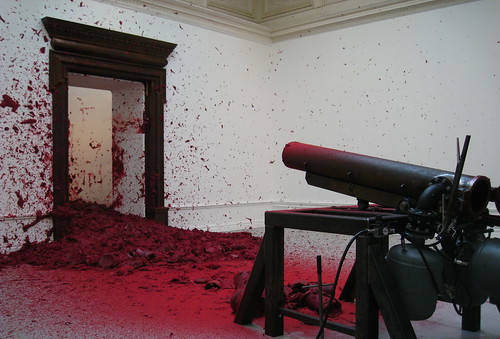
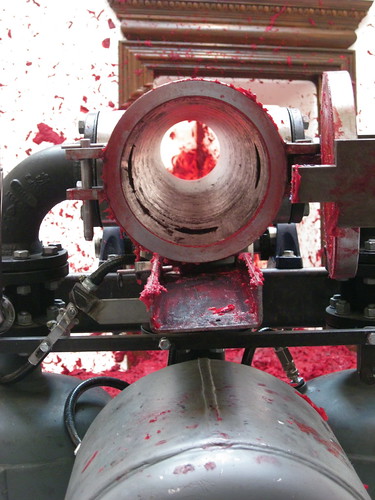
The other week we went (with Roger and Sheila) to the Anish Kapoor exhibition at the Royal Academy which features the work, 'Shooting into the Corner', in which, every 20 minutes, a canon is fired which discharges 'shells' of red wax though one of the RA doorways.

When the exhibition began, it looked like this...


Now it looks a whole lot messier...

Bloodshot IV

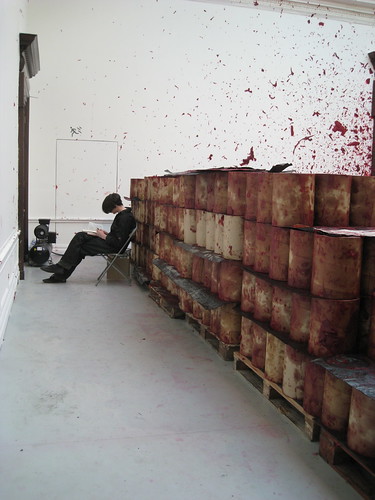
The young man responsible for firing the canon on the day of our visit (not the one in the film above), sat behind the stacked up shells of wax intently reading until the time came to fire the next missile, which he undertook with an imperious toss of his hair and the melodramatic flourish of a seasoned post-modern existentialist that was ludicrous but, also, happily hilarious.

Target

Another chunk of way having hurtled through the gallery at 50 miles an hour and splattered against the wall of the farther room. After which, the arty-artilleryman made a theatrical exit, returning to his book which was, in all likelihood, one of the lesser-known works of Kierkegaard.

Cannon Fodder
There were lots of intriguing exhibits on show which we weren't able to photograph, but which are glimpsed in this film...


The important thing about Kapoor is to respond to and enjoy what he does whilst, at all costs, avoiding the inevitably pretentious statements that art-fancier's attach to his work and with which the accompanying guide is liberally laced. To wit...

The drama of 'Shooting into the Corner' takes place in a space set apart, rather like a boxing ring, a ritual arena in which a symbolic act of violence is allowed to occur... The world also merges the boundaries of painting and sculpture. With connotations of action painting and references to artists such as Jackson Pollock, Kapoor implies that the very act of making a mark is violent. And yet, out of this violence, something of beauty arises. Blah-blah, blah-blah-blah...

The question that exercised us during our visit was how the Royal Academy cleaners are going to get rid of all the wax that Mr Kapoor has splattered all over the interior of Burlington House.

Ever the librarians, Sheila and Roger tracked down an answer in the pages of The Guardian. The answer is, apparently, orange-oil. Which is great to know, except that with the amount of wax they've got to contend with, Londoners are going to be lucky if they find any oranges in their Christmas stockings this year...

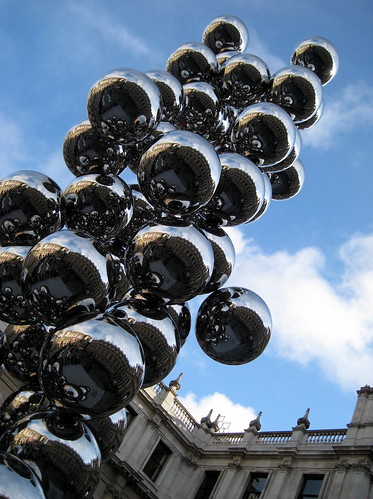
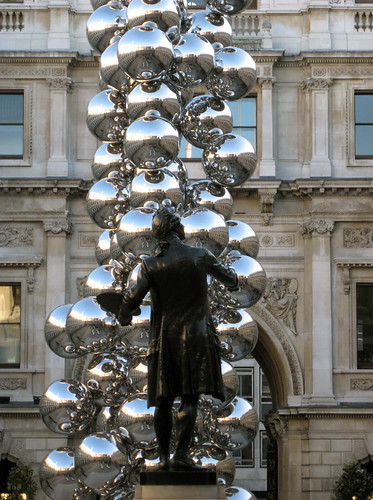
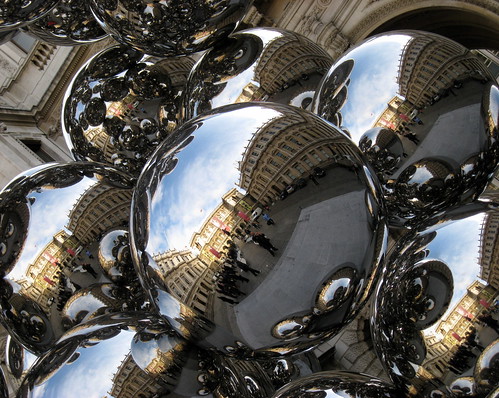
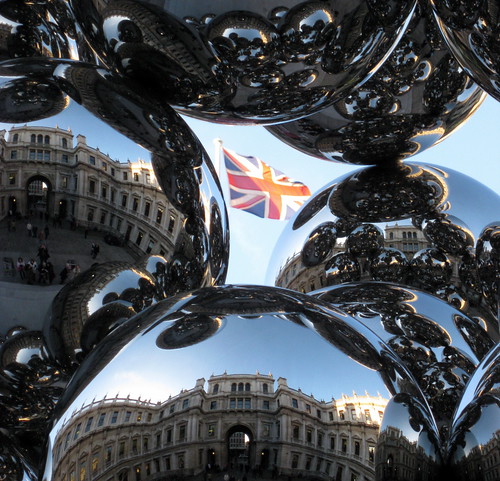
Anyway, outside the RA is one of Kapoor's most exciting sculptures: 'Tall Tree and the Eye'...

Bubbles III
Dwarfing the bronze statue of Sir Joshua Reynolds, Kapoor has constructed a tower of gleaming bubbles (or, bearing in mind the season, baubles), each reflecting the surroundings - including the other baubles and their reflections - and which is, quite simply, the best Christmas Tree in town this year...

Sir Joshua and Mr Kapoor I

Bubbles VI

Bubbles & Flag II

See it before the exhibition ends in three days time, on 11 December.

And view more images of Kapoor's sculpture in my flickr set, Arty-facts.

LATER: By the way, for 'canon' (above) please read 'cannon'. I decided not to correct this error as it would make nonsense of Sheila's comment (below)!

Images: Brian Sibley and David Weeks, © 2009