Showing posts with label Walt Disney World. Show all posts

Saturday, 22 October 2022

A MEMORY OF EPCOT – FORTY YEARS ON...


This is the story of something memorable that happened 40 years ago, today…


The invitation was rather grand…


It was also unexpected.

Of course, I knew the event was happening and I also knew that my friend, the science fantasy writer Ray Bradbury, was going to be there…


Incidentally, I love the proprietorial way in which Ray refers to Spaceship Earth as his building! With justification, of course, for he had helped create the journey through a history of communications that was recounted to guests riding its interior.


I was in Florida, making a BBC radio documentary about the soon-to-opened EPCOT Center. Earlier in 1982, I had spent a couple of weeks filming in both Florida and Los Angeles for another EPCOT-centric documentary – this time for BBC TV's 'Everyman' series.

The plan had been that I and my producer, Norman Stone, would return with a crew to film the finished project when the park debuted in the October. In the intervening months, however, the BBC ran out of programme funding and were unable to send us all back to Orlando to capture the opening ceremony and the necessary wrap-up interviews with our contributors.


Disney offered to fly us out and take care of us, but since such a gesture might be thought to compromise the independent editorial voice of the BBC, the Corporation declined. Norman, it was decreed, would have to make the trip alone and work with a US film crew.

Then, while in Florida during EPCOT's preview weeks, making my radio programme (separate division, separate funding), Disney in true fairy-godmotherly fashion waved a magic wand by telling me that I was going to be invited to the opening events as their guest and the BBC, with an example of dubious (but gratefully accepted) reasoning, argued that whilst it would have been unacceptable for Disney to fly me out to cover the opening, if – 'as a guest' who just happened to be there anyway – I chanced to meet up with Norman and his US film crew and was able to record a few interviews (unpaid, of course!) then honour would be satisfied.

And that is what happened.

Which is why, on 22 October 1982 – against all expectations – Ray and I found ourselves chatting in the shadow of his wonderful, iridescent Spaceship Earth and I came away with a now treasured souvenir of the occasion...


Later that evening EPCOT was closed to the public for the black-tie Spaceship Earth Gala Party. The press contingent (of which we were, nominally, a part) were not invited to this posh bash, but were, instead, bused off to enjoy an evening at the well-known Orlando night-spot, Rosie O'Grady's Good Time Emporium –– except, that is, for Norman and I…

Through the generosity of the friendships we had made with the folks at Disney Imagineering, we were handed that posh invitation at the top of this blog…

There was champagne and food and there was music from some of the all-time greatest American dance-bands: all of which meant that the celebrity guests had more than enough to occupy them during the evening without actually riding Spaceship Earth which, for most of the evening, had empty cars spiraling up through its geodesic structure. That was when Norman and I bumped into Ray and his daughter, the late Bettina Bradbury.

Two meetings in one day –– wonderful!

"Have you been on Spaceship Earth?" Ray asked excitedly.

Well, yes, of course we had – a couple of times, in fact.

Ray looked totally crestfallen.

"Damn!" he said, "I was going to ask you to ride it with me."

There wasn't a moment's hesitation from Norman and I!

"Of course we'd love to ride it with YOU!" we exclaimed.

And we did. No one else. Just us. Ray and Bettina in the front seats, Norman and I, in our hired tuxedos, behind.

There was the official narration (by The Outer Limits 'Control Voice', Vic Perrin) coming out of car's speaker system, while Ray provided his own unique commentary over the top – adding detail and explanation about why he had chosen this or that moment in the history of communication to be part of the Spaceship Earth story.

Unforgettable!

When a few days later, while waiting at Orlando airport for my flight home, I picked up a copy of Time magazine and was astonished to see a photo of Ray sitting in an airplane. How could this possibly be? Everybody knew that Ray never flew: the man who had envisioned the age of space travel, the man who had written The Martian Chronicles was afraid of flying! And yet, there he was – on a plane!

What had happened was that his cross-country train had been cancelled. Needing desperately to return home to work, he acquiesced to his aviophobia, telling his Disney hosts to buy him an air ticket, give him three double martinis and “pour him on the plane.”

Which they did, as witnessed to in Time magazine with its photo of an air-hostess helping Ray buckle his seat belt and the witty accompanying story:
TIME Monday November 8, 1982
People b
Flushed of face, a little white in the knuckles and after a send-off of what appeared to be one tee many martoonies, Science Fiction Novelist Ray Bradbury, 62 (Fahrenheit 451, The Martian Chronicles), nervously strapped himself into his seat.
The master of intergalactic fiction was embarking on his first airplane flight. (He doesn't even drive, a rare feat for someone from Los Angeles.) Bradbury, who set out by train and limousine, was returning home from Orlando, Fla., where he had taken part in the opening ceremonies of Disney's new Epcot Center.
After over 40 years of earth-bound travel, how did he like it aloft? "The stewardesses petted and smoothed my feathers," he said happily. Will he go up again? "No, not often." 
Fast forward to last year’s sale of Ray’s estate at auction. There, among the myriad lots, was a piece of cartoon art commemorating that memorable event with a depiction of Ray enjoying one of those "tee many martoonis" in company with Mickey Mouse!


The auctioneers were unable to give more than the briefest of descriptions. The artist’s signature was, they noted, indecipherable… But not to anyone who knew their Disney names!

The signature reads: ‘X Atencio’.


Veteran Disney artist and Imagineer, Francis Xavier Atencio (left) had designed the ‘Spoonful of Sugar’ nursery sequence in Mary Poppins with its cavorting toys, clothes and furniture; had animated on Fantasia and the acclaimed 3D cartoon, Toot Whistle Plunk and Boom; was one of those responsible for Disney’s brief dalliance with stop-motion animation in the experimental short, Noah’s Ark, and title sequences for, among other movies, The Parent Trap and The Misadventures of Merlin Jones.

Atencio, whose company ID badge simply read ‘X’, went on to do legendary theme-park work for Disney Imagineering: helping to design the Disneyland Railroad's Primeval World diorama and writing the scripts for two famed attractions: Pirates of the Caribbean and the Haunted Mansion, for which he also penned the lyrics to their respective theme songs, 'Yo Ho (A Pirate's Life for Me)' and 'Grim Grinning Ghosts'.

The surrounding mount is inscribed and signed by some of the senior members of Imagineering team responsible for the creation of EPCOT Center, including Marty Sklar, John Hench, Randy Bright and Pat Scanlon – all of whom had appeared in my BBC documentary and all now, sadly, passed on to the great theme park in the sky... 


It was Marty Sklar who had given me the title for my programme – ‘Waltopia’, which had been Marty's playful suggestion to Walt Disney as an alternative name for Walt Disney World.

With so many personal associations, I decided I really ought to give Ray and Mickey a new permanent home! So I did...


[A version of this story was first posted on this blog on 22 October 2015]

Saturday, 29 July 2017

REMEMBERING MARTY


It was with great sadness that heard of the death of a long time (some 30+ years) Disney friend, Marty Sklar. Rightly known as Walt's 'right-hand man', he wrote the first book about 'Disneyland' and worked with the Boss on speeches and many important projects including writing the script for the promotional film that introduced the world to Walt's concept of an Experimental Prototype Community of Tomorrow, shown a matter of weeks before his death in 1966. His role in expanding the Disney theme park franchise from its Anaheim origins to the four corners of the world, is a legendary legacy.

I had the great pleasure to work with Marty on a number of BBC radio programmes about Walt Disney and the Disney company and he provided the title – ‘Waltopia' – for a BBC TV documentary I made in 1982 on the creation of what was by then called EPCOT Center. During my interview with Marty, he recalled how, on first hearing of Walt's plans for a futuristic city, he had quipped: "You know, Walt, I've got the perfect name for your project – Waltopia!" Not only did Marty supply the show's title, he was the film’s opening and closing contributor with a number of appearances in between!

And when my producer Norman Stone and I went out to join the press contingent covering the opening of EPCOT, it was Marty who ensured that on the night before the opening day ceremonies – while the rest of the press corps were being entertained at Rosie O'Grady's nightclub in downtown Orlando – Norman and I had invitations to the exclusive black-tie party for the dedication of the park's iconic attraction, Spaceship Earth.

I have many fond memories of Marty, but one that I especially hold dear was being invited to the opening of the French Pavilion at EPCOT's World Showcase. During the ceremony, Marty spotted me seated on the elegant gilt chairs arranged outside the pavilion. He took something from his pocket, wrote on it and then, catching the attention of a cast member, indicted that it should be delivered to me. It was one of his business cards on which he had written: "Brian! This is some sort of Utopia where a Brit gets invited to the opening of France in America! Marty."

I had first become aware of the name 'Martin A. Sklar’ many years earlier when, as a young Disney fan living in the UK (without any hope of ever making it to California), I was given a copy of his book on Disneyland, brought back for me by some rich friends! Years later, when I realised that the author, 'Martin A. Sklar', was the same 'Marty' I had got to know at (as it then was) WED Imagineering, I carried it all the way to LA in order to get it signed!

Marty was one of the great unsung heroes of the Disney kingdom and I – like many others I am sure – came to value his insights into Walt and his world along with his integrity, candour, quite authority and personal modesty. More than that, I treasured the relationship I enjoyed, across a number of years with him: his friendship (much more than just professional courtesy) meant a great deal to me and I fondly salute his memory.


Here's a typical note from Marty: a truly gracious gentleman of great charm...


From Deadline Hollywood

Marty Sklar, the man who supervised the design and construction of Tokyo Disneyland, the Disney-MGM Studios, Disneyland Paris and other theme park attractions, has died at his home, Disney said tonight. He was 83.

Having started as an intern for Walt Disney, Sklar finished his 54-year career at Disney as the International Ambassador for Walt Disney Imagineering. That role meant traveling to art and design colleges and architecture schools to lecture and attract talent.

During his career, Sklar worked closely with Walt Disney and was instrumental in creating, enhancing and expanding Disney’s creative vision. Sklar was named a Disney Legend in 2001.

“Everything about Marty was legendary – his achievements, his spirit, his career,” said Bob Iger, Chairman and CEO of the Walt Disney Company. “He embodied the very best of Disney, from his bold originality to his joyful optimism and relentless drive for excellence. He was also a powerful connection to Walt himself. No one was more passionate about Disney than Marty and we’ll miss his enthusiasm, his grace, and his indomitable spirit.”

Born on February 6, 1934, in New Brunswick, NJ, Sklar was a student at UCLA and editor of its Daily Bruin newspaper when he was recruited to create The Disneyland News for Walt Disney’s new theme park in 1955. After graduating in 1956, he joined Disney full time and would go on to serve as Walt’s right-hand man — scripting speeches, marketing materials and creating a film showcasing Walt’s vision for Walt Disney World and Epcot, according to Disney.

During this period, he also joined WED Enterprises, the forerunner of Walt Disney Imagineering, and later would become the creative leader of Imagineering, leading the development of Disney theme parks and attractions for the next three decades. He retired as EVP and Imagineering Ambassador on July 17, 2009, Disneyland’s 54th birthday. Disney marked the occasion by paying tribute to Marty with the highest Parks and Resorts recognition, dedicating a window in his name on Disneyland’s City Hall.

“Marty left an indelible mark on Disney Parks around the globe and on all of the guests who make memories every day with us,” said Bob Chapek, Chairman of Walt Disney Parks and Resorts. “He was one of the few people that was fortunate to attend the opening of every single Disney park in the world, from Anaheim in 1955 to Shanghai just last year. We will dearly miss Marty’s passion, skill and imaginative spark that inspired generations of Cast, Crew and Imagineers.”

He also authored books about Disney including Dream It! Do It!: My Half-Century Creating Disney’s Magic Kingdoms (2013), and One Little Spark!: Mickey’s Ten Commandments and The Road to Imagineering (2015).

Skalr is survived by his wife of 60 years, Leah; son Howard and his wife, Katriina Koski-Sklar; grandchildren Gabriel and Hannah; daughter Leslie; and grandchildren Rachel and Jacob. In lieu of flowers, the family requests that donations be made in Marty’s name to Ryman Arts.

Thursday, 22 October 2015

FLIGHTS OF FANCY

This is the story of something memorable that happened 33 years ago, today…


The invitation was rather grand…


It was also unexpected.

Of course, I knew the event was happening and I also knew that my friend, the science fantasy writer Ray Bradbury, was going to be there…


Incidentally, I love the proprietorial way in which Ray refers to Spaceship Earth as his building! With justification, of course, for he had helped create the journey through a history of communications that was recounted to guests riding its interior.


I was in Florida, making a BBC radio documentary about the soon-to-opened EPCOT Center. Earlier in 1982, I had spent a couple of weeks filming in both Florida and Los Angeles for another EPCOT-centric documentary – this time for BBC TV's 'Everyman' series.

The plan had been that I and my producer, Norman Stone, would return with a crew to film the finished project when the park debuted in the October. In the intervening months, however, the BBC ran out of programme funding and were unable to send us all back to Orlando to capture the opening ceremony and the necessary wrap-up interviews with our contributors.

Disney offered to fly us out and take care of us, but since such a gesture might be thought to compromise the independent editorial voice of the BBC, the Corporation declined. Norman, it was decreed, would have to make the trip alone and work with a US film crew.

Then, while in Florida during EPCOT's preview weeks, making my radio programme (separate division, separate funding), Disney in true fairy-godmotherly fashion waved a magic wand by telling me that I was going to be invited to the opening events as their guest and the BBC, with an example of dubious (but gratefully accepted) reasoning, argued that whilst it would have been unacceptable for Disney to fly me out to cover the opening, if – 'as a guest' who just happened to be there anyway – I chanced to meet up with Norman and his US film crew and was able to record a few interviews (unpaid, of course!) then honour would be satisfied.

And that is what happened.

Which is why, on 22 October 1982 – against all expectations – Ray and I found ourselves chatting in the shadow of his wonderful, iridescent Spaceship Earth and I came away with a now treasured souvenir of the occasion...


Later that evening EPCOT was closed to the public for the black-tie Spaceship Earth Gala Party. The press contingent (of which we were, nominally, a part) were not invited to this posh bash, but were, instead, bused off to enjoy an evening at the well-known Orlando night-spot, Rosie O'Grady's Good Time Emporium –– except, that is, for Norman and I…

Through the generosity of the friendships we had made with the folks at Disney Imagineering, we were handed that posh invitation at the top of this blog…

There was champagne and food and there was music from some of the all-time greatest American dance-bands: all of which meant that the celebrity guests had more than enough to occupy them during the evening without actually riding Spaceship Earth which, for most of the evening, had empty cars spiraling up through its geodesic structure. That was when Norman and I bumped into Ray and his daughter Bettina.

Two meetings in one day –– wonderful!

"Have you been on Spaceship Earth?" Ray asked excitedly.

Well, yes, of course we had – a couple of times, in fact.

Ray looked totally crestfallen.

"Damn!" he said, "I was going to ask you to ride it with me."

There wasn't a moment's hesitation from Norman and I!

"Of course we'd love to ride it with YOU!" we exclaimed.

And we did. No one else. Just us. Ray and Bettina in the front seats, Norman and I, in our hired tuxedos, behind.

There was Walter Cronkite's narration coming out of car's speaker system, while Ray provided his own unique commentary over the top – adding detail and explanation about why he had chosen this or that moment in the history of communication to be part of the Spaceship Earth story.

Unforgettable!

When a few days later, while waiting at Orlando airport for my flight home, I picked up a copy of Time magazine and was astonished to see a photo of Ray sitting in an airplane. How could this possibly be? Everybody knew that Ray never flew: the man who had envisioned the age of space travel, the man who had written The Martian Chronicles was afraid of flying! And yet, there he was – on a plane!

What had happened was that his cross-country train had been cancelled. Needing desperately to return home to work, he acquiesced to his aviophobia, telling his Disney hosts to buy him an air ticket, give him three double martinis and “pour him on the plane.”

Which they did, as witnessed to in Time magazine with its photo of an air-hostess helping Ray buckle his seat belt and the witty accompanying story:
TIME Monday November 8, 1982
People b
Flushed of face, a little white in the knuckles and after a send-off of what appeared to be one tee many martoonies, Science Fiction Novelist Ray Bradbury, 62 (Fahrenheit 451, The Martian Chronicles), nervously strapped himself into his seat.
The master of intergalactic fiction was embarking on his first airplane flight. (He doesn't even drive, a rare feat for someone from Los Angeles.) Bradbury, who set out by train and limousine, was returning home from Orlando, Fla., where he had taken part in the opening ceremonies of Disney's new Epcot Center.
After over 40 years of earth-bound travel, how did he like it aloft? "The stewardesses petted and smoothed my feathers," he said happily. Will he go up again? "No, not often." 
Fast forward to last year’s sale of Ray’s estate at auction. There, among the myriad lots, was a piece of cartoon art commemorating that memorable event with a depiction of Ray enjoying one of those "tee many martoonis" in company with Mickey Mouse!


The auctioneers were unable to give more than the briefest of descriptions. The artist’s signature was, they noted, indecipherable… But not to anyone who knew their Disney names!

The signature reads: ‘X Atencio’.

Veteran Disney artist and Imagineer, Francis Xavier Atencio (left) had designed the ‘Spoonful of Sugar’ nursery sequence in Mary Poppins with its cavorting toys, clothes and furniture; had animated on Fantasia and the acclaimed 3D cartoon, Toot Whistle Plunk and Boom; was one of those responsible for Disney’s brief dalliance with stop-motion animation in the experimental short, Noah’s Ark, and title sequences for, among other movies, The Parent Trap and The Misadventures of Merlin Jones.

Atencio, whose company ID badge simply read ‘X’, went on to do legendary theme-park work for Disney Imagineering: helping to design the Disneyland Railroad's Primeval World diorama and writing the scripts for two famed attractions: Pirates of the Caribbean and the Haunted Mansion, for which he also penned the lyrics to their respective theme songs, 'Yo Ho (A Pirate's Life for Me)' and 'Grim Grinning Ghosts'.

The surrounding mount is inscribed and signed by some of the senior members of Imagineering team responsible for the creation of EPCOT Center, including Marty Sklar, John Hench, Randy Bright and Pat Scanlon – all of whom had appeared in my BBC documentary.


It was Marty Sklar who had given me the title for my programme – ‘Waltopia’, which had been Marty's playful suggestion to Walt Disney as an alternative name for Walt Disney World.

With so many personal associations, I decided I really ought to give Ray and Mickey a new permanent home! So I did...

Monday, 8 June 2009

MOUSE MEMORIES

Having said, earlier today, that I would be reducing the number of postings on this blog, I hadn't expected to post twice in one day! However...

I wanted to tell readers that today's Guardian carries my obituary to Wayne Allwine (left), the voice of Mickey Mouse.

I wrote this piece three weeks ago and it has been waiting in the newspaper's equivalent of the morgue until there was a chance to finally lay it to rest in print. Since I had an even longer wait for the appearance in The Independent of my recent obituary to actor, Peter Dennis, it would seem that far too many people dying right now!

Anyway... Outside the world of Disney, most people won't have heard of Wayne Allwine, but everyone, of course, has heard of the character to whom he lent his voice.

Mickey Mouse is, arguable, the most famous animated character of all time (partly because in addition to a significant film career dating back to the first-ever sound cartoon, Steamboat Willie in 1928) the Mouse became the iconic symbol of one of America's most enduring and successful corporations.

During Mickey's 80-year career he was only ever offically spoken for by three people: firstly Walt Disney who, despite having a natural baritone voice, decided to give his creation an excitably high-pitched falsetto.

Disney continued provided Mickey's voice (and, in the very early days, the voice of Minnie as well) until 1947 when - halfway though working on the 'Mickey and the Beanstalk' sequence in the feature film, Fun and Fancy Free - he handed over the task to Jimmy MacDonald who was responsible for the studio's audio post-production department and provided numerous voices and sound effects for Disney cartoons.

MacDonald carried out Mickey's vocal duties for another thirty years until, in 1977, the role passed to his protégé in the sound department, Wayne Allwine. Here they are: master and apprentice...


Wayne began voicing the Mouse in various TV shows as well speaking for the character when he made his big screen comeback in 1983 in Mickey's Christmas Carol.


I first met Wayne, together with his mentor, Jim MacDonald, in 1988 at a 60th birthday-bash for Mickey in Disneyland. I was struck by his modest, self-effacing charm, lively wit and his obvious sense of pride in playing a role that was known and loved throughout the world.


It was some years later that we met again when I was making a couple of radio series for the BBC: Ain't No Mickey Mouse Business, which explored the commercial history of the Mouse Factory, and Disney's Women, examining the role of women in Disney's life and the female characters in his films.

On these programmes I had the sheer joy of twice interviewing Wayne (in character as Mickey) with Russi Taylor, who had taken on the role of Minnie Mouse and had subsequently become Mrs Wayne Allwine. Since the studio has always maintained that - despite their advancing years - Mickey and Minnie were still just boy-and-girl-friends it was initially a source of some concern that the characters voices were getting wed. What if the Mice were to end up in the divorce court? What would that do to the reputation of the characters for whom they spoke? Their relationship became referred to as "The love that dares not squeak its name".

Anyone who encountered the Allwines would have been in no doubt that the couple were totally devoted to one another as well as to the heritage of the company for whom they worked and the characters they portrayed.

When Wayne and Russi began ad-libbing as Mickey and Minnie, it was impossible not to be caught up in their infectious sense of fun and - suspending disbelief - imagine yourself talking, in person, to those famous mice. It was, in fact, almost impossible to conduct an interview without collapsing in paroxysms of laughter at their hilarious repartee.

I last met the Allwines in 2001 (on the 100th anniversary of Walt Disney's birth), when I interviewed the couple beside World Showcase Lagoon in Epcot, Walt Disney World. At the end of our session, I left them sitting on a bench side-by-side, hand-in-hand gazing out across the Lagoon, clearly blissfully happy in each other's company and in the fantasy kingdom where they worked.

Here's the photograph of Wayne and Russi at last year's Disney Legends ceremony which accompanied my obituary in the paper, though not on-line...


...and you can read my tribute in full at Guardian.co.uk, although, sadly, it doesn't end in quite the way I had intended.

As you will see, it concludes with the words: "Allwine is survived by his wife, and by two daughters and three sons from an earlier marriage." But, as submitted, it went on "...and by a mouse who is, temporarily, lost for words."

And I'll leave you - and say farewell to Wayne - with his performance (alongside Russi's Minnie) in the 1995 short cartoon, Runaway Brain...


Monday, 18 May 2009

DISNEY DREAMSCAPES

I've been poring over a wonderful new book that has whisked me away from the gloom of South London to the sunshine of Orlando, Florida, and that most extraordinary of places (adored by some, reviled by others) Walt Disney World - Disneyland's younger, but bigger, East Coast sister.

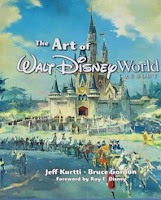
The Art of Walt Disney World by Jeff Kurtti and the late Bruce Gordon is, as the title suggests, a celebration of the art that went into creating the Disney theme park experience that is, essentially, an amalgam of architecture, engineering, landscaping and storytelling.

These artworks fulfilled two purposes: firstly as imaginative explorations of ideas and, later, while the Disney dreams and fantasies were being turned into concrete realities, as a way of introducing the public at large to a new Disney product.

The Tree of Life by Ben Tripp, 1992
Disney's Animal Kingdom
Click image to enlarge

Disney's entertainment complex in Florida now comprises four distinct parks as well as various themed recreation areas and an array of hotels, but when I first went there, in January 1982, there was just the one park called 'The Magic Kingdom' but commonly mis-referred to by tourists as 'Disneyland'. The mistake was understandable, since it was, to all intents and purposes a bigger and more elaborate version of the famous Anaheim original which Disney had opened in 1955.

Main Street Town Square with City Hall by Colin Campbell, 1968
The Magic Kingdom

Click image to enlarge

Before visiting a Disney park I admit to having had a somewhat cynical, disparaging (and possibly British) view of this part of the studio's enterprises, but - in the words of Goldsmith - I went to scoff and remained to pray.

The completeness of the creation is remarkable - nothing looks as if it had just been built, but rather as if it had always existed. I remember when Disney opened it's Paris version of Disneyland, I had a heated argument with a French journalist who dismissed the park as being made of cardboard and plastic! Nothing could be further from the truth. You don't have to like the theme park experience, but you can't dismiss it as if it were some gimcrack gewgaw thrown up overnight like a carnival midway.

There is an astonishing attention to detailing in everything - from the decor and dressing of buildings down to litter bins and door furnishings - that is staggering. Pointing out an architectural feature on the top of a building in Disneyland, a journalist once asked Walt Disney "Why bother with all those details that hardly anyone will ever look up high enough to notice?" Disney replied: "Because if they weren't there, people would notice."

The Disney parks are a 3D equivalent of the Disney films in which you have stepped into the screen and where your eye, as the visitor, becomes the camera.

20,000 Leagues Under the Sea
Design for attraction poster - artist/date unknown
Click image to enlarge

What took me to Florida back in 1982 was the unveiling of long-awaited plans for the launch of EPCOT (Experimental Prototype Community of Tomorrow), a futuristic Utopian concept that Walt Disney had begun talking about a few months before his death in 1966 but which had never got beyond the visionary stage and which had severely challenged and perplexed his successors.

Whereas Disney had clearly envisaged - however unfeasible it might have been - a real functioning city, the EPCOT that eventually began to be built was, instead, another theme park albeit one addressing aspects of history, culture, science and technology.

I well remember the first piece of artwork that I saw representing the concept of EPCOT...


 Spaceship Earth by Herbert Ryman, 1977
EPCOT - Future World
Click image to enlarge

'God rays' streaming from a golden sky dramatically illuminate the Geosphere, Spaceship Earth, that would become EPCOT's iconic image in the same way that Cinderella's Castle in The Magic Kingdom had become the signature image representing Walt Disney World when it first opened in 1971.

Within a few days of arriving, I was talking to the folks at Disney about the possibility of making a BBC TV documentary about EPCOT and was being taken round the sprawling building site and meeting the planners and builders who were engaged in this vast project - digging lagoons, constructing (among many other things) a Chinese temple, a Parisian boulevard, a Canadian chateau and, true to stereotype, a British pub! In addition there were pavilions dedicated to themes of transport, energy, the land and - as yet in the future - the seas...

The Living Seas Pavilion by Tony Baxter, 1975
EPCOT - Future World
Click image to enlarge

Having studied and written about Disney movies for many years, I was well aware that every animated feature - and, indeed, many of the studio's live-action films - began with story sketches and inspirational artwork that would set the style, tone and look of the film.

I soon discovered that the various locations, settings and attractions in the theme park had begun in a similar way - not, as one might suppose, with architectural blueprints but with pencil and pastel sketches and watercolour and oil paintings by artists, several of whom had been involved with Disney's animation for many years but who had moved from Burbank to Glendale to work for what, at the time, was called WED [for Walter Elias Disney] Imagineering.

Among these 'Imagineers' (a Disney word combining imagination and engineering) were artists like Marc Davis who, as one of Disney's legendary 'Nine Old Men', animated on many of the Disney classics from Bambi onwards and who created much of the look for the celebrated 'Pirates of the Caribbean' attraction - including these skeletons forever contemplating the checkmate on their chessboard...

'Perpetual Check' by Marc Davis, 1977The Pirates of the Caribbean - The Magic Kingdom
Click image to enlarge

Marc Davis also contributed to the look of many other attractions in both Disneyland and Walt Disney World including the Magic Kingdom's Rivers of America...

Rivers of America Show Scene by Marc Davis, 1970
The Magic Kingdom

Click image to enlarge

Mary Blair had styled a raft of Disney feature films including Song of the South, Cinderella, Alice in Wonderland and Peter Pan and then went on to design the New York World's Fair/Disneyland boat ride 'It's A Small World'...

'it's a small world' final scene by Mary Blair, 1970
The Magic Kingdom

Click image to enlarge

...as well as creating a huge mosaic for the Grand Canyon Concourse in Walt Disney World's then state-of-the-art A-frame Contemporary Hotel...

Grand Canyon Concourse Mural detail by Mary Blair, 1969
The Contemporary Hotel

Click image to enlarge

One of the most prolific of these artists was Herbert D Ryman who had begun his career at Metro-Goldwyn-Mayer, working on such classics as David Copperfield and Mutiny on the Bounty. He later worked on Ana and the King of Siam for 20th Century Fox and, in 1938, joined the creative team at Walt Disney Studios where he worked on films including Dumbo and Fantasia.

It was Herb (or Herbie) who created that evocative painting of the Geosphere shown earlier and, years earlier, had come up with the first 'overlook' for Disneyland and an impression of the central Sleeping Beauty's Castle (shown below but not from this book) which Walt used to sell his ideas to backers and sponsors...

Click image to enlarge


I had the privilege of spending time in Mr Ryman's company, talking about Disney and design and I still find his work endlessly intriguing: the powerfully evocative - yet almost illusory - way in which he painted dreamlike visions such as Walt Disney World's Castle with its turrets and towering spires long before the foundations were even laid - complete, please note, with Cinderella's royal coach, horses and attendants...

Cinderella Castle by Herbert Ryman, 1969
The Magic Kingdom

Click image to enlarge

...or his warmly nostalgic evocation of a long-past age of Americana with a period-costumed population (no tourists in Bermuda shorts and baseball caps here!) including a resident Town Crier...

Concord Bridge, Liberty Square by Herbert Ryman, 1968
The Magic Kingdom

Click image to enlarge

Sometimes Herb Ryman's impressions of places - such as the Equatorial African Pavilion planned for EPCOT's World Showcase but never built - are all that remain of the original dream...

Equatorial Africa Pavilion by Herbert Ryman, 1980
EPCOT - World Showcase
Click image to enlarge
Talking of unrealised dreams, when I was working on my TV documentary, I got to know two of Disney's leading 'Imagineers', Marty Sklar and the late John Hench and following on from a suggestion that I made for a future attraction for the British Pavilion in World Showcase, I was asked to write a treatment for a 'Charles Dickens Ride' that would take visitors (in cars styled like Victorian mail coaches) through a series of tableaux featuring well-known scenes and characters from Dickens' novels: Miss Havisham's Wedding breakfast, Oliver in Fagin's den, Mr Pickwick on the ice in Dingley Dell, Nicholas Nickleby in Dotheboys Hall and, of course, Ebenezer Scrooge and his various spirits...

The project was never seen through to completion, but, as I discovered in The Art of Walt Disney World, various visual interpretations of the idea were made including this scene of Scrooge and the Ghost of Christmas Past by Sam McKim...

"Are you the spirit, sir, whose coming was foretold to me?"
by Sam McKim, 1984
EPCOT - World Showcase
Click image to enlarge

What fun it would have been to have ridden one's own ride in a Disney theme park! On the night that EPCOT opened, I rode Spaceship Earth with the originator of that ride, Ray Bradbury, giving me an unforgettable personal commentary on the history of human culture from the cave to space exploration. I should dearly have liked to have been able to repay the compliment and take Ray on a tour of my Dickensland!

This is one of the pleasures of Kurtti and Gordon's book: for those who know and love this park there are not only insights into how things became the way they are, but how they might have been and - most beguiling of all - how they never were!

Often, when looking at the inspirational art created for the Disney animated classics, I have had a twinge of regret that some elusive quality captured by the artist has somehow, subsequently, been lost in the process of fixing the images onto film. The same is quite often true of the art of the theme parks, but fortunately, in this handsome volume, much of it is preserved for posterity and for our immediate delight.

Cinderella Mosaic Designs by Dorothea Redmond, 1970-71
The Magic Kingdom
Click image to enlarge

Here are few links where you can read more about Herbert Ryman, Mary Blair, Marc Davis and Sam McKim.

The Art of Walt Disney World is only available at WDW shops or on-line through the Laughing Place Store.