Showing posts with label Walt Disney. Show all posts

Saturday, 22 February 2025

MOODY BLUES


A seemingly simple but stunning artwork by Lee Everett Blair (1911-1993). A piece of concept art created for the live-action silhouetted orchestra shots leading iinto the opening, abstract sequence of Fantasia (1940) featuring Bach's 'Toccata and Fugue in D minor' as orchestrated and conducted by Leopold Stokowski and the Philadelphia Orchestra.

Blair was an American artist, born in Los Angeles and died in Soquel, California, and was the younger brother of Preston Blair and husband of Mary Blair.

Friday, 5 April 2024

MORNING BLUES!

Sometimes this is just how you feel in the morning –––
even on a Friday!


[Illustration: Cover of vintage breakfast menu (c. 1940) from the Walt Disney Studio Restaurant, Burbank, California, USA]

Friday, 5 January 2024

GLYNIS JOHNS (1923-2024)


Farewell to Glynis Johns, aged 100: beautiful lady (with amazing eyes) and exceptionally talented actress, equally skilled at playing dramatic, romantic or comedic roles. Daughter of veteran Welsh actor Mervyn Johns (himself a considerable talent), Glynis was at home on stage or in front of the camera, but it was the movies that elevated her career to star status.

Glynis made her film debut in 1938 in South Riding and success was quickly followed with Powell and Pressburger's 1941 war drama 49th Parallel in which stepping into a role vacated by Elisabeth Bergner in a very starry cast (Leslie Howard, Laurence Olivier, Anton Walbrook and Raymond Massey)
and for which she won a National Board of Review Award for Best Acting. In 1948 she had a triumph as the titular mermaid in the screwball comedy, Miranda which also featured David Tomlinson with whom she would later co-star in Mary Poppins as Mrs and Mr Banks.


Other films that followed included The Card second-billed to Alec Guinness and Flesh and Blood co-staring alongside Richard Todd; Walt Disney would subsequently cast Johns and Todd in two historical pictures: The Sword and the Rose and Rob Roy, the Highland Rogue. She provided a glamorous foil to Danny Kaye in his glorious medieval musical-romp, The Court Jester; and co-starred with Deborah Kerr, Robert Mitchum and Peter Ustinov in The Sundowners, with Dan O'Herlihy in The Cabinet of Caligari and with Peter O'Toole, Burton and Taylor in Under Milk Wood.
 

On stage, Glynis was the first actress play the role of Desiree Armfeldt in Stephen Sondheim's 1973 Broadway hit, A Little Night Music, in which she introduced – in her hallmark, husky voice – what would become one of Sondheim's most best-loved and enduring songs, 'Send in the Clowns'.  


This performance won Glynis a Tony Award for Best Actress in a Musical and Drama Desk Award for Outstanding Actress in a Musical. Sondheim likened her voice to a "rumpled bed", which is less of an insult than an acknowledgement of her seductive delivery.

The song's construction (now so famously known) was solely dictated by the musical ability of his leading lady. As Sondheim once described the structure:
 
"Isn't it rich (breathe-breathe),
Are we a pair (breathe-breathe),
Me here at last on the ground (breathe),
You in mid-air (breathe-breathe),
Send in the clowns."

Writing in The New York Times, music critic Anthony Tommasini perceptively said of the song: "Stephen Sondheim composed his most famous song, 'Send In the Clowns,' for an actress with virtually no voice ... and few genuine singers have performed it as effectively." Which is unquestionably true.

Of course, Glynis had already sung a roistering number in Walt Disney's 1964 film triumph, Mary Poppins, delivering 'Sister Suffragette', a militant battle-cry for women's rights in Edwardian England in the role of Jane and Michael's mother Mrs Winifred Banks. As the story goes, Walt invited Glynis to the studio, planning to offer her the role of the mother of the two children, Jane and Michael; however, the actress (already a Disney leading lady) assumed she was going to be offered the film's title role. 

To sell the supporting role and mollify the disappointed star, Walt called Poppins composers, Richard and Robert Sherman, and told them that he was taking Glynis to lunch and, afterwards, would be bringing her to the music room so they could play the new song they had composed for her. The Sherman Brothers, decoding Walt's unexpected call, worked through their own lunchtime and rewrote an abandoned song for Mary Poppins – 'Practically Perfect in every way / In ev'rything I do and in everything I say...' as a suffrage mission statement that now began, 'We're clearly soldiers in petticoats / Dauntless crusaders for women's votes!' The ruse (and the song) worked the necessary magic and Miss Johns accepted the role. 


Friday, 15 December 2023

THE DAY WALT DISNEY DIED


When my friend, French Disney scholar Christian Renaut, visited me last month, he gave me a very special gift: a copy of the famous 24 December 1966 issue of the French magazine Paris Match featuring a grieving Mickey Mouse to mark the death of Walt Disney, nine days earlier. 

The iconic cover painting was by French comic book artist, Pierre Nicolas, and the magazine contained a lengthy appreciation of the American filmmaker under the title, 'Adieu a Walt Disney - Il a Bati Un Empire Sur Une Souris'. Although very aware of this image – one that spoke to the global shock with which people received the news of Uncle Walt's death – I had never owned a copy.

It was a gift that brought back some powerful memories and, today, I am recalling an event that happened fifty-seven years ago today...

I am twelve years old and I'm getting ready for school and, suddenly, there is my father calling up the stairs: 'Brian... Walt Disney has died!'

Downstairs I can hear the murmuring drone of radio voices as my father – busy brewing early-morning tea – listens, as he does every morning, to the BBC Radio news programme, Today.

Maybe I should have have dashed downstairs to catch the reports, absorb the details, gather up the tributes. After all, Walt Disney was my hero. A strange idol for a young lad, maybe – but that is what he was.

I collected every book, magazine and trivial snippet that I could find about Disney and his studio. I was forever copying pictures of Disney characters in my sketch-books – in fact my youthful ambition was to be a Disney artist, to animate those fabulous beings that appeared in his films. I longed to be a part of that mystical process that created characters out of pencil, ink and paint and then imbue them with a power to move people to laughter or tears. I was, I admit, obsessed by the man and his movies.

Later that morning, on my way to school, I would buy the daily newspapers and – in a corner of the playground at morning break – pore over the obituaries; but, at the moment of first hearing the news, I had only one response: I sat on the edge of my bed and, like Paris Match's Mickey Mouse, I cried.

For the first time in my young life I experienced that bizarre phenomenon: a feeling of overwhelming grief at the death of someone whom I did not really know. Not only had I never met Walt Disney, I had – rather surprisingly – never even written him a fan-letter. Yet, I felt, as many others have felt on hearing of the death of some public figure, president or pop-star – that I had lost a friend, been bereaved of someone who held a unique place in my affections. The loss felt achingly huge; a void had yawned open in my life that I doubted could ever be filled...

In the four-and-a-half decades since that day, I have continued to study – and occasionally write about – Disney's life and work. I have also had the privilege of meeting many of those who knew, worked with, loved and (sometimes) loathed the man. Such encounters have brought me very close to feeling that I understand at least something of the unique personality and character that was Walter Elias Disney.

But I have never been – never shall be – as close to him as I was on that morning when my father called upstairs to tell me the news that Walt Disney had died...

That memory triggers another from six or seven years later...

My early fascination with Disney movies had been suddenly intensified when I borrowed R D Feild's book, The Art of Walt Disney from my local library. Here was someone who, unlike my Mum, didn't think of 'cartoons' as kid's stuff you ought to have grown out of by the time your voice breaks.

I wanted a copy of The Art of Walt Disney more than anything else in the world and began scouring the second-hand bookshops, which is how I stumbled on Fred Zentner. He later became The Cinema Bookshop in London’s Great Russell Street, but when I first met him he was selling film books, stills, posters and other gems – including a copy of the much-lusted-after Art of Walt Disney – from the basement of the Atlantis Bookshop, in Museum Street, just round the corner from the British Museum. Once found, I began, bit by bit, buying up Fred's stock of Disneyana.

Then came the day when he placed into my hands a copy of The Story of Walt Disney by Walt's daughter, Diane Disney Miller, as told to Pete Martin. It was a first edition American hardback, published by Henry Holt & Co (New York) in 1956. It still had its original dustwrapper with a portrait of Walt by studio artist, Al Dempster...


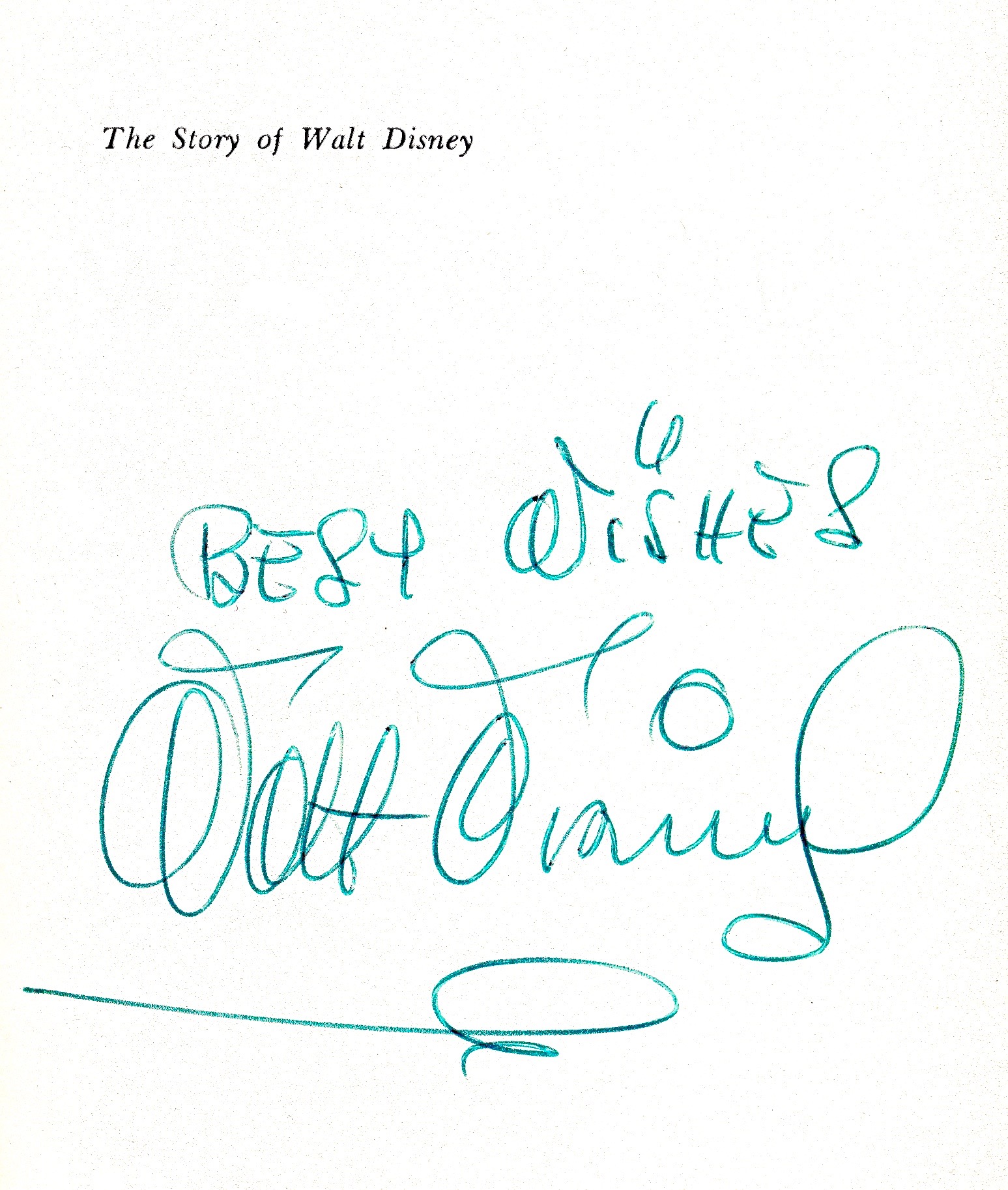
And what's more, it was ––– SIGNED!

There, on the half-title page, in green biro, with that distinctive bold handwriting was the inscription...

 
It was his very signature – including the little circle over the 'i' in 'Disney' that I emulated in my own signature. This man – whom I had never met but who exercised an obsessive fascination over me – had held this book, opened it and inscribed his name inside.

'How much is it?' I whisper, holding my breath.

'Forty pounds,' he replies.

All those years ago, yet I remember the conversation as if it were yesterday.

It was an awful lot of money!

I wanted it! No, I craved it! But, FORTY POUNDS...

Forty pounds for a book? My mother would go bananas! Besides, I couldn't afford it. I didn't have forty pounds. I didn't know when I ever would have forty pounds. But, right there and then, I desired that book with a passion that, call me eccentric if you will, I have scarcely felt about anything since.

But, how was it possible? FORTY POUNDS! It was way beyond my meager means. Then Fred Zentner showed himself to be a man who understood the full anguish of desire, because he made me an offer. If I paid him ten pounds a month for the next four months, he would keep the book for me until I had paid the full forty.

So, month on month, I made my pilgrimage to the Atlantis Bookshop, looked at the swirling green signature and paid another ten pounds.

Then, one day, it was mine.

Fast-forward thirteen years. I am standing in the Archive at the Walt Disney Studio in Burbank, California, talking with Archivist, Dave Smith. I am there researching a television documentary about EPCOT Center and I mention, in conversation, that the prize of my Disney collection was an autographed copy of The Story of Walt Disney

Dave Smith laughs and asks a question that almost brings the universe crashing down around my ears.

'Are you sure it's actually signed by Walt Disney?'

'Of course! It says so, in green biro: ‘Best Wishes Walt Disney’!'

'That may be,' he replies, 'but many people at the Studio, some of them distinguished animators, signed books and pictures on Walt's behalf.'

I look stunned. But, Dave goes on: 'The Disney signatures by these other artists are more like the famous logo signature that appears on Disney movies and merchandise. Walt's personal signature, however, is quite distinctive. Would you like to see a GENUINE Disney signature?'

Nothing could be simpler: within seconds I could know whether or not I owned the real thing. Or, I could leave things as they were. Except, of course, that now I couldn't. Dave Smith had sowed a terrible seed of doubt...

I hesitate for no more than a second: 'Yes, let's see a GENUINE Disney autograph…'


Then, relief and joy! 'It is just like mine!'

When, a few years later, I got to know Diane Disney Miller, I asked her about the book and she told me that her father used to sign copies for sale in the bookshop at Disneyland, which was very probably where my copy had originally been purchased.

She also explained that whilst The Story of Walt Disney carried her name as author (and, indeed, included many of her own reminiscences) it had been Walt himself who had collaborated directly with Hollywood biographer Pete Martin on the book. However, her father had decided that it would be better if his life-story were presented as if told by his daughter, partly because he felt that to tell it himself might appear arrogant, and partly because he wanted the recently married Diane to earn some money.

A decade passed and I found myself in San Francisco working with Diane in co-presenting a radio series for the BBC about her father. On this occasion, I had carried the treasured volume with me and I asked her to add her signature to the book’s title page.

Diane was modestly reluctant – since, as she had already told me, she didn’t consider herself in any sense the book’s ‘author’. However, eventually, she graciously relented and inscribed the book...


A few more years down the road, I had acquired a British edition of The Story of Walt Disney published by Odhams Press (London) in 1958...


I decided to take it with me when I attended the Los Angeles premiere of the documentary, Walt Disney: The Man Behind the Myth, in which I appeared (albeit briefly) as an interviewee. At the party afterwards, chatting with Diane and her husband Ron, I produced this volume and asked whether the book’s Non-Author would oblige with another inscription!

Appreciating the joke, she unhesitatingly agreed. Beneath the printed sub-title – ‘An intimate biography by his daughter, Diane Disney , as told to Pete Martin’ – she wrote: 'Actually, Brian – we know better, don’t we? Warmest, warmest regards, Diane.'


Nowadays, the autograph business is big business: copies of the recent reprint of The Story of Walt Disney with Diane's signature sell for several hundred dollars and someone, in a recent American auction, paid over three thousand dollars for a copy of the original edition signed (also in green biro!) by Walt.

So, all in all, I think that original – and seemingly astronomical – forty pounds of mine was money incredibly well spent!

It is not, however, for any financial value that I treasure these volumes, but for the even more valuable memories and associations that they hold…


Envoi

This blog post is based on an earlier posting from December 2012, since when David R. Smith and Diane and Ron Disney have passed away.

For the story of the making of the Paris Match cover-painting see this interview with artist Pierre Nicholas by my colleague, Didier Ghez on his blog, Disney History.

Monday, 12 June 2023

THE ART OF THE COMIC-BOOK (6)


This art of the comic-book blog celebrates a comic book title that dominated the 'funnies' section of America's newsstands of the 1940s and '50s: Walt Disney's Comics and Stories.

This example, Vol.4 No.9 (published 79 years ago, this month in June 1944!) showcases the work of comic-strip legend Walt Kelly (1913-1973), who would eventually move on from the Mouse Factory to create his own superb and long-running cartoon character, Pogo Possum, who – along with his engaging companions – resides in the Okefenokee Swamp that straddles the Georgia-Florida state-line.

A typical cover of Walt Disney's Comics and Stories featured Mickey Mouse & the Gang, although pretty quickly they were taken over by the Duck and his three troublesome nephews - Huey, Dewey and Louie – invariably giving grief to 'Unca' Donald'.

Here, however, Kelly shows Donald making music with two of Snow White's Seven Dwarfs, Dopey and Happy – the latter playing a double-bass with a Donald-shaped headstock that seems to have a beady eye on his doppelganger!

Saturday, 22 October 2022

A MEMORY OF EPCOT – FORTY YEARS ON...


This is the story of something memorable that happened 40 years ago, today…


The invitation was rather grand…


It was also unexpected.

Of course, I knew the event was happening and I also knew that my friend, the science fantasy writer Ray Bradbury, was going to be there…


Incidentally, I love the proprietorial way in which Ray refers to Spaceship Earth as his building! With justification, of course, for he had helped create the journey through a history of communications that was recounted to guests riding its interior.


I was in Florida, making a BBC radio documentary about the soon-to-opened EPCOT Center. Earlier in 1982, I had spent a couple of weeks filming in both Florida and Los Angeles for another EPCOT-centric documentary – this time for BBC TV's 'Everyman' series.

The plan had been that I and my producer, Norman Stone, would return with a crew to film the finished project when the park debuted in the October. In the intervening months, however, the BBC ran out of programme funding and were unable to send us all back to Orlando to capture the opening ceremony and the necessary wrap-up interviews with our contributors.


Disney offered to fly us out and take care of us, but since such a gesture might be thought to compromise the independent editorial voice of the BBC, the Corporation declined. Norman, it was decreed, would have to make the trip alone and work with a US film crew.

Then, while in Florida during EPCOT's preview weeks, making my radio programme (separate division, separate funding), Disney in true fairy-godmotherly fashion waved a magic wand by telling me that I was going to be invited to the opening events as their guest and the BBC, with an example of dubious (but gratefully accepted) reasoning, argued that whilst it would have been unacceptable for Disney to fly me out to cover the opening, if – 'as a guest' who just happened to be there anyway – I chanced to meet up with Norman and his US film crew and was able to record a few interviews (unpaid, of course!) then honour would be satisfied.

And that is what happened.

Which is why, on 22 October 1982 – against all expectations – Ray and I found ourselves chatting in the shadow of his wonderful, iridescent Spaceship Earth and I came away with a now treasured souvenir of the occasion...


Later that evening EPCOT was closed to the public for the black-tie Spaceship Earth Gala Party. The press contingent (of which we were, nominally, a part) were not invited to this posh bash, but were, instead, bused off to enjoy an evening at the well-known Orlando night-spot, Rosie O'Grady's Good Time Emporium –– except, that is, for Norman and I…

Through the generosity of the friendships we had made with the folks at Disney Imagineering, we were handed that posh invitation at the top of this blog…

There was champagne and food and there was music from some of the all-time greatest American dance-bands: all of which meant that the celebrity guests had more than enough to occupy them during the evening without actually riding Spaceship Earth which, for most of the evening, had empty cars spiraling up through its geodesic structure. That was when Norman and I bumped into Ray and his daughter, the late Bettina Bradbury.

Two meetings in one day –– wonderful!

"Have you been on Spaceship Earth?" Ray asked excitedly.

Well, yes, of course we had – a couple of times, in fact.

Ray looked totally crestfallen.

"Damn!" he said, "I was going to ask you to ride it with me."

There wasn't a moment's hesitation from Norman and I!

"Of course we'd love to ride it with YOU!" we exclaimed.

And we did. No one else. Just us. Ray and Bettina in the front seats, Norman and I, in our hired tuxedos, behind.

There was the official narration (by The Outer Limits 'Control Voice', Vic Perrin) coming out of car's speaker system, while Ray provided his own unique commentary over the top – adding detail and explanation about why he had chosen this or that moment in the history of communication to be part of the Spaceship Earth story.

Unforgettable!

When a few days later, while waiting at Orlando airport for my flight home, I picked up a copy of Time magazine and was astonished to see a photo of Ray sitting in an airplane. How could this possibly be? Everybody knew that Ray never flew: the man who had envisioned the age of space travel, the man who had written The Martian Chronicles was afraid of flying! And yet, there he was – on a plane!

What had happened was that his cross-country train had been cancelled. Needing desperately to return home to work, he acquiesced to his aviophobia, telling his Disney hosts to buy him an air ticket, give him three double martinis and “pour him on the plane.”

Which they did, as witnessed to in Time magazine with its photo of an air-hostess helping Ray buckle his seat belt and the witty accompanying story:
TIME Monday November 8, 1982
People b
Flushed of face, a little white in the knuckles and after a send-off of what appeared to be one tee many martoonies, Science Fiction Novelist Ray Bradbury, 62 (Fahrenheit 451, The Martian Chronicles), nervously strapped himself into his seat.
The master of intergalactic fiction was embarking on his first airplane flight. (He doesn't even drive, a rare feat for someone from Los Angeles.) Bradbury, who set out by train and limousine, was returning home from Orlando, Fla., where he had taken part in the opening ceremonies of Disney's new Epcot Center.
After over 40 years of earth-bound travel, how did he like it aloft? "The stewardesses petted and smoothed my feathers," he said happily. Will he go up again? "No, not often." 
Fast forward to last year’s sale of Ray’s estate at auction. There, among the myriad lots, was a piece of cartoon art commemorating that memorable event with a depiction of Ray enjoying one of those "tee many martoonis" in company with Mickey Mouse!


The auctioneers were unable to give more than the briefest of descriptions. The artist’s signature was, they noted, indecipherable… But not to anyone who knew their Disney names!

The signature reads: ‘X Atencio’.


Veteran Disney artist and Imagineer, Francis Xavier Atencio (left) had designed the ‘Spoonful of Sugar’ nursery sequence in Mary Poppins with its cavorting toys, clothes and furniture; had animated on Fantasia and the acclaimed 3D cartoon, Toot Whistle Plunk and Boom; was one of those responsible for Disney’s brief dalliance with stop-motion animation in the experimental short, Noah’s Ark, and title sequences for, among other movies, The Parent Trap and The Misadventures of Merlin Jones.

Atencio, whose company ID badge simply read ‘X’, went on to do legendary theme-park work for Disney Imagineering: helping to design the Disneyland Railroad's Primeval World diorama and writing the scripts for two famed attractions: Pirates of the Caribbean and the Haunted Mansion, for which he also penned the lyrics to their respective theme songs, 'Yo Ho (A Pirate's Life for Me)' and 'Grim Grinning Ghosts'.

The surrounding mount is inscribed and signed by some of the senior members of Imagineering team responsible for the creation of EPCOT Center, including Marty Sklar, John Hench, Randy Bright and Pat Scanlon – all of whom had appeared in my BBC documentary and all now, sadly, passed on to the great theme park in the sky... 


It was Marty Sklar who had given me the title for my programme – ‘Waltopia’, which had been Marty's playful suggestion to Walt Disney as an alternative name for Walt Disney World.

With so many personal associations, I decided I really ought to give Ray and Mickey a new permanent home! So I did...


[A version of this story was first posted on this blog on 22 October 2015]

Monday, 26 April 2021

Signed Books: THE STORY OF WALT DISNEY by Diane Disney Miller as told to Pete Martin


“How much is it?” I asked, and held my breath.


“Forty pounds,” he replied.


This conversation took place almost fifty years ago, but I remember it as if it were yesterday.


Forty pounds was an awful lot of money.


I was just twenty years old and was seriously bitten by the Disney-bug. My long-standing fascination – in truth, passion – with Disney movies had been suddenly intensified when I borrowed R. D. Field’s seminal book, The Art of Walt Disney from my local library. Here was an authoritative book about Disney, written by someone who, unlike my Mum, didn’t think of ‘cartoons’ as nothing more than kid’s stuff that any normal lad ought to have grown out of by the time his voice broke.


I wanted a copy of The Art of Walt Disney more than anything else in the world and began scouring second-hand bookshops in search of one, which is how I stumbled on Fred Zentner. He later owned one of the coolest stores in London, The Cinema Bookshop in London’s Great Russell Street – a stone’s throw from the British Museum – but, at that time, was selling film books, stills, posters and other gems (including a copy of the aforementioned and much-desired) The Art of Walt Disney – from the basement of The Atlantis Bookshop, a somewhat exotic emporium in nearby Museum Street. Once found, I began, bit-by-bit, buying up Fred’s stock of Disneyana.


Then came the day when he placed into my hands a copy of The Story of Walt Disney as told to Pete Martin by Walt’s daughter, Diane Disney Miller. It was a first edition American hardback, published by Henry Holt & Co (New York) in 1957. It still had its original dust-wrapper with a cover design by noted Disney studio artist Al Dempster and, what’s more, it was ––– SIGNED!

On the half-title page, in green ballpoint, with that distinctive bold handwriting, was the inscription:


It was his very signature ­– including the little circle over the ‘I’ in ‘Disney’ that I emulated in my own signature. This man – whom I had never met but who exercised such an obsessive fascination over me – had held this book, opened it and inscribed his name inside.

I wanted it!

No, I craved it!

But, FORTY POUNDS...

Forty pounds for a book? My mother would go bananas! Besides, I couldn't afford it. I didn’t have forty pounds. I didn’t know when I would ever have forty pounds. But, right there and then, I desired that book with a passion that I have scarcely felt about anything since.

But, FORTY POUNDS...

It was way beyond my meagre means. Then Fred Zentner showed himself to be a man who understood the full anguish of desire, because he made me an amazing offer. If I paid him ten pounds a month for the next four months, he would keep the book for me until I had paid the full amount. Month-by-month, I made my pilgrimage to The Atlantis Bookshop, took another look at the swirling green signature and paid further ten pounds. Then, one day, it was finally mine!

Fast-forward thirteen years; it is 1982 and I am in the Archive at the Walt Disney Studio in Burbank, California, talking to Archivist, Dave Smith. I am researching a television documentary about the soon-to-be-opened EPCOT and I mention, in passing, that the prize of my personal Disney collection is an autographed copy of The Story of Walt Disney.

Dave Smith laughs and asks a question that almost brings the universe crashing down around my ears.

“Are you sure it’s actually signed by Walt Disney?”

“Of course! It says so, in green ballpoint: ‘Best Wishes Walt Disney’!”

“That may be,” he replies, “but many people at the Studio - some of them distinguished animators – signed books and pictures on Walt’s behalf.”

I look stunned. But, Dave goes on: “The Disney signatures by these other artists are more like the famous logo signature that appears on Disney movies and merchandise. Walt’s personal signature, however, is quite distinctive. Would you like to see a GENUINE Disney signature?”

Nothing could be simpler: within seconds I could know whether or not I owned the real thing. Or, I could leave things as they were. Except, of course, that now I couldn’t. Dave Smith had sowed a seed of terrible doubt...

I hesitate for no more than a second. “OK, yes, let’s see a GENUINE Disney autograph…”

Dave give me a copy of an article he had written in 1981 for Manuscripts, the journal of The Manuscript Society, illustrated with a whole series of official Walt Disney signatures – mostly not by the man himself.

Then I saw this one...


Relief! Joy! The signature was just like mine!


When, a few years later, I got to know Diane Disney Miller, I asked her about the book and she told me that her father used to sign copies for sale in the bookshop at Disneyland, which was very probably where my copy had originally been purchased.


Diane also explained that whilst The Story of Walt Disney carried her name as author (and, indeed, included several of her own reminiscences) it had been Walt himself who had collaborated directly with Pete Martin on the book, which had originally been serialised in the pages of The Saturday Evening Post in 1956. Her father had decided that it would be better for his life-story to be presented as if told by his daughter, so that the Post’s fee could go directly to Diane who – with her husband, Ron Miller, and their two young children – was currently living with her parents while saving to buy a home of their own. So everyone involved agreed to the ruse and the story appeared with the copy-selling tag line: 


AT LAST

the intimate story of America’s

best-loved, least-known genius, told by

his daughter… 

MY DAD WALT DISNEY


Fast-forward to 1998, a decade-and-a-half on, when I find myself in San Francisco working with Diane on a BBC radio series about her father. I have carried the treasured volume with me and I ask her if she would add her signature to the book’s title page.


Diane is modestly reluctant since, as she had already told me, she didn’t consider herself in any sense the book’s ‘author’. However, she eventually relents and graciously inscribes the book: 


A few more years down the road, 2001, and I am, once again, in California attending the Los Angeles premiere of the documentary film, Walt Disney: The Man Behind the Myth in which I appear as an interviewee. By this time, I have acquired a British edition of that Disney life-story published in London by Odhams Press in 1958. 


At the post-screening party, chatting with Diane and her husband Ron Miller, I produce this volume and ask whether the book’s Non-Author would oblige with another inscription!

Appreciating the joke, she unhesitatingly agrees and beneath the printed sub-title - ‘An intimate biography by his daughter, DIANE DISNEY MILLER, as told to Pete Martin’ – she teasingly adds:


When, four years later in 2005, the Disney Press belatedly reissued The Story of Walt Disney, Diane wrote a foreword in which – for the first time publicly – she revealed the truth about the book’s writing.  


***


The autograph business is big business: a few years ago, at auction, a copy of the original edition signed by Walt (like mine in green ballpoint!) realised over three thousand dollars. And, there’s currently a signed copy listed on the Internet for twice that figure. I have only ever seen one other copy signed by both Walt and Diane.

So, all in all, I think that original ­– and seemingly astronomical – price-tag of forty pounds feels like money incredibly well spent!

It is not, however, for any financial value that I treasure these two volumes, but for the even more valuable memories and associations that they hold…


Monday, 6 July 2020

PRACTICALLY PERFECT

A nice addition to my Walt Disney Disney/Mary Poppins collection: the programme – in near mint condition – from the film's World Premiere at Grauman's Chinese Theatre in Hollywood fifty-six years ago on 27 August 1964. 

Here's the programme's cover with the iconic (uncredited) art by Disney studio artist Paul Wenzel that was also memorably featured on the early Poppins posters and the LP soundtrack recording.  


Although I don't think I was conscious of it back in 1964, I'm intrigued by the use of the 'neon marquee-light-bulb' lettering that suggests 'theatre' and 'musical' yet doesn't quite fit with the film's Edwardian setting.

As for the likenesses themselves, Wenzel's artwork is stunning, although I wonder whether, at the time of painting, the studio had still to finalise Julie's Poppins wig since the colour and styling are very obviously 'Julie' and not 'Mary'.

Here is Paul Wenzel's original artist's 'rough' for the double-portrait: bought in auction in December 2018 – not by me! –  for $5,520!


Below is a small selection of the interior pages, beginning with one focusing on the collaboration between Mr. Disney and Mrs. Travers...

Click image to enlarge

I do wonder what P.L.T. thought when she read: "Mrs Travers was invited to Burbank for story conferences. Elated with the treatment her beloved heroine was receiving, the authoress signed the formal contracts"   

ELATED? I'm not so sure about that!

 Click all images to enlarge


POST-SCRIPT
(One Day Later...)

I couldn't have guessed that posting details on Facebook of my having acquired this delightful collectable was just the beginning of a story...  

After posting these images, my Facebook friend and noted Poppins collector Mat Plendl posted the following images of an early Poppins LP and a Songbook featuring photographs of Julie Andrews and Dick Van Dyke that obviously provided a significant part of the inspiration for Paul Wenzel's now iconic illustration...


Images courtesy of Mat Plendl

Mat commented: 
"Dick Sherman told me, years ago, that this was the first run (maybe a test?), and that Walt thought it looked too much like a kids' thing and so they decided to give it a more grown-up, Broadway look. Plus, this photo of Julie is none too flattering. Very nearly impossible to find (along with a songbook with similar cover sold at Disneyland for a short time), a few escaped out to radio stations but they only appear on super-rare occasions, usually when a collector has died!"  

POST-POSTSCRIPT
(Later the Same Day...)
And still the story continues! 

Another Facebook friend, Chris Tassin, adds:
"Great to see the rare early pressings! A couple of years ago, I found the actual photos of Julie and Dick used as reference for the illustration."


Images courtesy of Chris Tassin

So there's the final link! It's now clear why Julie's hair bears no resemblance to her 'Poppins' look and it also shows that Paul Wenzel was a truly gifted illustrator! 

Many thanks to Mat Plendl and Chris Tassin for helping to solve what has been (for me) a 56-year-long mystery!