TWELFTH NIGHT... And the arrival of the last – or, maybe, the FIRST card of Christmas!

TWELFTH NIGHT... And the arrival of the last – or, maybe, the FIRST card of Christmas!

CHRISTMAS BELLS
I heard the bells on Christmas Day
Their old, familiar carols play,
And wild and sweet
The words repeat
Of peace on earth, good-will to men!
And thought how, as the day had come,
The belfries of all Christendom
Had rolled along
The unbroken song
Of peace on earth, good-will to men!
Till ringing, singing on its way,
The world revolved from night to day,
A voice, a chime,
A chant sublime
Of peace on earth, good-will to men!
Then from each black, accursed mouth
The cannon thundered in the South,
And with the sound
The carols drowned
Of peace on earth, good-will to men!
It was as if an earthquake rent
The hearth-stones of a continent,
And made forlorn
The households born
Of peace on earth, good-will to men!
And in despair I bowed my head;
"There is no peace on earth," I said;
"For hate is strong,
And mocks the song
Of peace on earth, good-will to men!"
Then pealed the bells more loud and deep:
"God is not dead, nor doth He sleep;
The Wrong shall fail,
The Right prevail,
With peace on earth, good-will to men."
Being now almost now that eve of eves, means it is time to watch, yet again, my
favourite Christmas films – in fact one of my all-time favourite films whether it's Christmas or not! – Frank Capra's eternally satisfying and
edifying 1946 masterpiece, It's a Wonderful Life.


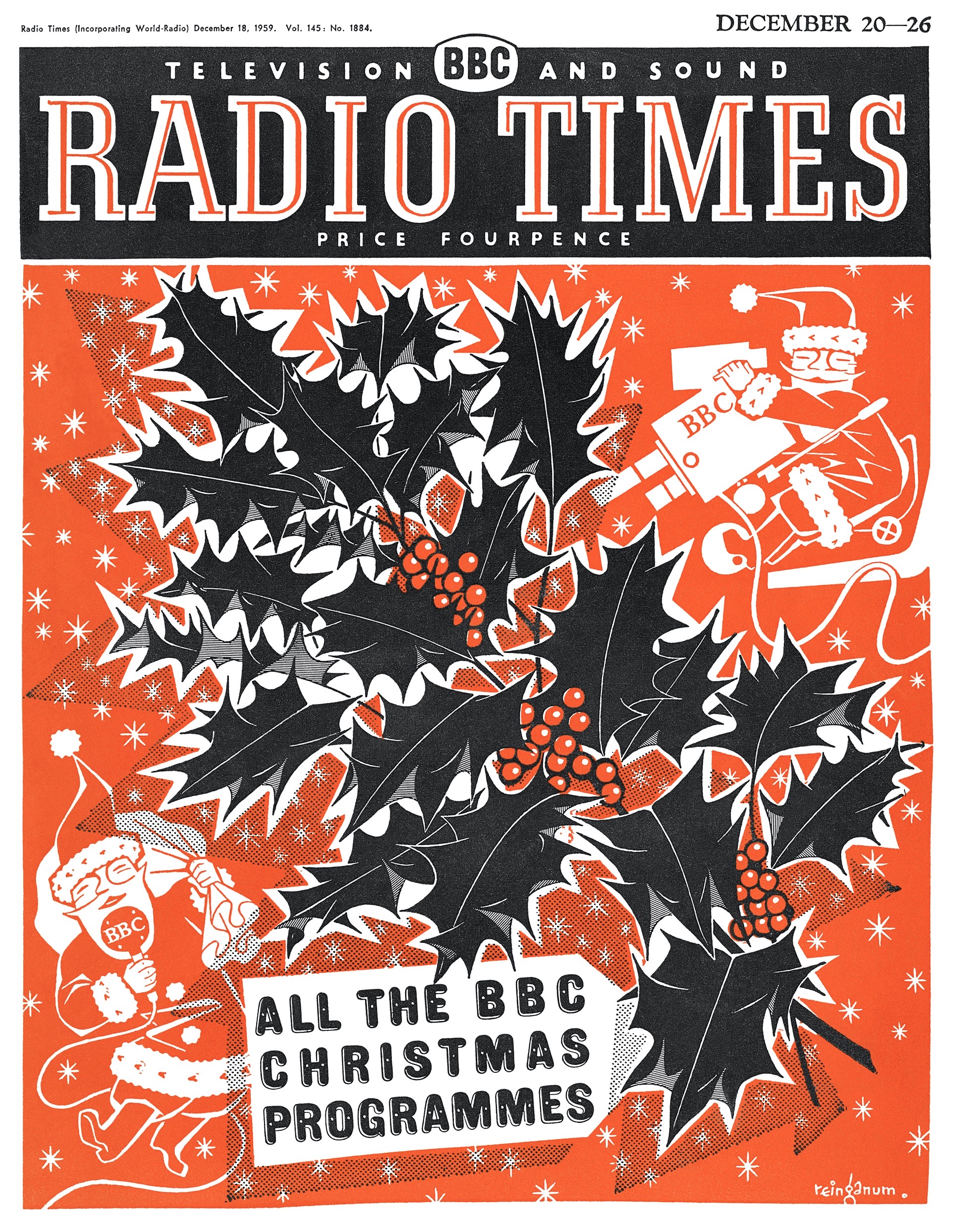
Remember those days in the Twentieth Century when the arrival of the Christmas Issue (later 'Bumper Issue') of Radio Times signaled the true beginning of seasonal festivities?
Historically, Radio Times was always a showcase for the work of some of the finest graphic and illustrative artists of the age and examples of their work is showcased in this very personal selection of classic covers from before-my-time, but by artists whose work I love – John Gilroy (he of the classic Guinness posters), Rex Whistler, Edward Ardizzone and Eric Fraser; from my childhood and adolescent years – C. Walter Hodges, J. S. Goodall, Ronald Searle, Rowland Hilder, Victor Reinganum and, again of course, Eric Fraser; and, lastly, from more recent years – the impeccable art of Tony Meeuwissen and a wonderful cavalcade of Santas and Snowmen by my friend, Mick Brownfield.
Among the later are his Father Christmas and Dalek cover and the alternative variant Strictly Come Dancing version for families with tiny tots who were scared of Doctor Who's inter-galactic, mechanical nemesis!


Eric Fraser, 1958


However pagan its origins, I have never lost (and I hope I shall never lose) my affection for the Christmas Tree: real or artificial it seems to me to be an enduring symbol of enduring life in midst of the bleak death of winter-tide.

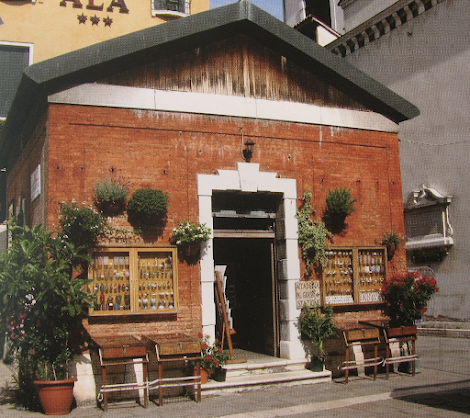
Until 2019, our Christmases were for many years celebrated in Venice where our Christmas tree was this small glass tree (hung with Father-Christmas-decorations) made by the skilled craftsman of F.G.B. di Bubacco Giorgio, a little shop occupying the bottom part of a former campanile in Campo Santa Maria del Giglio, just in front of our Venetian home-from-home, Hotel Ala.
This year our little Santa-tree sits the alongside a Klimt Friendship Tree, made on the Venetian island of Murano, that was the last Christmas gift from a very dear Venetian friend who passed away a few months ago.

Knowing that Covid was going to keep us from our much-loved La Serenissima this December, we invested in a new artificial tree which decked out in baubles and other dangling odds and ends looks like this...
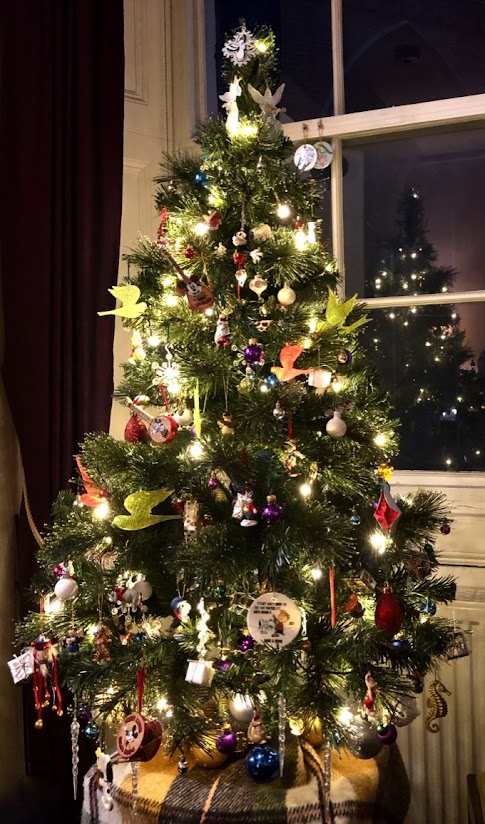
I am especially fond of a set of plastic birds that are now approaching 70-years-old and have been part of Sibley Christmases since I was a very small child. I think they came from F W Woolworth Company, now long-gone but once a popular fixture on pretty much every British high street.
I dare say, at the time, these birds cost no more than a few pence each, but as they 'fly' around the tree, catching the lights, they bring back so many memories of Christmases long gone: some happy, some sad; some wonderfully celebratory and others, truthfully, better forgotten and laid to rest...


Every family Christmas tree is, I suppose, a totemic symbol: memorializing in the present, events from the past and carrying them softly, happily – occasionally regretfully, but always hopefully – towards the next new year; the next, as yet unwritten, pages of our future...
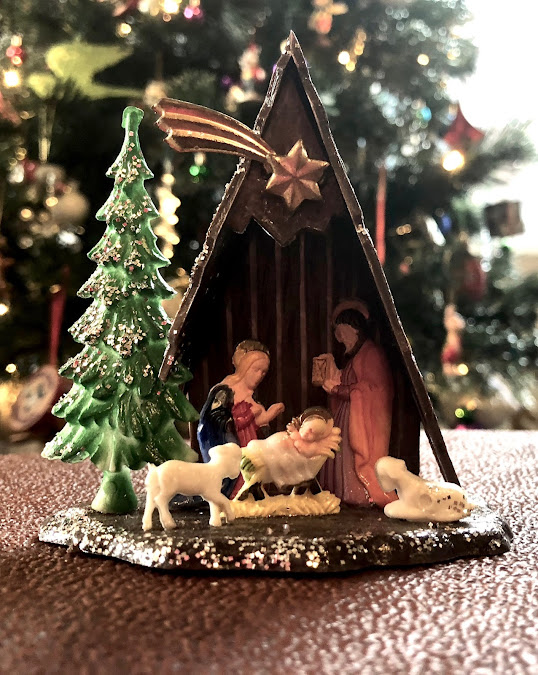
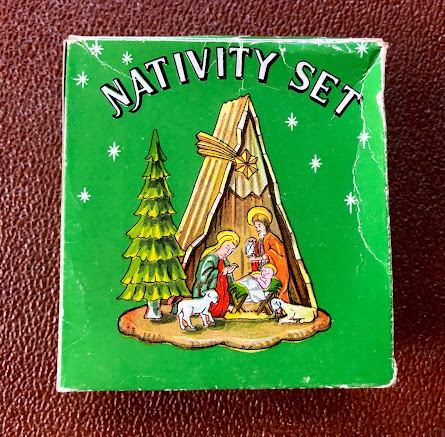
Dating from circa 1954, when I was about five years old, this was my first-ever concept of the Nativity.
It was – and still is – a cheap, naively designed, gaudily and crudely painted, and indiscriminately glitter-splattered plastic product of the type of Christmas decorations that were, at the time, ubiquitously 'Made in Hong Kong'.
However, to my young eyes, it seemed – and, oddly, still seems – a simply conceived and roughly presented icon that represents the uncomplicated, yet infinitely mysterious truth at the heart of the Christmas story.
There is the Stable, the Star, Mary, Joseph, the Baby and, for good measure, a newborn lamb or two.
And the tree? Well, possibly (though certainly beyond the imagination of my five-year-old self) a symbol, in its livid greenness, of life and growth; or, perhaps, a nod to the Old Gods of the Greenwood or to the Christmas tree of our modern Western era (the forest wildness tamed and brought into our homes to die as sacrifice to the season); or, again, if not too uncomfortable a concept, an evergreen foreshadowing of the harsh-grained Wood of the Cross...?
The knocker caught [Scrooge's] eye.
"I shall love it as long as I live!" cried Scrooge, patting it with his hand. "I scarcely ever looked at it before. What an honest expression it has in its face! It's a wonderful knocker!"

Before Charles Dickens wrote his much-adored masterpiece, A Christmas Carol in Prose: Being a Ghost Story of Christmas (1843), he had composed 'A Christmas Carol' in verse and included it The Posthumous Papers of the Pickwick Club, otherwise known as The Pickwick Papers (1836).
In Chapter XXVII of that book – titled 'A good-humored chapter' – the Pickwickians visit Dingley Dell and spend the Christmas holiday with Mr Wardle and his family. During the ensuing jovialities, their host – "a merry old gentleman" – sings 'A Christmas Carol' in praise of the season in, the author reports, a good, round, sturdy voice".
In 1890, many years after Dickens had written those verses and had gone on to use the phrase 'A Christmas Carol' as a title for his story about the reformation of the miser, Ebenezer Scrooge, publishers Marcus Ward & Co. Ltd., extracted Mr Wardle's song from its context within the setting of the Dingley Dell celebrations and issued it as a slim book in its own right, with illustrations by the Irish painter, Frank Bindley.
Here it is: one Dickens' rare poems, but significant in that it was written in celebration of that time of the year of which the author was such a passionate advocate...


