Showing posts with label poetry. Show all posts

Saturday, 30 November 2024

"O, CLOUDS UNFOLD!"


This glorious, image-laden stained glass window commemorating William Blake – artist, engraver, printer and poet – is found in St. Mary's Church, Battersea Church Road, Wandsworth, London. 
 
The work of John Hayward of Edenbridge, Kent, this is one of four windows installed in  St. Mary's between 1976 and 1982, each representing a famous person associated with the church. The other subjects are landscape painter, J. M. W. Turner; General Benedict Arnold of the American Revolutionary War; and the celebrated Eighteenth-Century botanist, William Curtis.
 
William Blake was married to Catherine Boucher in the church in 1782. Many will be surprised to learn that the wife of one of our greatest poets was illiterate, and could only make her mark with a cross in the wedding register. The wedding is suggested by a wedding ring between two pencil portraits; on the left is William drawn by Catherine and, on the right, Catherine as drawn by William. 
 
The design of the rest of the window attempts to give expression to the diversity of Blake’s talents as an artist and poet. Among his more insistent themes are those concerned with how we perceive both the greatest and the smallest elements in our world and the idea that all things contain a male and female principle.
 
The verse on the lower right-hand side of the window is the opening four lines of Blake’s poem, ‘Auguries of Innocence’, assumed to have been written in 1803, but not published until 1863:
 
To see a World in a Grain of Sand
And a Heaven in a Wild Flower
Hold Infinity in the palm of your hand
And Eternity in an hour
 
The figure in the roundel is from Blake’s illustration ‘Albion Rose’, etchings of which carried the artist’s inscription: ‘Albion rose from where he labourd at the Mill with Slaves / Giving himself for the Nations he danc'd the dance of Eternal Death’. The figure of Albion, is a personification of humanity and of Britain and is depicted freeing himself from the shackles of materialism.
 
At the bottom right is a picture of the Houses of Parliament to mark the connection with the late William Hamling, MP, in whose memory the window was given.
 
 
[Photo: Brian Sibley, May 2011]

Friday, 1 November 2024

NOVEMBER


No sun – no moon!
No morn 
– no noon –
No dawn 
– no dusk – no proper time of day –
No sky – no earthly view –
No distance looking blue 
–
No road 
– no street – no 't'other side the way' –
No end to any Row 
–
No indications where the Crescents go
–
No top to any steeple –
No recognitions of familiar people –
No courtesies for showing 'em 
–
No knowing 'em
–
No travelling at all – no locomotion,
No inkling of the way 
– no notion –
'No go' 
– by land or ocean –
No mail
– no post –
No news from any foreign coast
–
No Park – no Ring – no afternoon gentility –
No company 
– no nobility –
No warmth, no cheerfulness, no healthful ease,
No comfortable feel in any member
–
No shade, no shine, no butterflies, no bees,
No fruits, no flo
wers, no leaves, no birds,–
November! 

Thomas Hood (1799-1845)

Monday, 25 December 2023

PEACE ON EARTH GOOWILL TO MEN


CHRISTMAS BELLS


I heard the bells on Christmas Day

Their old, familiar carols play,

And wild and sweet

The words repeat

Of peace on earth, good-will to men!


And thought how, as the day had come,

The belfries of all Christendom

Had rolled along

The unbroken song

Of peace on earth, good-will to men!


Till ringing, singing on its way,

The world revolved from night to day,

A voice, a chime,

A chant sublime

Of peace on earth, good-will to men!


Then from each black, accursed mouth

The cannon thundered in the South,

And with the sound

The carols drowned

Of peace on earth, good-will to men!


It was as if an earthquake rent

The hearth-stones of a continent,

And made forlorn

The households born

Of peace on earth, good-will to men!


And in despair I bowed my head;

"There is no peace on earth," I said;

"For hate is strong,

And mocks the song

Of peace on earth, good-will to men!"


Then pealed the bells more loud and deep:

"God is not dead, nor doth He sleep;

The Wrong shall fail,

The Right prevail,

With peace on earth, good-will to men."


– Henry Wadsworth Longfellow (1807-1882)


'Christmas Bells' was written on December 25th, 1864 (some sources place its composition a year earlier) as a reflection on the American Civil War of 1861-1865.
 
[Artist: Anton Pieck (1895–1987)]

Wednesday, 1 November 2023

NO MATTER


I first read this verse by the nineteenth-century poet Thomas Hood when I was, maybe, 10 or 11, and although I probably didn't completely understand the meaning of all the lines, I still remember the absolute, pure delight that was awaiting me in last one...

NO!

No sun—no moon!
No morn—no noon—
No dawn—
No sky—no earthly view—
No distance looking blue—
No road—no street—no "t'other side the way"—
No end to any Row—
No indications where the Crescents go—
No top to any steeple—
No recognitions of familiar people—
No courtesies for showing 'em—
No knowing 'em!
No traveling at all—no locomotion,
No inkling of the way—no notion—
"No go"—by land or ocean—
No mail—no post—
No news from any foreign coast—
No park—no ring—no afternoon gentility—
No company—no nobility—
No warmth, no cheerfulness, no healthful ease,
No comfortable feel in any member—
No shade, no shine, no butterflies, no bees,
No fruits, no flowers, no leaves, no birds,
November!

– Thomas Hood (1799-1845)

Today, the poem is often presented in a considerably edited-down form and is invariable given the title 'November', which pretty much demolishes the punchline!

[Photo: Brian Sibley]

Sunday, 23 October 2022

A THOUGHT FOR OUR TIMES...


On the eve of the first ballot to elect the third leader of the Conservative Party (and, by default, Prime Minister) in just over three months, I offer you a remarkable and decidedly uncomfortable poem by Rudyard Kipling.


Published in the London newspaper, Sunday Pictorial, 103 years ago – almost to the very day – on October 26th, 1919, it contained the following startling, but strangely apposite, lines:


"...the Dog returns to his Vomit and the Sow returns to her Mire,
And the burnt Fool's bandaged finger goes wabbling back to the Fire..."


Maybe we should remember that prediction as the coming week unfolds...


***


Kipling titled his poem ‘The Gods of the Copybook Headings’, referencing a the type of moral and improving catch-phrases – old saws, proverbs and quotations from The Bible (such as the ones in the lines above) and Shakespeare – that were often printed across the top of pages in British schoolchildren’s copybooks in the 19th century, and which students were required to copy-out repeatedly in order to improve their handwriting and to instill the received 'wisdom' of those maxims.


Here, in full, is Kipling’s bitter, invective-laden warning…


The Gods of the Copybook Headings


As I pass through my incarnations in every age and race,

I make my proper prostrations to the Gods of the Market-Place.

Peering through reverent fingers I watch them flourish and fall,

And the Gods of the Copybook Headings, I notice, outlast them all.


We were living in trees when they met us. They showed us each in turn

That Water would certainly wet us, as Fire would certainly burn:

But we found them lacking in Uplift, Vision and Breadth of Mind,

So we left them to teach the Gorillas while we followed the March of Mankind.


We moved as the Spirit listed. They never altered their pace,

Being neither cloud nor wind-borne like the Gods of the Market Place,

But they always caught up with our progress, and presently word would come

That a tribe had been wiped off its icefield, or the lights had gone out in Rome.


With the Hopes that our World is built on they were utterly out of touch.

They denied that the Moon was Stilton; they denied she was even Dutch.

They denied that Wishes were Horses; they denied that a Pig had Wings.

So we worshipped the Gods of the Market Who promised these beautiful things.


When the Cambrian measures were forming, They promised perpetual peace.

They swore, if we gave them our weapons, that the wars of the tribes would cease.

But when we disarmed They sold us and delivered us bound to our foe,

And the Gods of the Copybook Headings said: "Stick to the Devil you know."


On the first Feminian Sandstones we were promised the Fuller Life

(Which started by loving our neighbour and ended by loving his wife)

Till our women had no more children and the men lost reason and faith,

And the Gods of the Copybook Headings said: "The Wages of Sin is Death."


In the Carboniferous Epoch we were promised abundance for all,

By robbing selected Peter to pay for collective Paul;

But, though we had plenty of money, there was nothing our money could buy,

And the Gods of the Copybook Headings said: "If you don't work you die."


Then the Gods of the Market tumbled, and their smooth-tongued wizards withdrew,

And the hearts of the meanest were humbled and began to believe it was true

That All is not Gold that Glitters, and Two and Two make Four—

And the Gods of the Copybook Headings limped up to explain it once more.


As it will be in the future, it was at the birth of Man—

There are only four things certain since Social Progress began:—

That the Dog returns to his Vomit and the Sow returns to her Mire,

And the burnt Fool's bandaged finger goes wabbling back to the Fire;


And that after this is accomplished, and the brave new world begins

When all men are paid for existing and no man must pay for his sins,

As surely as Water will wet us, as surely as Fire will burn,

The Gods of the Copybook Headings with terror and slaughter return!


***

Readers interested in the origin of Kipling’s sources for the ‘copybook headings’ (sometimes here – as elsewhere – popularly misquoted) and an analysis and appreciation of the poem, should visit this informative page on the website of The Kipling Society.

Thursday, 24 December 2020

DICKENS 'OTHER' CHRISTMAS CAROL


Before Charles Dickens wrote his much-adored masterpiece, A Christmas Carol in Prose: Being a Ghost Story of Christmas (1843), he had composed 'A Christmas Carol' in verse and included it The Posthumous Papers of the Pickwick Club, otherwise known as The Pickwick Papers (1836).

In Chapter XXVII of that book – titled 'A good-humored chapter' – the Pickwickians visit Dingley Dell and spend the Christmas holiday with Mr Wardle and his family. During the ensuing jovialities, their host – "a  merry old gentleman" – sings 'A Christmas Carol' in praise of the season in, the author reports, a good, round, sturdy voice".

In 1890, many years after Dickens had written those verses and had gone on to use the phrase 'A Christmas Carol' as a title for his story about the reformation of the miser, Ebenezer Scrooge, publishers Marcus Ward & Co. Ltd., extracted Mr Wardle's song from its context within the setting of the Dingley Dell celebrations and issued it as a slim book in its own right, with illustrations by the Irish painter, Frank Bindley.

Here it is: one Dickens' rare poems, but significant in that it was written in celebration of that time of the year of which the author was such a passionate advocate...


Monday, 2 October 2017

THE FULLNESS OF TIME


The poem below is by James Stephens (1880-1950), the Irish poet and author of The Crock of Gold, and comes from his 1912 volume of verse, The Hill of Vision.

I heard it for the first time yesterday, when it was sung to the tune of the Welsh folk-song, 'Tros y Garreg' (well, 'Irish' and 'Welsh', they're both Celtic!) at the Mass for The Feast of Michael, Gabriel, Raphael and All Angels at St John the Divine, Kennington.

Twenty-four hours later, this profoundly mystical proposition is still rattling around in my mind...

The Fullness of Time
On a rusty iron throne
Past the furthest star of space
I saw Satan sit alone,
Old and haggard was his face;
For his work was done and he
Rested in eternity.

And to him from out the sun
Came his father and his friend
Saying, now the work is done
Enmity is at an end:
And he guided Satan to
Paradises that he knew.

Gabriel without a frown,
Uriel without a spear,
Raphael came singing down
Welcoming their ancient peer,
And they seated him beside
One who had been crucified.


[Illustration: Gustave Doré for John Milton's Paradise Lost, c. 1866]

Saturday, 14 February 2015

TRUE LOVE

For this special day: some verses from one of my favourite humorous poets, Ogden Nash.

Written during WWII (hence the reference to the Axis in the first verse) it appeared in book form for the first time in Good Intentions, 1942.

Why not share its simple message with your own loved one...?

To My Valentine
More than a catbird hates a cat,
Or a criminal hates a clue,
Or the Axis hates the United States,
That's how much I love you.

I love you more than a duck can swim,
And more than a grapefruit squirts,
I love you more than a gin rummy is a bore,
And more than a toothache hurts.

As a shipwrecked sailor hates the sea,
Or a juggler hates a shove,
As a hostess detests unexpected guests,
That's how much you I love.

I love you more than a wasp can sting,
And more than the subway jerks,
I love you as much as a beggar needs a crutch,
And more than a hangnail irks.

I swear to you by the stars above,
And below, if such there be,
As the High Court loathes perjurious oaths,
That's how you're loved by me.


Sunday, 21 December 2014

ALMOST THERE...

Today is the fourth Sunday in Advent...

And this poem is by the Welsh poet, R S Thomas...

The Coming

And God held in his hand
A small globe.  Look he said.
The son looked.  Far off,
As through water, he saw
A scorched land of fierce
Colour.  The light burned
There; crusted buildings
Cast their shadows: a bright
Serpent, A river
Uncoiled itself, radiant
With slime.
                On a bare
Hill a bare tree saddened
The sky.  Many people
Held out their thin arms
To it, as though waiting
For a vanished April
To return to its crossed
Boughs.  The son watched
Them.  Let me go there, he said.


Sunday, 7 April 2013

TRAVELLER'S TALES

Funny how things come back from the long past to haunt – or enliven – your present...

My good friend, composer David Hewson (who scored a number of my shows and radio plays) has put on line an avant garde composition, Not Wanted on Voyage, that he wrote in collaboration with one of Britain's woefully overlooked modern composers – Richard ('Tony') Arnell.

Richard also plays the piano in the piece (recorded in 1990) and provides additional voices, while the poem itself is read – by me!

If you're game for ten minutes of unusual listening, join us on deck...

Tuesday, 5 February 2013

PICK OF THE PIX: POP POET

Here's another favourite photo from my flicker photostream...

Today, Martin Jenning's wonderful statue of Sir John Betjeman on London's St Pancras Station, the masterpiece of Victorian architecture which the former Poet Laureate helped save from dereliction...


Inscribed around the base of the statue are words from Betjeman's poem 'Cornish Cliffs':

And in the shadowless unclouded glare
Deep blue above us fades to whiteness where
A misty sea-line meets the wash of air.


Wednesday, 21 March 2012

A POEM FOR TODAY

It's United Nation's World Poetry Day, so here is one of my favourite poems written by that under-rated rhymester, Rudyard Kipling.

Published in 1919, 'The Gods of the Copybook Headings' foresaw the decline of the British Empire but – surprisingly (or perhaps not!) –the irritation and anger infusing Kipling's verse still has extraordinary resonance, ninety-three years on.

'The Copybook Headings' of the title were moral and improving maxims printed at the top of the pages of British students' school exercise books, called 'copybooks' and which the children had to copy out by hand.


The Gods of the Copybook Headings

AS I PASS through my incarnations in every age and race,
I make my proper prostrations to the Gods of the Market Place.
Peering through reverent fingers I watch them flourish and fall,
And the Gods of the Copybook Headings, I notice, outlast them all.

We were living in trees when they met us. They showed us each in turn
That Water would certainly wet us, as Fire would certainly burn:
But we found them lacking in Uplift, Vision and Breadth of Mind,
So we left them to teach the Gorillas while we followed the March of Mankind.

We moved as the Spirit listed. They never altered their pace,
Being neither cloud nor wind-borne like the Gods of the Market Place,
But they always caught up with our progress, and presently word would come
That a tribe had been wiped off its icefield, or the lights had gone out in Rome.

With the Hopes that our World is built on they were utterly out of touch,
They denied that the Moon was Stilton; they denied she was even Dutch;
They denied that Wishes were Horses; they denied that a Pig had Wings;
So we worshipped the Gods of the Market Who promised these beautiful things.

When the Cambrian measures were forming, They promised perpetual peace.
They swore, if we gave them our weapons, that the wars of the tribes would cease.
But when we disarmed They sold us and delivered us bound to our foe,
And the Gods of the Copybook Headings said: "Stick to the Devil you know."

On the first Feminian Sandstones we were promised the Fuller Life
(Which started by loving our neighbour and ended by loving his wife)
Till our women had no more children and the men lost reason and faith,
And the Gods of the Copybook Headings said: "The Wages of Sin is Death."

In the Carboniferous Epoch we were promised abundance for all,
By robbing selected Peter to pay for collective Paul;
But, though we had plenty of money, there was nothing our money could buy,
And the Gods of the Copybook Headings said: "If you don't work you die."

Then the Gods of the Market tumbled, and their smooth-tongued wizards withdrew
And the hearts of the meanest were humbled and began to believe it was true
That All is not Gold that Glitters, and Two and Two make Four
And the Gods of the Copybook Headings limped up to explain it once more.

As it will be in the future, it was at the birth of Man
There are only four things certain since Social Progress began.
That the Dog returns to his Vomit and the Sow returns to her Mire,
And the burnt Fool's bandaged finger goes wabbling back to the Fire;

And that after this is accomplished, and the brave new world begins
When all men are paid for existing and no man must pay for his sins,
As surely as Water will wet us, as surely as Fire will burn,
The Gods of the Copybook Headings with terror and slaughter return!

- Rudyard Kipling

Friday, 27 January 2012

BIRTHDAY FANCIES

Today is the 180th anniversary of the birth of Lewis Carroll on 27 January 1832.

To mark the occasion, here is one of his less-well-known nonsense poems with another of those rediscovered drawings made by my much-younger self...

MY FANCY

I painted her a gushing thing,
With years about a score;
I little thought to find they were
A least a dozen more;
My fancy gave her eyes of blue,
A curly auburn head:
I came to find the blue a green,
The auburn turned to red.

She boxed my ears this morning,
They tingled very much;
I own that I could wish her
A somewhat lighter touch;
And if you ask me how
Her charms might be improved,
I would not have them added to,
But just a few removed!


She has the bear's ethereal grace,
The bland hyaena's laugh,
The footstep of the elephant,
The neck of a giraffe;
I love her still, believe me,
Though my heart its passion hides;
"She's all my fancy painted her,"
But oh! how much besides!

Like so many of Lewis Carroll's verses, this is a parody of a popular poem of its day, now pretty much forgotten. The parodied poem here was 'Alice Gray' by William Mee:

She's all my fancy painted her,
She's lovely, she's divine,
But her heart it is another's,
She never can be mine;
Yet lov'd I as man never lov'd,
A love without decay,
Oh! my heart, my heart is breaking
For the love of Alice Gray!

Her dark brown hair is braided
O'er a brow of spotless white;
Her soft blue eye now languishes,
Now flashes with delight;
Her hair is braided not for me,
The eye is turned away;
Yet my heart, my heart is breaking
For the love of Alice Gray.

I've sunk beneath the summer's sun,
And trembled in the blast;
But my pilgrimage is nearly done,
The weary conflict's past;
And when the green sod wraps my grave,
Oh, his heart, his heart is broken
For the love of Alice Gray.

Sunday, 25 December 2011

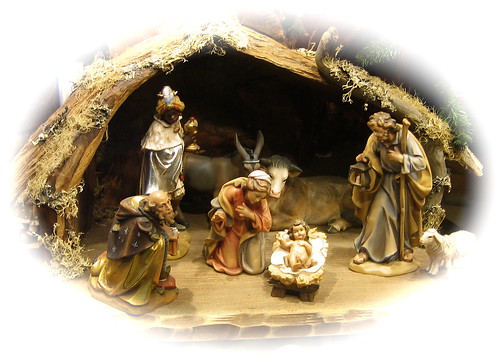
ADESTE FIDELIS

Greetings, Love and Blessings
at
C H R I S T M A S T I D E

Away in a Manger

Immensity cloistered in thy dear womb,
Now leaves His well-belov'd imprisonment,
There He hath made Himself to His intent
Weak enough, now into the world to come;
But O, for thee, for Him, hath the inn no room?
Yet lay Him in this stall, and from the Orient,
Stars and wise men will travel to prevent
The effect of Herod's jealous general doom.
Seest thou, my soul, with thy faith's eyes, how He
Which fills all place, yet none holds Him, doth lie?
Was not His pity towards thee wondrous high,
That would have need to be pitied by thee?
Kiss Him, and with Him into Egypt go,
With His kind mother, who partakes thy woe.

Nativity, A Christmas Poem - John Donne


"God Bless Us, Everyone!"


Images: Christmas Crib in Venice by Brian Sibley; Brian & David by Nghiem Ta

Tuesday, 8 November 2011

LINES AND SQUARES

On a nearby building-site – in an attempt to make the place look more attractive than building-sites usually look – colourful hoardings were erected and were specially graffitied with helpful suggestions on how to brighten up our otherwise hum-drum Kennington lives.

For example, why not...


Or, again, you could...


But, whatever we do, we were reminded, we absolutely MUST remember...


I wonder exactly when it was decided that one ought NOT to walk on the lines on the street?

Certainly if it wasn't down to A A Milne, he (with his penchant for bears) at least made it something of which every reader of When We Were Very Young became acutely aware through this little verse...


Whenever I walk in a London street,
I'm ever so careful to watch my feet;
And I keep in the squares,
And the masses of bears,
Who wait at the corners all ready to eat
The sillies who tread on the lines of the street,
Go back to their lairs,
And I say to them, "Bears,
just look how I'm walking in all the squares!"

And the little bears growl to each other, "He's mine,
As soon as he's silly and steps on a line."
And some of the bigger bears try to pretend
That they came round the corner to look for a friend;
And they try to pretend that nobody cares
Whether you walk on the lines or squares.
But only the sillies believe the talk;
It's ever so portant how you walk.
And it's ever so jolly to call out, "Bears,
just watch me walking in all the squares!"


A few hours after posting innocent piece of flummery above, I was driven by my insatiable curiosity (and readers of Kipling will recall where insatiable curiosity inevitably leads) to start trawling the net in search of a pre-Milnean origin for Linesofthestreetphobia!

The result was both illuminating and shocking according to CSI the website of the magazine Skeptical Enquiry.

Here (in their uncensored words) is the alleged origin of Christopher Robin's innocent bear-avoidance game:
Ill-fortune is said to be the result from stepping on a crack in the pavement. Present day society usually associates the superstition behind treading on cracks to the rhyme: "Step on a crack, break your mother's back" but the superstition actually goes back to the late 19th - early 20th Century and the racism that was prevalent in this period.

The original rhyming verse is thought to be "Step on a crack and your mother will turn black." It was also common to think that walking on the lines in pavement would mean you would marry a negro and have a black baby. (Apparently this superstition only applied to Caucasians and because of the rampant prejudice against black people, was considered an activity to avoid.)

Stepping on cracks also had significance for children. In the mid-20th Century it was popular to tell children that if they stepped on the cracks in the street, they would be eaten by the bears that congregate on street corners waiting for their lunch to walk by. [Appallingly, no credit given to Mr Milne here! Ed]

Also, the number of lines a person would walk on corresponded with the number of china dishes that the person would break, later in the day.

Only in the last few decades has the rhyming superstition resurfaced to be the recognized "step on a crack, break your mother's back" and in some areas, two superstitions above are melded together to include the number of lines one steps on will correspond with the number of your mother's bones that are broken.


Original illustrations to When We Were Very Young (1924) by Ernest H Shepard