Showing posts with label Venice. Show all posts

Sunday, 15 October 2023

MAPPING MY EARLY LIFE


I love maps! By which I mean that I am passionate about them – whether they depict real places or the let's-pretend realms of the imagination.
 

There cannot be anywhere better to write about the maps in my life than where I am now: Venice – or to be absolutely precise in case you want to locate it on a map: 2316 Calle del Pestrin, San Marco, 30124, Venice. You see Venice is both the most intricately and incompetently mapped city in the world.


When my husband, David, and I arrived here first, almost thirty years ago, we came clutching The Illustrated Venice Map by Magnetic North: chosen from Stanfords’ incomparable emporium, ‘Est. 1853’, at a time when it was the largest, and indeed only, map maker and seller in London and is still, today, the best starting point for the ardent traveller. I suspect that I selected this particular map of Venice (there were, at least, a dozen others) because it had little pictorial indicators of likely destinations: the Piazza San Marco – la Piazza (‘the Square’) – the Rialto Bridge, Santa Maria della Salute and Teatro La Fenice.


It was an Italian sitting next to us on the plane, helpfully advising us how best to reach our hotel with minimal chance of getting lost, who expressed, with surprise, his approval of our map, noting as we would soon discover that, unlike most tourist maps, it shows every calle, campo, ponte and fondamenta, mapping the city down to the shortest, narrowest of blind alleyways. However, it is much more than just that: it is also a map of a state of mind, a glorious figment of historical imagination. It has served us well, its folds worn to yawning slits that defy refolding; and, though rarely now referred to, we carry it still out of sentimentality.


The very first map of which I was aware – long before I understood that places, real or fictional, were capable of beingmapped – was of what I fancy must have been some piratical treasure island. It resided within the red (possibly) covers of a large gift book of tales, verses and puzzles selected to delight the younger reader. As I have it no longer (and, despite years of searching, have never found another) my recollections are imprecise: to my three-year-old self it seemed huge – of the proportions of a lectern Bible – and I hauled it around, insisting that any indulgent adult read to me from its pages.


My favourite story was that of Alice’s expedition into Wonderland that was serialised through the volume, chapter by chapter. But there was another story – pictorially told – of some adventurous, perhaps even swashbuckling, kind that featured a double-page spread, printed, my hazy memory thinks, in black and red and showing a map of an island. I believe I can almost make out its contours: its wavy coastline of coves and creeks; its chief attractions being mountains, forests and lagoons and, maybe, a spot significantly marked with an 'X'. I think of this map, existing now only in faulty memory and having never been seen again, as being mine alone. The next map to which I laid personal claim was, some might say, not a map at all – although I must beg to differ.


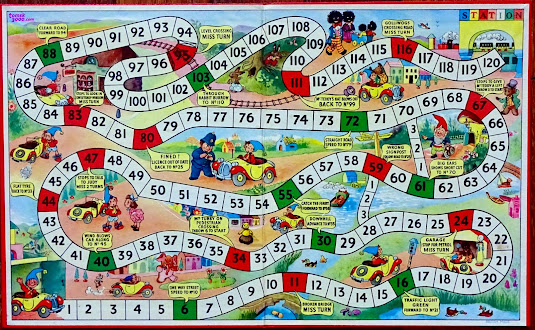
It came folded in half in a box together with a die and four bright plastic cars – green, blue, yellow and red. It was Christmas 1953, I was now four years old, and the radiantly yellow box-lid announced itself as containing ‘Enid Blyton’s LITTLE NODDY CAR GAME. Get to the Station with NODDY and his friends’.  


 CLICK IMAGE to ENLARGE


A snake of numbered squares crawled back and forth across the gaming board – or, as I knew it to be, a map of the route from Noddy’s house (square 1) to the Station (square 120) through a nursery-coloured landscape dotted with toy houses, roads and rivers, bridges, ferries, traffic lights and level crossings.
 

CLICK IMAGE to ENLARGE


Making a journey as Noddy was – like all the great literary journeyings from The Odyssey to The Pilgrim’s Progress to Moby Dick – punctuated with all manner of random incidents leading to advances or retreats, dictated here by the roll of a die: ‘Big Ears shows short cut to No. 70’ or (this was in the politically incorrect ‘50s) ‘Golliwogs crossing road, miss turn’. Some fifty years after my mother had given my Noddy map-game to an undeserving cousin, I bought another in an antique centre and was comforted to find that my childhood memories were still intact, from landing on square 30 (‘Downhill advance to No. 35’) to getting stopped by Mr Plod the Policemen on square 80 (‘Fined! Licence out of date, back to No. 25’).


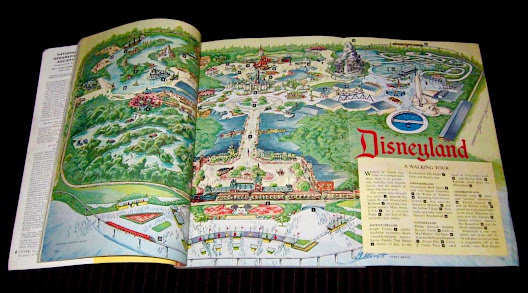
I now jump ten years, to August 1963 when the 14-year old me, now gripped in a passionate obsession with the life and films of Walt Disney, picks up a copy of National Geographic with a lead article (a satisfyingly staggering 50-pages long!) devoted to ‘The Magic Worlds of Walt Disney’ and find that it contains – to my breathless delight – a three-page, foldout pictorial map of Disneyland: a place, like Venice, that is both a reality and a fantasy 


 CLICK IMAGE to ENLARGE


Specially drawn by ‘J E Barrett, Staff Artist’, this is Disneyland before the coming of Pirates of the Caribbean (let alone the unlooked for arrival of Indiana Jones and Star Wars), when pack mules and mine trains still explored Nature’s Wonderland and when it was still possible to ride the Flying Saucers of Tomorrowland.


CLICK IMAGE to ENLARGE


Truthfully, I cannot recall the countless hours in which I pored over that map, drawn back again and again by the pseudo-gothic lettering of ‘Disneyland’ and studying its detail until (had it been possible for me to go to Disneyland) I could have found my way blindfold and without missing a step from the hippo-infested waters of the Jungle Cruise via the blue-roofed towers and turrets of Sleeping Beauty Castle to the helter-skeltering Matterhorn bobsleds.


And when, after an interval of over twenty years, I finally passed through the turnstiles to ‘The Happiest Place On Earth’, I found myself walking, as if in a dream, through those foldout pages of National Geographic: the map and the place metamorphosing into a present experience.


These then were my three ‘personally owned’ maps. My life since has, of course, been crowded with a great many maps with which I have been deeply in love – and about which I have even written books – but which I always knew I shared with others: for example, the puzzling chessboard ‘map’ at the front of Through the Looking-glass; or Moomin Valley with its wolf-topped Lofty Mountains and that enticing off-shore island, home to the enigmatic Hattifatteners; or Bilbo’s Wilderland in The Hobbit with its crooked spine of the Misty Mountains marking the frontier beyond which lay the cobwebbed forest of Mirkwood and greater perils yet. 


Then there have been those cosily reassuring maps made by E H Shepard: of Winnie-the-Pooh’s ‘100 Aker Wood’ and its surroundings (including the best-ever map location: ‘Where the woozle wasn’t’); and the rural home of the inhabitants of The Wind in the Willows with a river–– No! Sorry, Ratty, The River! – curling its way from Toad Hall to Pan Island and the Weir beyond. Or Pauline Baynes’ ornate charts of Narnia and Middle-earth: as evocative as the work of any fifteenth-century cartographer and meticulously embellished with cartouches portraying the various sites in the stories – Cair Paravel or Minas Tirith – realised in gleaming gem-like colours. 


None of these, however, can ever truly supplant those earliest depictions of the ordered middle-class world of Noddy’s 1950s Toyland; or the ever-beckoning pleasures Disney’s Garden of Earthly Delights as it was in the early ‘60s; or, again, that long-lost, foggily-recalled mysterious island map that first lured an unsuspecting three-year-old into succumbing to the unappeasable dreams of Elsewheres and Othertimes.

[Written in Venice, December 2016; Revisited in London,2023]


Thursday, 23 December 2021

O, CHRISTMAS TREE


However pagan its origins, I have never lost (and I hope I shall never lose) my affection for the Christmas Tree: real or artificial it seems to me to be an enduring symbol of enduring life in midst of the bleak death of winter-tide. 


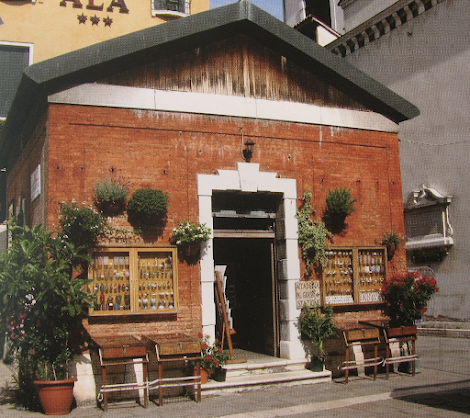
Until 2019, our Christmases were for many years celebrated in Venice where our Christmas tree was this small glass tree (hung with Father-Christmas-decorations) made by the skilled craftsman of F.G.B. di Bubacco Giorgio, a little shop occupying the bottom part of a former campanile in Campo Santa Maria del Giglio, just in front of our Venetian home-from-home, Hotel Ala.


This year our little Santa-tree sits the alongside a Klimt Friendship Tree, made on the Venetian island of Murano, that was the last Christmas gift from a very dear Venetian friend who passed away a few months ago.


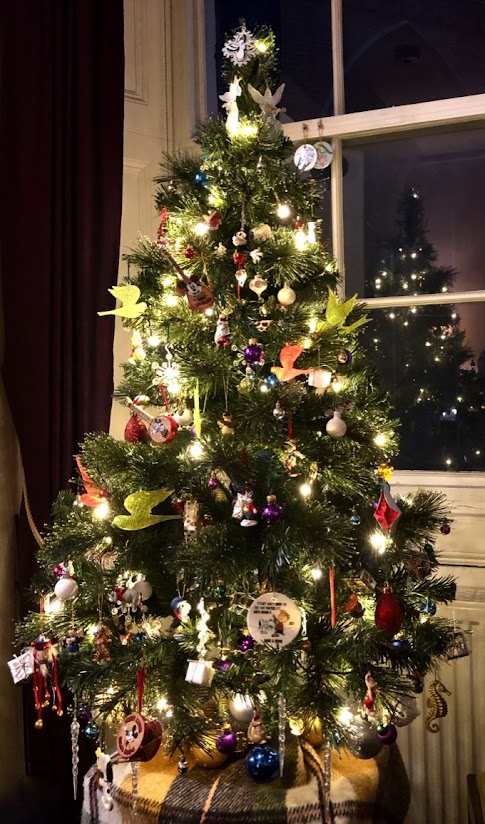
Knowing that Covid was going to keep us from our much-loved La Serenissima this December, we invested in a new artificial tree which decked out in baubles and other dangling odds and ends looks like this...


I am especially fond of a set of plastic birds that are now approaching 70-years-old and have been part of Sibley Christmases since I was a very small child. I think they came from F W Woolworth Company, now long-gone but once a popular fixture on pretty much every British high street. 

I dare say, at the time, these birds cost no more than a few pence each, but as they 'fly' around the tree, catching the lights, they bring back so many memories of Christmases long gone: some happy, some sad; some wonderfully celebratory and others, truthfully, better forgotten and laid to rest...


Every family Christmas tree is, I suppose, a totemic symbol: memorializing in the present, events from the past and carrying them softly, happily – occasionally regretfully, but always hopefully – towards the next new year; the next, as yet unwritten, pages of our future...


Tuesday, 3 December 2019

A CHRISTMAS TALE


Here's all about my new book, Joseph and the Three Gifts: An Angel’s Story...


It was, quite simply, a gift – a Christmas gift – given to me in Venice in the festival days of last December. I was in that ancient and beautiful city, long known by the grandiloquent title of La Serenissima, in order to celebrate Christmas and New Year and, between whiles, to work on a book about Venice.

This was not a commission and, like many professional writers, the book I wanted to write (but for which I did not yet have a publisher) kept being postponed in favour of writing for bread. There are, of course, more than enough books about Venice already and mine was – and remains – a potentially difficult project to sell since it is neither a guidebook nor a history, art or cookbook but, rather, a collection of essays about people, places, themes and ideas.

Anyway, I had, to my great pleasure, succeeded in writing one or two new pieces when another idea came my way, suddenly and unbidden, elbowing the Venice book aside and insistently demanding to be considered. It all began in one of the great churches of Venice, the Basilica di Santa Maria Gloriosa dei Frari (more simply known as The Frari), celebrated for housing the monumental tomb of Antonio Canova and Titian’s ecstatic ‘Assumption of the Virgin’.

Every Christmas, the Frari displays a large-scale Christmas diorama of a Bethlehem village jam-packed with houses, inns, shops, wells and watermills with a cast of automata people and animals. Lighting effects continually transform the scene from day to night and back again to an accompanying soundtrack of sacred music. Finding the Holy Family was, at first, a challenge among the vista of blacksmiths hammering at their forges, potters hunched over their wheels, bread-makers busy at their ovens, children fishing in the stream and housewives hanging out their washing.

Then I saw them: Mary gently rocking her newborn baby and, every few minutes, rising to her feet to hold out the Christ Child for the adoration of a couple of kneeling shepherds. Just behind her, stood Joseph; unlike the animated Mary, he was simply an immobile figure from a nativity set – in attendance, but absolutely not the focus of attention.

This triggered a recollection, from a few weeks earlier, of a visit to an exhibition devoted to the work of Edward Burne-Jones, where I had sat for some time contemplating his elaborate tapestry, The Adoration of the Magi. Once again, Joseph was there – in the picture – but over to one side, approaching the stable with a bunch of kindling and bowing his head in awe before the glorious brilliance of a mid-air angel and the dazzling splendour of the three distinguished visitors.


These two experiences fidgeted in my brain until, one still and sleepless Venetian night, they formed themselves into a series of questions: why doesn’t Joseph figure more prominently in the story in the nativity – always present, even singled out with a halo to indicate his holiness – but for ever a marginal figure, glimpsed on the side-lines, left in the shadow cast by the radiance and wonder of the Incarnation.

What sort of man was he, this Joseph? What was it in the character of this humble carpenter from Nazareth that led to his being chosen as foster-father to the Son of God? What was his reaction to the discovery that his fiancé was pregnant and how did he cope with the inevitable shame and embarrassment? And, having endured that dishonour, how did he handle the many mysterious events attending that Nativity with which we are all so universally familiar from the greatest masterpieces of art down to the cards, carols and cribs of our annual Christmastides?

What were Joseph’s feelings observing the inexplicable adoration of shepherds and Magi? And what did he make of those three curious, portentous gifts that the Wise Men from the East laid at the feet of his wife and child?

And, very specifically, whatever became of those gifts? Even as I wrote down these and the other questions that were teeming through my brain, I was surprised to find a series of answers – or, at least, possible answers – bubbling to the surface of my mind, provided by someone who was intimately involved with the events of the first Christmas and who witnessed the following thirty-something years that eventually led to the passion and glory of Easter –– the Archangel Gabriel. Once this unexpected Venetian Christmas gift had been given, all that was left to do was to listen to the angel and write the story down.

Joseph and The Three Gifts: An Angel’s Story with decorations by Henry Martin is published in hardback by Darton, Longman & Todd, priced £9.99 

And here's an interview with me in this week's edition of The Church Times...


Photo of Brian Sibley by David Weeks

Sunday, 6 January 2019

A WARNING TO INEBRIATES

One could celebrate in sculpture the great achievement of Noah in saving the human, animal and avian world from the Flood, but here in Venice – where flooding is an every day event! – the architect of the Palazzo Ducale curiously chose instead to immortalise his moment of human weakness with 'The Drunkenness of Noah'...


REFLECTIONS ON VENICE


Saturday, 5 January 2019

TINTORETTO – MASTERPIECES

The Palazzo Ducale here in Venice is celebrating the 500th anniversary of the birth of the master of Venetian painting, Tintoretto with a stunning array of his masterworks: paintings that impress by their freedom of brushwork, their relentlessly challenging compositions, their striking use of perspective and their depiction of powerfully muscular figures that reflect his huge admiration of Michelangelo.

In the painting 'Saint George, Saint Louis and the Princess' (1552), St George's broken lance, the slithy dragon and his Princess-rider seem almost to be forcing their way out of the canvas into the viewer's space...


This painting of 'The Presentation of Christ in the Temple' (c. 1554-1556) was painted to be viewed from the right-hand side, hence the position of this photograph. It was commissioned by the guild of coopers – hence the small barrel on the altar steps!


'The Deposition of Christ' (1562) seems to me one of the most extraordinarily poignant paintings of this post-Crucifixion scene in that here, unlike other artistic depictions (including Michelangelo's Pietà), Mary is not sorrowfully but serenely cradling her dead son, she is fainting away with the shock and horror of the moment...


These last two paintings – 'Saint Andrew and Saint Jerome' (1552) and 'The Forge of Vulcan' (1578) show the physical power and energy that Tintoretto was one of hallmarks of his brilliance and contributed in no small measure to his brilliantly successful career.


Photos: David Weeks

SLOGANISM

Venice's current slogan is interesting and, perhaps, a tad too negative; but it speaks of the deep woes of a great, historic and beautiful city that is totally dependent on tourism for its survival and yet, in fulfilling that role, is subjected to much visitor abuse and disrespect. It is Venice's great dilemma...


Photo: David Weeks © 2019


SAINTS & IMPOSTERS


Most people who photograph the statute of Venice's dragon-slaying St Theodore atop his column on the Molo, are unaware that he but a copy of the original which is housed in a somewhat lonely corner of the courtyard of the Palazzo Ducale: it is just a further indignity visited upon a luckless fellow who was good enough to serve as Venice's first patron saint until the ambitious Venetians snaffled the remains of St Mark and went for upgraded protection!


As for his quarry, it would be hard to find a feebler dragon than this sorry (and sorry for itself) specimen...


Photos: Brian Sibley © 2019

INTERLOPER IN PARADISE

Despite Tintoretto's skill in depicting people magnificently alive, he was really not so good with wildlife, as this 'Creation of the Animals' (1550-1553) reveals.

Most of the creatures (including household animals such as cats) are really poorly depicted; but I can forgive the artist his failings on account of the dynamic portrayal of the Creator and – more importantly – for including a unicorn in his vision of Eden!


TIDAL TIMES

After the exceptionally high tides that flooded Venice last November for a 24-hour period,  the city has recently been been experiencing less newsworthy low tides – so low, in fact, that they have left some gondolas in the Bacino Orseolo unappealingly mud-bound...


Photo: David Weeks © 2019

'G' IS FOR GONDOLA

Gondola photos are de rigueur –– or, rather, di rigore –– so here are a few photos of gondolas and gondoliers snapped during our visit to Venezia...


Photos: David Weeks & Brian Sibley © 2018/19