Showing posts with label puppets. Show all posts

Monday, 18 March 2024

"THAT'S THE WAY TO DO IT!"

There are days when I totally despair of the rank bonkerness with which our media is now infested!

A display currently on show at the V&A (Victoria and Albert Museum) 'mentions' (as a historical fact, please note) that the popular seaside entertainment, the Punch & Judy Show, has – over the years – opted to substitute the play's original 'Devil' puppet with one modelled on the features of hated public figures including Adolf Hitler, Margaret Thatcher and Osama bin Laden.

So?

Well, that story has now been re-presented as the V&A promulgating the monstrous proposition that Thatcher was as evil as Hitler and bin Laden and, as a result, that the museum ought to have its funding taken away and that those responsible for exhibition-label-writing should be flogged, naked, through the streets of London!

What utter whiffle and piffle! You can't possibly learn from history if you hide or deny it!

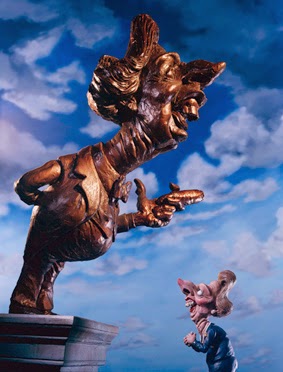
Anyway, here's Mrs Thatcher (or, rather, her 'Spitting Image' alter ego) as I accounted her at the Tate Gallery at their 2010 exhibition, 'Rude Britannia'.


[Photo: Brian Sibley]

Tuesday, 13 December 2022

THE PUPPET'S BACKBONE


After the truly shameful live-action version of Pinocchio recently released by Disney (a total betrayal of their great animation heritage) the prospect of another movie based on Pinocchio could only come with the knowledge that it couldn’t be worse than the one we’d just been given! As it happens it is, proportionally, as wonderful as its forerunner was dire.


If one could pick any director to film the story of a puppet that earns the right to become a real boy, Guillermo del Toro – having a reputation for emotionally complex movies – clearly deserves a place in any list of contenders and, with this truly astonishing film, he has not only proved himself worthy of the task, he has delivered what is nothing short of a masterpiece.


The medium in which del Toro has chosen to present this cinematic work of art is the time-consuming, labour-intensive craft of stop-frame animation. It is a technique as old as cinematography: it was responsible for some of film’s earliest experiments in conjuring the illusion of life, the amazing films of Czech puppet film-maker Jiří Trnka, Willis O'Brien’s legendary behemoth, King Kong, Ray Harryhausen’s dinosaurs and demons and the adorable menagerie of Aardman Animations. For this project del Toro has collaborated with Mark Gustafson who was responsible for the animation direction in Wes Anderson’s 2009 adaptation of Roald Dahl's  Fantastic Mr. Fox.  


Of course, del Toro’s Pinocchio is no closer to Carlo Collodi’s nineteenth century children’s story than was Walt Disney’s 1940 animated classic but – despite the undoubted moments of terror in Uncle Walt’s telling – del Toro has plumbed every nuanced psychological depth of the concept of a man-made creature given life that has been an ever-present narrative trope from Ovid’s Pygmalion and Galatea, via Mary Shelley’s Frankenstein to Chucky in the film Child’s Play and after.


Del Toro’s “little puppet made of pine” is no finely chiselled and polished marionette; he is a grotesque mockery of a child, crudely cobbled into being by an inebriated, grief-stricken Geppetto. We are in familiar del Toro territory: Pinocchio is a freak, a misfit, an outsider and a potential threat to everyone who conforms to societal norms. In a touching true moment of innocent self-understanding, Pinocchio compares his misaligned limbs with those of Geppetto’s finely carved figure of the crucified Christ (himself an image of the dangerous outsider) in the hillside village church. 


The script of this – the 22nd cinematic variation on the Pinocchio theme – admittedly plays faster and looser with Collodi’s didactic text than even Disney’s script-writers: the explosive puppet-theatre showman is neither Collodi’s Mangiafuoco nor Disney’s (volcanically named) Stromboli, he is, here, Count Volpe: an amalgam of the original man-mountain of malignancy (his original puppet-persona is still to be glimpsed as one of the carnival’s background-freaks) combined with the wily Fox and his side-kick Cat who were the stand-out rogues of the Disney version seducing Pinocchio from the straight-and-narrow with the romantic dream of “an actor's life.” In this new incarnation, the film’s central villain focuses the myriad ideas and forces that oppose Pinocchio's naive integrity.  


Collodi’s life-empowering Fairy with Turquoise Hair (Disney’s Hollywood-blonde Blue Fairy) is here transformed into an wondrous being: a mystical blue creature with wings of eyes like some Biblical phenomenon that del Toro names a Wood Sprite – the spirit not just of the woods, it seems, but of all things wooden – who with her similarly blue, many-eyed horned sister – are ancient, fantastical, creatures from a hitherto unexplored cavern in Pan’s labyrinth.


As in Disney, the talking cricket (so swiftly and violently dispatched by Pinocchio in Collodi’s novel) assumes the role of storyteller with the task of having charge of Pinocchio’s moral education given new meaning by his actually living in a knot-hole in the puppet’s chest. 


The cricket (or to give him his new, grandiose name ‘Sebastian J. Cricket’ is spoken – and sung – for by Ewan McGregor in a mix of bug bemusement and human irritation while David Bradley (in his third movie for del Toro) gives us the perfect Geppetto – a damaged soul, haunted by the past, wounded by loss and wrestling with those issues that have – throughout history – confronted fathers and sons. There is a starry line up of supporting voices including Christoph Waltz (as the, by-turns, charming and malevolent Count Volpe), Tilda Swinton (and the Sprite and Death) and an impressive vocal performance from young newcomer, Gregory Mann, as the titular character.


Eschewing the original period of the book in favour of Second World War Italy under ‘Il Duce’, del Toro gives uses his seemingly innocent puppet show to address a vast agenda of topics including war and peace, faith and disbelief, trust and deceit, wisdom and folly, grief and joy, cowardice and courage and, ultimately – in Geppetto’s relationship with both his long dead son and his own self-carved replacement – we are asked to grapple with nothing less than matters of life and death.


The scenario hurtles towards its climax in narrative territory with which we are familiar from book and earlier films: Geppetto’s rescue bid to save his wayward puppet-child leading to Pinocchio’s quest to save his creator-father from the monstrous dog-fish that has swallowed him and his little boat. The ending, however, is not quite what we may have been expecting, but – without spoiling your discovery – it is one that not only feels true to everything that has gone before but also, perhaps, the only place where del Toro could possibly ring down the curtain.


There are many moments en route to that place when – so bound up are we in this story and its telling – that it is difficult to remember that all the characters in this intimate drama are puppets – not just the one who looks like a puppet!


Guillermo del Toro’s Pinocchio achieves what only truly great animation can achieve: permission for an audience to invest in the sheer wonderment of story and characters and so allow themselves to be moved to laughter and tears by the age-old magic of puppetry. 


Tuesday, 21 April 2015

LION'S SHARE

Nine years ago, I blogged the following post on the topic of puppets and vent acts and one in particular featuring a Big Cat...


I was perhaps seven or eight years old and - rare event - had been given some money as a Christmas present!

So, what to spend it on? Well, in my mind there was no question! It was sitting there in the toyshop window and I been eyeing it up for weeks!

It was -- and you must promise NOT to laugh -- a Lenny the Lion glove puppet!

There! I’ve said it!

I was hooked on puppets and ventriloquial acts (my favourite radio show was Educating Archie with Peter Brough and Archie Andrews) and on television Lenny the Lion made a HUGE impact by being one of the first - if not the first - vent doll to be a character other than a child or an old man…

Lenny’s partner was Terry Hall who had the ability to operate the lion’s right arm (paw) in addition to the usual facial movements and this greatly increased the sense of animation.

I was an avid fan of Lenny’s television shows (one of which featured an early appearance by The Beatles), his weekly appearance in TV Comic as well as various spin-off books and annuals, not to mention records (he and Terry memorably recorded the seasonal hit I Want a Hippopotamus for Christmas); and, I suppose, that what I really loved about Lenny was his personality that was - well, frankly - CAMP!

Lenny (or Terry) had considerable trouble with his “r’s” which meant that the character had a bit of a lisp! He was also very easily embarrassed which frequently resulted in a gesture - which all TV-Oldies will recall in which Lenny would fling a paw across his eyes and say: “Oh, Tewwy, don’t embawwass me!”

So the truth of the matter is that Lenny was very probably my first gay icon!

Anyway, back to the subject in hand - or to be precise the puppet in (or on) hand…

I really, REALLY wanted it and very, VERY nearly got it...

But (not for the last time in my life) sensible adults put a great deal of sensible pressure on the wayward child and finally convinced him that, instead, he should buy ---- a WRISTWATCH.

Useful, admittedly, but boring… So, I got the Junior Timex and waved goodbye to a life with the Lion.


To be brutally honest, I'ver never quite got over making what was obviously a very stupid mistake and one which, in all likelihood, accounts for the fact that I now only ever wear Mickey Mouse or Snoopy watches and explains why I’m still scanning eBay in the hope of - one day - finding a Lenny the Lion glove puppet…


So, that's what I wrote back in 2006, and Somebody Out There must have remembered my love for Lenny because a parcel has just turned up containing a copy of...


There's no indication who bought it and had it sent to me, but whoever who was responsible for gifting me this delightful relic of my childhood, I send a huge and appreciative 'Thank you'!

Wednesday, 19 March 2014

DEAD SPIT

Tricky to say for the unwary, the names of Luck and Flaw were once the enfants terribles of British TV shocking, outraging, horrifying and, let's admit it, delighting the nation with their Spitting Image shows, in which scarily life-like celebrity puppets with uncannily sound-alike voices were seen generally behaving badly and taking the p*** out of royalty, politics and popular culture.

The latex caricatures by Roger Law and Peter Fluck (seen left among some of their early creations) soon became a beloved (and in certain quarters loathed and feared) institution that combined the knock-about politically incorrect humour of the Punch and Judy show with a three-dimensional realisation of the kind of savage satire and vitriolic humour popular with the British across several centuries of political cartoonists and social lampoonery from Gilray, Rowlandson and Hogarth to Ralph Steadman and Gerald Scarfe.

To celebrate three decades of Luck and Flaw's irreverent partnership, The Cartoon Museum has an superb new exhibition –– Spitting Image: From Start to Finish...


On show are cartoons, puppets and the superb models that Luck and Flaw created for many leading magazines and journals at the time and featuring Her Maj...


HM's third child, Prince Andrew posed naked as a Playgirl centre-fold and proudly displaying a couple of pounds of Cumberland sausage...


Former Labour Party leader, Neil Kinnock as Pinocchio with his wife, Glenys as Jiminy Cricket...


Tennis bad boy, John McEnroe...


US President Reagan and Nancy...


And unquestionably Spitting Image's greatest triumph – the ultimate Maggie Thatcher that out-Maggied and out-Thatched the real thing...


Here's a reminder of what she was like in action – twice over!!


And here, at the opening of the Cartoon Museum exhibition is Steve Nallon who loaned his voice to Mrs T and others...


Also on show is art from Luck and Flaw's amazingly illustrated editions of Treasure Island and A Christmas Carol...

 
And numerous examples of Spitting Image souvenirs that back in the '80s no British home was complete without!


Spitting Image:
From Start to Finnish continues until 
8 June 2014 at...

The Cartoon Museum
35 Little Russell Street
London
WC1A 2HH


Tel: 0207 580 8155

OPENING HOURS:

Monday - Saturday: 10:30-17:30
(including Bank Holidays)
Sunday: 12:00-17:30

LATE OPENINGS (until 8pm):
Thur 15 May, Fri 16 May, Sat 17 May
Thurs 22 May, 29 May, 5 June

Please note the Museum will be closed on Monday 9 June 2014

Check out the SPECIAL EVENTS being held at the Museum during the exhibition

WARNING: Don't miss this great exhibition –– if you do, SHE will know!


All models: © Luck and Flaw Spitting Image Archive © Spitting Image Productions Ltd, Spitting Image Archive.
John McEnroe ‘I’m playing to win’ Model Peter Fluck & Roger Law Photograph by John Lawrence Jones. Radio Times 19 -25 June 1982
© Luck and Flaw Spitting Image Archive
Margaret Thatcher PM
Model Spitting Image workshop. Photograph by John Lawrence Jones.
© Spitting Image Productions Ltd, Spitting Image Archive.
'Thatcher Cutting Up Britain' by Spitting Image Workshop.  Photograph by Spitting Image Workshop.
© Spitting Image Productions Ltd, Spitting Image Archive.
'Her Majesty The Queen' by Spitting Image Workshop.  Photograph by John Lawrence Jones.
© Spitting Image Productions Ltd, Spitting Image Archive.


Saturday, 12 October 2013

THAT'S THE WAY TO DO IT!

My first career ambition – when I was six years old – was to be a Punch and Judy Man.

Every year, for several years, we holidayed at the Kentish seaside resort of Broadstairs and, in 1955, I had a unforgettable experience. My obsession with P&J ensured that – day in, day out –  I'd be there watching the show on Broadstairs sands. I saw it so many times that, eventually, I knew the politically incorrect dialogue and knock-about action by heart: Mr Punch laying about him with his slap-stick, clobbering poor Judy, the hapless Baby, the Clown and the Policeman; the crocodile stealing the sausages and Mr P's final rendezvous with the Hangman...

One day, the Punch & Judy Man (or 'Professor' as they are known in the business), having noticed my daily attendance, called me over and asked why I kept coming to see the show. I told him how much I loved puppets and how I thought I might, one day, like to follow him into the profession.

Being a naturally garrulous child I also told him that it was going to be my birthday in a few days time – 14 July – when I would be six!  In response, he made me the most wonderful offer: as a birthday treat, I could join him in the booth and help with the show! Today, no one would dream of suggesting a child should be closeted in a little, dark tent with a stranger, but those were more innocent times.

The birthday eventually rolled around and I was beside myself with excitement as the Professor held back the flap of the tent and I went inside.

Throughout the show, I had the hugely responsible task of taking the puppets as they finished their scene and handing him the characters for the next scene...

Magic!

Decades passed and, one summer, David and I drove down to Broadstairs for a day-trip. I hadn't been there for years and I was repeatedly overwhelmed by waves of nostalgia and the memories of seemingly endless sunny days that, again and again, came flooding back.

Stopping to buy a postcard to send to my parents to remind them of those happy holidays we shared, I spotted this book...


Thinking it would be the perfect reminder of days gone by, I picked it up and began leafing through the pages of black-and-white images, only to be pulled up short by this one...

July 1955, and a sea of young laughing faces watching – what else but a Punch & Judy show...


July 1955!  

I was on holiday in Broadstairs in that very month, that actual year...

Goodness! I might so easily be somewhere in that crowd...  

Mightn't I...?

I examined the photo closer and, suddenly, there I was! 

And there I still am: in the midst of the throng, the young Brian Sibley – aspiring Punch & Judy Professor – watching with rapt attention and laughing with delight!


The years fell away as I unexpectedly encountered my former self and, for a minute or two, I was six once more!

Ah, well, too late now, I guess, to start up in a new profession..


Wednesday, 17 April 2013

IN MEMORIAM


Image: Margaret Thatcher (represented by Fluck and Law's puppet from the satirical TV show, Spitting Image TV show) visiting the exhibition, Rude Britannia at London's Tate Britain in 2010. 

© Brian Sibley 


Wednesday, 21 December 2011

A CANINE CHRISTMAS CAROL

Apologies, but I'm on about A Christmas Carol yet again...

Every year – pretty much without fail – somebody, somewhere comes up with a fresh take on Charles Dickens' seemingly immortal story: a newly illustrated edition, perhaps, or a stage, film or TV version that sets out to tell the oft-told tale anew.

Mr Magoo, Bugs Bunny, Mickey Mouse, The Flintstones and The Jetsons have all – for better or worse – had a go!


This year it's the turn of the on-line kid's show character, Ruffus the Dog and his puppet chums to tackle the classic.


It's not quite The Muppet's Christmas Carol and All Dogs Go to Heaven were there first with a canine re-working of the Carol, but it's got great charm and – all one can ask really – an obvious desire to capture the spirit of the original: which it does, wonderfully...


And here's a little behind-the-scenes video showing how a handful of people with, clearly, very limited resources, spent four days putting together their engaging little film.


You can visit Ruffus the Dog's website here; and you can read an interview with Ruffus' creator, Rob Mills, here.


Thursday, 9 June 2011

ZIPPED!

Alas and alack! The end of another era!

The voice of the tirelessly loquacious Zippy from the long-running British kids' TV show, Rainbow, has finally been zipped!

Actor, Roy Skelton, the voice of both the oval-headed, zip-lipped, extrovert, Zippy, and his pink pal, the shy, hippo-like George, died yesterday, aged 79.


Apart from talking to himself for twenty years as George and Zippy, Roy was a regular "Exterminator!" for those deadly nemeses of Dr Who – the Daleks!


That was, obviously, an out-take, but once you know who was giving those threatening commands, it is difficult not to think of Zippy scooting around inside the Dalek machines! Indeed, one video-masher found the temptation irresistible as you can see here.

And if you've never seen the Rainbow gang's private 'cast and crew' rude spoof of the show, you can watch it (depending on how allergic you are to Carry On style innuendo) here.

Farewell, Roy Skelton, man of many endearing and scary voices!


Tuesday, 25 May 2010

LIP SERVICE

RAY ALAN
(1930-2010)

I've always loved ventriloquist from my first radio-listening days which were dominated by Educating Archie with Archie Andrews and Peter Brough to my earliest TV-watching days when I fell under the spell of the Lenny the Lion and his wrangler, Terry Hall.

Ray Alan, who died yesterday aged 79, was one of the all time great masters of ventriloquism who endeared himself to adult audiences with his ever-so-slightly-inebriated companion Lord Charles who would repeatedly dismiss Alan as a "silly ass!" I saw them perform in the flesh (and veneer) at a Magic Circle banquet and they were a class act.

Alan also delighted young audiences with a cheeky schoolboy and cute duck duo called Titch and Quackers and with a magic-performing feline in a fez named Ali Cat.

There can be no better example of the ventriloquial art that this routine from the Bob Monkhouse Show in which Ray Alan demonstrates how to do it, while Lord Charles does the precisely the opposite! Pure genius!


Asked once what was the secret of good ventriloquism, Ray Alan replied: "Cractice!"

Friday, 20 March 2009

HIGHLY STRUNG

After watching Pinocchio you could haul out the old tool box and have a go at being Geppetto by simply following these not-quite-so-simple instructions, published in Popular Science in February 1940 and written, I notice, by some long-lost relative of mine, Hi Sibley...

Click on each page to enlarge


Good luck! And if you make one and it turns into a real boy, please let us know...

Thursday, 19 March 2009

PUPPET'S PROGRESS

I was amused to see on the Amazon page advertising the new Platinum Edition DVD of Walt Disney's Pinocchio, the following details...

Pinocchio (2 Disc Platinum Edition) DVD - Mel Blanc

The thing is, to list Mel Blanc as the star of the film is, to say the least, perverse. You see, whilst Blanc - who was famously the voice of Bugs Bunny, Daffy Duck, Porky Pig, Elmer Fudd et al - was indeed hired by Disney to provide the voice of Gideon the Cat, side-kick to that foxy gent, 'Honest' John Worthington Foulfellow, it was subsequently decided that Giddy (as HJWF calls him) should be played - like Dopey in Snow White and the Seven Dwarfs - as a mute pantomime character. As a result, all that remains of Mel Blanc's vocal performance - but enough, as far as Amazon are concerned to win him top billing - is an inebriated hiccup!

Anyway, you now know an arcane bit of Disney trivia and won't be too disappointed not to hear Mr Blanc among the film's voice cast.

Now, as long-term readers of this blog will know, I have posted before about my passion for this quite astonishing film...

Click on images to enlarge
...and I had an opportunity to enthuse when, a few months back, I was interviewed for No Strings Attached, the 'Making of...' feature that's included on the new 70th Anniversary DVD release of the film. Just to prove it, here is a screen-grab of me in mid-gab...


Naturally, I watched Pinocchio prior to the interview (although, over the years, I must have seen it close on fifty times) and having now seen it yet again in what is, literally, a sparkling restoration filled with the richest colours and deepest shadows, I am even more certain that this film is not just one of the great masterpieces of animation but also a great movie in any genre.

I first saw Pinocchio from the front row of the circle in the Odeon, Bromley, sometime in the early ‘sixties, when it was already on its umpty-umpth re-release. So entranced was I that I went back to see it again and again - and again!

This, of course, was in the days of 'continuous performances' which meant that I was able to watch Pinocchio eight times in one week!

Teaching myself to write in the dark, I filled an entire notebook with minute observations about the animation, the structure of the storytelling, the set-pieces and effects and the incredible richness of detailing (such as Geppetto's incredible array of carved clocks like the one on the right) that create an intense - almost claustrophobic - atmosphere of fantastical reality that swallows up the viewer as surely as Monstro the Whale has swallowed up Geppetto's boat.


The paintings (left and above) by the Swedish artist, Gustav Tenggren, are two of many pieces of inspirational art which helped create the ornately sumptuous styling of the film that is, essentially, a European picture book come to life.
Pinocchio was released in 1940, just two years after Disney's first animated feature, Snow White and the Seven Dwarfs, and the picture undoubtedly benefited not just from all the lessons learned in animating Snow White, but also from the fact that the huge financial success of that debut outing made it possible for serious money to be spent on developing the studio's second feature. The refinement of craft and increased expenditure can be seen in almost every sequence of Pinocchio.

Nevertheless, he two films could scarcely be more different: the first has freshness, exuberance and a naïve innocence that no Disney feature would ever re-capture; the second is more a more mature and studied piece of film-making, bolder and braver in breaking with the sweet formula of the fairy tale and in creating a cast of characters several of whom have an ambiguous morality.


Then there is the tone and look of the film. Despite the occasional scary moments Snow White and the Seven Dwarfs is essentially a light, airy film, whereas Pinocchio is dark and sombre…

It runs for just under an hour and a half and yet less than 15 minutes of that time takes place in daylight: the rest is made up of sinister night sequences and scenes shot underwater and within the gloomy, vaulted, cathedral-like interior of the whale.


There are scenes of menace and sheer out-and-out terror: Pinocchio cowering in a cage as Stromboli the puppet-master tells him that he will make a lot of money and when he is no longer any good he will make excellent firewood - a warning which he demonstrates by hurling a hatchet into the body of a lifeless puppet lying in a basket of wood...


Or, again, the scene in the dingy, smoky interior of the Red Lobster Inn where the Coachman reveals his scheme for abducting naughty little boys and taking them to Pleasure Island, his fat, flabby face transforming into a leering demon that terrifies even the crooked Honest John.

Above all, there is the shocking moment when the tough-kid, Lampwick, begins to transform into a donkey: running amok in the pool hall, kicking over chairs and tables and smashing mirrors with his newly-developed hooves.


True, at the end of the film there is a happy ending for Pinocchio, but not for Lampwick or for the other donkey-boys who have been crated up and sent to the salt mines.

A number of sequences carry a terrible sense of desolation: the ruins of Pleasure Island after the boys have reeked havoc and destruction; and the dusty interior of Geppetto’s deserted workshop after he has gone off to look for his missing boy.

Magically, the film juggles the terrifying with the funny, the harsh with the sentimental. And the forces of malevolence, whilst being an ever-present threat, are always counterpointed by the constancy of Geppetto and the loyalty of the temperamental but big-hearted Jiminy Cricket, who begins the film as a storyteller but then steps into the story itself not just as Pinocchio's conscience but also as the audience's guide and companion.


When Geppetto wishes on the Wishing Star that Pinocchio might become a real boy, Jiminy observes: “A really lovely thought but not all practical…” And when the Blue Fairy does, indeed, endow the puppet with life, he says with genuine astonishment, “What they can’t do these days!”

The Jiminy device (unique to the film since, in the original book by Carlo Collodi, Pinocchio flattens the Talking Cricket with one of Geppetto's mallets!) gives immediacy to the tale so that it appears to be a first hand recollection a true story that really happened.


We ought to wonder about the oddness of it all - a sharp-talking, street-wise American commentator who looks hardly anything like a real cricket and basically is only a cricket because we are told that he's a cricket. But we accept it entirely at face value despite the fact that this spunky little insect-man is providing a commentary on a story that unfolds in a quaint, old-fashioned European world that is less like Collodi's Italy than somewhere on the borders of Switzerland and Germany.


The use of the multiplane camera, that had been employed only sparingly in Snow White, gives Pinocchio great depth as can be seen in the opening pan across the moonlit rooftops and the spectacularly elaborate sequence of the hustle and bustle of the village coming awake to the sound of the school bell: the camera moves among the knotted jumble of streets and squares to reveal children running, laughing and playing at the pump; a mother giving a child's face a final scrub; an old man smoking his pipe; a baker going on his rounds; a goose girl driving her geese...


The animators also made skillful use of visual perspectives as in the shot filmed from Jiminy’s point of view as the camera - along with the cricket - literally hops towards the lighted window of Geppetto's workshop.

As for the special effects, they proliferate and are stunning: fire, smoke, lightning and rain; the Blue Fairy's magic wand; the distorted view of Pinocchio through Cleo’s goldfish bowl; Jiminy floating down on his umbrella reflected on the convex surface of Monstro’s eyeball; and the extraordinary sea scenes: the waves, wind and foam, the uproar of surf churned up by the enraged Monstro and the picturesque underwater landscape filled with reflections, bubbles and swirling shoals of fish...


Pinocchio is a tour de force of economic storytelling: compressing the many exploits in Collodi’s book into a single, compelling narrative, told in part through the music and songs that help delineate character and advance the plot: the fraudulent Honest John's 'Hi-diddly-dee, an Actor's Life for Me'; Pinocchio's 'There Are No Strings On Me', an ironic song of freedom sung just before his imprisonment by Stromboli; and Jiminy Cricket's 'Give a Little Whistle' and the opening and closing ballad, 'When You Wish Upon a Star' (movingly rendered by Jiminy's voice, Cliff Edwards) which became - and remains - the anthem of the Disney studio.


Apart from having restored the film to such pristine brilliance that is difficult to believe one is looking at a film that is seventy years old, the DVD contains a lot of extras.

There are puzzles and sing-alongs for the youngsters and many fascinating bonus items for the animation devotee including deleted scenes, an alternate ending, an abandoned song for Honest John, an art gallery, a feature about toys and toy-making past and present (that manages a not-to-subliminal plug for the unltimate WALL.E toy!) and, as has already been noted, an almost-hour-long feature on the background to the making of the film...


No Strings Attached explores every facet of the film from conception to release with inspirational art, storyboard sketches accompanied by the recollections, anecdotes and comments of animators past and present, sundry 'historians' (moi included!) and Dickie Jones, the original voice of Pinocchio who, it turns out, was a real boy after all!!

As for me, whenever I watch Pinocchio I, too, become a real boy once more...