Showing posts with label sculpture. Show all posts

Thursday, 2 February 2012

A CHIP OF THE OLD BLOCK


My recent mention of Eric Gill's statue of 'Prospero and Ariel' (inspired by the characters in Shakespeare's The Tempest) prompts me to tell anyone who doesn't know it, the following story...

While the sculpture was in progress, concerns were raised because it was thought that the dimensions of Ariel's penis intruded uncomfortably upon what were perceived as the boundaries of common decency. Such Rabelaisian candour could not permitted to embellish the facade of an organ of rectitude like the British Broadcasting Corporation!

Gill was requested (one can only imagine with what bureaucratic awkwardness!) to reduce the offending member. Rather surprisingly for someone who was a pretty rampant phallacist, Gill agreed, and duly cut the boy down to the size we now (just about) observe!


Click here to read Gill's biographer Fiona MacCarthy on the dilemma of whether the sculptor's sexual proclivities (some illegal, several immoral) should influence our appreciation of his sculptures.

Monday, 30 January 2012

AND THE WINNER IS...

I am thrilled that at last night's inaugural BBC Audio Drama Awards, I picked up the award for Best Adaptation for The History of Titus Groan, my serialisation of Mervyn Peake's 'Gormenghast' novels.

The awards were presented by David Tennant at a ceremony held in the Radio Theatre at Broadcasting House and here I am clutching it, shortly after the event...


Although Titus was unsuccessful the other two categories for which it was nominated (Best Use of Sound in a Audio Drama and Best Supporting Actor for Carl Prekopp who played Steerpike), the citation for the Adaptation Award praised all aspects of the production:
The judges described this as "a brilliant piece of radio drama. It was a hugely ambitious undertaking to adapt the darkly comic, surreal and visual world of Mervyn Peake's novels for sound and this adaptation is faithful to both the spirit and the landscape of the originals.

The almost Dickensian characters (wonderfully realised by an outstanding cast), the exquisite language and a rich and original soundscape works for both Peake aficionados and new listeners."
The award is engraved with a profile of Prospero taken from Eric Gill's famous statue, 'Prospero and Ariel' which has stood above the front doors to Broadcasting House for the past 80 years.


"The isle is full of noises..." and I've just won an award for adding to them!!


Post-Script on 2 February 2012:


It has been revealed that The History of Titus Groan was runner-up in the Best Use of Sound category in Sunday's Audio Drama Awards and the citation is a credit to the work of Peter Ringrose and his team of Studio Mangers: Anne Bunting, Martha Littlehailes, Jenni Burnett, Mike Etherden, and Alison Craig and the series' Composer Roger Goula:
A sumptuous listen in which the sound montage draws you into the location and psychological aspects of the drama, from the personal to the phantasmagorical, rendering each ambiance in almost forensic detail and beautifully capturing the spirit of the Gormenghast novels.

Images: BS by David Weeks; 'Prospero and Ariel' from R/DV/RS's Photostream

Saturday, 14 August 2010

HARE-BRAINED

The Annenberg Courtyard at the Royal Academy is often the setting for some fantastic large-scale works of art – remember last year's Tall Tree and the Eye by Anish Kapoor?

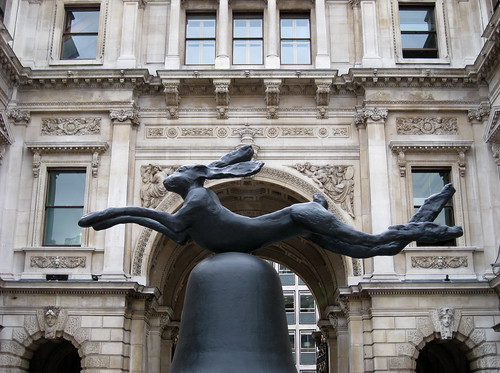
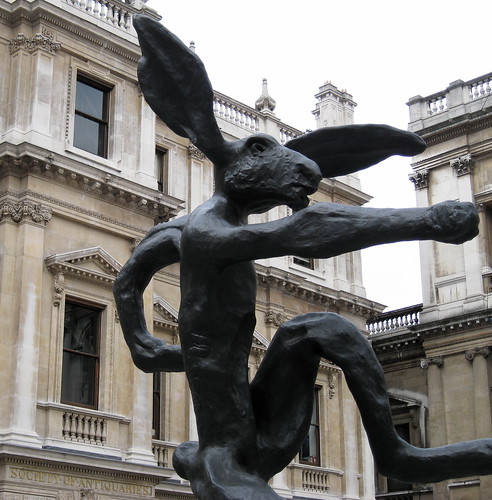
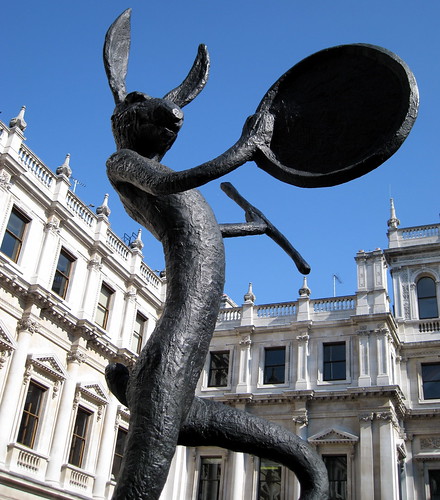
Greeting visitors to this year's Summer Exhibition are three giant sculptures by the late Barry Flanagan OBE, RA, featuring his hallmark images of leaping, dancing and music-making hares. Fanciful and frolicsome, they fill the courtyard - and its visitors - with heart-lifting Joie de Vivre.

Hare-bell

Dance (2)

Drummer

Dance (1)

The Royal Academy's Summer Exhibition remains on show until 22 August.

Images: Brian Sibley © 2010

You'll find more examples of Barry Flanagan's hares at Waddinton Galleries; and there are more images of art installations on my flickr set, Arty-facts. Oh, yes, and there are some more images on buttons blog.

Images: Brian Sibley © 2010

Thursday, 5 August 2010

PLATFORM POET

Blogging as I was a month or two back about Paddington reminded me that I've been meaning to blog about a long-overdue visit I made to another London railway terminus: the restored and renovated St Pancras International.

Often referred to as the 'Cathedral of the Railways', it combines William Henry Barlow's train shed, completed in 1868 (with an iron and glass roof that was, at the time, the largest single-span structure of its kind) and George Gilbert Scott's neo-Gothic masterpiece, the Midland Grand Hotel.

When, in the 1960s it looked as if St Pancras was doomed to be demolished, one of those who came to its defence was the Poet Laureate, Sir John Betjeman who told the bureaucrats planning to bring in the wrecking-ball that it would be a criminal folly to destroy a building whose name conjured up wondrous images of architecture and light in the mind of every Londoner.

"What he sees in his mind's eye," wrote Betjeman, "is that cluster of towers and pinnacles seen from Pentonville Hill and outlined against a foggy sunset, and the great arc of Barlow's train shed gaping to devour incoming engines, and the sudden burst of exuberant Gothic of the hotel seen from gloomy Judd Street."

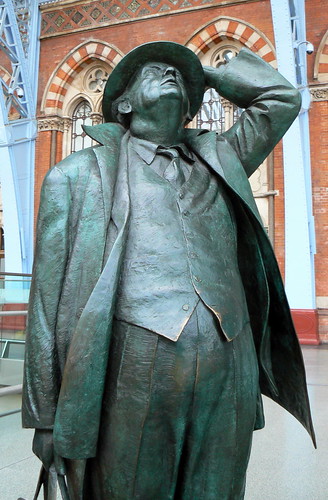
Appropriate then that when the station was reopened following its multi-million pound restoration and redevelopment, that a statue of Sir John should take pride of place on the upper level of the station concourse.
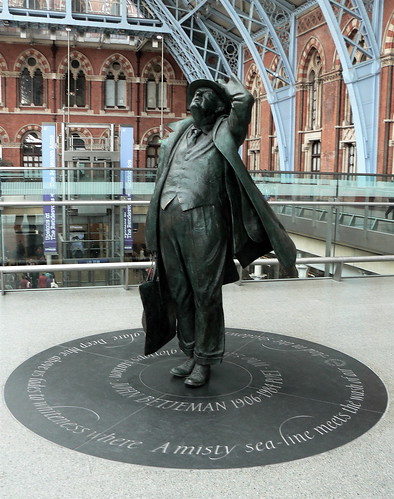
Sir John at St Pancras (2)
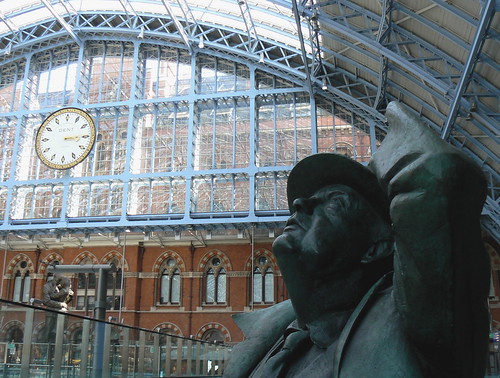
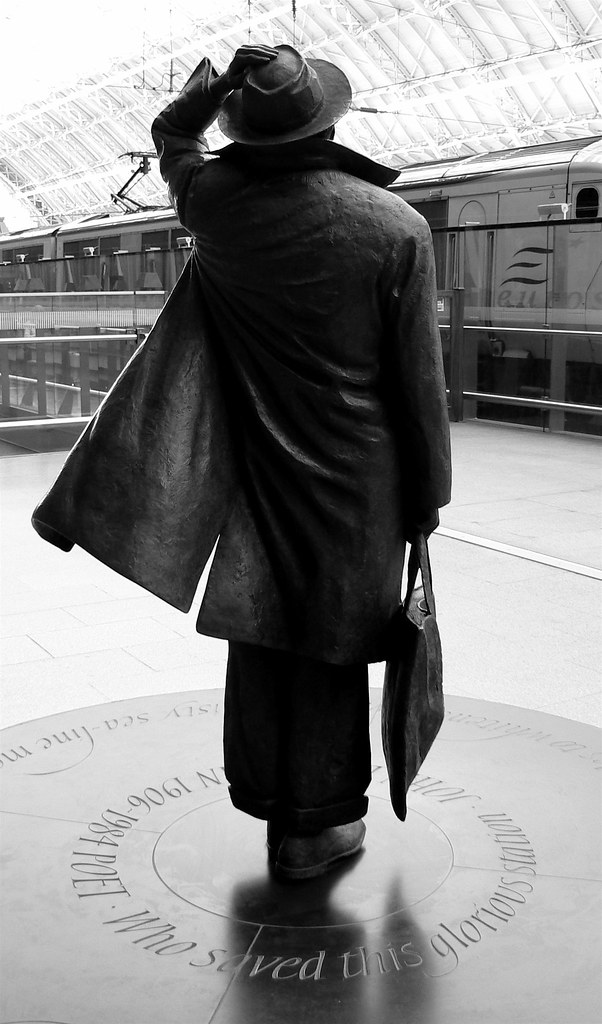
Created by sculptor, Martin Jennings, it shows a larger-than-life Betjeman clutching his hat, his overcoat billowing out behind him as he looks up at that great, wide span of Barlow's roof.

Sir John at St Pancras (4)

Sir John & Clock

Martin Jennings' work is a truly engaging tribute to a poet who could, by turn, be profound or trivial but who was always in touch with the vibrancy of history, people and places and who enthusiastically and unceasingly shared his passions for the poetry in everyday life.

Sir John at St Pancras (1)

You can read more about Betjeman and the saving and restoration of St Pancras in this 2007 article in The Independent.

Images © Brian Sibley, 2010 uploaded from my flickr Photostream.