Wednesday, 1 November 2017

CLINGING TO THE WRECKAGE – Part 1

Later than I'd hoped here's the first of two posts (mostly pictorial) celebrating Damien Hirst's monumental exhibition, Treasures from the WRECK of the Unbelievable, currently on show in Venice, Italy until 3 December.


Here's the official blurb:
The exhibition is displayed across 5,000 square meters of museum space and marks the first time that Palazzo Grassi and Punta della Dogana, the two Venetian venues of the Pinault Collection, are both dedicated to a single artist.

Damien Hirst’s most ambitious and complex project to date, ‘Treasures from the Wreck of the Unbelievable’ has been almost ten years in the making. Exceptional in scale and scope, the exhibition tells the story of the ancient wreck of a vast ship, the ‘Unbelievable’ (Apistos in the original Koine Greek), and presents what was discovered of its precious cargo: the impressive collection of Aulus Calidius Amotan – a freed slave better known as Cif Amotan II – which was destined for a temple dedicated to the sun
Everything from the words "the exhibition tells the story of..." onwards might be described as 'a grand deceit' or, to put it more directly, 'one enormous lie', for nothing exhibited is what it seems. Greek and Roman coins are fakes – aged as if with centuries of use – even the fragile nautilus and clam shells are painted bronze.

However, such is the cumulative effect of Hirst's vast creation – by turn beautiful, bizarre and downright bonkers – that the visitor is challenged to consider what makes something believable or unbelievable; to question what is art and what is artifice; whether an artifact displayed in a museum or gallery with the appropriate curatorial labeling is, necessarily, authentic simply because it is presented with the tropes and trappings with which we are familiar from centuries of being taught how to look at art and apprise culture.

The scope of these exhibits – busts, statues, weapons, armour, toys and trinkets crafted in Carrara marble, gold, silver, crystal, jade and lapis lazuli – is a staggering achievement by Hirst and his studio of artists. So, too, is the supporting documentation in the form of film footage of the treasurers – encrusted with centuries of coral – being found by divers and raised up from their watery resting place.

Every now and again the visitor may catch Damien Hirst giving a tell-tale wink: a striking similarity between say one of the, as yet unidentified, pharaohs or ancient deities and Kate Moss or Rihanna or sly jokes referencing Ray Harryhausen or Walt Disney, all of which only add to the delightful cock-snooking impertinence of this wild enterprise!

First we will enter the Palazzo Grassi – and while you are there, just click on any image to enlarge...


Photos: © David Weeks and Brian Sibley, 2017

Click HERE to visit Part 2 of the exhibition

Tuesday, 31 October 2017

SCHULZ, BRADBURY & HALLOWEEN

In only a few years, Halloween in Britain has gone from being a totally American and utterly un-British (and therefore inexplicable) holiday to being up there in the UK marketing and merchandising league with Christmas, Easter and Valentine’s Day.

There was a time when the only glimpse those of us on this side of the Atlantic ever got of the trick-or-treat world of Halloween was in Charles Schulz’ annual Peanuts strips in which Linus vainly waited in the pumpkin patch for the arrival of his own mythical invention – the Great Pumpkin!


Even though our stores are now annually full of Halloween paraphernalia, there is precious little cultural knowledge in Britain about the Catholic feasts of All Hallows (or All Saints) and All Souls celebrated on 1st and 2nd November,  or of the European traditions, superstitions and amusements that preceded them on October 31, known as All Hallows’ Eve – or Hallowe'en…

Those who would like to understand more about the origins and multi-faceted accretions that comprise the dark festival of the turning year can look them up in on-line or on-shelf encyclopedias...

But, if you'll take my advice, you'll, instead, hitch a ride with the mysterious Mr Carapace Clavicle Moundshroud in The Halloween Tree.

First published in 1972, this is an autumnal conjuring trick by that literary magician, the late Ray Bradbury, with haunting tombstone-black-and-white illustrations by Joe Mugnaini.

The cadaverous Moundshroud leads a group of youngsters on a frantic time-travelling jaunt through the “deep, dark, long, wild history of Halloween,” beginning within the shadow of the Halloween Tree…

The pumpkins on the Tree were not mere pumpkins. Each had a face sliced in it. Each face was different. Every eye was a stranger eye. Every nose was a weirder nose. Every mouth smiled hideously in some new way.

There must have been a thousand pumpkins on this tree, hung high and on every branch. A thousand smiles. A thousand grimaces. And twice-times-a-thousand glares and winks and blinks and leerings of fresh-cut eyes…

By wing and kite and broomstick they fly on the winds of lost centuries from the darkness of the cave before the discovery of fire, via the rituals of Druid England with its scythe-wielding October God of the Dead, to the gargoyle-encrusted towers of Notre Dame; from the bone-and-mummy-dust tombs of Ancient Egypt through the Grecian Isles to the City of Rome and away to South America and the candles and sugar skeletons of El Dia de los Muertos, The Day of the Dead...


It is a journey that memorably explains how light and darkness, faith and fear have shaped a festival now more widely celebrated than understood…

So, maybe when the little terrors come around knocking our knockers tonight, we should slip a copy of Mr Bradbury's classic into their Trick or Treat bags – then they might know why they were doing what they were doing and, if nothing else, at least it wouldn't rot their teeth!

Re-reading The Halloween Tree is an annual invitation to allow a bony finger to stir and prod among the leaf-mould and mummy-dust of my memories...

I travel back in time thirty-seven years...

It is 1980 and, after six years of corresponding with Ray Bradbury, we meet for the very first time when I interview him at the offices of his London publishers.

The book that I take with me on that occasion to ask him to inscribe is the first UK edition of The Halloween Tree...
Six years later, I am in Los Angeles and we meet for lunch in a restaurant on Rodeo Drive. Ray is there first and has has a Halloween treat awaiting me.

Under the napkin by my plate is a book...


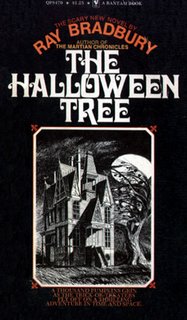
It is an American edition of the The Halloween Tree with a new, macabre cover design It is inscribed with a golden Halloween Tree drawing by the author, studded with grinning pumpkin lantern stickers!


No wonder this book has always been special to me...

In 2006 came another gift from Ray Bradbury: an e-mail in which he recounted a short history of how the Halloween Tree came to be planted and how it grew and put forth its unique autumnal fruits...
The Halloween Tree came about because I had lunch with [legendary Bugs Bunny animator] Chuck Jones forty years ago; he had just become a new friend.

The night before, an animated [Peanuts] film - The Great Pumpkin - had been on TV. My children disliked it so much that they ran over and kicked the TV set, along with me, because the whole idea of the Great Pumpkin supposedly arriving and then not arriving was incorrect to me. It was like shooting Santa Claus on the way down the chimney!

Chuck Jones and I agreed that we didn't like The Great Pumpkin, though we did admire Charlie Schultz, the cartoonist, very much. Then Chuck said, "Why don't we do a really good film on Halloween?" I said, "I think we could. Let me go home and bring something."

So I went home and brought Chuck a large painting of a Halloween Tree that I had painted down in the basement with my daughters a few years before.
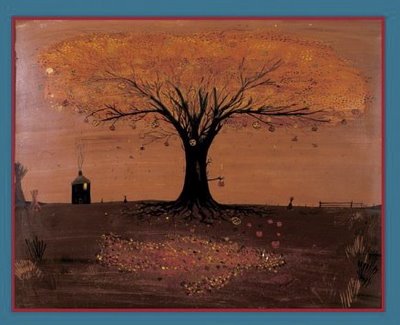
Chuck took one look at it and said, "My God, that's the genealogy of the holiday. Will you write a screenplay on this?" I said, "Yes, hire me!" So Chuck Jones and MGM hired me to write a TV script called The Halloween Tree.

Several months down the road, MGM decided to turn its back on animation, so they closed their unit and fired Chuck and me. I had nothing to do then so I took the script and wrote the novel of The Halloween Tree.

Later I wrote a second script for the final animated film, which was done by Hanna-Barbera a few years later, for which I received an Emmy Award for the script.
About three years ago I produced Something Wicked This Way Comes at a theater in Santa Monica and on Halloween night my biographer, Sam Weller, drove me to the play and then home again at around 10:30 at night and on the way, in four different yards we saw that people had placed pumpkins, real ones or papier mache, lit with candles in trees in their front yards.
Now, there are Halloween Trees beginning to appear all over the United States and I realized that with my story and that picture that I painted down in the basement with my daughters more than forty years ago, I've changed the history of Halloween in the entire country.
I've discussed this with the Disney people and suggested that they invite me to Disneyland on Halloween night and put up a tree full of papier mache pumpkins and have me there to turn on the whole thing. They would make themselves and me part of the future history of Halloween because no trees existed forty years ago – they began to appear only after my book and my film.
The Disney people haven't reacted so far because, I believe, the notice is very short. If we don't do it this year I'm hoping that Disney will invite me out next Halloween and initiate the birth of the Halloween Tree and the history of the holiday.
It's been an interesting experience for me and it thrills me to think that 100 years from now there will be Halloween trees all across our world...
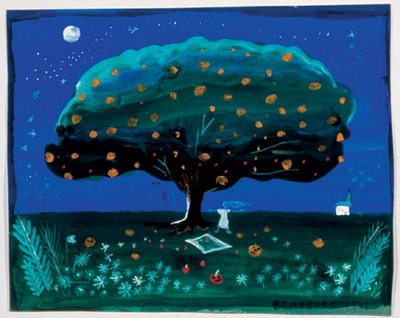
Happily, from 2007 onward, Disney have honoured Ray and his Halloween Tree in Disneyland.

And here's what it looks like...


A few Halloweens ago, I acquired a new reminder of Ray and his Halloween Tree: a signed artist's print by Joe Mugnaini, bought in 2015 from the sale of Ray's estate.

I love the stunning design: the sweep of Moundshroud's great bat wings, the cadaverous features, the way in which he powers his way across the inky crosshatched night sky blistered with stars...


Devotees of the book may be surprised to notice that Moundshroud is flying from right to left, when in the published book, he flies in the opposite direction.

Alas, too late now to ask either Joe or Ray why the orientation of the picture was altered, although one answer might be that, in the book, having him fly towards the right-hand page-turning made more sense as it carried the reader towards the next part of the story...

Well, that, at any rate, is my theory!

Inevitably then, tonight, my thoughts will turn to my late, dear friend.

'Trick or Treat, Ray? ––– What do you say?'

You can read more about Ray Bradbury and his books in my profile of him The Bradbury Machine.

You will also find many pages of information about the author and his work on the excellent internet site, Bradbury Media.

And, if you haven't heard it already, here's a radio programme I made in 1998 featuring an interview with Ray...


Some parts of this post first appeared on blogs from a few years ago.

Monday, 2 October 2017

THE FULLNESS OF TIME


The poem below is by James Stephens (1880-1950), the Irish poet and author of The Crock of Gold, and comes from his 1912 volume of verse, The Hill of Vision.

I heard it for the first time yesterday, when it was sung to the tune of the Welsh folk-song, 'Tros y Garreg' (well, 'Irish' and 'Welsh', they're both Celtic!) at the Mass for The Feast of Michael, Gabriel, Raphael and All Angels at St John the Divine, Kennington.

Twenty-four hours later, this profoundly mystical proposition is still rattling around in my mind...

The Fullness of Time
On a rusty iron throne
Past the furthest star of space
I saw Satan sit alone,
Old and haggard was his face;
For his work was done and he
Rested in eternity.

And to him from out the sun
Came his father and his friend
Saying, now the work is done
Enmity is at an end:
And he guided Satan to
Paradises that he knew.

Gabriel without a frown,
Uriel without a spear,
Raphael came singing down
Welcoming their ancient peer,
And they seated him beside
One who had been crucified.


[Illustration: Gustave Doré for John Milton's Paradise Lost, c. 1866]

Monday, 25 September 2017

SCARFE STAGED & SCREENED


When I was 14 and dreaming of a career as a cartoonist, I had many heroes – Searle, Emett, Hoffnung, Steadman, Trog – but only one true idol: Gerald Scarfe!

I used to cut out his cartoons from papers and magazines and study every pen-stroke: the placing, weight, thickness and trajectory of his line; the audacious angularity of his images; the intensity of his cross-hatching; the relationship between ink and naked paper; the seemingly effortless way in which he conjured all these talents.

It was difficult to know what I admired more about Scarfe: the assuredness of his draughtsmanship or the unrelenting savagery of his excoriating –– for example (a persaonl favourite) Mrs Thatcher's 'Belgrano' nightmare...


Over fifty years later, my idol remains securely atop his pedestal – the Master of his craft, wielding his pen courageously, unflinchingly pinning the fools, hypocrites and trumped-up monsters and demons of our age to his drawing-board and using their splattered blood to provide the ink for his next assault.

This is the Scarfe we all know. Less familiar, to some, will be the Scarfe currently on show in House of Illustration's latest exhibition: Gerald Scarfe: Stage & Screen, where we find the caricaturist at play in theatre and cinema.

Gerald Scarfe in the exhibition 2 © Paul Grover.jpg 

The intimate space at House of Illustration becomes, here, more spacious than might be expected as display cases are transformed into decorated toy-theatre-like boxes containing Scarfe's fantastical designs for opera, ballet and film – drawings, models, props and costumes; while the walls around overflow with his dynamic, literally larger-than-life, drawings.

Orpheus in the Underworld - character design © Gerald Scarfe.jpg

The projects represented here are those revolutionary productions of The Magic Flute, Orpheus in the Underworld (above) and The Nutcracker that he designed along with his iconic contributions to Pink Floyd: The Wall (1982) and his spiky assault on the cuteness of Disney which the studio astonishingly permitted, having invited him to style their 1997 animated feature, Hercules.

The exhibition opens with Scarfe's stunning designs for Peter Hall's 1993 production of The Magic Flute dominated by a giant bisected pyramid.

 Seattle Opera - The Magic Flute - publicity poster © Gerald Scarfe.jpg

In this interpretation, Pagageno and Pagagena were bird people and the stage was invaded by a bizarre menagerie of cross-mutated creatures – an giraffe-headed-ostrich, a crocodile-cum-penguin – escapees from ancient panels of Egyptian hieroglyphs via a Victorian heads-and-tails book. Scarfe's colour palette is alternately rich in the burnished gold of sand and sarcophagus and a deeper-than-deep-blue characterised by the Queen of the Night. 

The designs for the ENO's Orpheus in the Underworld (1999) is an elaborate Scarfe burlesque, presided over by a Hades in a horned top-hat and a livid pink and green scaled tail-coat tipped with cartoon barbs – just one of the extraordinary examples of the artist's designs realised in three-dimensions by brilliantly talented costumiers.


Orpheus in the Underworld - costume design © Gerald Scarfe (1).jpg

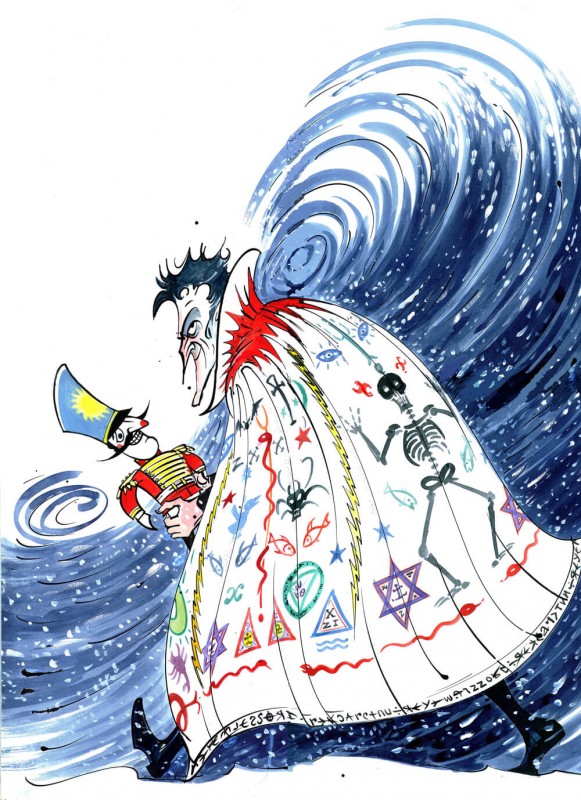
Equally stunning are the costumes for the English National Opera's 2002 production of Tchaikovsky's ballet, The Nutcracker: Herr Drosselmeyer's cloak, a vast swirl of material embellished with mystic symbols; the Mouse King, a menacing skeletal mask and a costume of tattered rags, and entourage of terrorist mice wearing black Mickey-Mouse-eared gas masks.


The films of Walt Disney were a vital influence on the young Scarfe – in particular the richly illustrative Pinocchio – so his eventual collaboration with the Disney Studio on Hercules is less surprising than it might seem. The examples of his work for this film reveal something of the inevitable tension between the collision of an animation style built on softness and roundness and an artist who is known for his spikes and angles.

However improbable, the collaboration resulted in a striking film and all the examples of his designs itch and twitch with incipient movement: Cerberus, a trio of red-eyed, slavering heads; the rearing, reptilian-eyed Hydra; the black bulk of the Minotor hurtling headlong down a cliff against a blood-red sky; Pegasus, springing into winged flight and yet another Scarfe interpretation of Hades, this time fringed with hellfire.


The exhibition also salutes Scarfe's work on a very different animated project Pink Floyd: The Wall – with its powerful imagery and dynamic energy that has haunted our memories for thirty-five years: the menacing 'Schoolteacher' marionette with educational mincing machine, the brick-solid 'Mother', the incendiary 'Ex-Wife', the metallic bird of prey and the goose-stepping hammers. And, of course, the Wall itself...


Pink Floyd - The Wall © Gerald Scarfe.jpg

House of Illustration continues to stage exhibitions celebrating the extraordinary breadth and diversity of the illustrator's art; if there are still any Londoners who have yet to discover this unique venue, then this opportunity to savour the art of Gerald Scarfe 'in performance' should provide an irresistible invitation.


House of Illustration is located at 2 Granary Square, a few minutes' walk from King's Cross station.  

Opening times:
10am-6pm, Tuesday-Sunday (closed Monday). Final admission is at 5:30pm.

For full programme details, admission prices and on-line booking visit House of Illustration. Also check out some of the publications and gifts available from their shop.

Thursday, 31 August 2017

BACK TO THE FUTURE


"Sir Humphrey"

"Yes, Minister?"

"Those chaps that converted their Civil Partnership to a Marriage, yesterday..."

"Yes, Minister?"

"What is the date on their Marriage Certificate?"
 

"Well, yesterday of course, Minister."
 

"August 30th, 2017"
 

"Correct, Minister."
 

"So, they were married yesterday?"
 

"Only in a manner of speaking, Minister."
 

"Oh?"
 

"You see, Minister, by section 9(6) of the Marriage Same Sex Couples Act 2013 (subject to any contrary provision made by or under that Act for any particular purpose) the marriage is to be treated as having subsisted from the date on which the Civil Partnership was formed."
 

"Which was when, Sir Humphrey?"
 

"On October 4th, 2007."
 

"So, they were actually married when they became Civil Partners?"
 

"Oh, no, Minister! Same sex couples weren't permitted to marry in 2007!"
 

"But you just said–––"
 

"What I said, Minister was that, 'by section 9(6) of the Marriage Same Sex Couples Act 2013 (subject to any contrary provision made by or under that Act––––'"

"Yes, yes, I heard that, Sir Humphrey! So, are you saying that although they didn't get married in 2007 – because  they couldn't get married – an Act of Parliament passed six years later made it lawful for them to subsequently be considered as being married even though, at the time, it wasn't lawful?"

"In a manner of speaking, Minister, yes." 

"Then, if I understand you correctly, even though their marriage certificate is dated yesterday, 30th August, 2017, they are now said to have become married ten years previously – despite the fact that such a union, on that date, was an impossibility?"
 

"Exactly so, Minister: your grasp of the matter is exemplary."
 

"Which means on 4th October 2017 – just five weeks after the date on their Marriage Certificate, they will be celebrating their 10th Wedding Anniversary?"
 

"Indeed, Minister."
 

"Then, maybe we should send a card to congratulate them?"
 

"Yes, Minister!"


by Brian Sibley & His Husband (from an idea by David Weeks!)
and with respectful apologies to Jonathan Lynn & Antony Jay

Cartoon
© Gerald Scarfe