Showing posts with label Gerald Scarfe. Show all posts

Friday, 24 January 2025

THE LABOURS OF GERALD SCARFE

 
For many years the work of the concept artist in animated filmmaking (and, indeed, in the of movies movies in general) was untold – or, more accurately, ignored. The focus was on the animators, the cartoon equivalent of the movie actors, and quite often (and pretty much always in the case of the Disney studio) on the Boss. 
 
Walt Disney was canny: early on in his business career he changed the studio name from The Disney Brothers Studio to Walt Disney Productions. He understood the important of personalising the films he produced by providing a single creative focus for all responses to the rapidly developing universe of mice, ducks, pigs and a fantastical pageant of fable and fairy-tale characters whose stories were brought to life in pen and ink.
 
I first became aware of ‘concept art’ in the pages of R. D. Field’s The Art of Walt Disney (1942) and in Bob Thomas’ Walt Disney: The Art of Animation (1958) and, then, again, in Christopher Finch’s The Art of Walt Disney from Mickey Mouse to the Magic Kingdoms (1973) and Frank Thomas and Ollie Johnston’s The Illusion of Life: Disney Animation (1981). Since the publication of these progressively revealing volumes we are now able to access any number of books devoted to the masterworks of such prolific concept artists as Gustav Tenggren, Kay Nielsen, David Hall, Mary Blair and Eyvind Earle.
 
Books on the art and design of several of the more recent Disney films have mapped the progress of a film’s look from sketch to screen and now we have a huge and truly astonishing volume, Disney's HERCULES – The Art of Gerald Scarfe, Insight Editions (7 January 2025) £60.
 

The decision to engage perhaps the most savage and unforgiving of Britain’s political caricaturists and hand him the job of setting the style for a movie about an ancient Greek hero-figure can’t have been easily reached. Gerald Scarfe’s routinely brutal – often shocking and, as result, controversial – cartoons might not have been the obvious choice for a studio whose output has almost always favoured the comfortable rather than the challenging, but then one only has to look at Scarfe’s drawings of British and American politicians in the guise of monsters and grotesques to realise how suited he would be to illustrate such beings as Cerberus, Medusa, Hades, the Hydra, the Furies and the Minotaur; or how his keen sense of humour might amusingly interpret the congregation of Gods or Hercules’ sidekick, Philoctetes the satyr; and, again, how his elegant sweeping penmanship might give flight to the  hero's mighty steed, Pegasus.


Scarfe was no no stranger to film or animation: a passionate lover of Disney since childhood, he had created his own award-winning animated film, Long Drawn-Out Trip, in 1973 and, in 1982, he had contributed electrifying animations to Alan Parker’s film Pink Floyd: The Wall that provided some of the most iconic images of ‘80s pop culture which are no less arresting and provocative in a new century.
 
Despite those known credentials, this book is a revelation, not just in revealing how Scarfe developed, modified and, frequently, radically re-defined his various concepts as he worked with Disney’s artists, but also in showing the startling diversity of media in which he worked: pen and ink, full-bloodied watercolour paintings of creatures and landscapes whether Olympian or Underwordly; dramatic moments rendered in chalk or a limited palette of red or white on black.


The giant size of this book (a lectern would be a useful aid to reading!) allows Scarfe’s art to make the fullest dramatic impact, giving his winged horses space to fly and permitting his multi-headed creatures and tempestuous Titans to rage unrestrained.


Disney's HERCULES – The Art of Gerald Scarfe is witness to the willingness of the Disney Studio to, as its founder expressed it, ‘dream and diversify’, to experiment with art just as Walt himself had done with FANTASIA and several other visionary concepts that either made it to screen or were lost along the way. 
 
More than that, this book is a glorious testimony to the breadth and depth of Gerald Scarfe’s artistry: inspiring in its imaginative inspiration, dynamically dramatic in its realisation and, repeatedly, featuring a hint of his wicked wit that is as sharp as his often angular characterisations.
 
Anyone interested in Scarfe, Disney, film, the art of animation or the craft of the caricaturist needs to own this book. I can't put more plainly than that!


Saturday, 18 May 2024

VISIONS OF HOPE

From the covers of the American television-listings magazine, TV GUIDE, across four decades, here are seven portraits of comedy legend, BOB HOPE – as depicted by the pens and paintbrushes of six masters of cartoon and illustration.
 
Hope's familiar features – the chin, nose, forehead and eyebrows – are brilliantly captured in caricatures by Hirschfeld, Searle. Scarfe and Davis, portraiture by Bernard Fuchs and the photo-realistic artwork by Richard Amsel.


TV GUIDE, January 26, 1957 by Al HIRSCHFELD (1903-2003)


 TV GUIDE, January 16, 1965 by Ronald SEARLE (1920-2011)

TV GUIDE, January 11, 1969 – Gerald SCARFE (b. 1936)
 
TV GUIDE, January 11, 1969 by Gerald SCARFE (b. 1936)
 
  TV GUIDE, April 10, 1971by Jack DAVIS (1924-2016)
 
TV GUIDE, February 28, 1976 by Bernard FUCHS [Again!] (1932-2009)

TV GUIDE, May 21, 1983 by Richard AMSEL (1947-1985)


Monday, 25 September 2017

SCARFE STAGED & SCREENED


When I was 14 and dreaming of a career as a cartoonist, I had many heroes – Searle, Emett, Hoffnung, Steadman, Trog – but only one true idol: Gerald Scarfe!

I used to cut out his cartoons from papers and magazines and study every pen-stroke: the placing, weight, thickness and trajectory of his line; the audacious angularity of his images; the intensity of his cross-hatching; the relationship between ink and naked paper; the seemingly effortless way in which he conjured all these talents.

It was difficult to know what I admired more about Scarfe: the assuredness of his draughtsmanship or the unrelenting savagery of his excoriating –– for example (a persaonl favourite) Mrs Thatcher's 'Belgrano' nightmare...


Over fifty years later, my idol remains securely atop his pedestal – the Master of his craft, wielding his pen courageously, unflinchingly pinning the fools, hypocrites and trumped-up monsters and demons of our age to his drawing-board and using their splattered blood to provide the ink for his next assault.

This is the Scarfe we all know. Less familiar, to some, will be the Scarfe currently on show in House of Illustration's latest exhibition: Gerald Scarfe: Stage & Screen, where we find the caricaturist at play in theatre and cinema.

Gerald Scarfe in the exhibition 2 © Paul Grover.jpg 

The intimate space at House of Illustration becomes, here, more spacious than might be expected as display cases are transformed into decorated toy-theatre-like boxes containing Scarfe's fantastical designs for opera, ballet and film – drawings, models, props and costumes; while the walls around overflow with his dynamic, literally larger-than-life, drawings.

Orpheus in the Underworld - character design © Gerald Scarfe.jpg

The projects represented here are those revolutionary productions of The Magic Flute, Orpheus in the Underworld (above) and The Nutcracker that he designed along with his iconic contributions to Pink Floyd: The Wall (1982) and his spiky assault on the cuteness of Disney which the studio astonishingly permitted, having invited him to style their 1997 animated feature, Hercules.

The exhibition opens with Scarfe's stunning designs for Peter Hall's 1993 production of The Magic Flute dominated by a giant bisected pyramid.

 Seattle Opera - The Magic Flute - publicity poster © Gerald Scarfe.jpg

In this interpretation, Pagageno and Pagagena were bird people and the stage was invaded by a bizarre menagerie of cross-mutated creatures – an giraffe-headed-ostrich, a crocodile-cum-penguin – escapees from ancient panels of Egyptian hieroglyphs via a Victorian heads-and-tails book. Scarfe's colour palette is alternately rich in the burnished gold of sand and sarcophagus and a deeper-than-deep-blue characterised by the Queen of the Night. 

The designs for the ENO's Orpheus in the Underworld (1999) is an elaborate Scarfe burlesque, presided over by a Hades in a horned top-hat and a livid pink and green scaled tail-coat tipped with cartoon barbs – just one of the extraordinary examples of the artist's designs realised in three-dimensions by brilliantly talented costumiers.


Orpheus in the Underworld - costume design © Gerald Scarfe (1).jpg

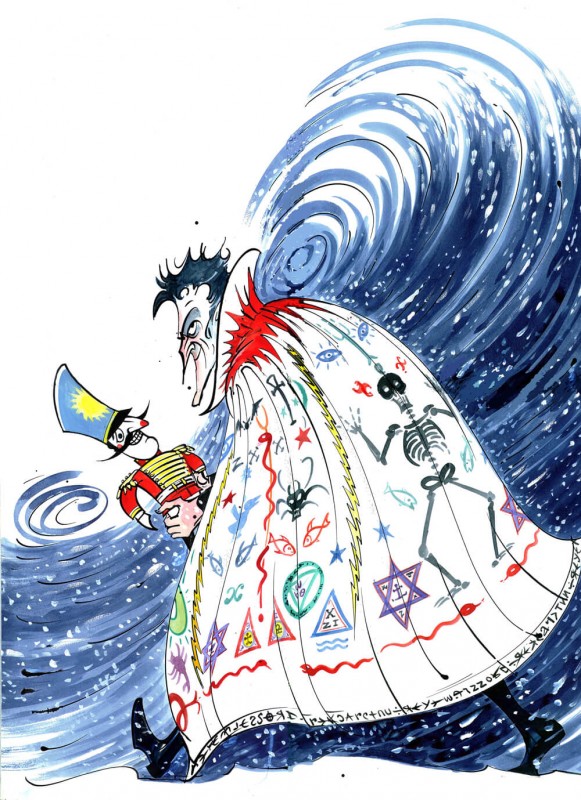
Equally stunning are the costumes for the English National Opera's 2002 production of Tchaikovsky's ballet, The Nutcracker: Herr Drosselmeyer's cloak, a vast swirl of material embellished with mystic symbols; the Mouse King, a menacing skeletal mask and a costume of tattered rags, and entourage of terrorist mice wearing black Mickey-Mouse-eared gas masks.


The films of Walt Disney were a vital influence on the young Scarfe – in particular the richly illustrative Pinocchio – so his eventual collaboration with the Disney Studio on Hercules is less surprising than it might seem. The examples of his work for this film reveal something of the inevitable tension between the collision of an animation style built on softness and roundness and an artist who is known for his spikes and angles.

However improbable, the collaboration resulted in a striking film and all the examples of his designs itch and twitch with incipient movement: Cerberus, a trio of red-eyed, slavering heads; the rearing, reptilian-eyed Hydra; the black bulk of the Minotor hurtling headlong down a cliff against a blood-red sky; Pegasus, springing into winged flight and yet another Scarfe interpretation of Hades, this time fringed with hellfire.


The exhibition also salutes Scarfe's work on a very different animated project Pink Floyd: The Wall – with its powerful imagery and dynamic energy that has haunted our memories for thirty-five years: the menacing 'Schoolteacher' marionette with educational mincing machine, the brick-solid 'Mother', the incendiary 'Ex-Wife', the metallic bird of prey and the goose-stepping hammers. And, of course, the Wall itself...


Pink Floyd - The Wall © Gerald Scarfe.jpg

House of Illustration continues to stage exhibitions celebrating the extraordinary breadth and diversity of the illustrator's art; if there are still any Londoners who have yet to discover this unique venue, then this opportunity to savour the art of Gerald Scarfe 'in performance' should provide an irresistible invitation.


House of Illustration is located at 2 Granary Square, a few minutes' walk from King's Cross station.  

Opening times:
10am-6pm, Tuesday-Sunday (closed Monday). Final admission is at 5:30pm.

For full programme details, admission prices and on-line booking visit House of Illustration. Also check out some of the publications and gifts available from their shop.

Wednesday, 5 April 2017

SCARFE-FACED

A memorable day, yesterday, with David and I being invited to lunch at Sotheby's auction house in London to celebrate the sale (today) of an astonishing array of cartoons, caricatures and drawings....


The unmistakable work of the (truly) legendary artist and satirist, Gerald Scarfe...

Photo: David Weeks

We were in celebrated company: in addition to Gerald, his wife, Jane Asher, and their son, Frederick, there were – among others – Felicity Dahl (widow of Roald) and Donald Sturrock (Dahl's biographer) and sitting next to David (to his great delight) Nick Mason of Pink Floyd!

The sale features a staggering range of Scarfe's work including many delicious inky assassinations. Here are Thatcher, Blair and Obama...


A sardonic future-vision: Prince William, leapfrogging his father, Prince Charles to seize the crown...


A clutch of Showbizers: Mick Jagger, Julie Andrews (in Mary Poppins), Nigel Hawthorne (in Yes, Minister) and Ian McKellen...


Also for sale are examples of Gerald Scarfe work for the theatre: McHeath in The Beggar's Opera and a costume designs for Drosselmeyer in the ballet, The Nutcracker and for the title-character of the operatic version of Roald Dahl's The Fantastic Mr Fox...


And, of course, Scarfe's work on two memorable – vastly different – film projects: Pink Floyd  – The Wall and Disney's Hercules...


On a wall by itself in the pre-sale exhibition (and in a class-act all of its own) hung one of Gerald Scarfe's most celebrated – and, at the time, notorious – portraits.

In 1964, The Times commissioned the artist to mark Winston Churchill's final day in the House of Commons, but the submitted picture was deemed too controversial to publish. 

The drawings is an extraordinary piece of work: the pathetic, decaying, sunken-eyed Churchill dominates the meticulously drawn architectural setting with Conservative politicians (including Reginald Maudling and Alec Douglas-Home) peeping out from behind his hunched bulk and the Speaker of the Commons, Sir Harry Hylton-Foster, lurking in the shadowy recess of the Speaker's Chair.


Six months later, when Churchill died, Peter Cook used the drawing on the cover of the satiric magazine, Private Eye... 


Bidding opens on this piece of British national (and cartoon) history at £100,000...

Wednesday, 18 January 2012

SITWELL BY SIBLEY

One of the nicer things about having to shift stacks of books and papers for the pending move has been the finding of things long forgotten, including a small cache of Sibley drawings that have recently come to light.

As a young man, one of my ambitions was to become (in addition being an actor) a cartoonist and caricaturist. My drawing board idols were three artists who dominated my imagination and whose names began with an 'S': Searle, Scarfe and Steadman.

Here is a caricature I made in my late teens of the poet (and glorious eccentric) Dame Edith Sitwell...


I think, when I made this cartoon, I had only recently discovered Facade: An Entertainment, the work that Dame Edith created in collaboration with William Walton and which, to a young enthusiast of the nonsense literature of Lewis Carroll and Edward Lear seemed to have more than a little in the way of kinship to the lands where Tulgey Woods and Bong Trees might grow!

Here is a short selection of numbers from Facade, performed on a 1953 British Decca recording by the poet and Peter Pears with Anthony Collins conducting The English Opera Group Ensemble...


Tuesday, 28 September 2010

THE LIFE OF WALT

Matthew Parris' guest on this week's edition of Great Lives (BBC Radio 4 today at 16:30), is the cartoonist Gerald Scarfe who nominates Walt Disney as his life of greatness.

Gerald, who later worked on the Disney Studio's Hercules, fell under the Disney magic when, as a young boy in 1940, he saw Pinocchio. An aspiring artist, he copied the film's characters and says that the villains later influenced his own, often savage, satiric style.

The expert 'witnesses' on the programme are veteran animator, Richard ('Dick') Williams (the man behind Who Framed Roger Rabbit? as well as the wonderful, Oscar-winning animated version of A Christmas Carol) and Yours-Truly.

Dick and I go back a long way: as a young man with ambitions to be an animator I used to visit his studio (then in London's Soho Square) where I met several of animation's elder statesmen: including Ken Harris (responsible for among other cartoon creations, Warner Bros' Wile E Coyote); Grim Natwick who animated both Betty Boop and Snow White; Art Babbitt who gave life to the Three Little Pigs and Snow's nemesis, the Wicked Queen; and Shamus Culhane who animated Miss White's dwarfs and, later Woody Woodpecker.

I had not, however, realised just how far back Dick and I went, until he recalled our first meeting when he had asked me how old I was and I had owned up to being –– fifteen! Where the heck did those intervening forty-five years go...?

You can hear Gerald, Dick and I talking about Walt Disney – exploring some of the facts, exploding some of the myths – on Great Lives on BBC Radio 4 at 16:30 this afternoon. The programme will be repeated on Friday at 23:00 and can also be heard, after its initial broadcast, via BBC iPlayer.

Friday, 18 June 2010

NAUGHTY PICTURES

Wandering round exhibitions can certainly be tiring, but weary culture-vultures at Tate Britain can currently take a breather by sitting on Winston Churchill sitting on Adolf Hitler...

Winnie and Adolf

The Churchill-Hitler seat was designed by Gerald Scarfe for Rude Britannia: British Comic Art which opened at the Tate last week and runs until 5 September. Incidentally, the cigar-smoking, Churchillian bulldog (masquerading as Winnie's frequent companion 'The Black Dog' of depression) was added later to stop unwary visitors from bumping into Adolf's zeich heiling left arm!

Of course, Tate Britain the depository of over five centuries of British art, is no stranger to rudery as can be seen from the shortlist to most Turner Prize shows. But this time it's letting its hair down and having a bit a laugh, albeit often with serious intent, over what many would categorise as ephemera - newspaper cartoons, comics, saucy postcards - interspersed with examples of modern art.


The critics have almost universally complained that there aren't enough chuckles or guffaws and maybe that's true, but the work of masters of the caricature - from Rowlandson (above), Gilray, Hogarth and Cruickshank through to Scrafe, Steadman, Steve Bell and Martin Rowson - are all proof that the pen, when dipped in the vitriolic ink of satire, can be far mightier than the sword.

What the Tate has provided is an opportunity for cartoonists (the aforementioned Scarfe and Bell together with the creators of Viz and the comedian, Harry Hill) to assist in curating an exhibition that is sometimes so disturbing that laughter is impossible as with Peter Kennard and Cat Picton Phillips' Photo-Op...


In truth, much of what is shown here is shocking, but there are also moments to have a chuckle whether it be in the pages of the Beano or in naively provocative paintings by the always delicious Beryl Cook, whose Ladies Night (right) shows a gaggle of giggling, gawping, girls enjoying a raucous night on the town.

Keeping Beryl's ladies company are the cads, curates, old maids and bathing belles peopling the seaside postcards created by that master of sauciness, Donald McGill, whose work during the 1950s was regularly the subject of obscenity prosecutions in holiday resorts the length and breadth of Britain.

A Stick of Rock, Cock?

The day I went to see the show, there were several distinguished visitors looking around...

Gallery-goer (2)

Maybe it wasn't actually her, but she was certainly her 'Spitting Image'! Or, there again, perhaps it was her and that's why strange, blue, prehistoric (or, perhaps, mythological) birds of prey were circling overhead...

Thatcher Harpies

You can hear my full views on Rude Britannia (well, quite a few of them, anyway) when I'll be discussing the exhibition with Claudia Winkleman on BBC Radio 2's Arts Show tonight at around 11:30 pm. The programme will also feature a conversation I had with Gerald Scarfe, one of my all-time cartoon heroes, when we sat awhile on Mr Churchill and Herr Hitler...

Brian and Gerald

Images: Mostly © Brian Sibley and uploaded via my flickr Photostream.