“How much is it?” I
asked, and held my breath.
“Forty pounds,” he
replied.
This conversation
took place almost fifty years ago, but I remember it as if it were yesterday.
Forty pounds was an
awful lot of money.
I was just twenty
years old and was seriously bitten by the Disney-bug. My long-standing
fascination – in truth, passion – with Disney movies had been suddenly
intensified when I borrowed R. D. Field’s seminal book, The Art of Walt
Disney from my local library. Here was an authoritative book about Disney,
written by someone who, unlike my Mum, didn’t think of ‘cartoons’ as nothing
more than kid’s stuff that any normal lad ought to have grown out of by the
time his voice broke.
I wanted a copy of The
Art of Walt Disney more than anything else in the world and began scouring
second-hand bookshops in search of one, which is how I stumbled on Fred
Zentner. He later owned one of the coolest stores in London, The Cinema
Bookshop in London’s Great Russell Street – a stone’s throw from the British Museum
– but, at that time, was selling film books, stills, posters and other gems (including
a copy of the aforementioned and much-desired) The Art of Walt Disney –
from the basement of The Atlantis Bookshop, a somewhat exotic emporium in
nearby Museum Street. Once found, I began, bit-by-bit, buying up Fred’s stock
of Disneyana.
Then came the day
when he placed into my hands a copy of The Story of Walt Disney as told
to Pete Martin by Walt’s daughter, Diane Disney Miller. It was a first edition
American hardback, published by Henry Holt & Co (New York) in 1957. It
still had its original dust-wrapper with a cover design by noted Disney studio
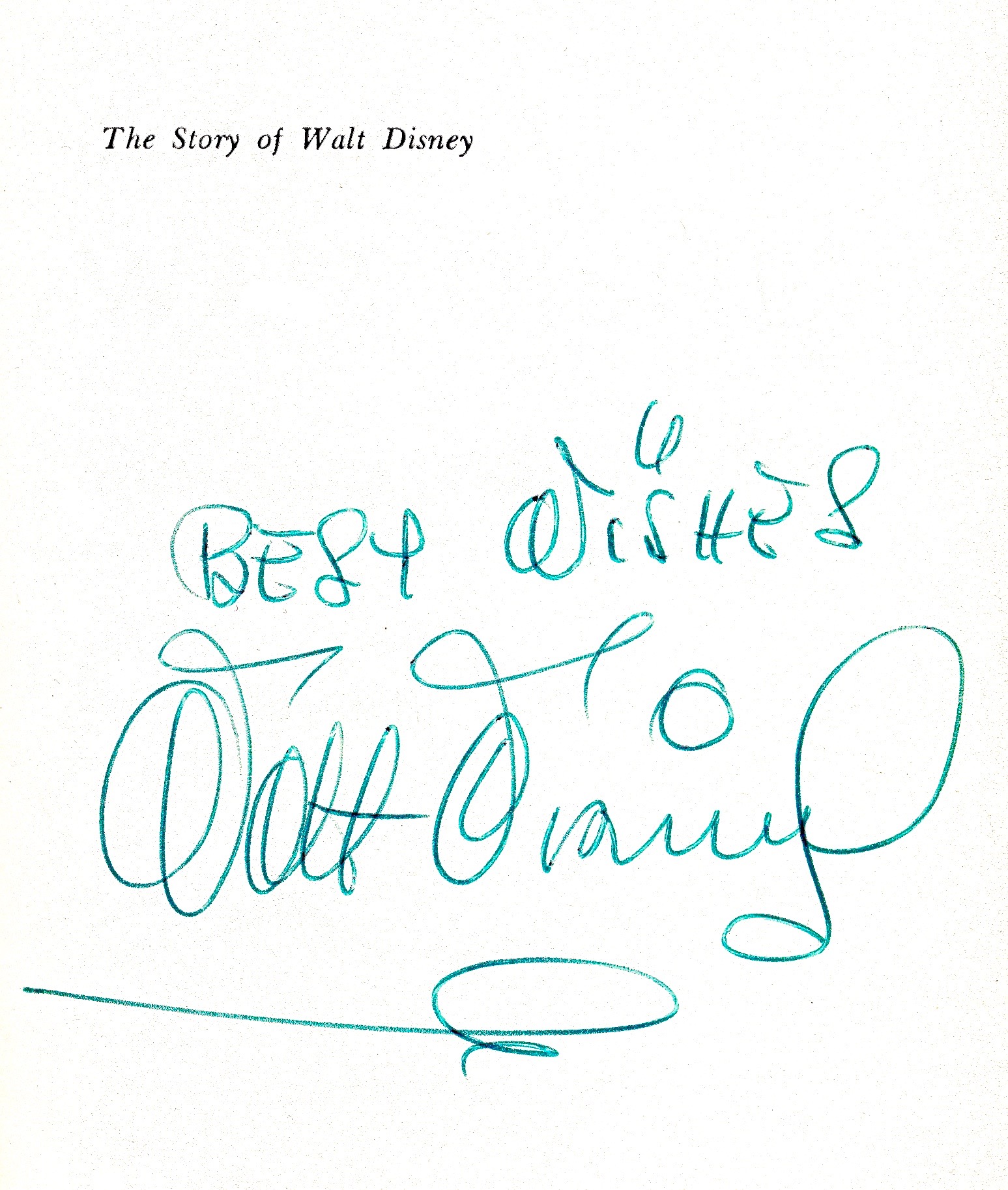
artist Al Dempster and, what’s more, it was ––– SIGNED!
On the half-title page, in green ballpoint, with that distinctive bold
handwriting, was the inscription:

It was his very
signature – including the little circle over the ‘I’ in ‘Disney’ that I
emulated in my own signature. This man – whom I had never met but who exercised
such an obsessive fascination over me – had held this book, opened it and
inscribed his name inside.
I wanted it!
No, I craved it!
But, FORTY POUNDS...
Forty pounds for a book? My mother would go bananas! Besides, I couldn't afford
it. I didn’t have forty pounds. I didn’t know when I would ever have forty pounds. But, right there and then, I desired that
book with a passion that I have scarcely felt about anything since.
But, FORTY POUNDS...
It was way beyond my meagre means. Then Fred Zentner showed himself to be a man
who understood the full anguish of desire, because he made me an amazing offer.
If I paid him ten pounds a month for the next four months, he would keep the
book for me until I had paid the full amount. Month-by-month, I made my
pilgrimage to The Atlantis Bookshop, took another look at the swirling green
signature and paid further ten pounds. Then, one day, it was finally mine!
Fast-forward thirteen years; it is 1982 and I am in the Archive at the Walt
Disney Studio in Burbank, California, talking to Archivist, Dave Smith. I am
researching a television documentary about the soon-to-be-opened EPCOT and I
mention, in passing, that the prize of my personal Disney collection is an
autographed copy of The Story of Walt Disney.
Dave Smith laughs and asks a question that almost brings the universe crashing
down around my ears.
“Are you sure it’s actually signed by Walt Disney?”
“Of course! It says so, in green ballpoint: ‘Best Wishes Walt Disney’!”
“That may be,” he replies, “but many people at the Studio - some of them
distinguished animators – signed books and pictures on Walt’s behalf.”
I look stunned. But, Dave goes on: “The Disney signatures by these other
artists are more like the famous logo signature that appears on Disney movies
and merchandise. Walt’s personal signature, however, is quite distinctive.
Would you like to see a GENUINE Disney signature?”
Nothing could be simpler: within seconds I could know whether or not I owned
the real thing. Or, I could leave things as they were. Except, of course, that
now I couldn’t. Dave Smith had sowed a seed of terrible doubt...
I hesitate for no more than a second. “OK, yes, let’s see a GENUINE
Disney autograph…”
Dave give me a copy of an article he had written in 1981 for Manuscripts,
the journal of The Manuscript Society, illustrated with a whole series of
official Walt Disney signatures – mostly not by the man himself.
Then I saw this one...

Relief! Joy! The
signature was just like mine!
When, a few years later, I got to know Diane Disney Miller, I asked her about
the book and she told me that her father used to sign copies for sale in the
bookshop at Disneyland, which was very probably where my copy had originally
been purchased.
Diane also explained that whilst The Story of Walt Disney carried her name
as author (and, indeed, included several of her own reminiscences) it had been
Walt himself who had collaborated directly with Pete Martin on the book, which
had originally been serialised in the pages of The Saturday Evening Post
in 1956. Her father had decided that it would be better for his life-story to
be presented as if told by his daughter, so that the Post’s fee could go
directly to Diane who – with her husband, Ron Miller, and their two young
children – was currently living with her parents while saving to buy a home of
their own. So everyone involved agreed to the ruse and the story appeared with
the copy-selling tag line:
AT LAST
the
intimate story of America’s
best-loved, least-known genius, told by
his
daughter…
MY DAD WALT DISNEY
Fast-forward to
1998, a decade-and-a-half on, when I find myself in San Francisco working with
Diane on a BBC radio series about her father. I have carried the treasured
volume with me and I ask her if she would add her signature to the book’s title
page.
Diane is modestly reluctant since, as she had already told me, she didn’t
consider herself in any sense the book’s ‘author’. However, she eventually
relents and graciously inscribes the book:
A few more years
down the road, 2001, and I am, once again, in California attending the Los
Angeles premiere of the documentary film, Walt Disney: The Man Behind the
Myth in which I appear as an interviewee. By this time, I have acquired a
British edition of that Disney life-story published in London by Odhams Press
in 1958.
At the
post-screening party, chatting with Diane and her husband Ron Miller, I produce
this volume and ask whether the book’s Non-Author would oblige with another
inscription!
Appreciating the joke, she unhesitatingly agrees and beneath the printed
sub-title - ‘An intimate biography by his daughter, DIANE DISNEY MILLER, as
told to Pete Martin’ – she teasingly adds:
When, four years
later in 2005, the Disney Press
belatedly reissued The Story of Walt Disney, Diane wrote a foreword
in which – for the first time publicly – she revealed the truth about the
book’s writing.
***
The autograph business
is big business: a few years ago, at auction, a copy of the original edition
signed by Walt (like mine in green ballpoint!) realised over three thousand
dollars. And, there’s currently a signed copy listed on the Internet for twice
that figure. I have only ever seen one other copy signed by both Walt and
Diane.
So, all in all, I think that original – and seemingly astronomical – price-tag
of forty pounds feels like money incredibly well spent!
It is not, however, for any financial value that I treasure these two volumes,
but for the even more valuable memories and associations that they hold…