Showing posts with label Glinatsi Family. Show all posts

Wednesday, 21 July 2010

MY BIG FAT GREEK BIRTHDAY

As I mentioned last Wednesday, I celebrated my first (well, my sixty-first) birthday in my Greek house (that is to say, the house that I stay in when I go to Greece!) in Emporios on the island of Kalymnos.

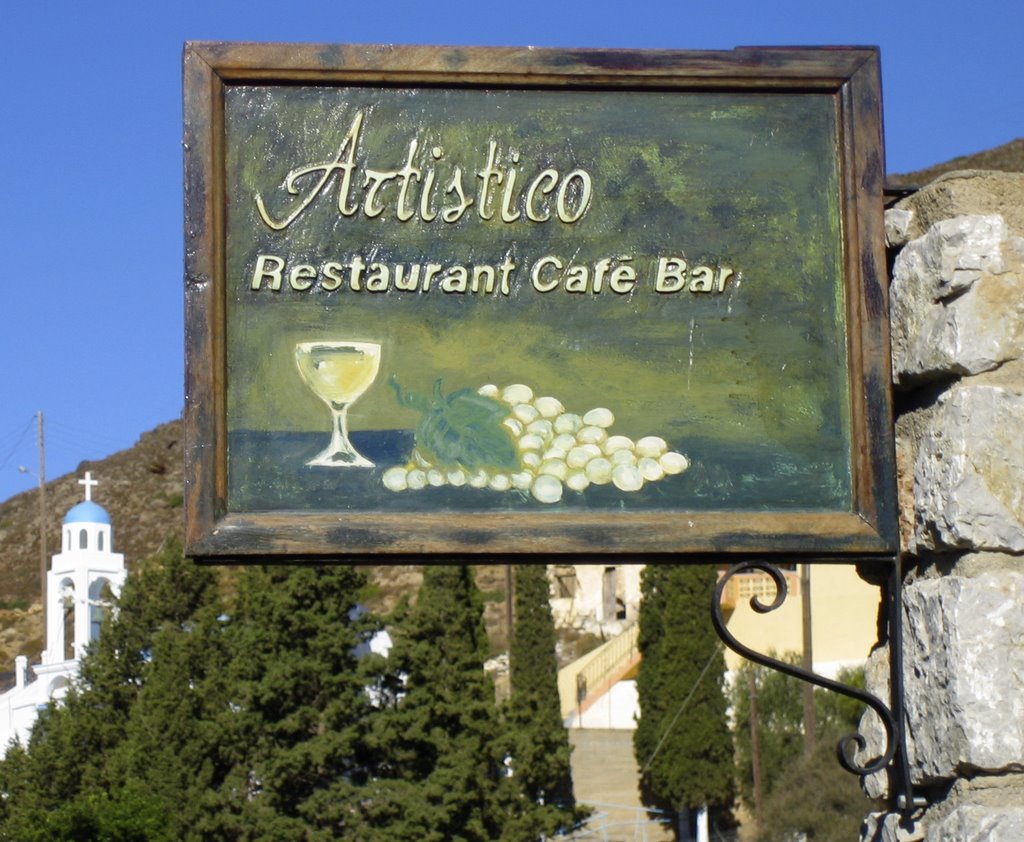
The party was held, naturally, at Artistico Restaurant, where Yorgos and Irini Glinatsi gave me this utterly scrumptious and uniquely personalised birthday cake...

My Big Fat Greek Birthday Cake!

Mercifully, the other sixty candles were omitted for reasons of health and safety: i.e. the risk of either setting fire to the entire village or me going into cardiac arrest whilst trying to blow them out!

As is traditional on such occasions, everyone else in the restaurant got a slice (which, obviously, I tried not to be too mean-spirited about) but, luckily, I got a corner-piece which I decided was the best option since it clearly fell within my healthy 'five-a-day' allocation!

Wednesday, 14 July 2010

LAST TANGO IN EMPORIOS

Don't know what the heck you're grinning about, Sibley, you're sixty-one today!

Greek Tango!

This photo of me dancing an improvised Greek version of the Tango with our hostess, Irini Glinatsi of Artistico Taverna in Emporios on the Greek island of Kalymnos, was actually taken six years ago when I was rather more agile than I am today!

Still, you never know because - now, as then - it's truly amazing what a few-too-many-ouzos can do!

Sunday, 14 September 2008

WORRY KNOT

Every Greek worth his salt can handle one and pretty much every tourist takes one home to dangle on the rear-view mirror of their car!

Kompolói (κομπολόι, pronounced koboloi) are Greek 'worry beads' (far left) and the name is derived from the medieval word κομβολόγιον made up of the two words κόμβος ('knot') and λόγιο ('collection') which comes from the Greek expression, 'se kathe kompo leo' (literally 'in each knot he says') and links this fidget device to the komboskini, the prayer beads or knotted prayer ropes of the Orthodox monks.

However, whilst resembling a rosary, the kompolói no longer has any religious significance.

Kompolói come in all sizes (the usual length is approximately two palm widths) and with varying numbers of beads - though always an odd number. There is also a 'head' composed of a fixed bead (παπάς, 'priest'), a shield (θυρεός) to separate the two threads and help the beads to flow freely, and a tassel (φούντα).

A variation on the kompolói (above near left) is a single strand of beads - sometimes only two - that is known as begleri or mpegleri, derived from the verb mpeglerizo meaning 'I roll the dice'.

According to a Greek website (curiously advertising itself as 'A Taste of Greece - without the Travel'!):


The kompolói, or coboloi and was first introduced by the Turks. From the Turks it became popular, as an accessory at the hands of the dignitaries and sovereigns as symbol of force, wealth and power.

Soon kompolóis became popular among the common people as means for meditation and companion in lounging and to calm the pain.
Because kompolói is a accessory able to cover various human needs, it passed to the hands of antisocial elements. For them it became symbol of independence, freedom and reactive and rough behaviour.

The above, in addition to the intensification of the production and the rhythms of life after the second World War, lead to the decay of kompolói, since the new conditions and ideologies created societies of people struggling to success and survive.

In our age, when rhythms of life are exhausting and stress, shopping, drinks, smoking, depression and antidepressant drugs have become a matter of everyday life, kompoloi makes a dynamic come-back and offers many solutions to the 'dead ends' of contemporary life. Because kompolói is:

o A way of giving up bad habits, such as smoking, nervousness or comfort eating, or biting our nails

o A jewel, when it is strung with valuable beads made of amber, semi-precious stones or precious metals

o A remedy, when it is made of semiprecious stones, which radiate a health-enhancing energy

o A piece of art, when it is designed with high standards of aesthetics

o
A collector’s item, as it can be rare, beautiful, and precious

o A symbol of strength, power, when it is artistic and precious

o An amulet, when it contains symbols of our beliefs and good luck

o A psychotherapist, because the massage to our fingers can relax our neural system

o A home decorative for our the furniture, table and the walls

o A joy for our senses, with its purling beads, silken touch, vibrant colours, and the magical scent of amber and aromatic wood

o A personal trainer, because we can use it to train our fingers' skills

o An heirloom, redolent of our forebears’ lives and the tales they told, and bearing the story of our own lives forward to generations to come

o A medium between man and God, because it can be used as a rosary to count prayers

o A symbol of wealth; it points out that we have plenty of free time

o
A reflection of our personality, as it reflects our ego, in the same way as our car or our house does

This is why we are not exaggerating if we say "show me your worry beads and I’ll show you who you are". Indeed, kompoloi is not just a fashion fad: it is a necessity! It is the jewel of men and the symbol of independency for women. Instead of smoking cigarettes one after the other, or yelling out angry vocals, lets keep or fingers busy with our favourite worry beads.
So, now you know - although I have to say, I have yet to see any 'independent' Greek women demonstrating their skill with the kompolói...

Nikolas Glinatsi and his fiancé, Eleni, gave me a kompolói and a beglari as a going-away present this year...


Whilst I have 'played' with Greek worry beads for a number of years, I am far from accomplished, so here's Nickolas' father, George Glinatsi, demonstrating how to do it properly.

First, here's how to handle your kompolói...


And now the beglari technique...


Hmmm...
Well, I guess I'll just have to keep practising and hope I can show some improvement before next year!

Images: Brian Sibley / Movies: David Weeks © 2008

Friday, 15 August 2008

HOLY GOAT

Back on Kalymnos...

Today is the Assumption Feast of the Panagia.

Panagia is a Greek word (Παναγία) meaning 'All-holy' and is one of the titles used by the Orthodox Christian churches of Mary, the mother of Jesus.

The Feast of the Assumption, celebrated on August 15, commemorates the Catholic doctrine that Mary "having completed the course of her earthly life, was assumed body and soul into heavenly glory."

On the same day, the Eastern Orthodox church celebrates what is referred to as The Dormition of the Theotokos or 'The Falling Asleep of the Mother of God'.

The theology is slightly different here, Orthodox Christians believe that Mary died a natural death, that her soul was received by Christ, but that on the third day after her death her body was resurrected and taken up into heaven in anticipation of the general resurrection scheduled for all believers at the Second Coming of Christ.


Here on Kalymnos, as on all the Greek islands, Panagia is one of great religious feasts of the Christian year preceded by a 14-day fast during which no red meat, poultry, meat or dairy products, fish, oil, or wine are permitted. This fast is still strictly observed by much of the population, including the Glinatisi family at Artistico with whom we are staying - despite the fact that they are having to cook and cater for guests and visitors who eat at their taverna.

The traditional Panagia meal is roast goat and is a reminder of the historical and economic significance of this animal within Greek culture. The animals that clamber and scramble about among the rocky mountain slopes above Emporios - the sharp clanking of their bells is often the first sound one hears on waking in the early morning - were once the staple (and are still the symbolic) source of sustaining life...


As with all 'new' religions it is interesting to reflect on how they overlap with the old, pagan beliefs which they supplanted. The goats of Greece are the only traceable decedents of Pan (Πάν) the goat-horned, goat-bearded, goat-footed god of ancient myth...


Pan was the mythic deity associated with shepherds and their flocks and of mountains, fields and woods and, therefore, with spring -- and fertility: the symbolism of a being that is half man and half goat is one that does not require the services of a Freud to decipher!

This particular statue, exhibited in the National Museum in Athens, depicts Pan attempting to embrace Aphrodite (the Goddess of Love, beauty and fertility) who has removed her left sandal with which she teasingly threatens to strike him.

Above this ill-assorted pair of would-be/wouldn't-be lovers is hovering the mischievous Eros who, one suspects, is actually egging-on the lecherous old goat.

The sculpture was found on the island of Delos (famous as the alleged birthplace of the god Apollo) and dates from around 100 BCE.

Some of you will have seen this photo before, but I make no excuse for republishing it because, for me, it captures something about the mystery of the Greek islands where - despite the people's obvious Christian devotion - one of Pan's satyrs might, perhaps, still be glimpsed in the shadows...


Images: Brian Sibley and David Weeks © 2005/2007.

Sunday, 12 August 2007

GRECIAN 2007

Tomorrow, after what has been, if not the year from Hell then at least the year from Purgatory, we (as Cliff sang) are all going on a summer holiday, no more working for a week or four...

And - thanks to David for fixing and paying for everything - (hopefully) no more worries either...

Those worries - which I am leaving behind, snuggled up for warmth to my overdraft and credit-card bills - include a total absence of work in the rest of the year; looming examinations/explorations for my Psoriatic Arthritis (with rheumatologists and dermatologists); steroid injections in both wrists for Carpal Tunnel Syndrome; and an angiogram to find out precisely what is going on in my heart (following an abnormal result from the recent echocardiogram); all of which is, I think, more than enough to be going on with...

Anyway, my aim while we're away ("away" being Emporios on the Greek island of Kalymnos, via Athens, staying - once again - at 'Artistico' with the Glinatsi family) is to try and get some rest and relaxation in the hope of recovering from some of the traumas, trials and tribulations of the past twelve months and to get myself into a rather better frame of mind and body to face the aforementioned ordeals awaiting me on my return.

I am also hoping to do a bit of what (in my case) is laughingly known as "creative writing" - including a children's novel that I have been trying to write, on and off, for the past year.

All of which means that daily blogs will be a little different for the next month... All will be revealed, in due course!

I hope you'll still drop by from time to time; but, please, just remember that our Internet connection will be dial-up and not always accessible, so blog arrivals may be a little erratic and it may take longer than usual for any comments to get published.

So, for now, I'll say Καλὸ ταξείδι! (Kaló taxídi), which is Greek for Bon Voyage!


Image: © Brian Sibley & David Weeks, 2007

Thursday, 28 September 2006

WORLD WIDE LUNCH

It’s two weeks, yesterday, since we left Kalymnos and the tan and, more importantly, the feeling of contentment are already beginning to fade…

But the memories live on and one of them - extremely personal to me, as it happens - is out there for all to see --- on the World Wide Web!

It was Wednesday, 30th August and I came up from a hard day on the beach and ordered a spot of lunch at Artistico...


I decided on a Greek salad, a plate of tzatziki and another of tomato patties and cheese balls. A short while afterwards, a selection of food approximating to my order was brought out on a tray and carried right past me to a table on the other side of the restaurant where it was artfully arranged and then photographed by a young man with a lot of serious camera equipment…

In a London restaurant I would, by now, have been hurtling towards my short-fuse explosive mood, but this is on Kalymnos - in Emporios - at Artistico… With an extreme effort I managed a raised eyebrow and a quizzical look…

Irene Glinatsi hurried over to reassure me: yes, that was, indeed, my lunch she explained, but the young man with the camera furiously clicking away was putting together images for a French web-site on Kalymnos and he wanted a few shots of some typical dishes on the Artistico menu and my lunch, apparently, fitted the bill...

The photographic shoot went on for a few minutes and then the young man relocated and served my food with sufficient aplomb to suggest that, if other work fails, he could reasonably hope to hold down a job in a French restaurant!

He also gave me details of the web site on which my lunch was to make its guest appearance.


Called Kalyrock.com it is primarily intended for rock climbers (not being one myself I’ve never previously mentioned that Kalymnos is, in fact, an ace climbing resort) but which contains many pretty pictures of this lovely island.

Yesterday in London, it being grey and overcast, I found myself missing the sun, sea and sky of our Greek paradise so much that I decided to go to Kalyrock.com and visit my lunch…


Do you know, I could almost taste it…

Then, late last evening, we telephoned Artistico in order to wish Nikola Glinatsi a happy 25th birthday - talking to Nikola and Irene and hearing all the news from Emporios only served to confirm my severe pangs of holiday-home-sickness!

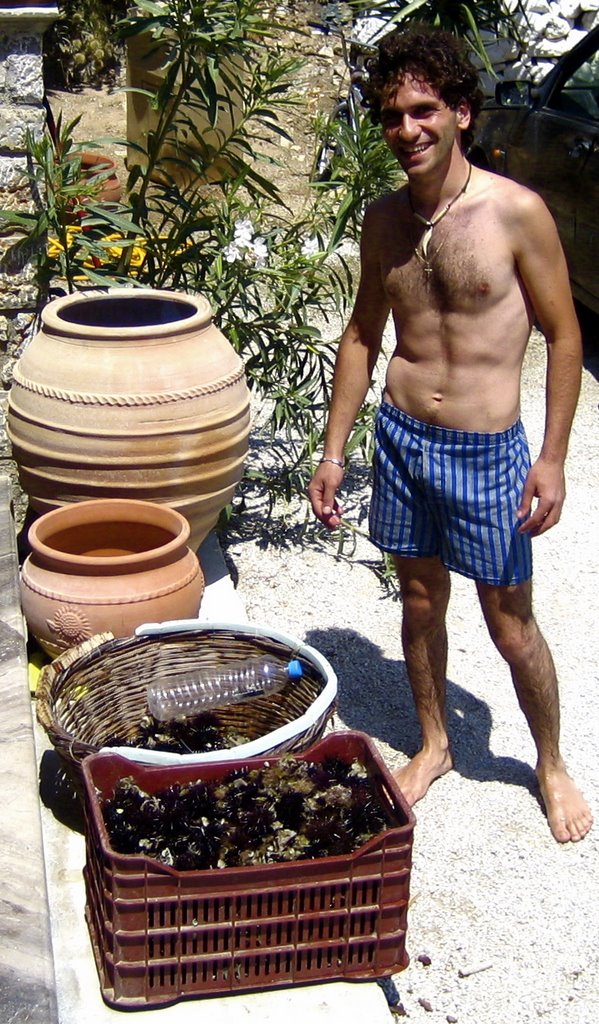
Here's a photo of Nikola having just returned from a fishing trip with a particularly impressive haul of local sea urchins * which reminds me of another of those useful Greek sayings: "If you don’t wet your arse - you won’t eat fish!"


* Sea urchins are a much-prized delicacy, but one which I confess to having passed on once I'd discovered that the spiny outer cases continue moving for a quite some while after the creatures have been cut open and had their insides consumed. Call me old-fashioned, if you will, but being a wishy-washy city-dweller, I'm afraid I tend to prefer food that stays still when it's on the plate!

Wednesday, 13 September 2006

ΑΝΤΙΟ KALYMNOS

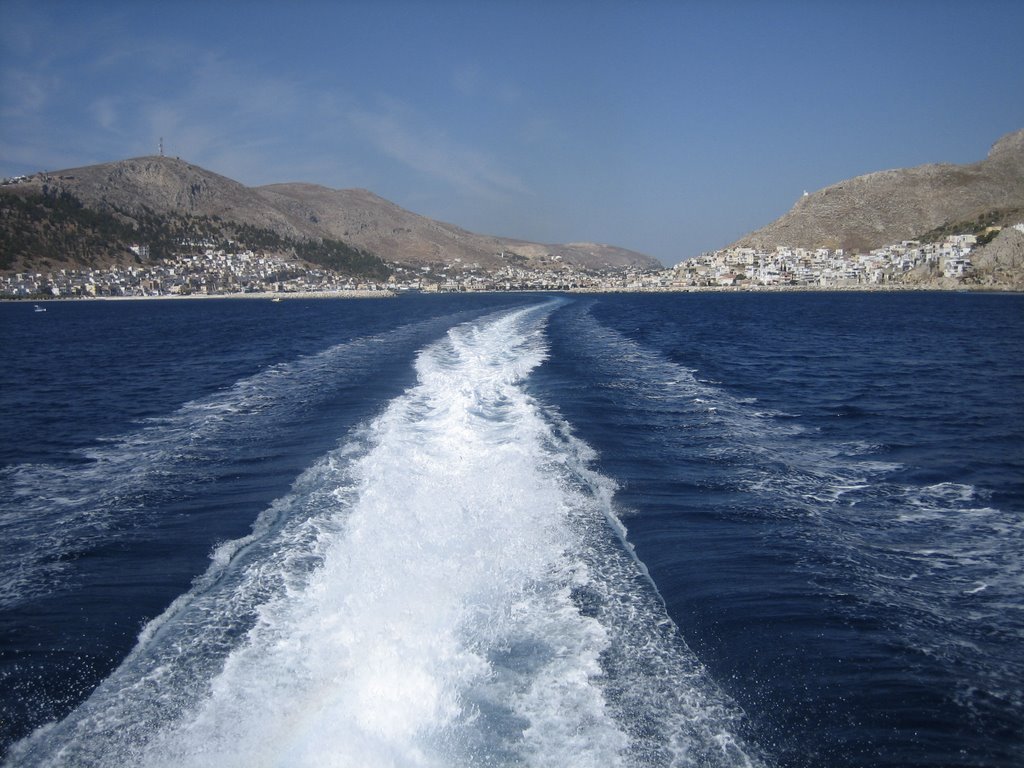
Sadly, it is time to say...


FAREWELL, KALYMNOS...


[Images: © David Weeks]

Monday, 11 September 2006

PASSING THOUGHT

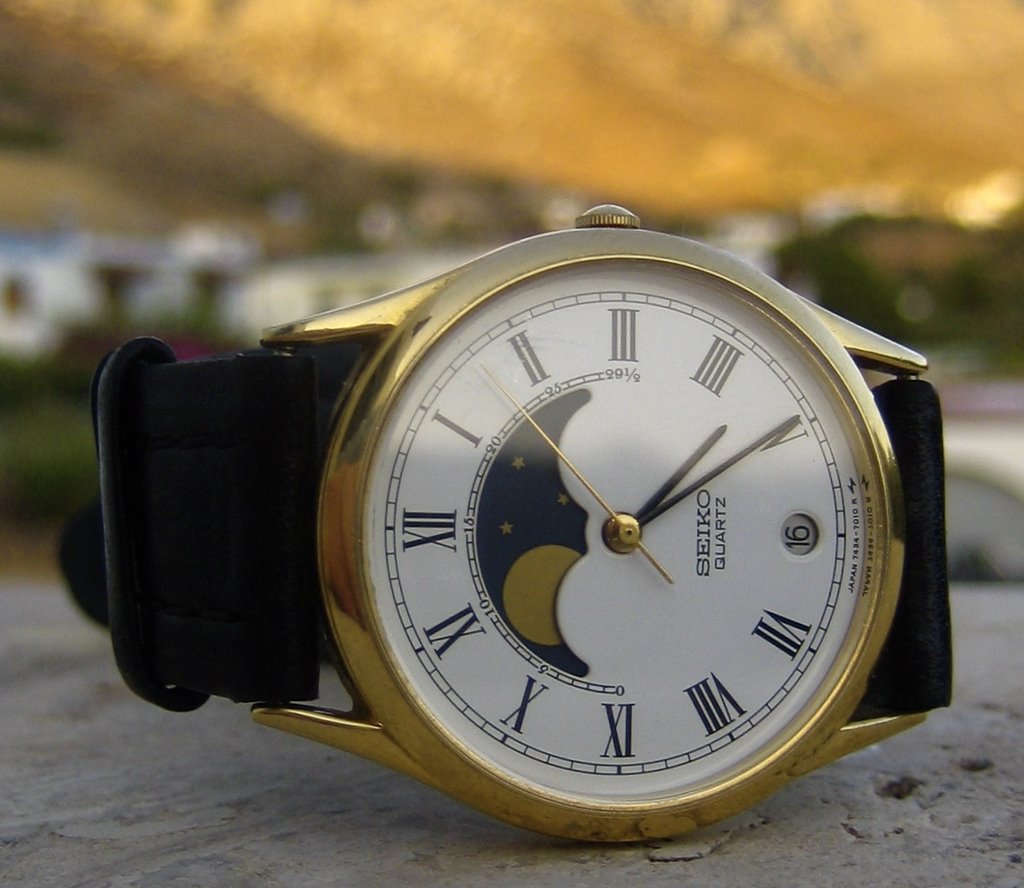
As in previous years, when I arrived in Emporios, I took off and stopped my watch…


Unfortunately, time did not stand still and a month has passed even without watching the watch…

Everyone is conscious of our forthcoming departure: George spent some time yesterday evening reflecting on the nature of time and the relative speed or slowness of its passing and Themelis was driven off to Pothia in order to start school today so we have already said farewell to the wild-boy of Emporios.

It took no less than three series of goodbye hugs and kisses - spread out across half-an-hour - before he could be finally prised into the car! “When you are friends,” he told us, “you must have lots of kisses!”

So, the sense of departure has now begun and even the sound of the sea breaking on the shore, to which I awoke this morning, has assumed a melancholy note…

Emily Dickinson understood all too clearly why such moments make us feel what as we do when she wrote of the nature of life...


"That it will never come again
is what makes life so sweet..."


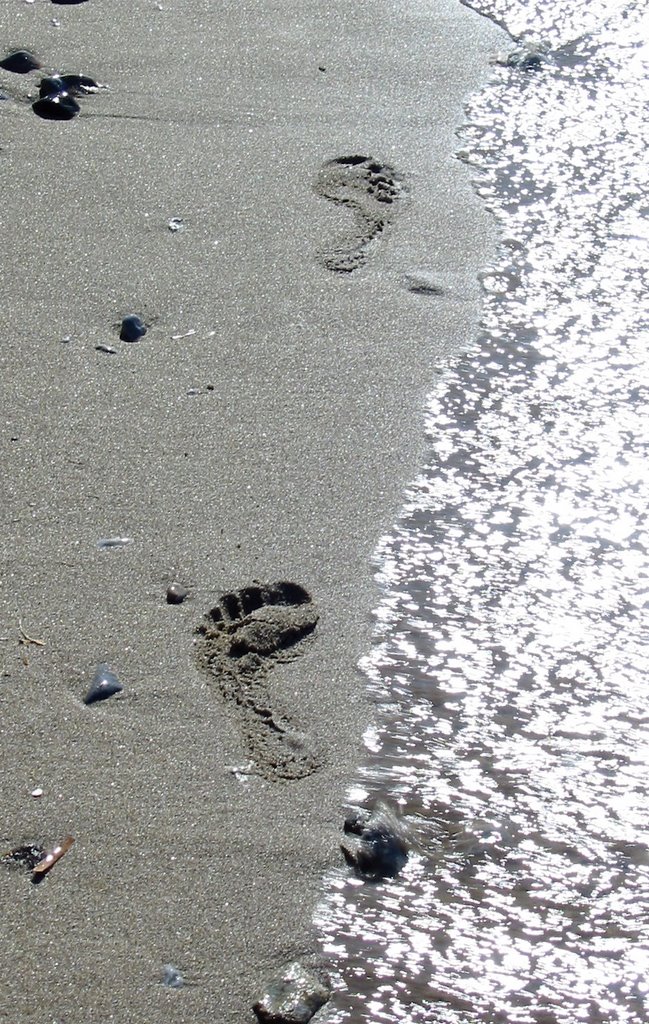
[Footprints image: David Weeks]

Sunday, 10 September 2006

PHILOSOPHICALLY SPEAKING

The Greeks, as they say, have a word for it; in proof of which, Irene Glinatsi occasionally introduces a Greek phrase or saying into the conversation such as, “When the water gets into the stream,” meaning when things settle down into their natural course; or, “It’s only the mountains that never meet,” which is a Kalymnian variation on our more prosaic expression, “It’s a small world…”


When Irene’s eleven-year-old son, Themelis, is not running wild, he is also clearly a born philosopher. As our friend, Gill, was preparing to leave Emporios the other week after her seventh or eighth visit, the youngest Glinatsi announced that, “The puzzle that is Artistico will now be missing an important piece and will not be complete again until Gill returns.”

And, the other day, when I was explaining to Themelis’ father that something that I had said was “a joke”, the lad sagaciously observed: “All life is a joke! We come; we make our little jokes; and then - poof! - Goodbye! See you in the next place!”

Tuesday, 5 September 2006

BOYS WILL BE BOYS...

The world over, they are the same…

Boys!

In and out of mischief more times than can be easily reckoned; riding the mood swings of a rollercoaster; sometimes leaning towards manhood and independence, but just as often falling back into vulnerability of being a child…

Making catapults, kicking footballs, building tree-houses, blowing bubblegum bubbles until they burst all over the face and, ideally, get so thoroughly stuck in the hair that the gum can only be removed by the application of ice-cubes!

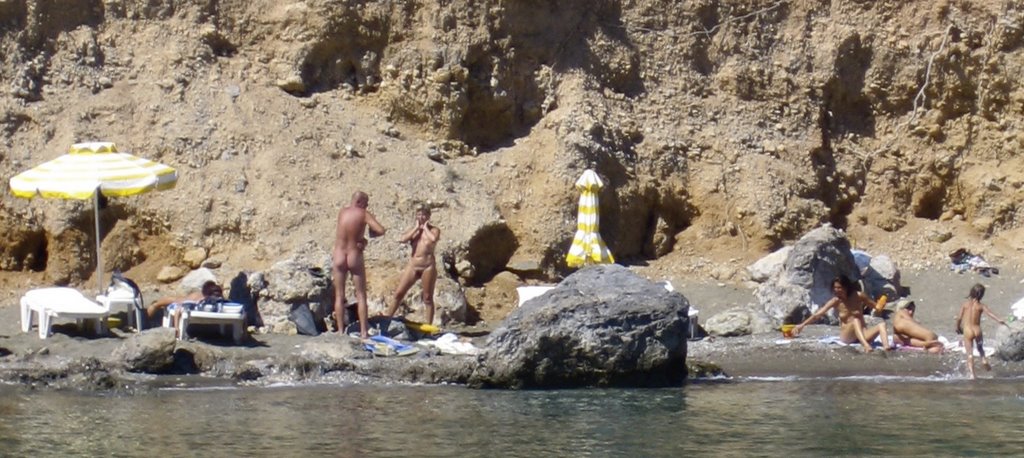
Themelis demonstrated his bubblegum-blowing skills during our day trip to Telendos and - being a boy - showed considerable interest in the denizens of the island’s nude bathing beach. Whilst being hidden away in a tiny cove in order to avoid distressing locals of a nervous disposition, they are exposed to twice-daily viewing by the passengers on the passing Telendos boat - especially when Themelis has persuaded the skipper take his boat closer in to the shore than usual!

Friday, 25 August 2006

A WOMAN’S PLACE

This is Irene Glinatsi: chef, hostess, singer, dancer --- in short, Goddess of Artistico!


After what might be as much as a twelve-hour a day in the kitchen, Irene will still have the staying power and sheer showbiz pizzazz at midnight and beyond, to toss aside her apron and sing to the guitar-accompaniment of her husband, George, or to lead the dancing with energy and stamina that would be envied by someone half her age.

With Greece Orthodoxy as its religion, Kalymnos, like all the Geek islands, is an essentially patriarchal culture. But the very particular history of this place - for centuries the centre of the sponge diving in the Dodecanese - has left it a uniquely matriarch-influenced society. With so many of the able-bodied men away at sea for six months or more at a time, the women of Kalymnos provided strength-giving continuity and stability to the island community…

Now, as then, men provide the figureheads in politics, religion and family life, but there is no doubting that women are still a powerhouse force: the silent (and sometimes not so silent) engine that drives Kalymnian society.

[Image: David Weeks]

Monday, 21 August 2006

FOOD FOR THOUGHT

Like all small island communities the world over, Kalymnos understands something most of the rest us have long since forgotten - self-sufficiency.

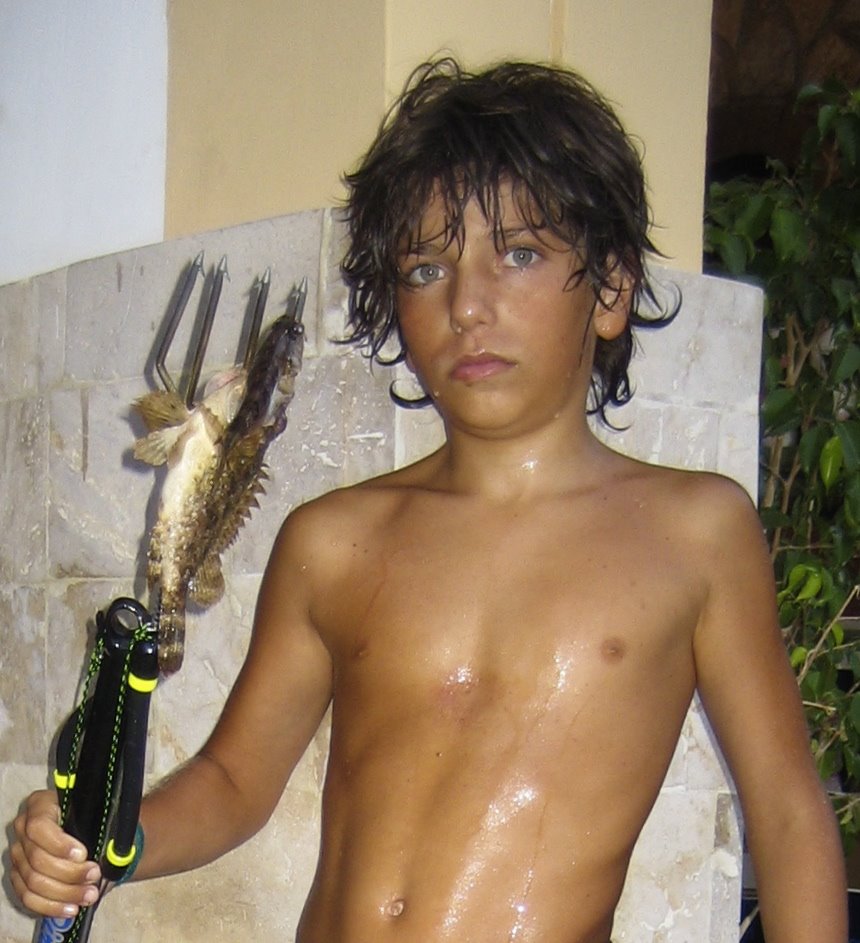
Late yesterday afternoon, twelve year-old Themelis Glinatsi took his harpoon and went hunting. An hour later, he brought home a scorpion fish which his mother, Irene, cooked for his supper. And that is about as basic as the process of living can get...


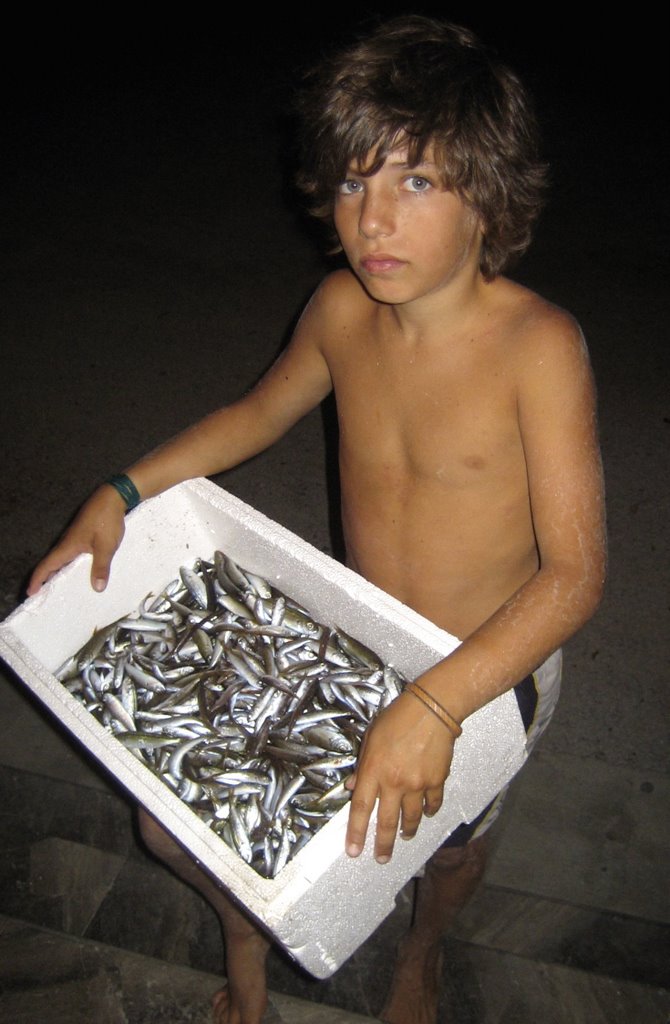
As a visitor, you may be forgiven for failing to notice the proximity of Themelis’ fishing expedition to the very primitive instincts that dictated the survival and evolution of Homo sapiens. But you can’t possibly fail to appreciate the pleasure of eating fresh-cooked whitebait that was swimming around the end of Emporios’ little jetty until, half an hour go, when Themelis fished them out and carried them - still flipping and twisting - into the kitchen at Artistico!

There is simply not the ritziest restaurant in London, Paris, Rome or New York that can offer its swankiest patrons with the fattest wallets a dish that is both as simple and yet as rare…

Thursday, 17 August 2006

GREEKS BEARING/WEARING GIFTS

This is Nikola Glinatsi, a huge fan of Peter Jackson’s The Lord of the Rings film trilogy, with the gift we brought him from Middle-earth via London: a personally inscribed photograph of Sir Ian McKellan as Gandalf. The look of delight says it all and the Glinatsi family are now ready to offer Kalymnian hospitality to Sir Ian any time he cares to stop by Artistico, their unique taverna at the heart of Emporios.


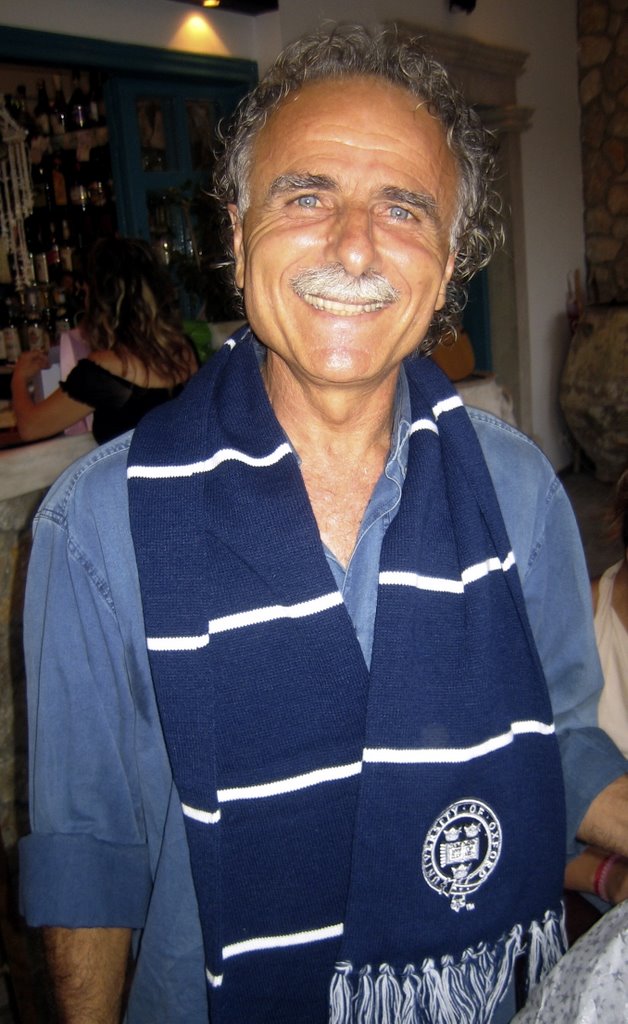
And this is Nikola’s father, George, who prides himself - it is one of his famous lines - on speaking “Oxford English”. Despite the fact that the temperature is 32 degrees, George sportingly sports the University scarf that we bought for him at his alma mater!

Wednesday, 16 August 2006

THERE! WE’RE HERE!

Minor stresses on the trip from Athens to Kos: travellers on eight flights simultaneously trying to go through security with all the usual volatile Mediterranean behaviour: queue-jumping, irate objections, raised voices, heated exchanges, semaphore-like waving of the hands and snorts of exasperation.

Security was scarily cursory and a teenage lad in front of me who was travelling with a Swiss Army knife was told he really wasn’t supposed to be carrying it on a flight and was then handed it back…

The small prop-plane was cramped and hot and delayed by half-an-hour while attempts were made to accommodate the CASES which people insisted on carrying as hand-baggage (weight limitations on hold luggage are just 15 kilograms instead of the usual 23 kilos) in tiny over-head lockers and under seats and which were, finally, hauled away to be accommodated somewhere in the tail area of the plane.

At Kos instead of the usual ferry we took the smaller, quicker Dolphin: a little boat that bounced and buffeted its way across the choppy waters (a high wind was whipping up the sea into white-capped waves) with water cascading over the luggage stacked in the back of the boat, inadequately protected by a large sheet of plastic vaguely secured by a medium-sized ROCK!

The one comforting thought for passengers was that if they felt at all bilious their needs had been thoughtfully catered for in the form of a plentiful supply of paper bags stuffed in a containiner on the cabin wall and marked in bold felt-tip pen - ‘EMETOY’!

And so, after a final taxi ride we arrived to a warm welcome from the Glinatisi family in Emporios.


Nikolas, the elder son, said (in his broken English but with his ever-charming smile): “You have come home!”

And, indeed, that is what it feels like…