Tuesday, 6 August 2013
THE LION, THE WITCH AND THE PUB-DOOR...
The work of a literate graffitist? Or knowing advice to passers-by from a seasoned explorer?
Who knows...
Of course, the first discoverer of Narnia, C S Lewis, was a man who was noted for enjoying a pint of good English ale, so maybe – just possibly – it's worth a try...
Next time you're passing, Roger, give the handle a bit of tug and see what happens. However, if it starts to open and you notice a few snowflakes drifting out, I'd check your travel insurance before going further...
Tuesday, 8 November 2011
LINES AND SQUARES
For example, why not...
Or, again, you could...

But, whatever we do, we were reminded, we absolutely MUST remember...

I wonder exactly when it was decided that one ought NOT to walk on the lines on the street?
Certainly if it wasn't down to A A Milne, he (with his penchant for bears) at least made it something of which every reader of When We Were Very Young became acutely aware through this little verse...
Whenever I walk in a London street,
I'm ever so careful to watch my feet;
And I keep in the squares,
And the masses of bears,
Who wait at the corners all ready to eat
The sillies who tread on the lines of the street,
Go back to their lairs,
And I say to them, "Bears,
just look how I'm walking in all the squares!"
And the little bears growl to each other, "He's mine,
As soon as he's silly and steps on a line."
And some of the bigger bears try to pretend
That they came round the corner to look for a friend;
And they try to pretend that nobody cares
Whether you walk on the lines or squares.
But only the sillies believe the talk;
It's ever so portant how you walk.
And it's ever so jolly to call out, "Bears,
just watch me walking in all the squares!"

The result was both illuminating and shocking according to CSI the website of the magazine Skeptical Enquiry.
Here (in their uncensored words) is the alleged origin of Christopher Robin's innocent bear-avoidance game:
Ill-fortune is said to be the result from stepping on a crack in the pavement. Present day society usually associates the superstition behind treading on cracks to the rhyme: "Step on a crack, break your mother's back" but the superstition actually goes back to the late 19th - early 20th Century and the racism that was prevalent in this period.The original rhyming verse is thought to be "Step on a crack and your mother will turn black." It was also common to think that walking on the lines in pavement would mean you would marry a negro and have a black baby. (Apparently this superstition only applied to Caucasians and because of the rampant prejudice against black people, was considered an activity to avoid.)
Stepping on cracks also had significance for children. In the mid-20th Century it was popular to tell children that if they stepped on the cracks in the street, they would be eaten by the bears that congregate on street corners waiting for their lunch to walk by. [Appallingly, no credit given to Mr Milne here! Ed]
Also, the number of lines a person would walk on corresponded with the number of china dishes that the person would break, later in the day.
Only in the last few decades has the rhyming superstition resurfaced to be the recognized "step on a crack, break your mother's back" and in some areas, two superstitions above are melded together to include the number of lines one steps on will correspond with the number of your mother's bones that are broken.
Original illustrations to When We Were Very Young (1924) by Ernest H Shepard
Sunday, 28 February 2010
SUPERCALIGRAPHIC...
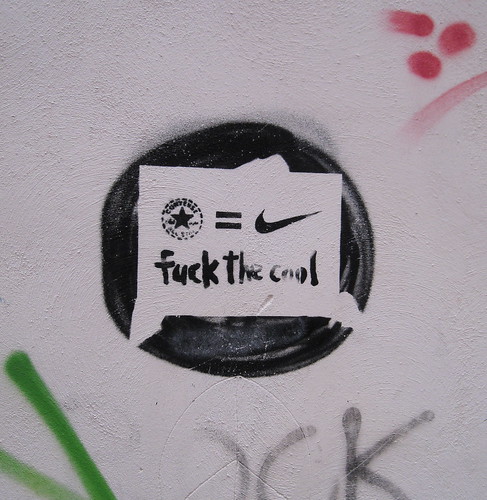
Here in Britain -- well, anyway, in the Surrey town of Epsom! -- we are much more restrained and refined in our graffiting!
Does this mean that Banksy is finally going soft?