Showing posts with label E H Shepard. Show all posts

Sunday, 17 March 2019

BEETLEMANIA!

Chris Beetles Gallery, my favourite selling art gallery, has just had a website face-lift making its extraordinarily diverse stock of artworks more tantalizingly accessible to the the online gallery-goer.

Former doctor, watercolour expert, past and present collector, Chris Beetles is an idiosyncratic dealer in English watercolours, illustrations, cartoons, photography and oils. In a profile, a few years ago, Renaissance: The Fine Art Collector, wrote: "If you want to buy a beautiful 19th century Edward Lear watercolour, an original Quentin Blake from a classic Roald Dahl book, an up-to-date Matt cartoon from the Daily Telegraph or a stunning Norman Parkinson photograph from the pages of Vogue, then this is the place to visit with everything just 'waiting in the wings'. It is virtually impossible to enter this venerable, approachable and reassuringly British gallery without adding to your collection. This also makes it the perfect place to start one…"

As a regular visitor (in real and virtual time) to Chris' gallery – and as a sometime (very modest) collector – I have, for many years, enjoyed the opportunity to discover more about the joys of many aspects of art and, in particular, those that are almost universally ignored by our great art institutions and, indeed, most commercial galleries too: illustration art, cartoons and caricatures. 

At Beetles' London gallery – 10 Ryder Street in the heart of  St James’s – I have met the aforementioned Quentin Blake, fellow illustrators Michael Foreman, Helen Oxenbury, John Burningham and others and enjoyed brilliant exhibitions either devoted to the work of specific artists or, in his legendary annual Illustrators blockbuster where an astonishing variety of graphic artists are hung shoulder to shoulder among them Mervyn Peake, Ronald Searle, Rowland Emett, Mabel Lucy Atwell, Arthur Rackham, Charles and William Heath Robinson, Eric Fraser, Al Hirschfeld, Lawson Wood, George and Eileen Soper, Edward Ardizzone, Norman Thelwell and Louis Wain.

The rejuvenated gallery website allows the visitor to browse its extensive collection by artist A to Z or by area of interest from 'Victorian' to 'American', from 'Cartoons' to 'Decorative Arts', 'Prints and Etchings' to 'Literary Manuscripts' or, in these days of Brexit uncertainty, 'Early English' to 'European'!

You can explore the current exhibitions featuring the vibrant paintings of Geraldine Girvan and a bicentennial celebration of the work of John Ruskin, reflecting on the work of artists who either helped him hone his aesthetic and skills or who received his praise and support.

Enthusiasts can also create a 'My Beetles Wall', a personal exhibition space on which to display your favourite exhibits.

I won't keep you further from your exploration of the delights in store, but I will just encourage you further to visit with a handful of fantastic images currently available to pursue or maybe, depending on your bank balance, take home to hang on your wall!

 Arthur Rackham

 Al Hirschfeld

 William Heath Robinson


Lesley Anne Ivory

 Edward Ardizzone

 Kathleen Hale

Eric Fraser

 Lawson Wood

 Michael Foreman


George Soper

 Mervyn Peake

 Paul Cox

Ronald Searle

E. H. Shepard


You can also visit Chris Beetles Gallery in person (Monday - Saturday, 10am - 5.30pm) at: 

8 & 10 Ryder Street, 
St James’s, 
London 
SW1Y 6QB

Saturday, 18 November 2017

HUSH, HUSH, WHISPER WHO DARES...


I've just noticed that the DVD of Goodbye Christopher Robin is online as a pre-order item which reminds me that I never wrote about the film when it opened, despite having attended the premiere.

The film garnered mixed – indeed polarised – reviews with critiques ranging from:
"Goodbye Christopher Robin touches something bigger than its own ambitions. It touches, in a way movies rarely do, on some essential current of life" to "The film's main conflict is with its source material, twisting and wringing A A Milne's life for everything it's worth and hoping enough is squeezed out to qualify as a film"; and from "the movie's focus on the caustic effects of celebrity make this narrative set in the first half of the 20th century particularly relevant for the media-frenzied 21st" to "everything in this too-too movie feels overfermented, off".

For me, watching the film was a curious experience, mainly because I know too much about the subject. I have a written books, radio plays and programmes touching on the movie's story-line, as well as having known the 'real life Christopher Robin' and corresponded with his mother, his nanny and the artist, Ernest H Shepard who drew the unforgettable illustrations. So, my judgement is probably tainted with both too much knowledge of How Things Actually Were and an abiding affection for the collaboration between Milne and Shepard that created two books of verses about 'Christopher Robin' (and other children) and two books of stories about Winnie-the-Pooh, Piglet, Eeyore and the rest of the inhabitants of the 100 Aker Wood that have been literally life-long friends.

Trying to view the film dispassionately is, therefore, quite difficult. But let me try...

The first thing that needs to be said is that the scenario dexterously walks the perilous tightrope between sentiment and sentimentality; and the screenplay – by the absurdly talented Frank Cottrell-Boyce – merges the factual with the fictional while deftly coping with the difficulty of not being able to quote from the books (due to their being the copyright property of the Disney Company) while providing sufficient memory-triggering imagery to take our minds to where the screenwriter wants us to be. So, for example, a scene in which Mr Milne and his young son track their own footsteps through the snow carries us back to a snowy spinney where Pooh and Piglet do something similar without once having to mention the word 'Woozle'.

Simon Curtis has a light but sure hand on the directorial tiller and is served well by his cast: Domhnall Gleeson and Margot Robbie as Alan and Daphne Milne – the former abstracted by shattering experiences from the First World War, the latter a rather self-absorbed '20s socialite – Kelly Macdonald as Olive, the nanny who is closer to the Milne's child than they are, and young Will Tilston (a stunning debut) as the 8-year-old Christopher and Alex Lawther as his, later, 18-year-old self.

The photography by Ben Smithard is full of great beauty – the authentic across-the-seasons Ashdown Forest settings are achingly exquisite featuring the genuine Poohsticks Bridge and the Milne's actual country home, Cotchford Farm.


Some quibbles are inevitable (from a veteran Poohologist) and are easily explained by the need of charactersation and dramatic tension, but it was hard to accept the 'chummy' friendship between Milne and Shepard who – despite their common experiences during the Great War – were never close friends but only ever professional collaborators; and, whilst there is hardly a photograph or portrait of Milne where is depicted without his pipe, there's not a whiff of 'Old Holborn' evident in this writer's study. No doubt the same restrictions on certification meant that the society cocktail party in the film is a similarly smoke-free zone.

But, as I say, these are trivialities (as is the curious decision to give the clean-shave Shepard an unnecessary moustache); however, my overwhelming concern (is that too extreme a word?) about Goodbye Christopher Robin is the way it has impacted on the Truth, whatever that is...

The thing is: the film is the story of how celebrity distorted the life of the title character by fictionalising the young Christopher Milne into that literary character 'Christopher Robin' who said his prayers, went to watch the Changing of the Guard at Buckingham Palace and lived in a tree in the middle of the forest with talking animals.

The film asks us to mourn the cost of that distortion (whilst simultaneously celebrating the brilliance of the books that resulted from it) but in doing so, Goodbye Christopher Robin inevitably fictionalises the story yet again, taking it further from, not closer to, the truth. The image of A A Milne sitting on the top of the Ashdown Forest alongside his son – interchangeably as a child and as a man – suggests a sense of understanding and reconciliation between them that is an emotionally satisfying coda, but one that is basically, and sadly, untrue.


The balance is redressed by the fact that my friend and Pooh-colleague, Ann Thwaite who, in 1990, wrote the definitive biography of A A Milne has now written a new book with a partially-similar title to the film, Goodbye Christopher Robin: A A Milne and the Making of Winnie-the-Pooh.

The book tells the story as it really was, completing the picture with a fuller understanding of who Milne was (his reputation – now largely forgotten – as a premier Punch humorist, essayist, writer of light and a hugely successful West End and Broadway dramatist) and what made him tick, his relationship with Daphne ("I married her because she laughed at my jokes") and the impact of the social mores existing among the upper and upper-middle classes of the 1920s which often resulted in the bond between child and nanny that had greater resonance than between child and mother.


Anne's full biography is also still in print, A A Milne: His Life, as is Milne's own account of How-Things-Were (just reprinted) It's Too Late Now: The Autobiography of a Writer.

And anyone who really wants to know what it was like growing up and growing older as 'Christopher Robin' should read Christopher Milne's brilliantly written reflection – by turn, sharply painful and deeply moving – The Enchanted Places: A Childhood Memoir which, thanks to the film, is back in print.

 
Also recently published is James Campbell's The Art of Winnie-the-Pooh: How E H Shepard Illustrated an Icon containing a exceptional gallery of illustrations – many published for the first time – but which is so riddled with errors of identification, as to make the book anything but the last word on Shepard's artistry and his contribution to the mythology of the 100 Aker Wood.

And, finally, anyone seeking more news on Pooh can always consult my own Three Cheers for Pooh...


Wednesday, 14 October 2015

BIRTHDAY BEAR!

So Owl wrote... and this is what he wrote:
 

HIPY PAPY BTHUTHDTH THUTHDA BTHUTHDY.
 

Pooh looked on admiringly.
 

"I'm just saying 'A Happy Birthday'," said Owl carelessly.
 

"It's a nice long one," said Pooh, very much impressed by it.
 

"Well, actually, of course, I'm saying 'A Very Happy Birthday with love from Pooh.' Naturally it takes a good deal of pencil to say a long thing like that."
 

"Oh, I see," said Pooh.
On the 14 October, 1926, the publishing firm of Methuen & Co., published a  new book by A A Milne featuring a Bear of Very Little Brain named ––– yes, of course! Winnie-the-Pooh.

So, today is Pooh Bear's 89th birthday! Who would have believed a diet of Hunny and regular games of Pooh sticks could keep a Bear so young in heart?


As it happens, today is – for me – a equally important milestone. From the earliest days of childhood, Pooh was my boon companion: I love him and his hums – and his friends in the 100 Aker Wood: nervous Piglet, gloomy Eeyore, bossy Rabbit, punctilious Owl, fussy Kanga, excitable Roo and, of course, the ever-bouncy Tigger –– all perfectly depicted in the incomparable illustrations of E H Shepard.


I kept my affection for Pooh and company across the years and when, 39 years ago, I sold my very first radio programme to the BBC, it was a celebration of Winnie-the-Pooh's 50th birthday.

Three Cheers for Pooh was broadcast, on this day, in 1976. The programme was presented by actor (and Teddy Bear aficionado) Peter Bull (with whom I had become friends some years earlier) and featured veteran BBC actor, Norman Shelley (the BBC's original voice of Pooh) and another dear friend, the talented singer, pianist and broadcaster, Anthony Miall.

It's very old but it still has some charm (I think) and I'm very fond of it because it launched my radio writing and broadcasting career. Not only that, but it's about Pooh!


Thursday, 19 December 2013

GREETINGS FROM TOAD HALL

Here's an old Christmas card which I've put on display amongst this year's current crop of greetings.

Based on a card design by E H Shepard, this scene showing Toad, Rat, Mole and Badger providing seasonal music for two watching children was originally sent to subscribers to the Reprint Society in 1954 to announce the fact that Kenneth Grahame's The Wind in the Willows (illustrated, of course, by Shepard) was their 'Christmas extra volume' for the year.

I really like the idea that, having rescued Toad Hall from the stoats and the weasels, Mr Toad's new 'fad' is nothing more adventurous than playing the tuba in the village band!


Monday, 14 October 2013

POOH PERFECT

Today is Winnie-the-Pooh's 87th birthday – if you date his literary origins from his first appearance under that name – and 'under the name of Sanders' in A A Milne's book, Winnie-the-Pooh, published on this day in 1926. 

Mind you, he had already made his bow, two years earlier, in When We Were Very Young, under the rather less impressive moniker, 'Teddy Bear'.

I shall be celebrating 'The Best Bear in All the World' (as Christopher Robin calls him) this evening with a talk to the members of the famous Garrick Club of which Milne was a member and, though royalties on his books, a major benefactor.

Entitled Mr Milne, Mr Shepard and that Bear of Very Little Brain, it will look at Pooh's history and the contributions of AAM, his son, Christopher (who was responsible for Pooh before the bear started having adventures in the '100 Aker Wood') and illustrator Ernest H Shepard who drew the pictures that are now as integral a part of the books as the words they decorate.

Here, to mark the event, is a suite of three Shepard illustrations for Pooh's second book, The House at Pooh Corner (1928), which were originally owned by my friend the artist and illustrator, Pauline Baynes, and came to me after her death. 

Shepard drew a series of five illustrations depicting Pooh's friend Piglet plating a 'haycorn' and of these three, only the central drawing was used in the book along with two others of Pooh planting the haycorn and jumping up and down on the earth once the hole had been filled in.

This the first time these previously unseen pictures have been published...


Thursday, 19 April 2012

THE TRUTH ABOUT POOHSTICKS

Currently on show at Chris Beetles Gallery is an exhibition of cartoons and caricatures by Bill Hewison, Ed McLachlan and Mike Williams Three of the ALL-TIME Great Gag Artists of PUNCH.

One of my favourite gags from the collection is this cartoon by Williams (after a former Punch artist, E H Shepard)...


To see more of the same – and different – click here.

The exhibition remains on show until 5 May 2012.

Chris Beetles Gallery, 8 & 10 Ryder Street, St James's, London, SW1Y 6QB
Telephone: 020 7839 7551

Gallery Opening Times: Monday - Saturday, 10:00 - 17:30pm

Tuesday, 8 November 2011

LINES AND SQUARES

On a nearby building-site – in an attempt to make the place look more attractive than building-sites usually look – colourful hoardings were erected and were specially graffitied with helpful suggestions on how to brighten up our otherwise hum-drum Kennington lives.

For example, why not...


Or, again, you could...


But, whatever we do, we were reminded, we absolutely MUST remember...


I wonder exactly when it was decided that one ought NOT to walk on the lines on the street?

Certainly if it wasn't down to A A Milne, he (with his penchant for bears) at least made it something of which every reader of When We Were Very Young became acutely aware through this little verse...


Whenever I walk in a London street,
I'm ever so careful to watch my feet;
And I keep in the squares,
And the masses of bears,
Who wait at the corners all ready to eat
The sillies who tread on the lines of the street,
Go back to their lairs,
And I say to them, "Bears,
just look how I'm walking in all the squares!"

And the little bears growl to each other, "He's mine,
As soon as he's silly and steps on a line."
And some of the bigger bears try to pretend
That they came round the corner to look for a friend;
And they try to pretend that nobody cares
Whether you walk on the lines or squares.
But only the sillies believe the talk;
It's ever so portant how you walk.
And it's ever so jolly to call out, "Bears,
just watch me walking in all the squares!"


A few hours after posting innocent piece of flummery above, I was driven by my insatiable curiosity (and readers of Kipling will recall where insatiable curiosity inevitably leads) to start trawling the net in search of a pre-Milnean origin for Linesofthestreetphobia!

The result was both illuminating and shocking according to CSI the website of the magazine Skeptical Enquiry.

Here (in their uncensored words) is the alleged origin of Christopher Robin's innocent bear-avoidance game:
Ill-fortune is said to be the result from stepping on a crack in the pavement. Present day society usually associates the superstition behind treading on cracks to the rhyme: "Step on a crack, break your mother's back" but the superstition actually goes back to the late 19th - early 20th Century and the racism that was prevalent in this period.

The original rhyming verse is thought to be "Step on a crack and your mother will turn black." It was also common to think that walking on the lines in pavement would mean you would marry a negro and have a black baby. (Apparently this superstition only applied to Caucasians and because of the rampant prejudice against black people, was considered an activity to avoid.)

Stepping on cracks also had significance for children. In the mid-20th Century it was popular to tell children that if they stepped on the cracks in the street, they would be eaten by the bears that congregate on street corners waiting for their lunch to walk by. [Appallingly, no credit given to Mr Milne here! Ed]

Also, the number of lines a person would walk on corresponded with the number of china dishes that the person would break, later in the day.

Only in the last few decades has the rhyming superstition resurfaced to be the recognized "step on a crack, break your mother's back" and in some areas, two superstitions above are melded together to include the number of lines one steps on will correspond with the number of your mother's bones that are broken.


Original illustrations to When We Were Very Young (1924) by Ernest H Shepard

Monday, 25 April 2011

DE-TAILING

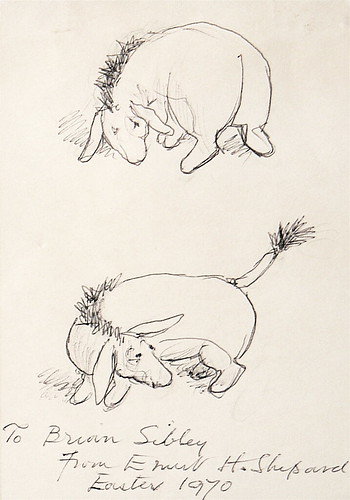
Here's an Easter greeting I received (can this really be true?) forty-one years ago!

A drawing by Ernest H Shepard – illustrator of A A Milne's Winnie-the-Pooh and Christopher Robin books – depicting my favourite character, Eeyore the old grey donkey and the tail that was lost and regained...

"Oh, Eeyore!"


True the line is a little shaky, but Shepard was 90 years old at the time and it was over forty years since he had drawn his original pictures of Eeyore, Pooh and the other denizens of the 100 Aker Wood.
"What's happened to your tail?" [Pooh] said in surprise.

"What has happened to it?" said Eeyore.

"It isn't there!"

"Are you sure?"

"Well, either a tail is there or it isn't there. You can't make a mistake about it, and yours isn't there!"

"Then what is?"

"Nothing."

"That Accounts for a Good Deal," said Eeyore gloomily. "It Explains Everything. No Wonder."

"You must have left it somewhere," said Winnie-the-Pooh.

"Somebody must have taken it," said Eeyore. "How Like Them," he added after a long silence.

Thursday, 10 December 2009

THE MAN WHO DREW POOH (and MOLE)

Today is the 130th birthday of Ernest Howard Shepard, the artist and illustrator who captured in line those now immortal creations of A A Milne and Kenneth Grahame who resided, respectively, in the 100 Acre Wood...


...and along the willow-shaded banks of the Thames...


Shepard died in 1976 in his 96th year and lies at rest in the graveyard of St Peter's Church, West Sussex...

Click on image to enlarge

His simple stone is engraved with a painters palette hanging on a willow tree flanked by Mole and Toady.


Images: Illustrations by E H Shepard; Shepard's grave photographed by Charles for Wikipedia


Wednesday, 14 October 2009

IMPOOHSONATIONS

Thirty-three years ago, today (to save you counting that was 1976), the BBC very kindly broadcast my first-ever radio programme called Three Cheers for Pooh in celebration of Certain Significant Birthday.

To explain: fifty years earlier (and for those without sufficient fingers, that was 1926) A A Milne had written a book entitled
Winnie-the-Pooh. It was inspired by his son's teddy bear of the same name and it had wonderful decorations by the artist and illustrator, E H Shepard.

Because everyone enjoyed the stories and pictures about Pooh and his friends in the '100 Aker Wood', Mr Milne and Mr Shepard put together another volume, two years later, going under the title of
The House at Pooh Corner.

Eighty-something years on - or, to put it another way, nine days ago - we saw the publication of Return to the Hundred Acre Wood, a sequel to Mr Milne's books written by David Benedictus and illustrated (after the style of Shepard) by Mark Burgess.

In view of all of which, I should like to offer my readers, a newly discovered episode in the life of the Bear of Very Little Brain...


Chapter Ten-and-a-Half

In which Winnie-the-Pooh discovers that
whereas they had been two they were now three

Winnie-the-Pooh was counting. The only counting Pooh usually did involved checking how many honey pots there were - or sometimes, disappointingly, weren't - in his cupboard. Today, however, which happened to be his birthday, Pooh was counting books.

"That's strange," said Pooh to himself, rubbing his nose thoughtfully with his paw, "because there have only ever been Two for as long as I can remember (and I can't remember how long that is) but now there are Three which is one more than there ought to be. And that is what I call very strange."

"What is?" asked Piglet who had just arrived at Pooh's house to see whether it was the sort of day when Something Exciting might be going to happen or whether it was just one of those days where nothing really happened which would be even better, provided he and Pooh were together when it wasn't happening.


"It's puzzling," said Pooh, puzzled.

On the table were three books that all looked very similar. Piglet looked at them.

One was called Winnie-the-Pooh, which of course Piglet knew was Pooh's name, although he also knew that it had stories in it about him - Piglet - including one in which for a shortish time he went under the name of Henry Pootle.

The book next to it had rather more words on the cover, but Piglet knew, because Christopher Robin had told him, that it said The House at Pooh Corner and he knew that he was in that book too, especially in a story about how he had done a Very Grand Thing.

And then there was a third book...

"Where did that come from?" asked Piglet, understanding now why Pooh was puzzled.

"Just what I ask myself, " said Pooh.

And just as Pooh was asking himself that question, Owl arrived because he had heard about the very puzzling situation concerning Pooh's Books from Eeyore the old grey donkey (who had heard it from two of Rabbit's Friends and Relations, Late and Early) and decided it was one of those times when Someone with a Mind was called for.

Owl turned the third book round several times so that he could get a good look at it first sideways and then upside down and eventually announced that it was called Return to the Hundred Acre Wood which sounded like a railway ticket that Christopher Robin had showed him once when he had come back from the seaside.

It was just about then that Rabbit bustled in with a very worried look on his face. "Owl," he said importantly and then added "And Pooh," and then, noticing Piglet, "And Piglet... We are not alone!"

Pooh looked round in case maybe Kanga and Baby Roo had come along too or perhaps Tigger had bounced into the room without his noticing, although it was almost impossible not to notice Tigger even when he was trying not to bounce.

"No, Rabbit," said Pooh, "you are mistaken. We are alone, if you can be alone, that is, when there are three of you."

"Four!" said Rabbit crossly. There are four of us here, Pooh, or can't you count?"

"Not very well, lately," replied Pooh, "I was just saying to myself before the rest of you arrived, there used to be only Two Books about me and all of us in the Forest and now there are Three!"

"And that's not the worst of it," said Rabbit, dramatically seizing the third book. "There's a story in here about an Otter."

A what-er?" asked Pooh.

"It's an animal," explained Rabbit, "like us only different. It's a mustelid."

"A Mustard Lid?" asked Pooh, getting very confused.

"Well," said Owl, "that explains it! Everyone knows that Mustard is One of the Hotter Condiments."

"Not hotter," said Rabbit, who was beginning to lose his patience, "Otter! They live in rivers and are related to weasles."

"I think you mean Woozles," put in Pooh who had once tracked a Woozle-that wasn't."

"But, according to this book," persisted Rabbit, "there is an Otter is called Lottie who is supposed to be One of Us."

Rabbit waited for this information to sink in before going on.

"I have conducted a Thorough Check," went on Rabbit, "and asked all my Friends and Relations - including Small who is always going missing and tends to Finds Things Out while trying to find his way back - and all of them say the same thing."

"And what is that?" asked Owl.

"That this character - and, therefore, I suspect, the entire book - is a Fraudulent Deception!"

Piglet was just asking Pooh, in a whisper, what a Fraudulent Deception was and whether it was larger than a Heffalump and had teeth at the sharp end, when Eeyore arrived.

"Does anyone know anything about this new book?" he asked. "Not that I'm bothered, because I don't suppose I'm in it and, even if I were, it would only be by mistake, just because I had happened to wander in, rather like now, and sat down on one of the pages. You don't mind if I sit down, do you Pooh, even though you haven't actually asked me?"

Pooh said Eeyore was welcome to sit down and Eeyore did so, muttering to himself, "A little consideration for others, a modicum of thoughtfulness what does it cost? Nothing and Everything!"

"Of course," said Owl, ignoring Eeyore's interruption, "you could say that Imitation is the Sincerest Form of Flattery."

Leafing through the book and chuckling to himself, Owl added, "For example, there are several things in here said by Eeyore which, as far as I know, he hasn't ever said, but could have and might have done if he'd only thought of them!"

"Typical!" sighed Eeyore. "They take your words and twist them to make them say whatever they want them to say. But what does it matter? After all, it's only Eeyore!"

"Anyway," said Rabbit with an irritated moving-on kind of cough, "the important thing to decide is what are we going to do about it."

"Let's ask Christopher Robin," said Piglet just as Christopher Robin walked through the door.

"About this book," began Pooh, "that wasn't One of the Two but is now a Third..."

"It really doesn't matter much," replied Christopher Robin, "because I learned in sums that three into two doesn't go, so that settles it."

And suddenly everyone felt much happier about everything.

"And, now," went on Christopher Robin, "I really think it's time for a little Smackerel of Something, because today is Winnie-the-Pooh's birthday!"

Which is exactly what they had, except for Pooh who had a Rather Large Smackerel of Something which, in Pooh's case meant the entire contents of a not-exactly-small jar of honey.

And when Pooh tipped up the pot - just to check that the honey went right down to the bottom of the jar, which it usually does, but you never can tell - several largish dollops of honey got dolloped, quite by accident, onto the copy of Return to the Hundred Acre Wood so that the pages got all stuck together and everyone knew, without actually Saying it Out Loud, that they would never have to open it again...


HAPPY BIRTHDAY, POOH BEAR!

Images: Illustrations by Mark Burgess (in the style of E H Shepard) from Return to the Hundred Acre Wood © 2009


Tuesday, 2 June 2009

IN WHICH WE SAY 'GOODBYE'

When I was a young, struggling writer, I eked out my scanty income by writing obituaries for The Times. These were not tributes to people who had died, but to people who were going to die - at some point in the future.

All newspapers keep obituaries of notable people on file against the day when they are required and I cornered the market in preparing obits on a number of illustrators, cartoonists and animators. What was especially good about the arrangement was that they paid for the pieces up-front, then and there - you didn't have to wait until the person died to collect your fee!

Every now and then one of these early obituaries still surface. For example, when Charles (Peanuts) Schulz died, a few years ago, I was pleased to see, that the Times obituary was mine, even though the paper's policy of anonymity for its obit-writers meant that only I (and the Times obits editor) was aware of the fact.

Nowadays, as an aging, struggling writer, I find that I am, once again, writing obituaries, though, sadly, these tend to be tributes to personal friends. Happily, at least, they usually now appear in the pages of newspapers where authorship is credited.

The latest of these appeared in last Saturday's edition of The Independent and was a tribute to the actor Peter Dennis who became a friend thirty years ago when we both attended an event at the London Zoo where a sculpture was unveiled commemorating the sometime presence on the Zoo's famous Mappin terrace of a bear called Winnie who very kindly loaned her name to another bear (of Very Little Brain) called Winnie-the-Pooh - or Pooh for short.

I was there by virtue of the fact that I was something of a Milne/Pooh expert (Joan Bakewell once referred to me on a TV programme as *shudder* a "Poohologist") and Peter was there because he had made a name for himself with a one-man show based on the Pooh stories called Bother!

The unveiling was performed by the incredibly shy Christopher Milne (the original - poor chap! - 'Christopher Robin') and Peter read a chapter from one of Christopher's father's books. At lunch afterwards, Peter and I found ourselves seated on either side of Mr Milne and it was to be the beginning of a long friendship.

As an actor, Peter played in just about everything from Shakespeare to panto as well as many modern dramas. J B Priestly, after seeing him as Stanton in his play Dangerous Corner, wrote to say he had given the finest ever performance in the role, and he became well known for his TV roles such as the family butler, Sutton, in Hadleigh, the popular series, starring Gerald Harper.

However, it was his readings of the Pooh stories that endeared him to audiences at the Edinburgh Festival, at private soirées in the Palace of Westminster and before vast audiences at the Hollywood Bowl.

What is fascinating about Peter's success is that it came about almost accidentally. It was in 1969 that a friend took the then 36-year-old actor to an exhibition of the work of Milne’s illustrator, E H Shepard, at the Victoria and Albert Museum in London and, somewhat belatedly in life, he was introduced to Christopher Robin and his fiends in the 100 Aker Wood.

Click image to enlarge

Having lived what he described as a “joyless childhood” without the companionship of books, Peter had never encountered the Milne classics but, when he did, it was love at first reading and the seed was sown for what would become a career bringing the stories and verses alive for others.

As I note in my obituary...

Many actors have recorded Milne’s stories [among them Alan Bennett, Willie Rushton, Lionel Jeffries, James Stewart, Robert Shaw and Carol Channing] but none have captured the author’s sharply defined characters and sly, ironic wit as successfully as Dennis. His vocal characterisations were a delight: the ponderous thought processes of Pooh; the jumpily anxious conversation of Piglet (peppered with grunts and snorts); the lugubrious melancholy of Eeyore; the clipped, efficient, tones of Rabbit and the pompous grandiloquence of Owl. Equally successful was his matter-of-fact delivery, devoid of both the cloying sentiment often associated with the books and the strident brashness that came with their Disneyfication.


Peter made an acclaimed series of broadcasts and then recordings of all the Pooh stories and Christopher Robin verses and, during the last months of his life - while heroically fighting cancer - he recorded readings of Christopher Milne's remarkable autobiographical volumes, The Enchanted Places and The Path Through the Trees.

Peter was a very particular talent and a very particular friend and I already miss his irrepressible Tigger-like exuberance for life.

You can read the full obituary here.

And you can find out more about Peter (and listen to extracts from his recordings) here and (at the bottom of the page) here.

Images: Photo by David Weeks; Map of Pooh's World by E H Shepard

Tuesday, 3 March 2009

MAGNETIC ATTRACTIONS

I seem to have gathered rather a lot of fridge magnets over the years and looking at them the other day, I realised that they represented a kind of saga of my life (and the lives of my friends) over the last decade or two.

Click on images to enlarge

So I thought I'd make a small, but representative, selection of the dozens of magnets currently on display, relieve them of the notes and out-of-date vouchers they normally keep in place and share with you their origins which turn out to be quite international...


Top Row (left to right): A pair mini-clogs featuring Miffy, the rabbit created by the Dutch artist and writer, Dick Bruna.

Cartoon of David by a caricaturist with whom he worked at some corporate dinner. She caught something of his character really rather well: the impish twinkle, perhaps, just before he produces your chosen card!

One of Oscar Wilde's cleverisms purchased in the shop at London's National Portrait Gallery on a trip there with our friends Val and Michael..

I'm not sure where I got the ceramic dodo, but I've always had a kind of empathy with these absurd, hapless birds so cruelly condemned to extinction by unthinking Man.

Second Row: Ena Sharples (a memorable early character in Coronation Street, played by Violet Carson) from the shop at Granada Studios in Manchester, during a visit there with my best mate, radio producer, Malcolm Prince, when we were making a series about soap operas. Alas, the Studio Tour is now sadly closed to visitors.

Las Vegas bottle opener brought back from the Strip by my old pal, Irascian. Decorative and functional - the gift, I mean, although the same could also be said of the giver!

Souvenir of The Living Seas pavilion in EPCOT Center, Walt Disney World, Florida, the opening of which I attended with my good friend and fellow Disney historian, Richard Holliss. You won't find Mickey Mouse there these days as it's been re-vamped as The Seas with Nemo & Friends. Hmmm...

Keepsake from Hearst Castle, San Simeon, California, the fabulous, fanciful home of William Randolph Hearst who was the original inspiration for Charles Foster Kane in Citizen Kane. It was bought on a unforgettable visit with the aforementioned Malcolm Prince when we were driving from San Francisco to LA during the making of a radio series about Walt Disney.

Kangaroo decorated by an aboriginal artist bought in The Rocks Market, Sydney Harbour, en route to New Zealand on Rings business.

The Wicked Witch from The Wizard of Oz, although I'm not sure where she came from -- other than the West, obviously!


Third Row: Rocket from the Tintin adventures Destination Moon and Explorers on the Moon bought at a Hergé exhibition which David and I visited at the Centre George Pompidou, Paris.

John Tenniel's Humpty Dumpty (from Lewis Carroll's Through the Looking Glass) bought from that Carrollian cornucopia in Oxford known as Alice's Shop.

A stylised representation of the classic Doric architecture of Paestum, brought back from Italy for us by Richard and Chris Holliss. A reminder that whilst we know Venice like the back of our hand, most of Italy is, well, a foreign country to us...

"Aah, Bisto!" The classic 'twenties advertisement featuring the Bisto Kids by cartoonist Wilf Owen. This came from the nostalgia section of the shop in the Imperial War Museum. Not being a great lover of planes, tanks and guns, I'm afraid I spent most of my time in the shop!

100% Toro from Spain, courtesy of our own dear Polkadotsoph. Like all great logos, it's 100% simple and effective.

Bottom Row: Edinburgh Festival poster from our last visit in 1997 - goodness, is really that long ago?

One of a set of magnets given away with Findus frozen products in 1992 when Disneyland Paris had just opened and was still known as EuroDisneyland. Of course I have the complete set (God knows how many packets of fish fingers I had to get through!) but this magnet is of my favourite section of the park, Fantasyland, and features Peter Pan.

E H Shepard's Pooh and Piglet (though manufactured under license from Disney, naturally!) with a caption that I used to try and heed when approaching the fridge in the days of my diet! I must start looking at it again!

Athena's Owl from a tat-shop in the Plaka, Athens. True, the head is too big - but then maybe that's due to all the wisdom crammed within!

Memento of the Jurassic Park attraction at Universal Studios in Los Angeles, visited during yet another American jaunt with Mr Prince. "Was this work?" you ask. Well, let's just say it was research!

This is, believe me, only a fraction of the stuff on our refrigerator. I'll give you a further tour another day.

In the meanwhile, why not tell me - or show me - what's on your fridge?

*

Oh, yes, and happy birthday greetings today to Sibley-blog regular, Boll Weavil...

Many Happy Returns, Boll!