One hundred and sixty-three years ago, today, the Reverend Charles
Lutwidge Dodgson and an Oxford colleague, the Reverend Robinson
Duckworth, took the three daughters of the Dean of Christ Church –
Lorina, Alice and Edith Liddell – on a boating trip.
As
they rowed along on that 'golden afternoon', Dodgson improvised a fantasy about the curious
adventures of a little girl named (like one of the girls on the trip)
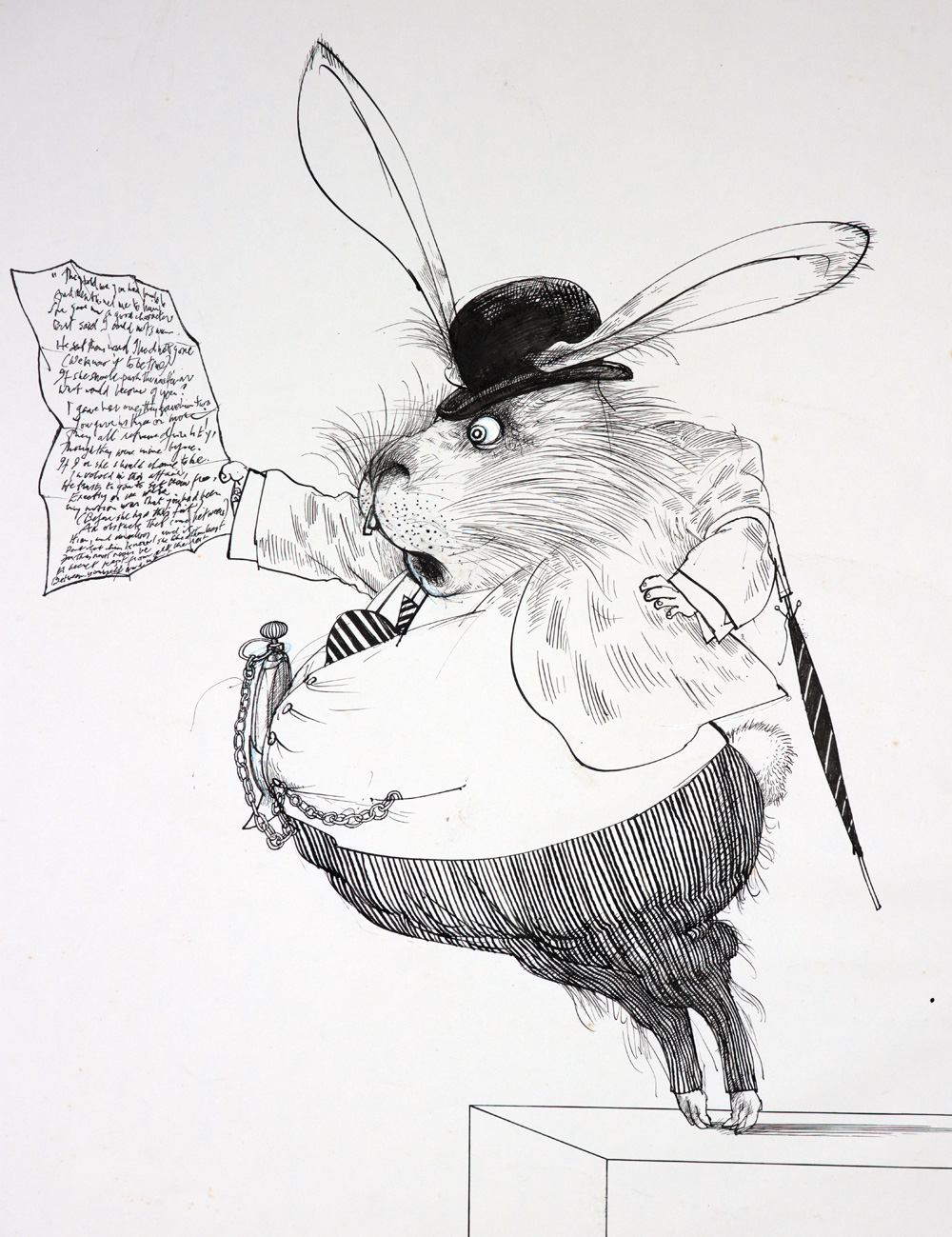
'Alice', who followed a White Rabbit in a waistcoat with a watch down a rabbit-hole and found
herself in a true land of wonders...
At Alice’s request, Dodgson wrote out the story – first calling it
Alice’s Adventures Under Ground – and added his own distinctively idiosyncratic illustrations.
By 1865, it had grown (like someone who had nibbled an EAT ME cake) into
Alice’s Adventures in Wonderland and was published under the authorship of 'Lewis Carroll' with illustrations by the legendary
Punch cartoonist, Sir John Tenniel.
The
book was made Mr Dodgson’s alter ego one of the most famous men in
Victorian England. It also revolutionised children’s literature by
abandoning, at a stroke, the long and piously-held tradition of
moral-and-improving tales for the young in favour of zany, witty
nonsense that had no underlying message other than fun...
Across the succeeding years, Alice has been endlessly reinterpreted by illustrators and filmmakers...
Mervyn Peake (1946)
Tove Jansson (1966)
Salvador Dali (1969)
Ralph Steadman (1973)
Walt Disney (1951)
Walt Disney & Tim Burton (2010)
July
the 4th is also, of course, American Independence Day and – apart from over fifty years of Disney influence – it is
interesting to note how many true literary successors to Lewis Carroll have sprung up in America,
among them: L Frank Baum, James Thurber, Ogden Nash and Maurice Sendak.
But then perhaps this
shouldn’t really surprise us, since the Americans have always shown
themselves to be far greater lovers and defenders of Wonderland (and
Looking-glass World) than the English have ever been…
Maybe
there are reasons for this affinity between the American sensibility
and Carroll’s nonsense realm: for one thing, Alice is a highly
independent and self-determining individual (a truly revolutionary
notion
for a child’s book of the 1800s); for another, the Wonderlanders with
whom she mixes are a wildly disparate conglomeration of diverse species –
animals, humans, animals-dressed-as-humans and humans-with-animal-masks
– all of whom (for the most part) rub along together but who are,
together, fiercely territorial!
I find it fascinating – and humbling – that, in 1948 (by which time the original manuscript of
Alice’s Adventures Under Ground
had been sold and was in the possession of an American collector), a
group of US well-wishers, led by the Librarian of Congress, should
have started a fund to raise the considerable sum of money required to
buy back the manuscript and send it home to us!

That
first foray into Carroll's underground wonderworld now resides in the
British Library and maybe we should remember the American act of
selfless generosity which made that possible the next time we look at,
say, the Elgin Marbles…