Showing posts with label C S Lewis. Show all posts

Sunday, 28 March 2021

Signed Books: THE LION'S WORLD by Rowan Williams


Today, known as 'Palm Sunday', marks the beginning of the season referred to in the worldwide Christian church as 'Holy Week' – commemorating the events leading up to Good Friday and Easter Sunday, so I wanted to share a signed book that wasn't entirely out of sympathy with that theme. 

Hence my choice of The Lion's World (2012) by Rowan Williams, the immediate past Archbishop of Canterbury. 


I can claim only a passing relationship with The Right Reverend and Right Honourable The Lord Williams of Oystermouth, other than that he once invited myself and David to an event at his official London home, Lambeth Palace: a fascinating wine-and-canapes evening that saw all sorts and conditions of arty and media folk rubbing shoulders with one another in the Palace's Great Hall; among them, I recall, Simon Callow, delivering grandiloquent pronouncements in a extravagant-theatrical manner and Alan Bennett lurking in a corner, obviously somewhat out of his comfort zone, and murmuring to us that he was eager to make a speedy getaway as soon as was respectfully possible after Lord and Lady Rowan had made their initial circuit of the room.


His Lordship and I did have one other thing in common: we had both written and exchanged books about C S Lewis and the Land of Narnia. 


As you can see, Lord Williams signed my copy of The Lion's World: 


+ Rowan C:  


Now here's bit of ecclesiastical trivia for you... the signature follows the historic tradition for the signatures of Archbishops: the cross indicating his status as a bishop while the 'C' is shorthand for 'Cantuar', which is an abbreviation of the Latin name 'Cantuariensis' for Canterbury.


My other encounter with Rowan Williams was on Sunday 23 September 2012, a little over a month before the end of his tenure as Archbishop. The occasion was a service at our local church, St John the Divine, Kennington, during what was the last day of a series of visits that he made to parishes local to Lambeth Palace.


His Lordship is a man of great intellect and an authoritative speaker – delivering erudite addresses with not a single note in sight. He is also a warm and humorous man as can be demonstrated by a little anecdote from that event in 2012. Following the service, I introduced him to two of our closest friends: Sheila and Roger who had joined us for the occasion. 


"Archbishop," I said, "this is Sheila Shrigley, a Licensed Lay Minister at All Saints Church, Ascot." 


Greetings were exchanged and hands duly shaken. 


"And this," I went on "is her husband, Roger, who is a Quaker." 


"A Quaker!" replied the Archbishop, enthusiastically taking Roger's hand, "I should like to be one of those –– when I grow up!"


Friday, 22 November 2013

THE DAY OF THE LION

Later today, C S Lewis will join some of the greatest names in literature – Shakespeare, Chaucer, Dickens, Walter Scott, Jane Austen and Lewis Carroll – in Westminster Abbey's Poet's Corner.

This honour marks the 50th anniversary of Lewis death and will be attended by many scholars, clergy and admirers of books as diverse as Mere Christianity, The Screwtape Letters, The Chronicles of Narnia and Out of the Silent Planet.


There have been a number of programmes on TV and radio marking the occasion and today there are two transmissions of my play, The Northern Irishman in C S Lewis with Geoffrey Palmer as Lewis.

The programme receives its first transmission at 10:00 am and is repeated at 15:00. You'll find details of the programme here, and the programme will be in the BBC iPlayer for the next seven days.

The Northern Irish Man in CS Lewis (Radio 4 Extra, 10.00am) is Brian Sibley’s elegant and insightful reflection on Lewis’s childhood, growing up in Ulster, enthralled by the wild tales of his nurse Lizzie, lonely when his brother was sent away to school and their mother falls ill, finding comfort in imaginary adventures. Geoffrey Palmer plays Lewis. 

Gillian Reynolds, Radio Critic of The Daily Telegraph

Thursday, 10 October 2013

INTO THE WARDROBE AND OUT OF THE SHADOWS

Next month – November 23 – will mark the 50th anniversary of the death of C S Lewis, an event overshadowed, at the time, by the assassination of President John F Kennedy in Dallas, Texas.

In the five decades since, Lewis' life and work – from that much-loved septet of children's classics, 'The Chronicles of Narnia', to a pew's-length of theological books – have been increasingly discussed and analysed by writers and commentators until the number of books about C S Lewis have grown to vastly outnumber the substantial number he wrote himself.

With so much Lewisiana out there, anyone playing catch-up might not be entirely sure where to begin. Well, I have come across the perfect solution: a new book in the 'Brief Guides' series...


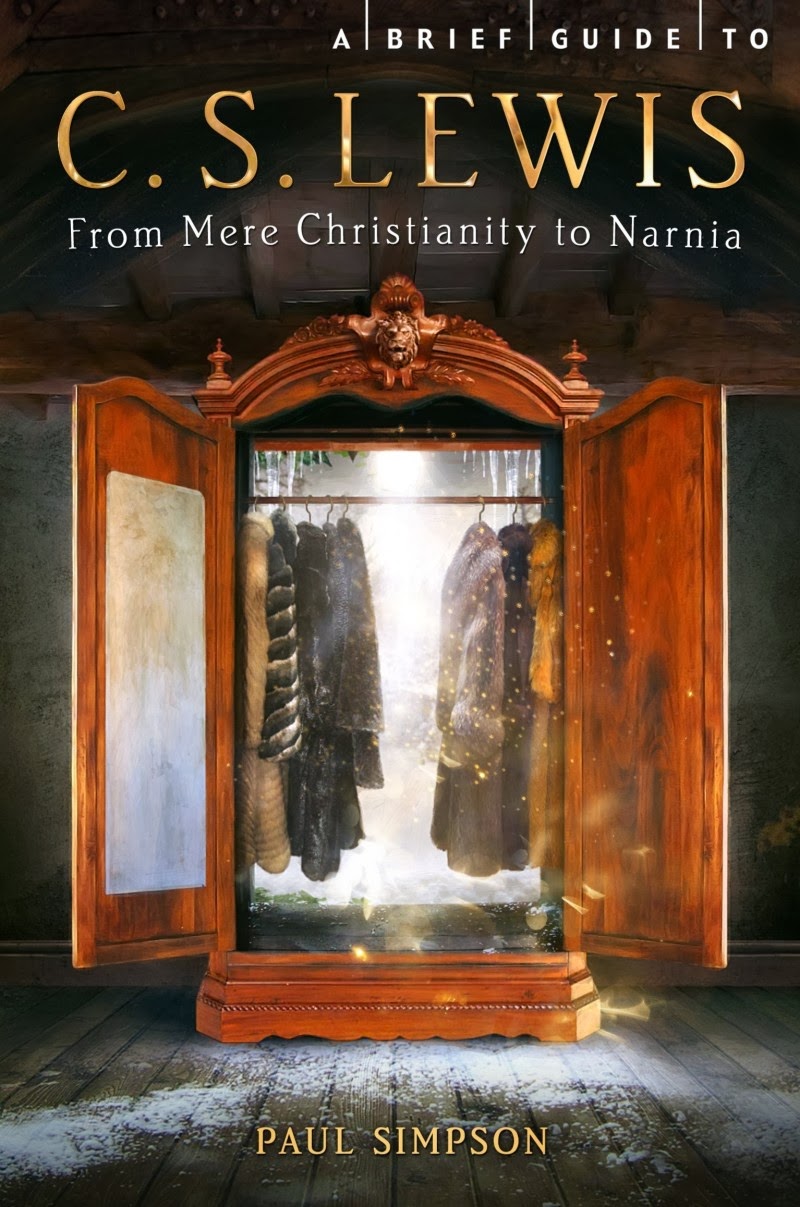
Paul Simpson's well-researched, highly accessible and very readable A Brief Guide to C. S. Lewis is an affectionate and enthusiastic tribute to Lewis' work, providing a concise yet fact-filled introduction to Lewis' fiction, an overview of his other writings, a biography and a look at all the many different versions of his stories that have appeared on radio, TV, stage and film. 

In doing so, the author draws on new interviews with (to quote the publisher's blurb) "some of the many talented people who have worked on these adaptations". In compliance with current requirements for transparency, I need to  declare an interest in that I am among those whom Mr Simpson interviewed about my radio dramatisations of The Chronicles of Narnia, my book Shadowlands and the various incarnations through which that particular project passed on its journey from small to big screen.

Mention of Shadowlands – the story of the love between Lewis and the American writer, Joy Davidman, and their battles with the grisly spectre of cancer – prompts me (if you'll pardon the indulgence) to mention the re-publication, today, of that particular volume with a new introduction and a most generous Foreword by Alistair McGrath, C S Lewis' most recent biographer.


You can order Paul Simpson's A Brief Guide to C S Lewis here.
And get your copy of Shadowlands: The True Story of C S Lewis and Joy Davidman here.

Wednesday, 5 December 2012

AN ARTIST'S IMAGINATION

She was one of the finest illustrators of the twentieth century who would, this year, have celebrated her 90th birthday.


I am speaking of that wondrous mistress of the the magical realms of Narnia and Middle-earth, Pauline Baynes, whose illustrations, decorations and map-making for the works of C S Lewis and J R R Tolkien are – despite the talented offerings of many successive artists and filmmakers – still indelibly associated with those now classic texts.


The work of this remarkable artist is currently being celebrated with an exhibition, 'An Artist's Imagination' at The Museum of Farnham, appropriately since she trained at the Farnham School of Art and lived much of her life in nearby Dockenfield.

In additions to a display of her books, many of which – for world myths and religious texts – will come as a fascinating surprise to those who only know Baynes' drawings for the Chronicles of Narnia and Tolkien stories like Farmer Giles of Ham and The Adventures of Tom Bombadil.

There are examples of the early illustrations by her (and her talented sister, Angela) as well as cover art for The Tattler and other magazines and commercial art for such companies as biscuit manufacturer, Huntley and Palmer...


This particular image is reproduced on a beautiful Christmas card that can purchased at the museum, price £2.00. A second card shows one of Baynes' stunning seasonal covers for The Tattler.

Several of our pieces are on display including this illustration of Lucy and the Sea People (from The Voyage of the 'Dawn Treader') made for my book, The Land of Narnia...


A wonderful image of Famer Giles confronting Chrysophylax from Tolkien's Stories and Poems...


And a number of illustrations made for my unpublished children's story, Osric the Extraordinary Owl, including this stunning group of peacocks...


There is also this unexpected vision of demons and monsters entitled 'The Final Triunmph of Good over the Devil'...


Photo of Pauline Baynes by David Weeks

The exhibition, An Artist's Imagination, continues until 8 January 2013. Admission free.

The Museum is open Tuesday – Saturday, 10am – 5pm. Closed 23 December–1 January.

The Museum of Farnham
Willmer House
38 West Street
Farnham
Surrey
GU9 7DX
Telephone: 01252 715094

Sunday, 2 January 2011

THE MAN WHO DISCOVERED NARNIA

Thanks to eagle-eyed Radio Times reader, Sheila, I can tell you that another Sibley programme is getting a BBC Radio 7 repeat today...


The Northern Irish Man in C S Lewis
(not the snappiest title in the history of radio-writing, I admit!) tells the story – or, at least, my version of the story – of the Belfast childhood of children's writer and Christian apologist, C S (for Clive Staples) Lewis, and of the influence that the landscape, legends and people of Northern Ireland had on the creation and depiction of the Land of Narnia.

C S Lewis is played by Geoffrey Palmer and the programme can be heard at 10:15 this morning and, after that, via BBC iPlayer for the next seven days.

If you are a frequent traveller (in your imagination) to those lands that lie between the Lamp-post and the Great Castle at Cair Paravel, you might just enjoy this exploration...

Thursday, 30 September 2010

ALPHABOOKS

I just recover from answering one meme (the one asking me to list my frequently watched movies) when, knock me down with a feather, along comes another one: this time courtesy of my friend SCB at Where there are Meadowlarks...

Here are THE RULES (for there must always be RULES) as laid down by SCB:

1. Go through the alphabet, and for each letter, think of a book you've read that starts with that letter (A, An, and The do not count).

2. You must write down the FIRST book you think of for any given letter. This may make for some odd choices, but them's the breaks.

3. You must have actually READ the book. (I thought of lots that started with some letters, but I hadn't read them.)

4. If you think of a more impressive-sounding book for a particular letter, but you've already written your first thought down, you CANNOT change to the more impressive-sounding book. As an example, you have to leave "Fifty Famous Fairy Tales" (the Whitman Publishing pink and white one) on the list, even if you come up with fifty more impressive books afterwards.

5. If you can think of a book for X, you win... my lasting admiration (I can't afford real prizes!)

6. You can then tag as many people as you like. The more the merrier.

So, here's the list I drew up...

Alice's Adventures in Wonderland – Lewis Carroll

Brave New World – Aldous Huxley

A Christmas Carol – Charles Dickens

Doctor Dolittle – Hugh Lofting

The Exploits of Moominpappa – Tove Jansson

Fahrenheit 451 – Ray Bradbury

Gormenghast – Mervyn Peake

The Hobbit – J R R Tolkien

It's Too Late Now – A A Milne
(The autobiography of Pooh's creator)

Just So Stories – Rudyard Kipling

A Kid for Two Farthings – Wolf Mankowitz

The Lord of the Rings – J R R Tolkien

Mary Poppins – P L Travers

Noddy in Toyland – Enid Blyton
(Nostromo by Joseph Conrad would have sounded better, but there it is!)

The Once and Future King – T H White

Peter and Wendy – J M Barrie

Quentin Durwood – Sir Walter Scott

Ring of Bright Water – Gavin Maxwell

Something Wicked This Way Comes – Ray Bradbury

Treasure Island – Robert Louis Stevenson

Utopia - Thomas More

The Voyage of the 'Dawn Treader' – C S Lewis

The Wind in the Willows – Kenneth Graham

EXterminator! – William S Burroughs (Oh, well, it was worth a try!)

Yertle the Turtle and Other Stories – Dr Seuss

Zen in the Art of Writing – Ray Bradbury


I suppose it's not too surprising that there are two titles by Tolkien and three by Bradbury – plus, of course, Carroll, Milne and Peake – but the preponderance of children's books suggests that I have already entered my second childhood which is, I guess, pretty accurate!

I hesitate to tag anyone, but (if they'd like to do it and have the time) then I'll tag Gill, Sheila, Sharon, Suzanne and anyone else who fancies having a go...

Sunday, 17 May 2009

RETURN TO NARNIA

Whatever the truth about The Narnia Code, the stories will lose nothing of their appeal and - like the four Pevensie children in the books - we will always want to go back there.

I wrote recently about artist Andrew Skilleter and his dramatic interpretations of C S Lewis' seven 'Chronicles of Narnia' originally made for the audio cassettes cases of my BBC adaptations and which are currently being exhibited as part of The Wonder of Illustration at the Salisbury and South Wiltshire Museum, The King's House, Wiltshire, until Saturday 4 July.

If you enjoyed Andrew's visualisations of Aslan's world, you may care to visit his new website where he gives 'The Artist's Perspective' on the project and where he is offering for sale a beautifully produced limited edition of Fine Art Lifetime Giclee Prints of each of the original artworks.

Remember (to paraphrase Aslan):"Once a friend of Narnia, always a friend of Narnia!"

RE-BREAKING THE CODE

If you missed the BBC documentary, The Narnia Code about C S Lewis and the alleged secret code hidden within his septet of children's novels, 'The Chronicles of Narnia' you've got another chance to catch it tomorrow.

The programme (in which I appeared as a contributor) proved so popular on its first transmission - 15% audience share or 1.9million viewers which is more than a million more viewers than the next most popular programme in that time slot - that it has been scheduled for a repeat on BBC FOUR tomorrow (Monday) evening at 19:30.

So, have the BBC got the message yet? SIBLEY = RATINGS! I bet they haven't!

And, after watching last night's TV marathon (or, at least, the final nine hours of it!), I've come up with a new prime-time unreality programme format: Has Andrew Lloyd Webber Got Talent?


CORRECTION: Oops! Obviously, the title of that programme should have read: Has Andrew Lloyd Webber Got Talent!

Friday, 17 April 2009

MAKING HORSE SENSE

The blog posting you've all been waiting for...

CAPTION COMPETITION RESULTS!

This was the photograph - of one of the New York Central Park carriage horses looking at an incomplete, parked bicycle - for which I requested suitable captions.

As usual, the Sibleyblog readership rose to the occasion with a plethora of amusing suggestions for what the horse might be thinking or saying.

Judging the entries on this occasion was She of Polkadots & Moonbeams, mainly as a punishment for not having entered the competition herself!

As always, the entries were judged anonymously.

There were, not surprisingly, some common threads: not just on the obvious theme of transportation but also on the subject of eating...

Anyway, here first of all, the runners-up in the order in which their entries were received...

SUZANNE...

"Well, if that's the competition these days I don't know what all the fuss is about..."

"Brrfff - I knew I shouldn't have eaten that Wagonwheel!"

"Hey there, gorgeous; do you come here often?"


DAVID WEEKS...

"Not even a mule could get between the shafts of that carriage."

"Damnedest carriage I ever saw, no wonder the little fella did a runner!"

"Leave anything lying around for even a few minutes and parts get taken."


MUIR...

"So - trade's even bad for a New York bike, huh?"


BOLL WEAVIL...

"Horseless transport ? Do me a favour ! It's got no chance !"

"OK, I'm going to count to three and we'll see who makes the end of the road first then, matey..."


SHEILA...

"If God had intended us to cycle, he would have given us 2 legs and 2 wheels, not 4 legs and 1 wheel."


GOOD DOG...

"I know times are tough but he’ll never get his kingdom with that!"

"'Harold,' he said. 'I’ve got it,' he said. 'Why don’t you train Hercules to go out and pick up the scrap by himself. That way we can stay home, put our feet up and have a nice pickled onion...' You dirty old mmmmhhhhaaaaaaannnn!"


LISAH...

"Hay! Who left that there?"

"The front tyre would have tasted a bit better with a sprinkling of salt and pepper."

"I wonder if Chris Hoy is in town."


And so to the winners!

Fourth Place

GILL

(with apologies to George Orwell)

"Four legs good, one wheel bad!"


Third Place


BOLL WEAVIL


"Hmm yes, very nice, but do you have anything with four pedals
and possibly even a front wheel?"


Second Place

SHEILA


"I'm just wondering if eating that wheel was such a good idea"


FIRST PLACE

BITTER ANIMATOR


"Great! I have the dexterity to get the cap off
the Super Glue and then this happens."


Congratulations to the winners and thanks to everyone for entering. There'll be another caption competition in a few week's time!

***


Just Children's Books?

If you missed last night's broadcast of The Narnia Code, the documentary based on Dr Michael Ward's controversial book, Planet Narnia and it's interpretation of C S Lewis' septet of fantasy novels beginning with The Lion, the Witch and the Wardrobe, you can catch it for the next seven days on the BBC iPlayer.


Wednesday, 15 April 2009

STAR-CODES

Talking of Narnia...

I wrote, some years ago, that C S Lewis was now one of those authors - like Shakespeare, Dickens and Lewis' chum, Tolkien - whose collected works have been vastly outnumbered by works about them.

Indeed, new books on Lewis appear, it seems, almost every month, but none has been quite so radical or has stimulated quiet so much debate as Planet Narnia: The Seven Heavens in the Imagination of C S Lewis by Dr Michael Ward...


The author of Planet Narnia argues that Lewis' celebrated cycle of children's novels, 'The Chronicles of Narnia', is based on an understanding of medieval cosmology.

Lewis was a medievalist and was, indeed, fascinated by astronomy which is no doubt why there are so many astronomical/astrological references within his books about Narnia.

And it is from these facts that Michael Ward has extrapolated a theory that each of the seven volumes has a mystical connection with a different planet that, in turn, provides the key to its meaning and symbolism.


Dr Ward developed his theory in 2003 after reading Lewis' poem, 'The Planets', which refers to the influence of Jupiter with the words: “winter passed/And guilt forgiv’n” - which are two of the themes in The Lion, the Witch and the Wardrobe.

From this beginning, Ward has gone on to propose a thesis in which the seven planets known of in medieval cosmology provides the theme for the seven Narnian Chronicles, So, for example, Prince Caspian is seen as essentially a war story and, therefore, inspired by Mars. Similarly, The Voyage of the 'Dawn Treader' is the solar novel full of references to gold and light as well as another sun symbol, the dragon, while The Horse and His Boy is based on Mercury, the planet ruling the star sign Gemini, and features characters who are twins.

The Planet Narnia theory is now to be explored in an hour-long television documentary, The Narnia Code, broadcast on BBC 1 tomorrow evening - Thursday 16 April - at 10:35 pm

The programme is the work of Norman Stone who directed the original television play about C S Lewis, Shadowlands, and, as you will see from this advance peek into the cracking of the code, I am one of the contributors to the programme...


You may, like me, remain skeptical about Michael Ward's claims, but The Narnia Code is fascinating if, for no other reason, than because it reminds us what another Oxford don, Charles Dodgson (aka Lewis Carroll), once observed:

"Words mean so much more than we mean to express when we use them: so a whole book ought to mean a great deal more than the writer meant."


You can read more about Michael Ward's book and his cosmic theories on his official web-site, Planet Narnia.


Monday, 13 April 2009

PICTURING NARNIA

C S Lewis once said, "For me, all fiction begins with pictures in my head," and that was particularly true of his seven books for children that are collectively known as ‘The Chronicles of Narnia’.

For example, The Lion, the Witch and the Wardrobe grew out of two recurrent pictures that the author had been carrying in his head for some time: one was of a queen riding in a sledge (born, perhaps, from memories of childhood reading of Han Andersen's The Snow Queen) the other was of a faun carrying parcels and an umbrella in a snowy wood and pictured here by Lewis' first illustrator, Pauline Baynes...


When I was given the opportunity to adapt these stories for radio, I really wanted the resulting broadcasts to create pictures in the minds of my listeners.

Later, when those programmes were marketed as audio cassettes, they obviously needed the help of pictures to sell them to a new audience. At that time, most of Pauline Baynes' illustrations were in black and white and I considered myself very fortunate to have had Andrew Skilleter, the well-known fantasy/Dr Who artist create a new series of pictures which adorned the cassette cases for some years and which are currently on display at Salisbury and South Wiltshire Museum as part of The Wonder of Illustration exhibition,

Although the title of The Lion, the Witch and the Wardrobe tells you, at once, that the lion in question - Aslan, of course - is central to the story, the lion's role in the remaining volumes is sometimes less clearly defined and, in one or two of the books, he seems at first glance to play hardly any part at all, perhaps only making an appearance in the concluding chapters.

What becomes obvious, however, as the history of Narnia unfolds, is that underlying all the stories is the nature and power of Aslan. And this is something that Andrew Skilleter intuitively grasped in making the artwork for these audio versions.

It is most evident in his symbolic designs for the first two adaptations. For The Magician’s Nephew, the artist depicted Aslan bringing life to the barren environment of Narnia, the musical notes of his creation song becoming trees, birds and stars in the new world.


Similarly, for The Lion, the Witch and the Wardrobe, Aslan is shown straddling two landscapes: one covered in snow from the perpetual winter imposed by the White Witch, the other a verdant spring garden freshly awoken to new life by the returning Lion.


The other five paintings reflect Aslan’s constant presence in the drama: appearing almost as a vision in the desert dust behind the eponymous characters of The Horse and His Boy...


As an heraldic image on the sail of the ship in The Voyage of the ‘Dawn Treader’...


As an ever-watchful (but unseen) observer of the action in Prince Caspian and The Silver Chair...


And, for the final volume, The Last Battle, he is shown standing upon the threshold of the doorway between the dying land of Narnia and the inner world of Aslan’s Country...


Andrew Skilleter brought to these pieces of artwork - together with the slipcase for the collection in the form of an elaborately carved wardrobe (lined with fur coats!) - an intelligence and a sympathy that complimented the telling of these much-loved tales, coupled with a sensibility as a designer for creating intriguing images that invited the listener to discover the story behind the pictures.

The exhibition The Wonder of Illustration remains on show at the Salisbury and South Wiltshire Museum, The King's House, Wiltshire, until Saturday 4 July; Monday-Saturday 10:00 to 17:00; Sundays (July only) 12:00 to 17:00.

There's more of Andrew's work on his official web-site, including his cover art for my radio adaptation of J R R Tolkien's Tales of the Perilous Realm.

Today, the CDs of my Narnia adaptations are decorated with examples of Pauline Baynes line illustrations subsequently coloured by the artist, but it is good that Andrew Skilleter's visions of the land betond the wardrobe are being seen once more.

I'm actually rather proud of these dramatisation (an even longer project - in terms of its 15 hours of air-time - than the epic serialisation of The Lord of the Rings and which was also undertaken single-handedly) as well as of the productions themselves with their star-studded casts that include Bernard Cribbins, Richard Griffiths, Frances Tomelty, Tom Wilkinson, Sylvester McCoy, Timothy Bateson, Martin Jarvis, Fiona Shaw, John Sessions, Robert Eddison, Maurice Denham, Mary Wimbush, Robin Bailey, Rosemary Martin, Melvyn Hayes, David Collings, Timothy Spall and (in all seven plays) one of the great radio voices, Stephen Thorne, as Aslan.


Friday, 10 April 2009

WHAT IS TRUTH?

Today is what Christians the world over refer to as Good Friday...

On this day, according to the Gospel of John, Jesus was brought before the Roman governor, Pontius Pilate, and when he observed that, "Every one who is of the truth hears my voice," Pilate famously asked "What is truth?"

That question came to mind recently when we visited the Byzantium exhibition at the Royal Academy which included, among its amazing hoard of treasures, a ornately decorated 13 Century reliquary said to contain a splinter of the True Cross.


The story of the True Cross is an extraordinary example of world mythology, beginning in 1260 with an account by Jacopo de Voragine, Bishop of Genoa, in his book Golden Legend.

According to the good Bishop, when Adam lay dying, he begged his son, Seth, to go to the Archangel Michael and beg a seed from the Tree of Life that grew in the Garden of Eden. This request having been granted, the seed was placed in Adam's mouth when he died and was buried. The seed subsequently germinated, took root, and grew into a tree.

Centuries later, the story goes on, the tree was cut down and the wood from it was used to build a bridge over which the Queen of Sheba passed on her journey to meet King Solomon. Struck by the symbolism represented by the bridge Her Majesty, allegedly, fell to her knees and worshiped it - as depicted (right) by Piero della Francesca.

During her visit with Solomon, the Queen told him that a piece of wood from the bridge would bring about a new order that would replace God's Covenant with the Jewish people and Solomon, fearful of the eventual destruction of his people, had the timber from the bridge buried. Nevertheless, fourteen generations later, this very wood, it is said, became the cross used at the crucifixion of Jesus.

Jacopo de Voragine went on to describe the subsequent finding of the cross by Helena, mother of the first Christian Emperor, Constantine. This part of the story dates back to the fifth century and the writings of Socrates Scholasticus and other early writers of ecclesiastical histories...

As the tale goes, the site of the Holy Sepulchre, where Jesus had been buried, was now surmounted by a temple to Venus. On a pilgrimage to Jerusalem, Constantine's aged mother had the temple destroyed and the Sepulchre uncovered, whereupon three crosses were also unearthed as depicted (right) in Agnolo Gaddi's 1380 painting.

In order to determine which cross was which, Macarius, Bishop of Jerusalem, had a dying woman placed on all three in turn on and when she recovered from the touch of the third cross this was taken as a sign that this was the specific cross on which Christ had died.

Socrates Scholasticus reports that the nails with which Christ had been fastened to the cross were also found and that Helena had sent these to Constantinople, where they were incorporated into her son's helmet and the bridle of his horse.

Now, whilst I don't personally believe this to be anything other than a legend, I was greatly moved by the reliquary of the True Cross displayed in the Royal Academy: moved because, whatever the truth or fiction might be about the slither of wood within the silver casing, it represents over 800 years of faith and belief.

In C S Lewis' The Voyage of the 'Dawn Treader', the children meet Ramandu who tells them that he is a 'retired' star (of the celestial variety) but Eustace challenges this concept, saying: "In our world, a star is a huge ball of flaming gas."

To which Ramandu replies: "Even in your world, my son, that is not what a star is but only what it's made of."

The curator's label on the reliquary in the Byzantium exhibition prosaically described the item as: "Silver gilt, cloisonné opaque enamels on a silver gilt support, wood, glass paste."

But that, of course, is only what it is made of, not what it is...

And, whatever we believe, that is truth which may be worth pondering...


Images: Crucifixion by Gustav Doré ; Ramandu by Pauline Baynes

Monday, 4 August 2008

PAULINE BAYNES: QUEEN OF NARNIA AND MIDDLE-EARTH


Pauline Baynes
(1922-2008)

It is with deep sadness that I write these few words about our dear friend, Pauline Baynes, who died, on Friday, in the cottage in Dockenfield, Surrey, where she had lived and worked for many years.

There are certain illustrators whose work is so intimately interwoven with the author's text as to rank as the books' co-creators. Sir John Tenniel, for example, the first illustrator of Alice's Adventures in Wonderland and E H Shepard who, with A A Milne, led us into the world of Winnie-the-Pooh.

Similarly, Pauline Baynes' pictures of country and denizens in C S Lewis' seven Chronicles of Narnia are still – despite the recent big-screen movie imagery – the definitive depiction of that extraordinary land beyond the wardrobe...


I can remember, precisely, where I was when I read each of the Narnian Chronicles: for example, I read The Magician's Nephew one winter's day curled up before an open fire while my mother was making cakes and pastry on the kitchen table.

Once glance at the vista on the jacket of the Puffin paperback edition of that book still not only evokes what is, for me, the essence of the land of Narnia – with its seashore, mountains, woods and lakes – but also gives me back a specific day from the tenth year of my life!


I first met Pauline almost thirty years ago, in October 1979, at a 'Narnia Book Fair' held at Church House Bookshop, Westminster. I was carrying one of my most treasured possessions: a copy of Tolkien's The Adventures of Tom Bombadil which the author had signed for me ten years earlier. She added her own signature to the title page, doubling its value to me as a collector.


Following that initial meeting, we kept in touch, collaborated on a book, The Land of Narnia, and, during the past 10 years, became close friends.

After the death of my and David's mothers, she became a kind of adoptive mum and (perhaps because she had no children of her own) interested herself in what we were doing and fussed over and cared for us in the various ups and downs of our lives. We loved her dearly and are deeply aware of how we – and others in her extended adopted family – are going to miss her...

She had a ceaselessly inquiring mind and energetically debated every topic imaginable. She could be sharply critical and quixotically changeable; she never suffered fools gladly, sniffed out cant and hypocrisy in a second and enjoyed nothing better than the kind of conversation which could veer from total seriousness to helpless laughter.

But all these are personal feelings and what I want to do in this posting is remind people of the extraordinary talent possessed by this modest, unassuming woman who created images that define the childhoods of millions...

After producing illustrations for various books of fairy tales, Pauline Baynes' career was established when, in 1949, J R R Tolkien's publishers showed the author of The Hobbit a portfolio of her artwork. Tolkien had written Farmer Giles of Ham, a fanciful novella with a faux-medieval setting, and being dissatisfied with the pictures that had been produced for the book was looking for a new illustrator.


Pauline produced a series of witty line illustrations that perfectly caught the essence of Tolkien's story to an extent that he declared them to be "more than illustrations, they are a collateral theme." He also delighted in reporting that friends had said that the pictures had reduced his text to "a commentary on the drawings"!

Pauline revisited the story of Farmer Giles and his exploits with the somewhat reluctant dragon, Chrysophylax Dives, on several occasions such as for the 50th edition of the story published in 1999...


It was the beginning of a long friendship between author and illustrator with Pauline decorating Tolkien's subsequent books, The Adventures of Tom Bombadil and Smith of Wootton Major.


It had been Tolkien's wish that Pauline should illustrate The Lord of the Rings, but the book grew into a project that rendered that plan impractical although it was her slipcase design for the three volumes that was adapted as a cover for the first one-volume paperback edition: providing what was, for an entire generation, a peek into the essentially English landscape of Middle-earth...


Posthumously Pauline illustrated Tolkien's Poems and Stories (including Leaf by Niggle) and Bilbo's Last Song. She also created that memorable map of Middle-earth that was a feature of thousands of student bedrooms...

Click to enlarge

I remember Pauline telling me that she always wondered whether Tolkien's wife, Edith, had ever actually read her husband's magnum opus. Her doubts stemmed from the day she took her artwork for the Middle-earth map to show the author. Above the map she had drawn the figures of the Nine Walkers – Frodo, Sam, Aragorn, Gandalf, Boromir, Legolas, Gimli, Merry and Pippin – setting out on the Quest of the Ring; beneath the map she had added an array of villains: marauding Orcs, the Nine Black Riders, Gollum and, the bottom right hand corner, Shelob.

Tolkien was pleased with the map – apart from one mis-spelled name that had to be corrected – and called to Edith to come and see. "Look what Pauline's done," said Tolkien. Edith scrutinized the map and the two groups of characters and then - pointing to Shelob - said: "Ooo, look at that horrid spider!"


It was the collaboration with Tolkien that resulted in Pauline's subsequent association with the septet of children's novels by C S Lewis beginning with The Lion, the Witch and the Wardrobe and known, collectively, as The Chronicles of Narnia.


 "Met C S Lewis. Came home. Made rock cakes." That, according to Pauline, was how she recorded in her diary one of the two meetings she had with the author whose work she so memorably embellished. It tells you exactly how she viewed her contribution to books that, for millions, of us were seminal childhood reading.


The illustrations for the Lewis books contributed significantly to their success and now are inseparable from the text, but she illustrated over a hundred other books as well as designing jackets and frontispieces for others and contributing numerous decorative pictures (left) to the illustrated magazines which proliferated in the 1940s and '50s such as The Sphere, The Tattler and The Illustrated London News. Her artistic output was astonishing: designs for inn signs, stained glass, church embroideries and Christmas cards.

Other commissions included pictures for school text books, and fanciful advertisements for a variety of products such as, here (courtesy of her friend, Martin Springett), Huntley and Palmer's biscuits...


Among her finest works (and there are a great many more) should be listed Henri Pourrat's A Treasury of French Tales; Amabel Williams-Ellis' Fairy Tales from the British Isles and The Arabian Nights reflecting her fascination with Persian miniatures.

She also decorated The Puffin Book of Nursery Rhymes, collected by her friends Peter and Iona Opie; and, spectacularly, Grant Uden's A Dictionary of Chivalry which contained a staggering near-600 illustrations in its margins and won the artist the coveted Kate Greenaway Medal.

She illustrated stories by Helen Piers, Rosemary Harris and Rumer Godden  as well as the final volume of Mary Norton's Borrowers saga and produced another iconic images for the cover of the first paperback edition (right) of Richard Adams' Watership Down.

What her work on these and other books show is her tirelessly painstaking research into the detailing of period costume and architecture and, above all, her extraordinary talent for conveying landscape and depicting natural life – especially animals, whether wild or domestic and, in particular, horses and, of course, dogs which were so much a part of her life.

Her later picture books – many on religious subjects such as All Things Bright and Beautiful, The Song of the Three Holy Children, Noah and the Ark In the Beginning and I Believe – demonstrate the artist's talent for design and her superb mastery of fluid line, gem-like colours and the use of negative space.

 There were also an amazing number of drawings done as favours for charitable organisations and friends. For example, in 1977, I was editing Bandersnatch, the newsletter of the Lewis Carroll Society when the discovery of the 'lost' chapter of Through the Looking Glass and what Alice Found There, featuring a Wasp in a Wig reading a newspaper came to light.

The episode had been dropped from the book at proof stage because John Tenniel had said such a bizarre character was beyond his powers to illustrate. But Pauline proved Tenniel wrong by creating this superb miniature (left) which I featured on the mast-head to Bandersnatch for several years.

Pauline remained prolific until the end of her life, illustrating a selection of writings from the Qur'an and the Book of Job (below) which are still to be published...


Pauline's last completed projects was producing 21 full page illustrations for a story of mine, entitled Oscar the Extraordinary Owl. She was disappointed when a succession of publishers declined the book, and concluded that her style was now too old fashioned and out of step with the current trends in children's publishing.


One day, I trust, someone will recognise again her singular talent for composition and publish some of these works which she made towards the end of her life purely for the pleasure of making pictures – so that they may bring pleasure to others just as her illustrations to the books of Lewis and Tolkien have done for fifty years...

When we visited her a few weeks ago, the drawing board facing in the window that looked out onto her pretty cottage garden, was covered with a series of energetic drawings – each a Baynesian mini-masterpiece of design – illustrating Aesop's Fables (right).

Today, that drawing board lies bare.

The artist is gone; but the artwork that she created lives on...


You can read my full obituary to Pauline Baynes here in The Independent.

Other obituaries appeared in The Guardian and The Telegraph; although unsigned they were written by two more of her close friends, respectively, David Henshall and Charlotte Cory. There was also a full obituary in The Times.

Post Script: According to Pauline's executor (who has read her diaries), she didn't write, "Met C S Lewis. Came home. Made rock cakes." However, I've let it stand because the fact that she said that's what she wrote provides an intriguing insight into her complex character.

Images: Photographs of Pauline Baynes and her drawing board © Brian Sibley, 2008; Art: Copyrights in the illustrations and artworks of Pauline Baynes are held and administered by The Chapin Library of Rare Books.