Showing posts with label death. Show all posts

Friday, 5 May 2023

"UNEASY LIES THE HEAD..."

'The Execution of King Charles the First - Execution of King Charles I, artist unknown

[Click on images to enlarge] 


“I go from a corruptible to an incorruptible Crown, where no disturbance can be, no disturbance in the World.”

The words of King Charles I, spoken on the scaffold outside the Banqueting Hall on Whitehall, London, on the day of his execution, Tuesday 30 January 1649


The details of the day's grim happenings and a full transcript of King's speech (which had been recorded in shorthand) were memorialised in a number of popularly published pamphlets, such as King Charls his speech made upon the scaffold… 


The publisher, Peter Cole, rushed to register his pamphlet with the Stationers’ Company on 31 January 1649, the day immediately following the execution, so as to take advantage of a market eager for accounts of the king’s final hours. So speedily was the pamphlet rushed into print that no one noticed that the date of the event was erroneously given as being in January 1648!

Although many members of the public had attended the execution, the distance between the crowd and and scaffold plus an icy winter wind had prevented all but a few from hearing any of his words, something which Charles comments upon in the published speech: ‘I shall be very little heard of anybody here…’.  However, thanks to Bishop William Juxon, who recorded his words in shorthand, and through the published pamphlet, the King was heard as he finally answered the charges that had been brought against him at his trial in the Great Hall at Westminster, wishing ‘to clear myself both as an honest man, and a good King, and a good Christian’.

Here, with astonishing immediacy, is an eyewitness account of the regicide as Londoners would have read it within 24 hours its happening...


KING CHARLS
HIS
SPEECH

Made upon the
SCAFFOLD
At Whitehall-Gate,

Immediately before his Execution,
On Tuesday the 30 of Ian. 1648

VVith a Relation of the maner of
his going to Execution

Published by Special Authority.

London:
Printed by Peter Cole, at the sign of the
Printing-Press in Cornhil, near the
Royal Exchange. 1649.


About ten in the Morning the King was brought from St. James's, walking on foot through the Park, with a Regiment of Foot, part before and part behind him, with Colours flying, Drums beating, his private Guard of Partizans with some of his Gentlemen before and some behind bareheaded, D. J U X O N next behind him and Col. Thomlinson (who had the charge of him) talking with the King bareheaded from the Park, up the stairs into the Gallery, and so into the Cabinet-Chamber where he used to lie, where he continued at his Devotion, refusing to dine, (having before taken the Sacrament) only about an hour before he came forth, he drank a glass of Claret wine, and eat a piece of bread about twelve at noon.


(It is observed the King desired to have the use of the cabinet and the little room next it where there was a trap door.)


From thence he was accompanied by Dr. Juxon, Col. Thomlinson and other officers formerly appointed to attend him and the private guard of partizans, with musketeers on each side, through the Banqueting house adjoining to which the scaffold was erected between Whitehall Gate and the Gate leading into the gallery from St. James's: The Scaffold was hung round with black and the floor covered with black and the Ax and Block laid in the middle of the Scaffold. There were divers companies of Foot, and Troops of Horse placed on the one side of the Scaffold towards Kings-Street and on the other side towards Charing Cross, and the multitudes of people that came to be Spectators, very great.


The King being come upon the Scaffold, look'd very earnestly upon the Block and ask'd Col. Hacker if there were no higher; and then spake thus (directing his speech chiefly to Col: Thomlinson).


King. I shall be very little heard of anybody here, I shall therefore speak a word unto you here. Indeed I could hold my peace very well, if I did not think that holding my peace would make some men think that I did submit to the guilt as well as to the punishment. But I think it is my duty to God first and to my country for to clear myself both as an honest man and a good King, and a good Christian. I shall begin first with my innocence. In troth I think it not very needful for me to insist long upon this, for all the world knows that I never did begin a War with the two Houses of Parliament. And I call God to witness, to whom I must shortly make an account, that I never did intend for to encroach upon their privileges. They began upon me, it is the Militia they began upon, they confest that the Militia was mine, but they thought it fit for to have it from me. And, to be short, if any body will look to the dates of Commissions, of their commissions and mine, and likewise to the Declarations, will see clearly that they began these unhappy troubles, not I. So that as the guilt of these enormous crimes that are laid against me I hope in God that God will clear me of it, I will not, I am in charity. God forbid that I should lay it upon the two Houses of Parliament; there is no necessity of either, I hope that they are free of this guilt; for I do believe that ill instruments between them and me has been the chief cause of all this bloodshed; so that by way of speaking, as I finde my self clear of this, I hope (and pray God) that they may too; yet for all this, God forbid that I should be so ill a Christian as not to say that Gods Judgments are just upon me. Many times he does pay Justice by an unjust Sentence, that is ordinary; I will onely say this, That an unjust Sentence (Strafford) that I suffered for to take effect, is punished now by an unjust Sentence upon me; that is, so far as I have said, to shew you that I am an innocent man.


Now for to shew you that I am a good Christian; I hope there is (pointing to D. Juxon) a good man that will bear me witness that I have forgiven all the world, and even those in particular that have been the chief causes of my death. Who they are, God knows, I do not desire to know, God forgive them. But this is not all, my charity must go further. I wish that they may repent, for indeed they have committed a great sin in that particular. I pray God, with St. Stephen, that this be not laid to their charge. Nay, not only so, but that they may take the right way to the peace of the kingdom, for my charity commands me not only to forgive particular men, but my charity commands me to endeavour to the last gasp the Peace of the Kingdom. So, Sirs, I do wish with all my soul, and I do hope there is some here (turning to some gentlemen that wrote) that will carry it further, that they may endeavour the peace of the Kingdom. Now, (Sirs) I must show you both how you are out of the way and will put you in a way; first, you are out of the way, for certainly all the way you have ever had yet, as I could find by anything, is by way of conquest. Certainly this is an ill way, for Conquest, (Sir) in my opinion, is never just, except that there be a good just Cause, either for matter of wrong or just Title, and then if you go beyond it, the first quarrel that you have to it, that makes it unjust at the end that was just at the first: But if it be only matter of Conquest, there is a great Robbery; as a Pirat said to Alexander, that He was the great Robber, he was but a petty Robber: and so, Sir, I do think the way that you are in, is much out of the way. Now Sir, for to put you in the way, believe it you will never do right, nor God will never prosper you, until you give God his due, the King his due (that is, my Successors) and the People their due; I am as much for them as any of you: You must give God his due by regulating rightly His Church (according to the Scripture) which is now out of order. For to set you in a way particularly now I cannot, but onely this. A national synod freely called, freely debating among themselves, must settle this, when that every opinion is freely and clearly heard.


For the King, indeed I will not, (then turning to a Gentlemen that touched the Ax, said, Hurt not the Ax, that may hurt me) [meaning if he did blunt the edg] For the King:) The Laws of the Land will clearly instruct you for that; therefore, because it concerns My Own particular, I onely give you a touch of it.


For the people. And truly I desire their Liberty and Freedom as much as any Body whomsoever. But I must tell you, That their Liberty and Freedom, consists in having of Government; those Laws, by which their Life and their gGods may be most their own. It is not for having share in government (Sir) that [9/10] is nothing pertaining to them. A subject and a soveraign are clean different things, and therefore until they do that, I mean, that you do put the people in that liberty as I say, certainly they will never enjoy themselves.


Sirs, It was for this that now I Am come here. If I would have given way to an Arbitrary way, for to have all Laws changed according to the power of the Sword, I needed not to have come here; and therefore, I tell you, (and I pray God it be not laid to your charge) That I Am the Martyr of the People.


Introth, Sirs, I shall not hold you much longer, for I will only say thus to you. That in truth I could have desired some little time longer, because I would have put then that I have said in a little more order, and a little better digested than I have done. And, therefore, I hope that you will excuse Me.

I have delivered my Conscience. I pray God, that you do take those courses that are best for the good of the Kingdom and your own Salvations.


Dr. Juxon.

Will Your Majesty (though it may be very well known Your Majesties Affections to Religion, yet it may be expected, that You should) say somewhat for the Worlds satisfaction.


King,

I thank you very heartily (my Lord) for that, I had almost forgotten it. Introth, Sirs, My Conscience in Religion, I think, is very well knowne to all the World; and, therefore, I declare before you all that I die a Christian, according to the profession of the Church of ENGLAND, as I found it left me by my father. And this honest man [pointing to Dr. Juxon] I think will witness it. Then turning to the Officers said, Sirs, excuse me for this same. I have a good Cause, and I have a gracious God; I will say no more. Then turning to Colonel Hacker, he said, Take care that they do not put Me to pain, and Sir this, and it please you: But then a Gentleman coming near the Ax, the King said, Take heed of the Ax. Pray take heed of the Ax.


Then the King, speaking to the Executioner said, I shall say but very short Prayers, and when I thrust out my hands... Then the King called to Dr. Juxon for His Night-Cap, and having put it on said to the Executioner, Does My Hair trouble you? Who desired Him to put it all under His Cap, which the King did accordingly, by the help of the Executioner and the Bishop: then the King turning to Dr. Juxon said, I have a good Cause, and a gracious GOD on my side.


Doctor Juxon.

There is but one Stage more. This Stage is turbulent and troublesome; it is a short one: But You may consider it will soon carry You a very great way; it will carry You from Earth to Heaven; and there you shall finde a great deal of Cordial, Joy, and Comfort.


King

I go from a corruptible, to an incorruptible Crown; where no disturbance can be, no disturbance in the World.


Doctor Juxon.

You are exchanged from a Temporal to an eternal Crown; a good exchange.


The King then said to the Executioner, is My Hair well: Then the King took off His Cloak and His George, giving His George to Dr. Juxon, saying, Remember„. (It is thought for to give it to the Prince.) Then the King put off His Dublet and being in His Wastecoat, put His Cloak on again; then looking upon the block, said to the Executioner, You must set it fast.


Executioner. It is fast Sir.


King. It might have been a little higher.


Executioner. It can be no higher Sir.


King. When I put out my hands this way (Stretching them out) then...


After having said two or three words (as he stood) to Himself with hands and eyes lift up. Immediately stooping down, laid His Neck on the Block: And then the Executioner again putting his Hair under his Cap, the King said, Stay for the signe. (Thinking he had been going to strike)


Executioner. Yes, I will, and it please Your Majesty.


And after a very little pawse, the King stretching forth his hands, The Executioner at one blow, severed his head from his Body.


That when the Kings head was cut off, the Executioner held it up, and shewed it to the Spectators.


And his Body was put in a Coffin, covered with black Velvet, for that purpose.


The Kings body now lies in His Lodging Chamber at Whitehall.


Sic transit gloria mundi.


'The Execution of King Charles I' by Ernest Crofts RA, 1847-1911


[The low height of executioner's block had been determined lest the King had struggled and had need to be tied down. As the preceding account shows no such eventuality occurred and the King conducted himself with astonishing composure.]


'Funeral of Charles I, St George's Chapel, Windsor, 1649' by Ernest Crofts RA, 1847-1911

Thursday, 15 December 2016

THE DEATH OF INNOCENCE


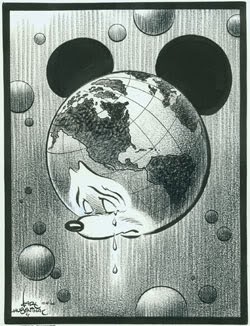
https://blogger.googleusercontent.com/img/b/R29vZ2xl/AVvXsEgw_dfvF1ClaLracOepc0lcCpm2bGs_MF4-zllhX-7XAs7FmtJNATWmSOgyxoVIXj8FFwdDjqIX7ErLlKXyUQvtly4cS1UIS64asyYL33n52ymLcy6D4qjYgNjHWSxWzHr_t8-h/s1600/Mickey_Globe_Crying.jpgThe event I am recalling happened fifty years ago today...

I am getting ready for school and, suddenly, my father is calling up the stairs: "Brian, Walt Disney has died..."

Downstairs, I heard the murmuring drone of radio voices as my father – busy brewing early-morning tea – listens, as he does every day, to the BBC’s morning news programme.

I ought, perhaps, to have dashed downstairs to listen to the reports, absorb the details, gather up the tributes. After all, Walt Disney was my hero. A strange idol for a teenage lad, maybe – but that is what he was.

I collected every book, magazine and trivial snippet that I could find about Disney and his studio. I was forever copying pictures of Disney characters in my sketchbooks – in fact my youthful ambition was to be a Disney artist, to animate those fabulous beings that appeared in his films. I longed to be a part of that mystical process that created characters out of ink and paint and then imbued them with a power to move people to laughter or tears; I was obsessed by the man and his movies.

Later that morning, on my way to school, I would buy the daily newspapers and – in a corner of the playground at morning break – pore over the obituaries; but, at the moment of first hearing the news, I had only one response: I sat on the edge of my bed and wept.


For the first time in my young life I experienced that bizarre phenomenon: a feeling of overwhelming grief at the death of someone whom I did not know. Not only had I never met Walt Disney, I had – rather surprisingly – never even written him a fan letter. Yet, I had been bereaved of someone who held a truly unique place in my affections and the loss felt achingly huge.

During the fifty years since that day, I have continued to study and, occasionally, write about the life and work of Walt Disney and, in the process, had the privilege of meeting many of those who knew, loved and (occasionally) loathed the man. Now, once again, I am working on a book about Disney and am realising that I am passing on a torch to those who will come after who will not have the familiarity of having lived when Disney was still known throughout the world as a flesh-and-blood person as opposed to just a corporate name represented by a copyrighted signature.

That knowledge, as much as anything else, is what fires my enthusiasm, because, whilst my experiences and encounters have brought me very close to feeling that I understand much about the personality and character of Walter Elias Disney, I have never been – and never will be – as close to him as I was on that morning when my father called upstairs to tell me the news that Walt Disney had died.

Friday, 29 May 2015

FOOD FOR REMEMBRANCE

This is Koliva, a special Greek Orthodox food made to commemorate the souls of the departed...


It contains wheat or barley (the seed which is buried in the ground brings for the new life), thrice cleaned, steeped in hot water and then dried on cloths before being mixed with sesame seeds (toasted and ground), cinnamon, nutmeg, honey and, sometimes, pomegranate seeds. The finished dish is then blessed by a priest at a Mass at which the living remember and pray for their loved ones and all souls who have died in faith of the church as part of a tradition dating back to the 12th Century.

The recipe actually predates even Christianity to the ancient Greek culture with particular reference to the Pantheon of deities: the barley or wheat representing Demeter the earth goddess, pomegranate signifying her daughter, Persephone, the queen of the underworld and, when other almonds and raisins were added, Aphrodite and Dionysus to whom those nuts and fruit were sacred.

It was a privilege to be able to share in a moment of Greek (and Eastern Orthodox) culture that is both truly historic and full of spiritual symbolism – especially as tomorrow marks the 15th anniversary of my own mother's death...


You can read all about Koliva here.

Photos © Brian Sibley and David Weeks

Friday, 13 March 2015

THE LATE LORD OF DISCWORLD

“Where did you say your business was?” said Lezek.
“Is it far?”

No further than the thickness of a shadow, said Death. Where the first primal cell was, there was I also. 
Where man is, there am I.
When the last life crawls under freezing stars, there will I be.


Farewell, Terry Pratchett!

You had a rare genius for storytelling and myth-making that had its roots deep in the centuries-long history of fantasy and legend but which produced exotic flowers blooming in a riot of contemporary satire...

The Discworld is flat and rides on the back of four giant elephants
who stand on the shell of the enormous star turtle...
and is bounded by a waterfall that cascades endlessly into space.
Scientists have calculated that the chance of anything

so patently absurd actually existing are millions to one.
But magicians have calculated that million-to-one chances
crop up nine times out of ten.

You could be prickly and curmudgeonly and woe-betide the idiot who tested your endurance of folly...

They say a little knowledge is a dangerous thing,
but it is not one half so bad as a lot of ignorance

You battled the demon dementia with courage and humour and gave the bastard a run for its money...

The pen is mightier than the sword... 
if the sword is very short, and the pen is very sharp

We had several memorable encounters including these two conversations for the BBC World Service...


"There are times when you realise that events are so far out of your control that it is a relief to just sit back and see what happens next – that lovely sense of crystalline relief that there is nothing you can do about it. So, if Death walked in now and put his bony fingers on my arm, I think a sense of hopeful expectation would be about the most I could muster; but there's no point in saying 'Excuse me, there's something I want to finish'! One should take life as it comes ––– that's what Death always does."


"The only reason for walking into the jaws of Death
is so's you can steal his gold teeth."

Terry Pratchett
(1948-2015)

Sunday, 15 December 2013

DEATH IN VENICE

I am so looking forward to returning Venice for Christmas. It's two years since we were there last but one thing is certain, it won't have changed much!

One of the pleasures of being in this city of wonders is discovering what new wild and unlikely things the Venetian glass-makers have come up with. Here's an example from a year or two back: the grim reaper about to ride off in pursuit of a few errant souls! Terry Pratchett in Venezia!

Friday, 1 November 2013

DEAD TIME

The on-going sorting of a life-time of miscellaneous 'stuff' has recently yielded up a selection of badges celebrating Dia de Muertos – the Day of the Dead...


Celebrated today in various forms in different cultures around the world – and connected to the Christian festivals of All Saint's Day and All Soul's Day – the Day of the Dead has, at its ancient roots, a yearning to answer one of civilization's oldest obsessions: what happens to us when we die and a deep-seated desire to comprehend the transience of flesh and the enduring spirit of human life and love through the memories of the living...


One of my long held ambitions – becoming more and more unlikely (this side of the grave) – would be to travel to Mexico to witness this extraordinary festival that does not hide death or shun him as the black-swathed scythe-wielding reaper of souls, but acknowledges death and its rightful place –– in the very midst of life...

You can read more about The Day of the Dead, here, here and here.

AND now...

To offer you a more discomforting encounter with Death, here – set South of the Border, down Mexico way – is my radio adaptation of a favourite short story by that master of the magical, mysterious and macabre, Ray Bradbury. First broadcast on BBC Radio 4 on 31 December 1992 as part of the popular 'Fear on Four' series, it is entitled...

THE NEXT IN LINE


I am indebted to my old friend 'Boll Weavil' for preserving this 'lost' Sibley drama.

Thursday, 31 October 2013

DEATH AND THE MAGICIAN

Many strange things are alleged to have happened on Halloween. One that most certainly did occur was the death of a man whose name was – in his lifetime and has remained in the 87 years since – synonymous with Magic...

HOUDINI

Throughout his life, Harry Houdini diced with death – accepting challenges to undertake life-threatening stunts and dangerous escapes. 

Following the death of his beloved mother, he sought to discover whether there was a means of contacting the departed: a quest that led him to expose fraudulent mediums and spiritualists who faked contact with the dead for financial gain.


And so he danced with the Grim Reaper – cheek-to-bony-cheek – until his own tragic death on 31 October, 1926.

The story of Houdini's life, death and what did (and didn't) happen afterwards is told in this radio programme which was first broadcast on this night in 1996 to mark the 70th  anniversary of the legend that was HOUDINI...

"ARE YOU THERE, HARRY HOUDINI?"

Monday, 28 October 2013

PLAYING THE JACK

As we edge closer to Halloween – that dark night when spines are tingled with tales of terror – allow me to introduce you to–––

JACK the RIPPER!


Historical figure...? Or a nightmare creation of myth and legend...? 'Jack the Ripper' – whose true identity remains a mystery – is both.

In 1988 to mark the 100th anniversary of the serial killer's frightful reign of terror, I went to London's East End and walked the dark streets and shadowy courtyards – many unchanged in a century – where Jack performed the fearful atrocities that were to terrify all London and send shock-waves throughout the Empire and the world...


This is the story I brought back and broadcast on the BBC World Service. The story of–––

JACK from HELL!


Wednesday, 8 December 2010

REPORTS OF MY DEATH...

Following on from my last posting...

I don't know about Alison (mainly because I don't know Alison Sibley), but it certainly gave me quite a turn!

Saturday, 4 December 2010

GRAVE THOUGHTS

Imagine my delight: finding I had made it onto Quotations Blog: The Famous Quote Site!

And then discovering that my quoted quote was all about dying....


Prompted by a question from Steven Hartley (see 'Thoughts' below), I tracked down the quote to this very blog: in fact my fifth-ever posting, back in 2006. To read the whole post – and make sense of the 'quote' – CLICK HERE. What's more, you'll also find a far more entertaining quote from an interview I had with Terry Pratchett!

Friday, 30 April 2010

ENOUGH SAID

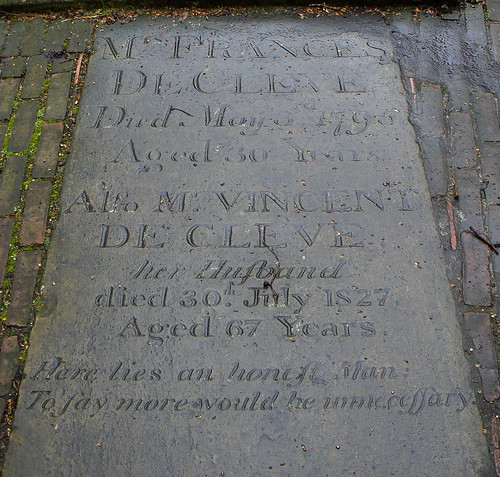
This old tombstone is to be found in the churchyard of what was, formerly, St Mary's-at-Lambeth (next to the London home of the Archbishop of Canterbury, Lambeth Palace) and what is now The Garden Museum.

The tablet commemorates Mrs Frances De Cleve and her husband, Mr Vincent De Cleve, who died, at the age of 67, in 1827 and who is remembered with this epitaph...

Epitaph
Or, turning all those 'f's back into 's's...

Here lies an honest Man:
To say more would be unnecessary

It's probably an unneceffary question, but how many contemporary obituary-writers could be as succinct?

Image: Brian Sibley © 2010, uploaded via my flickr Photostream.

Saturday, 11 April 2009

CROSS AGAIN

Following yesterday's post, Jen wrote to say:

"Thanks for a fascinating Good Friday blog. The reliquary cross is exquisite, yet reminded me of a display of lead crosses in London's Science Museum..."


These crosses are very basic in their design and production: undecorated, with irregular edges and battered surfaces - were not found during the excavation of a London cemetery in shafts suggestive of an institutional system of burial.

Archaeologists Barney Sloane and Bruce Watson concluded that the bodies were most likely prisoners from nearby Newgate Gaol who had died of ‘gaol distemper’, or typhus, in the 1700s.

As no other lead burial crosses of this date have been reported, and documentary evidence is not yet found, Sloane and Watson can only speculate that, since they are clearly made by unskilled hands, the prisoners may have produced them for dying inmates - or themselves...

"Crudely fashioned," writes Jen, "they, too, are representative of faith and belief in what must have been dire times, moving in their simplicity and the mysterious circumstances surrounding them."


Image: Science Museum where you can read more

Tuesday, 21 October 2008

GRAVE REMARKS

I quite often visit Southwark Cathedral - it's a little treat I give myself after sitting around for hours in the rheumatology clinic in nearby Guy's Hospital.

A place of Christian devotion for over 1,000 years, Southwark is a beautiful oasis of peace, light and tranquility poised on the banks of the Thames, alongside London Bridge which spans the river from the hustle and bustle of the fruit and vegetable traders of Borough Market and that of the bankers and brokers of the City.

Whenever I'm there I renew my acquaintance with the Once-Great-and-the-Good who are buried here in an aggregation of the most characterful - and colourful - tombs...

There is, for example, the final resting place (well, it's more like a very elaborate, slightly gaudy, canopied bed) of John Gower, the fifteenth century poet and friend of Chaucer with whom he shares - at least amongst literary historians - the distinction of being one of the fathers of English poetry...


But, my favourite tomb (if that doesn't that smack of too much morbidity) is that commemorating the life of...

John Trehearne
Gentleman Portar to King James the First


who died in 1618 and who is depicted alongside Margaret with whom "he lived together man and wife for fifty years" and (below) a collection of children and Very Small People...

Click image to enlarge

The plaque that Mr and Mrs Trehearne are holding is inscribed with a piece of doggerel that is quite clearly not the work of the aforementioned J Gower Esq...

Had Kings a power to lend their Svbject's breath,
Trehearne thov shovld'st not be cast down by Death,
Thy Royal Master still wovld keep thee then.
Bvt length of days are beyond the reach of men,
Nor wealth, nor strength, or great men's love can ease
The wound Death's arrows make, for thov hast these.
In thy King's Covrt good place to thee is given,
Whence thov shalt go Ye King's Covrt in Heaven.


Now, the Trehearne tomb has given me the idea for a new

CAPTION COMPETITION

What I'm inviting you to do is suggest what conversations, comments and observations might be being exchanged by the Trehearnes as they pass yet another day in their getting-on-for-400-year-long sojourn in Southwark...

Click image to enlarge

Submissions via the 'Thoughts' option below.

Closing date 26 October
. Usual Terms and Conditions apply!

Images: Brian Sibley & David Weeks © 2008

Thursday, 25 September 2008

BURNING DECISIONS

From the website of Australian funeral Directors Piddingtons:


Our stylish cremation options leave
nothing to be desired.


Fashionably decorated, our cremation facilities offer modern style, without sacrificing quality. You can be rest assured that your loved one will be kept safe for ages to come.
I can hardly wait: I always wanted to end up helping fill in holes in a garden wall --- especially one this 'stylish'!

Still, I guess if this truly fulfills your criteria of 'leaves nothing to be desired', then you might as well be dead!

Thursday, 24 July 2008

RETURN TO THE SHADOWLANDS

Tomorrow evening (Friday 25) BBC Radio 2 begins a repeat broadcast of IAN RICHARDSON's moving reading my book, Shadowlands, telling the story of the late-flowering romance between writer and Oxford academic, C S ('Jack') Lewis - famously the creator of the Land of Narnia - and Joy Davidman, an American, Jewish, former-Communist, divorcée, poet who had converted to Christianity as a result of Lewis' apologetics.

I do hope that mentioning this again on my blog doesn't sound too much like blowing my own trumpet, but actually I'm really wanting to blow Ian Richardson's trumpet...

This little book of mine has gone through many interpretations - including recordings by Joss Ackland, David Suchet and myself (on a Talking Book for the Blind) - but none of them have quite caught the essence of the story in the way in which Ian's reading does. It is full of passion and compassion, strength and gentleness, joy and sorrow...

It would have been, I think, an infinitely poignant performance even if the reader had not died just a few weeks after completing the recording. I am so proud that this was one of the last performances by a truly great actor.

SHARON MAIL, who has recently completed work on a commemorative volume about the life and career of Ian Richardson (and who, under a soubriquet, is a regular commenter on this blog) writes:

Ian Richardson was the complete actor. On screen he could convey so much by the raising of an eyebrow, on stage he had a wonderful, inventive physical presence. But what will be remembered most is his glorious voice.

When I interviewed actor Alex Jennings, he recalled the last time he saw Ian, shortly before he died, at a Carol Concert for the charity Cancer UK, which Alex supports. He had asked Ian to open the event by reading the lesson and recalled, "My partner said that it was like there was suddenly a Rolls Royce driving down the centre aisles of St Paul’s Cathedral and it was the voice of God."

How fitting it was then, that Ian’s final performances were readings of The Chronicles of Clovis by Saki; Accolades, Christopher William Hill's radio play about A L Rowse; and Brian’s beautiful radio adaptation of his work, Shadowlands.

Listening to Ian's performance of Shadowlands requires great concentration, because every syllable is given due attention and the words and phrases lovingly caressed in such a way that it is hard not to get lost in wonderment at the delivery. And yet, when he speaks his words, we feel Jack’s joy and his pain, his sense of love and of loss and when he reads extracts from 'The Chronicles of Narnia', we are in Narnia too.

The eight episodes of Shadowlands run across a nine week period with a one-week break on Friday 29 August (because it's Blackpool Lights Night and, as a result, there's no room for shadows!) and can be heard from 21:15-21:30 pm.

You can catch each episode again for seven days after transmission on the BBC's iplayer.


Thursday, 1 November 2007

DEARLY DEPARTED

Two days ago, as you will no doubt be aware from the legions of tots who came to your door demanding candy with menaces, was Hallowe'en, though we've now largely forgotten than the name means The Eve of All Hallows --- or The Day Before Hallowmas.

The word "hallows" means saints and "mas" simply means mass, for this is the Christian feast celebrated yesterday in honour of all the saints, known and unknown - a few of whom are shown above right, as painted by Fra Angelico - and which the Church has marked, in some way or other, since the fourth century AD.

Of course, the phrase known or unknown is one of those divine religious catch-alls, but whether they are known on earth or not they all have one thing in common: they are those who have attained the beatific vision in heaven -- or to put it more simply (maybe?) "the eternal, direct perception of God enjoyed by those who are in Heaven, imparting supreme happiness or blessedness", which, Thomas Aquinas said, was the ultimate end of human existence after physical death.

And what, you ask, of those who haven't aspired to such - if you'll pardon the pun - lofty heights? Well - there's another handy catch-all coming up - they have today: All Souls' Day, also known as the Feast of All Souls or Commemoration of all the Faithful Departed (from the Latin Commemoratio omnium Fidelium Defunctorum), or, elsewhere in the world, as Día de los Difuntos or Día de los Muertos - The Day of the Dead...


The other week, in a shadowy corner of London's Southwark Cathedral, I encountered these momento mori: their all-but toothless jaws hungrily chomping upon the gilded wings of some hapless cherubs and the green leaves of forgotten youth...

I was reminded (with apologies to those who have been complaining about the recent references to death on this blog) of the words of Emily Dickinson...
All but Death, can be Adjusted—
Dynasties repaired—
Systems—settled in their Sockets—
Citadels—dissolved—

Wastes of Lives—resown with Colors
By Succeeding Springs—
Death—unto itself—Exception—
Is exempt from Change—


Images: © Brian Sibley 2007

********************************

POST SCRIPT (10:05): The following comments on the above blog came by e-mail with illustrations and so couldn't be added in the usual way. Out of deference for those who've had enough of all this going on about DEATH (see comments below), I decided to add these contributions to this All Soul's Day post so as to GET IT OVER WITH!

First SACRA CANTERO MANCEBO mailed me as follows:
I thought, after reading your blog today, that perhaps you might not know these paintings by one of the most popular painters of the Spanish baroque (after Velazquez and Murillo) Juan Valdés Leal.

In the background of Sic Gloria Transit Mundi, you can see a pair of scales, with the words "ni más" "ni menos", which means: "nor more, nor less".


The other painting carries the words "In ictu oculi" ("In a blink of an eye") which, I think, needs no explanation...


These paintings are in Seville, and were painted for the Charity Hospital of the city around the 1670s and one was for the death of a bishop, or perhaps a cardinal, a very power vision to the people of XVII Century Spain.

Well, as you can see, I love art, specially the antique; that's one of the reasons that I very much enjoy your blog (only one of them). I thought that Emily Dickinson's poem finds a good explanation in these pictures.
Impressive, sombre stuff - though, I must say, I'm rather glad they've stopped decorating hospitals in this manner...

And now, on a (very slightly) lighter note, CHRISTINE FITZGERALD wrote:


Speaking of momento mori... I did this several years ago for Dia de los Muertos. The image started with a photo of an old New England tombstone - thank god for Photoshop!

The Hispanic community isn't thrilled with the American expropriation of their holiday, but
I have sent out cards for several years without major objections. This was one of them.
Casper LeBlanc lived to be 17.

Saturday, 27 October 2007

GRIM FACTS

It must be something to do with this time of year (or too many recent dealings with hospitals!) but I came across a quote the other day by Robert Alton Harris, who wrote:

You can be a king or a street sweeper,
But everybody dances with the Grim Reaper.


This reminded me of an exchange I once had with Discworld author, TERRY PRATCHETT, during an interview for a BBC book programme.

We were talking about DEATH, who appears as a character in many of the Discworld novels and who - contrary to expectations - has a butler (Albert), an adopted daughter (Ysabell), an assistant (Mort), a pale horse (Binky) and lives in a black-and-white, suburban villa with a golf course and a pond containing a skeletal trout!

"Just supposing," I said to Pratchett, "that the door to this studio was to suddenly whisper open and DEATH was to come in and lay his bony hand on your shoulder, what would you do?"

"Well," replied Pratchett, "there's nothing I could do! But that wouldn't matter, because I long ago learned to take life as it comes!"

He paused and then, with a wry smile, added: "Which, of course, when you think about it, is exactly what DEATH does: takes life as it comes!"

Sunday, 20 May 2007

DO NOT GO GENTLY...

At the recent memorial service for Ian Richardson, Dame Helen Mirren read a poem entitled 'Dirge without Music' by the American lyrical poet and playwright, Edna St Vincent Millay (1892 – 1950), the first woman to receive the Pulitzer Prize for Poetry.

It has something in common with Dylan Thomas' well-known verse, 'Do not go gentle into that good night...' and W H Auden's 'Stop all the clocks, cut off the telephone...' (made famous by the film Four Weddings and a Funeral) in that it is about the raging anger that is an intrinsic part of grief.


Dirge without Music

I am not resigned to the shutting away of loving hearts in the hard ground.
So it is, and so it will be, for so it has been, time out of mind:
Into the darkness they go, the wise and the lovely. Crowned
With lilies and with laurel they go; but I am not resigned.
Lovers and thinkers, into the earth with you.
Be one with the dull, the indiscriminate dust.
A fragment of what you felt, of what you knew,
A formula, a phrase remains, --- but the best is lost.

The answers quick and keen, the honest look, the laughter, the love,
They are gone. They have gone to feed the roses. Elegant and curled
Is the blossom. Fragrant is the blossom. I know. But I do not approve.
More precious was the light in your eyes than all the roses in the world.

Down, down, down into the darkness of the grave
Gently they go, the beautiful, the tender, the kind;
Quietly they go, the intelligent, the witty, the brave.
I know. But I do not approve. And I am not resigned.

***

Dame Helen's reading was charged with high emotion and she was all but overcome by the final line of the second verse. This was hardly surprising since, without question, this is one of the most passionate and painful responses to the death of a loved one I have ever encountered...

On the subject of grief and anger...

Bela, a fellow admirer of Ian Richardson, attending the service, refers to this poem and its reading in a post headed Grotesque and Unseemly, a title that refers not to Dame Helen's touching performance but to the scrum of photographers and autograph-hunters that flocked like vultures around the steps of St Paul's Covent Garden, following the service, button-holing every famous name they could recognise.

I too was appalled, but decided not to mention it in my report because I didn't want to sound a sour note when writing about something that had been a loving, celebratory service, honouring a fine actor.

But Bela is absolutely right: the display of insensitivity was staggering and anger-inducing and - whilst everyone attending the service behaved impeccably and gave the photographers and autograph collectors the snaps and inscriptions they wanted - it was a reminder of the extraordinary level of intrusiveness that celebrities are expected to endure.

What staggered me, as I noted on Bela's blog, was that some of the autograph seekers didn't even wait until people got outside the church... I happened to be coming down the aisle behind Elizabeth Spriggs - who was walking on a stick and with some difficulty - when a fan pushed his way in front and thrust an open autograph book and a pen at her. Then, having got her signature, he snatched back the book and dashed off in pursuit of Prunella Scales.


[Image: Tomb on San Michele, Venice © Brian Sibley]

Wednesday, 16 May 2007

OUR REVELS NOW ARE ENDED

Among yesterday's congregation were David Suchet, Prunella Scales, Julian Glover, Charlotte Rampling, Trevor Nunn, Charles Kay, Isla Blair and Elizabeth Spriggs. They and many other familiar faces from stage and television had gathered at St Paul’s Covent Garden, ‘The Actor’s Church’, to pay tribute to the late Ian Richardson.

It was an hour-long drama performed and directed to perfection, evoking laughter, summoning tears, combining mourning and celebrating in equal measure, in order to say farewell to a much loved and admired actor in the way only theatre people can...

We entered the church to a subtle organ arrangement (so subtle that most people would have missed it) of songs from My Fair Lady: a doubly appropriate welcome since Ian had acted and sung the role of Professor Henry Higgins and because St Paul’s is the church featured in the opening scene of Pygmalion and My Fair Lady and under the portico of which Higgins loiters in order to eavesdrop on the gutter-English of Eliza Doolittle.

This was followed (unbilled in the order of service) by Ian’s voice as Richard II exhorting us, for god’s sake, to sit upon the ground and tell sad stories of the death of kings…

“Ian loved memorial services,” said one of the actor’s sons, Miles Richardson, “He said it was an opportunity for all the old farts to get together!” Then, looking round the pews packed with names from the Who’s Who of British Theatre, he added, “Thank you for coming!”

There was a sterling rendition of ‘Jerusalem’ that would have gladdened the heart of every member of the Women’s Institute from whose ranks, one suspects, had come the considerable phalanx of female admirers that swelled the congregation.

There was a Robbie Burns song from Scottish soprano, Isobel Buchanan; Stephen Gray singing 'Blow, Northern Wind', a song Ian had sung in a production of Pericles; and there was a hilarious piece of comic nonsense from Sir Donald Sinden about watching a Noh Drama in Japan which - though Sir Donald forgot to mention it - was Ian's favourite joke!

There were readings by Dame Helen Mirren and Simon Russell Beale and reminiscences from composer Guy Wolfenden and the theatre equivalent of Zeus, Sir Peter Hall.

Sir Peter recalled seeing Ian act for the first time with the Birmingham Rep and of inviting him to join the newly founded RSC. He praised Ian's 'voice' and noted that "some actors think that to raise ones voice is unnatural!" Not a view with which PH has any truck: "I tell them, 'You are wearing somebody else's clothes, saying somebody else's words and sitting on somebody else's chair. What's natural about THAT?'"

In concluding what was the closest thing in the service to a eulogy, Sir Peter said that Ian had, in his work both as a classical actor and as a star of popular television dramas, provided “hours and hours not of truth, but of credibility”.

Richard Pasco then read Shakespeare's poem 'Fear no more...' from Cymbeline:
Fear no more the heat o' the sun,
Nor the furious winter's rages;
Thou thy worldly task hast done,
Home art gone, and ta'en thy wages;
Golden lads and girls all must,
As chimney-sweepers, come to dust.

Fear no more the frown o' the great;
Thou art past the tyrant's stroke:
Care no more to clothe and eat;
To thee the reed is as the oak:
The sceptre, learning, physic, must
All follow this, and come to dust.

Fear no more the lightning-flash,
Nor the all-dreaded thunder-stone;
Fear not slander, censure rash;
Thou hast finished joy and moan;
All lovers young, all lovers must
Consign to thee, and come to dust.

No exorciser harm thee!
Nor no witchcraft charm thee!
Ghost unlaid forbear thee!
Nothing ill come near thee!
Quiet consummation have;
And renownéd be thy grave!
Lines that were aptly followed by Geoffrey Burgon’s famous setting of ‘Nunc Dimittis’ in the version used as the closing music to Tinker, Tailor, Soldier, Spy (in which Ian had played the ‘Tailor’) with St Paul’s Cathedral chorister, Paul Phoenix piping Simeon's prayer, "Now lettest thou thy servant depart in peace..."

After which it was left to Sir Derek Jacobi to deliver the curtain speech in the form of Prospero's final perorartion from The Tempest:
Our revels now are ended. These our actors,
As I foretold you, were all spirits and
Are melted into air, into thin air:
And, like the baseless fabric of this vision,
The cloud-capp'd towers, the gorgeous palaces,
The solemn temples, the great globe itself,
Yea, all which it inherit, shall dissolve
And, like this insubstantial pageant faded,
Leave not a rack behind. We are such stuff
As dreams are made on, and our little life
Is rounded with a sleep.


A reminder…

There are two more episodes of Ian Richardson’s reading of my book Shadowlands still to be broadcast on BBC Radio (88-90.2 FM) this and next Friday evening at 21.15.

Last week - for the second time - Radio Times chose Shadowlands as its ‘Pick of the Day’, calling it “a rare and poignant piece of radio.” And that is a tribute solely to the performance of the reader who posessed one of the great voices of our age...