Showing posts with label epiphany. Show all posts

Wednesday, 6 January 2021

EPIPHANY AND THE THREE GIFTS


Today is the feast of 'Epiphany', the day in the Christian calendar that celebrates the revelation of God incarnate as Jesus Christ. 


In Western Christianity, the feast commemorates principally  the visit of the Magi to the Christ Child.


To mark this festival, here's an extract from my book, published Christmas 2019, Joseph and the Three Gifts: An Angel's Story...


'EPIPHANY'


Time to talk about those Three Kings – or, as they are alternatively known, the Three Wise Men…


You have seen them so many times – in their robes, crowns and turbans – that it will not change your view to be told that the number three is only a guess (based on the number of gifts), that they were not necessarily kings (at least not until they were designated as such in much later versions of the story), that their names, as we now popularly know them, were never officially recorded and that they didn’t actually arrive that night at the stable, but came later – up to two years later – long after Mary, Joseph and the child were living in rather more conventional accommodation.


But rather than confuse what has been a perfectly successful story that has stood the test of time for centuries, we’ll stick to the facts as they have been set down in legend.


They come, these wise men from the East – sages, let’s say, in their own far-off lands – with their camels, entourages, servants and all the standard paraphernalia of authority figures.


They are also sometimes referred to as Magi – ‘magicians’ is probably not the best word, so let’s say they ‘astrologers’, although they are also, almost certainly, astronomers since, in those times, the two are pretty much one and the same. 


Men of stature and significance they may be, but they are certainly not followers of the God of Moses. Nevertheless, they have been summoned to make their journey by the rising of a new star in the Eastern sky. There are those who have sought to explain this claim with speculations about comets and eclipses, but I prefer the more poetic explanation that the heavens themselves proclaimed the magnitude of this cosmic event.


The challenge set these Magi was to seek, find and pay reverence to a child who, as the signs foretold, was born to kingship. And, without doubt, it has proved a hard task and has been a long and onerous pilgrimage through the worst bleak mid-winter weather.


However, as their quest nears its goal, these wise men – for all their wisdom – make a disastrous and near-fatal error. They decide to consult the local monarch, King Herod (or, as he prefers, Herod the Great), as to the birthplace of the new sovereign of whom they’ve been told. It was, I suppose, the logical thing to do: if you are seeking the whereabouts of one king, ask the advice of another. 


Unfortunately, this particular king happens to be a paranoid psychopath. So when three wandering sages ask the Jewish-born Herod, ‘Where is the child born King of the Jews?’, he is seriously rattled. What does it mean? Usurpation? Herod consults his own wise men and, from their extensive knowledge of ancient prophecy, they advise His Majesty that Bethlehem is the likely birthplace. Had Joseph been aware of this, several perplexing aspects of his recent experiences would have made more sense, such as that edict of Caesar Augustus and the ninety-mile trek to a Bethlehem birthplace. Order is all too often masked by partial knowledge.    


The fearful Herod slyly instructs the travellers to pursue their mission and, if they find the child, to return with news so that – as he disingenuously claims – he, too, may go and pay homage. The unsuspecting Magi head straight to Bethlehem, unaware that the consequence of their regrettable mistake will cost many lives.


That is in the future; for the moment, here they are three more outsiders arriving in the heavily congested town. For sake of continuity, then, let’s return to that now somewhat overcrowded stable to witness their entrance. Out of courtesy to the old stories, I will use their traditional names…


Caspar (or, if you prefer, Kaspar or Gaspar), the young man: lithe, virile and clean-shaven, believed by some to be a king of India; Melchior, the old man: stooped and venerable with long white hair and beard, often referred to as a king of Persia; and Balthazar, bearded and dark of skin: a king, it is said, of Arabia. You can, if you’ve a mind to, research their individual and collective histories across centuries of lore, but – believe me – as with any fable it will add little to your appreciation.


They kneel or, in the case of Melchior (whose old knees no longer permit kneeling) bow before Mary and the baby, something so at odds with Joseph’s understanding of custom and correctness that he steps back a pace in bafflement.


Then the visitors open and offer gifts of astonishing value and disconcerting significance that Mary accepts with solemnity and apparent understanding, but which further trouble Joseph and make him feel even more an observer of another person’s story.


Caspar is first; his gift, enfolded in richly embroidered silk, is a porphyry jar, plain and unadorned, but with a stopper of blue agate which, when removed, releases the clean, sweet, aroma of frankincense that transforms the stale stable air with its bouquet of citrus and spice.


Melchior is next, his gift, securely tied with leather straps, is a finely wrought casket of antique silver, studded with garnets as red as blood and pearls the colour of a summer moon and, within, a great quantity of gold gleaming with a heavy, burnished warmth in the lantern-light. 


Then last (or first, the order is unimportant) Balthazar presents his gift: a purple velvet bag secured with golden, tasselled cords from which he takes a box of pale, translucent alabaster incised with a complex design inlaid with lapis lazuli the colour of a peacock’s breast. When opened, a heady, overpowering perfume spills out into the air: redolent of new-turned earth, laced with resin, it is the bitter fragrance of myrrh. 


These offerings are not only heavy with weight and worth but also with prefigurement: frankincense representing divinity and worship; gold for kingship and honour; and myrrh for death and burial.


If Joseph has even a glimmer of comprehension about the meaning of these portents, it is overwhelmed by the prosaic question of how he will manage the journey back to Nazareth with wife, child and such seriously cumbersome luggage.


The Illustrations are by Henry Martin

Here's a link for anyone tempted to read the rest of Joseph and the Three Gifts: An Angel's Story


Tuesday, 6 January 2015

CLOCKING-ON

David and I first came to Venice in 1998 and from that year until our visit in 2006 we never saw one of the city's most celebrated landmarks: the Torre dell'Orologio, the ornately decorated Renaissance clock tower that stands on the north side of the Piazza San Marco.

Built in the 15th Century, the tower features a carving of the Lion of Saint Mark, a statue of the Madonna and Christ Child, a vast clock face marking 24 (not 12) hours, the moon phases and the houses of the zodiac and is surmounted by a huge bell on which the hours are struck by two hammer-wielding Moors scantily clad in animal skins.


For the first eight years of our visiting Venice, the clock was under wraps for restoration and we saw this extraordinary edifice for the first time in 2006 when the scaffolding finally came down. But it was a couple of years later that we got to witness a special feature of the clock that is only ever seen twice a year...

During Ascension Week and on the Feast of Epiphany – today – the panels to the right and left of the central statue, which normally display the hour and minutes in Roman numerals on giant revolving drums, are removed and replaced with doors that, every hour (from 9:00-5:00) open onto the balcony allowing elaborate automata figures of a trumpet-tooting Angel and the gift-bearing Magi to process before the Virgin and Child, tipping their crowns as they pass.

Here they are in action at 1:00 pm today...


The performance today went a good deal smoother than our first memory of clock-watching in 2008... It was raining at 9 o'clock when the Wise Men and their Angelic Companion made their debut appearance and apart from a lot of bedraggled pigeons and a handful of disinterested caribinari, David and I were the only witnesses to the event; which, as you will see from our video that day, is probably just as well!


Today is a public holiday and here in Venice, as in all Italy, Epiphany is still commemorated and is a vital part of the celebrations (at least as far as the children are concerned) since it is the day signalling the arrival  La Befana – a female counterpart of those Santa Claus/Father Christmas/St Nicholas characters who feature in the Northern European and American Christmas festivities...


An old woman riding a broomstick through the air at night, La Befana, wears a black shawl and carries a sack of sweets and gifts which she leaves in the stockings that the children hang up for her. She is covered in soot because – like Santa – she enters the children's houses via the chimney.

Children who have not been good during the year, receive (instead of sweets) bags of ashes or a lump of coal – nowadays, black sugar-candy!


Because she's a good housekeeper, Befana always uses her broom to sweep the floor before leaving. It is polite to leaves out a small glass of wine for La Befana, together with something to eat - just as Santa gets all those glasses of milk and mince pies...

One Christian legend (similar to the Russian tale of Babushka) tells how La Befana was visited by the three Wise Men, seeking directions as to where Jesus had been born. The old woman did not know, but – being a homely, house-proud soul – she gave the travellers shelter for the night.

The following day, the Wise Men invited La Befana to join them on their quest, but she refused saying that she was far too busy with her housework. Then, too late, she charged her mind and went off in search the the Wise Men and the Christ Child, but was unable to find them. So it was that – to this very day – La Befana is searching for them still and, on her travels, leaves toys and candy for all the good children she finds.

Italian children are warned that if they ever see La Befana they'll receive a thwack from her broomstick: a typical adult ruse to keep youngsters in their beds on Epiphany Eve while parents are distributing sweets – or coal – and sweeping the floor.


To mark Epiphany – and the arrival of La Befana – a regatta is held in Venice every 6 January, with veteran gondoliers (in witchy drag), rowing up the Grand Canal to a finishing line at the Rialto Bridge.


Traffic on the Grand Canal comes to a halt and everyone crowds the fondamenta on either side of the Canal. A giant stocking hangs down from the bridge to mark the winning post and great excitement attends the race and the presentation of the special Befana-emblazoned pennants (left) that are the prizes while everyone – especially (right)  little old Italian ladies – get on with the really serious business of enjoying hot chocolate, mulled wine and sweet flaky biscuits called (in the Venetian dialect) galani...


HAPPY EPIPHANY!


Sunday, 6 January 2013

TREASURING-UP

Now Christmas is past, 
Twelfth Night is the last.
To the Old Year adieu,
Great joy to the new!

When I was young, I never much liked this particular day, because last night being 'Twelfth Night', the Christmas tree had been taken down and the decorations packed away for another year. Not only that, but it also meant that a return to school was now imminent!

There are many ancient traditions – including much feasting and fun – connected with what has been called 'the forgotten holiday' and one of them is the superstition that it is unlucky to leave your decorations up beyond that date – what's more, if you forget to take them down in time, you have to leave them up for an entire year to avoid misfortune!

This has been the first year in many that we have had a Christmas – and, therefore, a Christmas tree – at home and as much as I have loved decorating it (even if it is an artificial one) and looking at it over the holiday, I really don't want it hanging around all year-long! Not only that, but it would mean that I would be deprived of the very real pleasure of 'rediscovering' the various tree decorations come another December.

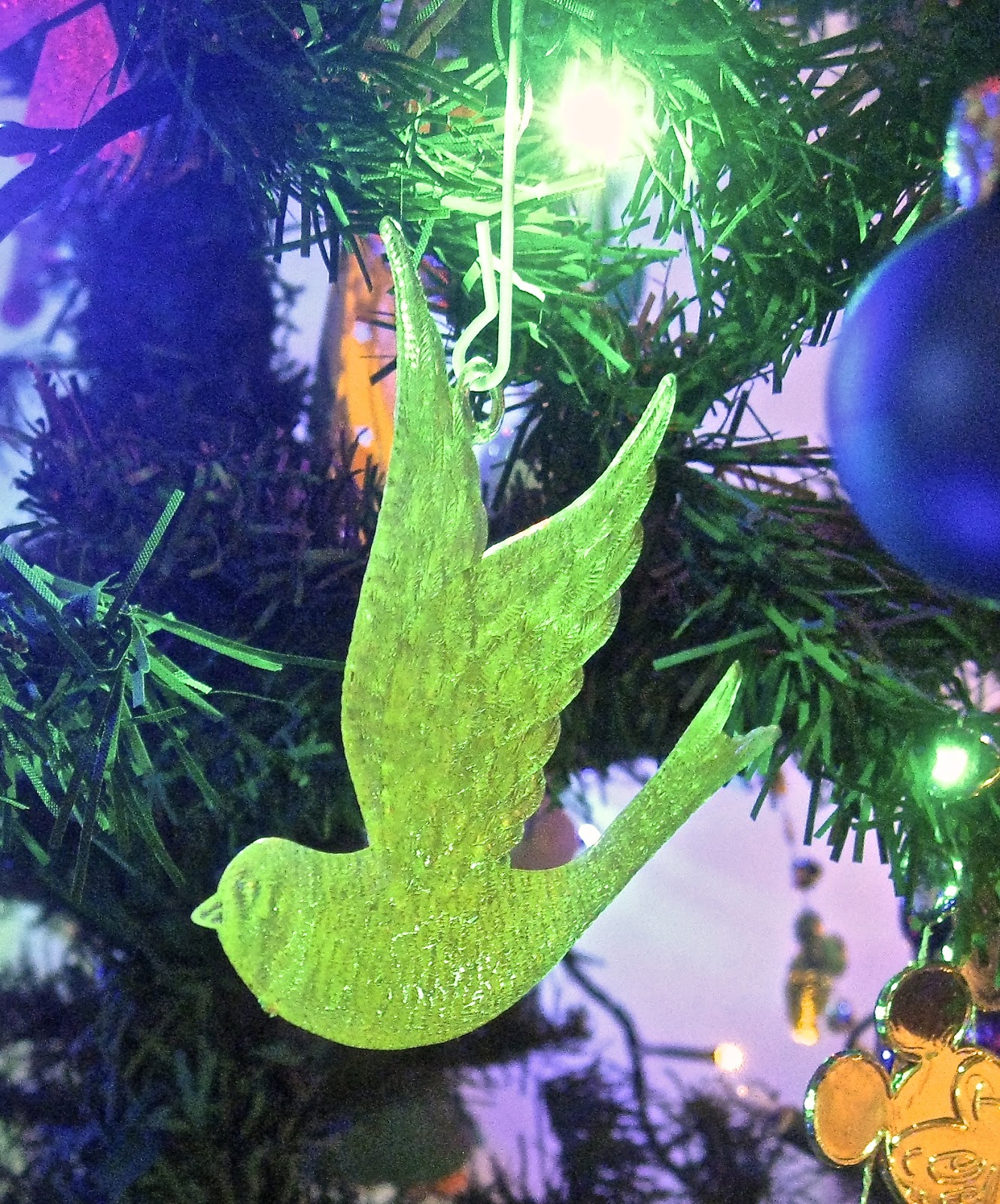
Concerning those decorations, I have to confess that there are – surprise, surprise – rather a lot of Disneyesque nick-knacks on my tree (the morbidly fascinated will find examples here) but the items I value most are six elderly plastic birds that my mother and I bought in Woolworth's (price: 6 old pence each) fifty-eight years ago...


Flying about amongst the branches, they awake the spirit of Christmas Past and memories come flooding back of many Christmases: some happy and, sadly, quite a few not... But whatever recollections they bring to mind, I treasure them greatly...

Anyway, there is, I have just discovered, significant disagreement about exactly when Twelfth Night falls: many people consider it to be today – twelve days after Christmas Day – but officially, it seems, the calculation should be made from sunset on 24 December, Christmas Eve (from a time when the day was deemed to end when the sun went down as opposed to midnight) which would make Twelfth Night 5 January – the eve of Epiphany.


Epiphany, the feast on which, according to church tradition, the Christ Child was visited by three wise men bearing gifts of gold, frankincense and myrrh, prompts a thought in my mind... How did this simple couple, Joseph and Mary – a humble carpenter and his very young wife – react to being given these curious and extravagant gifts? Gold for kingship; frankincense for priestly anointing and myrrh for embalming at death. Perhaps they were just yet another mystery among so many that had marked out their recent lives. According to Luke the Evangelist: 'Mary treasured up all these things and pondered them in her heart...'

But what did they do with these valuable presents once they had returned to the tedium of everyday life in Nazareth? 

At last year's London exhibition of Pre-Raphaelite art, I spent some time contemplating William Holman Hunt's painting, 'The Shadow of Death'. Completed in 1873, it depicts Christ stretching from his work in his father's carpentry shop and, in so doing, casting a shadow that foreshadows his crucifixion...


In a picture laden with symbolism, one particular detail drew my eye: Mary is shown upon her knees, turning and seeing the ominous shadow. But what intrigued me most was that, in Holman Hunt's imagination, Mary is disturbed in the act of looking in a chest containing –– the gifts of the magi...


As my plastic Christmas birds return to their tissue-paper nests, I will be wrapping-up and storing-away memories of yet another Christmas: one or two moments of sadness and regret, but, thankfully, many more of joy and happiness.

Moments and memories to be treasured up...


Images: The Epiphany is depicted in a mural titled "Adoration of the Magi" in the Basilica of the Immaculate Conception at Conception Abbey in Conception, Missouri and was painted by Benedictine monks in the late 1800s.

William Holman Hunt's 'The Shadow of Death' hangs in The Manchester City Art Gallery

Friday, 6 January 2012

ON THE TWELFTH DAY OF CHRISTMAS

A little Wordle – remember Wordle? – for Epiphany...


If you don't know Wordle - check it out!

For a more spiritual celebration of the day, here's 'The Adoration of the Magi' painted in 1542 by Jacopo Bassano and now hanging in the National Gallery of Scotland...


I do love the fact that even when painting a sacred subject these Italians can't resist adding a good bottom – or, in this case (if you count man and horse), two bottoms!