Showing posts with label Julie Andrews. Show all posts

Monday, 6 July 2020

PRACTICALLY PERFECT

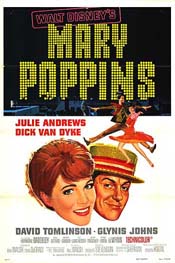
A nice addition to my Walt Disney Disney/Mary Poppins collection: the programme – in near mint condition – from the film's World Premiere at Grauman's Chinese Theatre in Hollywood fifty-six years ago on 27 August 1964. 

Here's the programme's cover with the iconic (uncredited) art by Disney studio artist Paul Wenzel that was also memorably featured on the early Poppins posters and the LP soundtrack recording.  


Although I don't think I was conscious of it back in 1964, I'm intrigued by the use of the 'neon marquee-light-bulb' lettering that suggests 'theatre' and 'musical' yet doesn't quite fit with the film's Edwardian setting.

As for the likenesses themselves, Wenzel's artwork is stunning, although I wonder whether, at the time of painting, the studio had still to finalise Julie's Poppins wig since the colour and styling are very obviously 'Julie' and not 'Mary'.

Here is Paul Wenzel's original artist's 'rough' for the double-portrait: bought in auction in December 2018 – not by me! –  for $5,520!


Below is a small selection of the interior pages, beginning with one focusing on the collaboration between Mr. Disney and Mrs. Travers...

Click image to enlarge

I do wonder what P.L.T. thought when she read: "Mrs Travers was invited to Burbank for story conferences. Elated with the treatment her beloved heroine was receiving, the authoress signed the formal contracts"   

ELATED? I'm not so sure about that!

 Click all images to enlarge


POST-SCRIPT
(One Day Later...)

I couldn't have guessed that posting details on Facebook of my having acquired this delightful collectable was just the beginning of a story...  

After posting these images, my Facebook friend and noted Poppins collector Mat Plendl posted the following images of an early Poppins LP and a Songbook featuring photographs of Julie Andrews and Dick Van Dyke that obviously provided a significant part of the inspiration for Paul Wenzel's now iconic illustration...


Images courtesy of Mat Plendl

Mat commented: 
"Dick Sherman told me, years ago, that this was the first run (maybe a test?), and that Walt thought it looked too much like a kids' thing and so they decided to give it a more grown-up, Broadway look. Plus, this photo of Julie is none too flattering. Very nearly impossible to find (along with a songbook with similar cover sold at Disneyland for a short time), a few escaped out to radio stations but they only appear on super-rare occasions, usually when a collector has died!"  

POST-POSTSCRIPT
(Later the Same Day...)
And still the story continues! 

Another Facebook friend, Chris Tassin, adds:
"Great to see the rare early pressings! A couple of years ago, I found the actual photos of Julie and Dick used as reference for the illustration."


Images courtesy of Chris Tassin

So there's the final link! It's now clear why Julie's hair bears no resemblance to her 'Poppins' look and it also shows that Paul Wenzel was a truly gifted illustrator! 

Many thanks to Mat Plendl and Chris Tassin for helping to solve what has been (for me) a 56-year-long mystery!

Sunday, 7 December 2014

THE MAN BEHIND THE BOOK


This afternoon's episode of The Once and Future King takes T H White's saga based on the old Arthurian romances to a different level – a place where the human drama reaches a tortuous complexity with deceit piled on deceit and the emergence of a dark, tragic secret that has haunted Arthur for years and has fired the homicidal hatred of the King's bastard son, Mordred.

Shaun Mason as Gawaine and Joel MacCormack as his half-brother Mordred
in the BBC production, The Once and Future King

The way in which the story unfolds: revealing ever new twists and turns of human relationships that may be cast in the trappings of myth and legend but which are as modern as our own 21st century lives...  

It was what White had sensed within the pages of that earlier saga, Thomas Malory's Le Morte d'Arthur. As White later told a friend, it was in 1937 that he had picked up a copy of Malory's 1485 book (about which he written a thesis when at university) and discovered – or re-discovered – something potent about Malory's writing: 
I was thrilled and astonished to find that (a) The thing was a perfect tragedy with a beginning, a middle and an end implicit in the beginning and (b) the characters were real people with recognisable reactions which could be forecast... Anyway, I somehow started writing a book.
That book, published in 1938, was The Sword in the Stone and was described by White as "a preface to Malory" since it was about the childhood of Arthur, a topic passed over by Malory.

For quite some time, 'T H White' was, for me, just a name on the cover of that book – one of the  favourites of my youth. It was a year or two before "Stephen", my best friend at school to whom I shall be always indebted for his passionate advocacy of White's writing, introduced me to some of the author's other books...

First, the rest of the Arthurian cycle (The Once and Future King), Darkness at Pemberley, Farewell Victoria, Mistress Masham's Repose, The Elephant and the Kangaroo, The Age of Scandal, The Book of Beasts, The Godstone and the Blackymor, The Master and – aside from the Arthurian books – what I think of as two of his finest pieces of writing The Goshawk and England Have My Bones...

First published in 1936, England Have My Bones was described in a later (post-Sword in the Stone edition) as follows...
In 1934, T. H. White, while residing in the countryside of Britain and Scotland, began keeping a diary to record the unique delights and constant surprises which a city dweller happens upon when he leaves the world behind. That diary, published in 1936 by G. P. Putnam's Sons, invited rapturous comparison with such masterpieces of the outdoor experience as Izaak Walton's The Compleat Angler.
The poetry of fire, the mystery of trees, the marvels of trout fishing, the joy of the hunt and the delicious comfort of a blazing fire in a snug public house; the always miraculous change of the seasons, the thrill of learning to shoot, to fish, to fly a plane, to win at darts and watch a mare foal—all are recounted with a passionate enthusiasm in a wisely witty manner worthy of Merlin himself.
Only T H White could create images as indelible, phrases as memorable as these:
"The fisherman fishes as the urchin eats cream buns, from lust..."
"Dogs, like very small children, are quite mad..."
Here is the master wizard working his wonders in a magical setting. Bound to cast its spell over young and old alike, England Have My Bones is a volume to treasure.
Indeed it is...

Born in Bombay 1906, the initials 'T H' stood for Terence Hanbury (although he was always known to friends as 'Tim'); educated at Cheltenham College and Queens' College, Cambridge, he taught at Stowe School, Buckinghamshire, before becoming a writer.

In 1946, the author settled in Alderney, third largest of the Channel Islands, where he would live for the remainder of his life.

I recently acquired a postcard written by White to friends in the United States, showing his home on Alderney...


Thirteen years later, shortly before Alan Jay Lerner and Frederick Loewe's 1960 musical, Camelot, opened on Broadway with Richard Burton and Julie Andrews, the BBC arts programme, Monitor, travelled to the Isle of Alderney where Robert Robinson interviewed – or, rather attempted to interview – White.

Playful and elusive, White seems to be giving little away, although he does – almost inadvertently – reveal a very real sense in which the character of Merlyn in The Once and Future King clearly owes much of his irascible, mercurial personality to that of his creator!


As a dramatist, I am always anxious about whether or not I am entitled to make changes (sometimes additions) to a work I am bringing to radio and I took great comfort from White's answer to then question of who he reacted to the process of having his book adapted for the stage...
THW: Some people say, 'Are you doing anything about they're doing?' Well now, if you're being painted by an artist, you let him paint you and you don't lean over his shoulder the whole time saying, 'I don't squint as much as that!' I'm not interring with Lerner and Loewe; let them get on with it...

RR: Well, do you think they're going to interfere with you?

THW: No... Well, I don't mind if they do. If they think I squint let them say so!
I hope he'd have been as tolerant of my interferences as (according to Alan Jay Lerner's autobiography) he was of the transition of The Once and Future King into Camelot

 Richard Burton, Julie Andrews, Robert Goulet and Roddy McDowall in Camelot.
© Al Hirschfeld, The Margo Feiden Galleries Ltd., New York

Episode 5 of The Once and Future King are featured on the current edition of Radio 4's Pick of the Week. You can listen here.

Monday, 1 September 2014

"THAT CERTAIN THING CALLED THE BOYFRIEND"

News comes of the death of British composer and playwright, Sandy Wilson, aged 90.

Wilson is best-remembered for his enduringly popular musical, The Boy Friend, written in 1953 as an affectionate, light-as-air spoof on the theatrical musicals popular in the 1920s.

Beginning life at London's Players' Theatre Club, The Boy Friend opened in the West End, in an expanded form, in 1954 and ran for 2,078 performances, making it, briefly, the third-longest running musical in West End or Broadway history after Chu Chin Chow and Oklahoma! until its record was broken by Salad Days.

The Broadway production, opening in 1954, starred Julie Andrews as Polly Browne, the central character who is search of the eponymous boy friend. It was Andrews' American debut and established her true star potential.


I interviewed Sandy Wilson, a few years ago, when I was researching and writing a BBC Radio 2 series on 'The Musical' . To be precise, I interviewed him twice!

The first 'attempt' (that's the only way I can describe it) did not go well: he was ill-at-ease, took offence at some questions, baulked at answering others, was generally reluctant to discuss the musical genre in general and refused point-blank to comment on the contemporary scene. In short, the interview was a complete and utter disaster. The man who'd written the song 'I Could Be Happy With You' was obviously anything but – and nor was I!

At the end of this uncomfortable encounter, Wilson grudgingly signed my copy of his autobiography (ironically, under the circumstances, entitled, I Could Be Happy) adding the inscription: "Well, I tried!"

The following day, I decided I wasn't going to leave it at that... I found a period greetings card in the shape of a fan featuring '20s 'flappers' in a carnival setting, wrote an abject note asking whether he might possibly consider giving me a "second chance", because I couldn't possibly conceive of our making a series of programmes for the BBC on the musical without his involvement.

He instantly replied, graciously saying that the failure of the interview was entirely his fault and, yes, he'd "be happy to try again"! So, we did: he was a pussycat and I knew what pitfalls NOT to fall into! The interview was a success and our second meeting ended with his sitting at the piano playing me some of his numbers...

Those two visits to Sandy Wilson's London flat will, for completely different reasons, long live in my memory...


In 1971, The Boy Friend was filmed by Ken Russell, starring Twiggy and Christopher Gable. The movie proved to be less about spoofing 1920s stage shows as the Busby Berkeley film musicals of the 1930s and, to Wilson's understandable chagrin, included songs written by other composers including 'You Are My Lucky Star' from Singin' in the Rain. But for all that, it had all the usual, unpredictable Russell extravagances, some brilliantly staged numbers and a top-flight cast giving terrific, high-energy performances.

Here, from that film, are the legendary Tommy Tune with Antonia Ellis and the Boys and Girls singing and dancing their way through Sandy Wilson's effervescent 'Won't You Charleston With Me?'


Alexander Galbraith "Sandy" Wilson
1924-2014

Wednesday, 7 May 2008

MISS JULIE ANDREWS: AT HOME

It's one of those occasions when you have to pinch yourself and ask, "Is this really happening?" I'm sitting in a suite in London's Dorchester Hotel with Julie Andrews - yes, the Julie Andrews - Mary Poppins! Maria Von Trapp! - who is asking, "Shall I be mother?" and pouring me a cup of tea.

"Sugar?" Just a spoonful...

Ten years ago, 1998. Radio producer, Malcolm Prince, and I are finally about to have an interview for which we've waited weeks. It's been on, it's been off and, now, it's back on again...

Julie is in London, rehearsing with the cast of the new musical, Doctor Dolittle, in which she is providing the voice of Polynesia the Parrot, and she's agreed to give us an interview for a radio series we're making on Disney's Women - the real and fictional women in the life and films of Walt Disney.

The evening of the interview eventually arrives. We are on time - well, absurdly early, of course! - but Miss Andrews is delayed. Detained at rehearsals....

An hour passes. Then another... We sit in the Dorchester bar, drinking over-priced orange juice, not daring to risk any alcohol - just in case the interview actually happens! I'm unaccountably nervous. It feels how, I imagine ,it would feel if you were waiting for an audience with the Queen...

I look at my watch. It's getting late. Miss Andrews is now stuck in traffic. The interview will definitely get rescheduled... Then the call to go up to her suite.

If possible, I am now even more anxious: at the end of a long day of rehearsals, she'll be tired, she'll be hungry. She's certainly never going to be able to give us the promised hour of her time...

In the suite we sit and wait some more. So near and yet so far... I hum to myself: "Fa - a long, long way to run..." How true.

Then the door opens and in comes Mary Poppins - spit-spot, hurry up, no dawdling...

She greets us with a big, warm smile and instantly defuses all anxiety. "Gentlemen! I am terribly sorry to be so late and to have kept you waiting!"

We shake our heads. Was she late? Had we been kept waiting? Really? We hadn't noticed!

Malcolm ventures that we'll try not to keep her too long. Again: the reassuring, I-have-confidence-in-sunshine, smile...

"I think we said an hour. Let's do it!"

Always the trouper, her on-with-the-show, vaudeville origins coming to the fore.

"But first, I need to freshen up - and then I think we all need a cup of tea!"

She vanishes into the bathroom, an assistant phones room-service and in a twinkling - only Disney magic could have done it quicker - a tray with a silver tea-pot and bone china tea-cups materialises before our eyes.

Then she's back, settling herself beside me on the sofa and asking if she should be mother...

Perfect! In fact, supercalifragilisticexpialidocious!

The interview - which flows effortlessly and runs for well over an hour- passes in a kind of hazy, pink blur...


Disney's Women was duly broadcast - to considerable acclaim - and, subsequently part of the interview relating to Mary Poppins found its way into an essay I contributed to A Lively Oracle, a book about Poppins' creator, P L Travers - which also published one of Andrews' fascinating (and revealing) letters sent to Travers from the Disney sound stage in Burbank.

When, last year, I wrote (with Michael Lassell) my book Mary Poppins: Anything Can Happen If You Let It I'd planned to include part of what Julie had said about Walt, Mrs Travers and playing the practically perfect nanny. But word came down from on high in the Mouse's Kingdom that the Andrews references and quotes would have to go.

The only reason I supposed that this curious decision had been taken - for Julie's presence in the film was crucial not just to the movie itself, but also to her own future career - was that, for some time she had been reportedly working on her autobiography. Maybe she was anxious that we didn't preempt her own book... Who knows? Anyway, the problematic passages were excised and that was that.

And, once again, I waited for Miss Andrews - or, rather, this time, for her book!

And now it's here. Home: A Memoir of My Early Years is, as you'd expect, a charming read. But it's much more than that, being uncompromisingly honest - whilst remaining, as she would say, "polite and decent".

Home is jam-packed with insightful stories: the benefits and pitfalls of being a born-in-a-trunk child star; singing (aged 13 years) for Queen Elizabeth and Princess Elizabeth at a Royal Command performance on the stage of the London Palladium; appearing on radio with Peter Brough and that other Andrews - Archie; getting the role of Polly Browne in the first Broadway production of Sandy Wilson's The Boy Friend (as a result of a recommendation from fellow Educating Archie regular, Hattie Jacques); and, later, her fairy-tale romance with Tony Walton; playing opposite Richard Burton and Roddy McDowell in Camelot and becoming friends with T H ('Tim') White, the idiosyncratic author of The Once and Future King, the book on which the musical was based.

And, of course, there are the chapters that will doubtless excite most reader-interest - her experiences during the creation of Lerner and Loewe's classic musical, My Fair Lady. Fascinating to learn, incidentally, that they nearly called their show Fanfaroon - a man who blows his own trumpet! All things considered it's probably just as well that they didn't...

Here, Julie reveals the monstrous egocentricities of Rex Harrison, the lovableness of Stanley (Alfred Doolittle) Holloway and Robert (Colonel Pickering) Coote, the utter beastliness of designer, Cecil Beaton and the devoted, nurturing care and attention which director Moss Hart showed towards his inexperienced young star at a point when everyone - and, in particular, the monstrous Rex - considered her a total liability and the show's undoubted ticket to the graveyard of theatrical flops and failures...

"She'll be fine," Hart told his wife after 48 hours of ceaseless coaching, "she has that terrible British strength that makes you wonder how they ever lost India."

Of course, what I was most interested in was what she would say about Poppins? Would it differ in some crucial way from my own interview account? But, no! There it is, virtually word-for-word as it was told to me over the teacups in the Dorchester...

The first volume concludes with Andrews getting the Poppins role, so there's plenty more to come in volume two: The Sound of Music, Thoroughly Modern Millie, Star!, Darling Lili, Hitchcock and Torn Curtain, Blake Edwards, S.O.B. and Victor/Victoria and the story of what happened to that extraordinary voice - not to mention the Shrek and Princess Diaries movies.

Meanwhile, if you'd like to read part of the missing text of my book, you'll find it posted on my Ex Libris blog...


Friday, 18 April 2008

ENCHANTING!

Once Upon a Time...

Well, only this week, actually, I finally caught up with a film on DVD that was one of last year's surprise hits: Enchanted, and I was... well... simply enchanted!

Giselle is a perfectly straightforward Disney girl... She lives in the animated world of Andalasia, doing what all such young ladies do: chatting with the local woodland creatures, singing songs in a trilling coloratura and dreaming of meeting Prince Right.

When handsome (but nicely dim) hunk, Prince Edward, happens to hear Giselle's dulcet tones wafting through the forest glades as he is galloping around on his big white charger, all ought to be set for a happily-ever-after ending, but it's not as easy as that...

Prince Edward has one of those liabilities commonly encountered in the realm of faery: the wicked Stepmother and the villainous Queen Narissa has no intention of allowing the couple to enjoy married bliss since that would unnecessarily impinge on her own royal status.

Disguised as a crone, the Queen tricks Giselle into taking a turn around the palace gardens in order to make a wish at the local wishing well. Once there, she gives Giselle the old heave-ho, shunting her through a magic portal into another fantastical world - modern day Manhattan.


Once in the 'real' world, Giselle (Amy Adams) takes on human - as opposed to animated - form, as do Prince Edward (James Marsden) when he sets out to rescue the girl of his dreams, Queen Narissa's loyal henchman, Nathanial (Timothy Spall) who is intent upon frustrating the rescue-attempt and Giselle's particular woodland chum, Pip the Chipmunk, who is doing his Disney-best to help...

Truly a maiden in distress, Giselle is aided by a divorce lawyer, Robert Philip (Patrick Dempsey) and his six-year old daughter, Morgan, who readily accepts that the somewhat kooky lady in the white ball gown might be the princess she claims to be...

There are complications arising as a result of Robert's pending engagement to his current girlfriend, Nancy, and the usual dangers associated with poisoned apples.

But things get really fiery when H M Queen Narissa (the magnificently nasty Susan Sarandon) eventually shows up in person and, as these ladies sometimes tend to do, transmogrifies into a huge, scaly, wing-beating, tail-lashing dragon.

Anyone who has ever seen Disney's classic fairy-tales Snow White and the Seven Dwarfs, Cinderella and Sleeping Beauty will recognize the numerous parallels and decode what is a lovingly and charmingly fabricated piece of pure homage.

Enchanted works on many levels. For those who accept the story just as it's told, it is a delightful fantasy and a piece of first-rate family entertainment; while out-and-out Disney-geeks will immediately identify the voice of Julie (Mary Poppins) Andrews as the film's storyteller and instantly spot the cameo-appearances by Paige O'Hara (Belle in Beauty and the Beast), Jodi Benson (Ariel in The Little Mermaid) and Judy Kuhn (Pocahontas).

Of course, only very sad people will notice - and understand why - the name of Robert's law firm is Churchill, Harline and Smith or why the TV soap opera, which is an important plot device and features the aforementioned Ms O'Hara, has characters called 'Angela', 'Jerry' and 'Ogden'...

And probably no one - other than me - will have realised why the TV reporter was named 'Mary Ilene Caselotti'...

Got it?

Yes...?
No...?

Hmmm...

Well, if you understood that reference, then you get double--- No!--- Treble-bonus points; but then you wouldn't really need to watch Enchanted because you'd probably already be living in Disneyland!

Anyway, here's the trailer - though it is merely a glimpse of the full enchantment in store...


DON'T FORGET: TODAY is the closing date for submissions to the current CA(P)TION COM-PET-ITION

Monday, 4 June 2007

CHIP OFF THE OLD BLOCK

How often do you ever get to meet one of your childhood heroes and find them utterly unchanged? Inevitably, the handsome hunk is now pot-bellied and bald, the glamorous pin-up has become grey and scrawny.

But yesterday, I met someone with whom I was obsessed as a child and who, happily, doesn’t look a day older than how I remember him from fifty years ago…

His name - though it will only be familiar to British readers of a certain age - is ARCHIE ANDREWS.


For those in need of an explanation, here it comes…

Archie Andrews was the ventriloquial doll of entertainer Peter Brough, whose BBC comedy programme, Educating Archie was, for over a decade, the nation’s favourite radio show.

Today, that is a cue for people to guffaw at the notion of a ventriloquist on radio. But those of us who tuned in every Sunday lunchtime to hear Archie’s quick-witted banter with his guardian - always referred to simply as “Brough” as if he were merely the butler - know that Archie’s success had very little to do with the art of ventriloquism and everything to do with character

Like his famous predecessor on American radio, Edgar Bergen, Peter Brough created a character that, quite simply, we the listeners loved and the limitless boundaries of a purely audio medium meant that Archie (like Bergen’s sassy side-kick, Charlie McCarthy) could get up to all kinds of exploits that didn’t require any literal, physical support from the vent. Freed in this way, Archie was able to overcome his Pinocchio syndrome and - to millions of listeners - was no longer a woodenhead, but a real boy!

"Millions?" you ask? Yep! FIFTEEN Million listeners a week, making Brough one of the top-paid entertainers of his era and requiring Archie to be insured for £10,000.

Educating Archie, was written by some of the finest scriptwriting talent you could name: Eric Sykes, Ronald Wolfe and Ronald Cheshney and, later, Marty Feldman. And the supporting cast became stars in their own right while their catchphrases entered the lingo of the nation’s playgrounds.

One of Archie’s earliest tutors was played by Tony (“Flippin’ kids!”) Hancock before his move to 23 Railway Cuttings, East Cheam and the odd-job man was Max Bygraves, whose quoatble sayings included “That’s a good idea - son!” and “I’ve arrived, and to prove it, I’m here!”

Fourteen-year-old Julie Andrews was Archie’s girlfriend and the resident singer; Hattie Jacques was Agatha Dinglebody and Beryl Reid was variously Monica, the adenoidal schoolgirl and Brummie Marlene with habitual greeting, “Good evening, each!”

Among others involved over the years were Bernard Breslaw ("Hello, it's me - Twinkletoes"!), Dick Emery (“I hate yew!”) not to mention the likes of Bruce Forsyth, Sid James, Gilbert Harding, Alfred Marks and Harry Secombe.

I listened to the weekly show (and later watched Archie's antics when he moved onto TV) and I did my best to collect whatever Archie Andrews merchandising I could find. I especially treasured my Archie annuals -- at least until my Mum gave them away to a totally undeserving cousin!

Even after Brough and Archie retired in 1961, I clung on to fond and happy memories of those rib-tickling shows and in adulthood wrote Peter Brough a seriously belated fan letter and asked him to sign my copy of his autobiography called, naturally, Educating Archie

Then yesterday, as part of this year’s Magic Circle Heritage Weekend, magic-and-show-business historian John Fisher (whose most recent book is the acclaimed biography of comedian Tommy Cooper Always Leave Them Laughing) included in the programme a passionate tribute to Educating Archie and - though I scarcely dared to believe it true - invited the star of the show to make an appearance along with his present guardian, Colin Burnett-Dick, who bought Archie at auction (for £34,000) following Peter Brough’s death in 1999.


John Fisher, Archie and Colin Burnett-Dick

It seems that Archie and Colin are busily cooking-up a comeback for Master Andrews and, if they are successful, then I hazard a guess that there'll be a sizable bunch of 50-somethings who will be totally overjoyed.

Meanwhile, yesterday, Colin allowed Archie to spend a bit of time greeting some of his fans who, while they may not have worn quite as well the young man himself, were still clearly kids at heart!


Getting the opportunity to meet Archie face-to-face raised some interesting thoughts about the power of puppet personality and the Promethean nature of the puppeteer.

Unlike most vent dolls that seem dull and lifeless until given animation, Archie, unquestionably, gives the illusion - even in repose - of being vibrantly "alive". This, perhaps, has something to do with the sculptor's craft, for he has the most arresting expression - largely as a result of those wide, glistening eyes - but, more than this, the puppet seems to have absorbed, and to still embody, some essence of the personality of the puppeteer who first gave him life...

Or so it seemed to me... And why not? After all, the oldest myth in the world is that of creation, where a deity takes dust - the very stuff of the earth - and, with it, creates man. There is, surely, a sense in which every artist is a sub-creator, taking dust - in the form of wood, stone or pigment - and with them creating lifelike images. The puppeteer, however, takes one step nearer to the gods and, like Pygmalion in the story told by Ovid, seizes the power to imbue the image with every semblence of life itself.

But now I am now straying into mysterious terriority that should probably be left to learned professors of some such subject as 'totemic symbolism'!


Archie also met up with Another Media Celebrity who, like Archie, can also waggle his ears!

[Images: Painting of 'Pygmalion and Galatea' by Jean-Leon Gerome; Photographs © David Weeks, 2007]

Monday, 12 March 2007

I’M IT!

There’s a game of blog-tag going around and I got tagged by Brian Sibley…

Yes, yes, I know

But this is another Brian Sibley who lives in the USA.

The idea is that I have to reveal FIVE things about myself that no one (or most people) won’t know and then tag five other bloggers to carry on the game…

So, here are my five little-known Sibley facts.

I have…

1) Performed, solo, on the stage of the London Palladium…
My God, but it’s a big stage! By the time you’ve walked to the centre spot, you’ve aged six months!

2) Taken tea with Julie Andrews…
And she actually said: “Shall I be mother?”

3) Preached a sermon in the Chapel of Magdalene College, Cambridge…
Unfortunately I shocked the porter because I didn’t have any robes! “You’re a free-church minister then are you, sir?” he asked and when I told him I was a layman, he went very pale and almost fainted away!

4) Spent the night in Cannon Row Police Station...
All further details withheld!

5) Dubbed the voice of Christopher Lee as Saruman…
It was ONLY a TEMPORARY soundtrack mocked-up during the making of the extended cut of The Lord of the Rings: The Return of the King, but if Mr Lee had ever found out he would have been seriously NOT amused!

That's five of my not-so-dark secrets revealed and I now tag the following bloggers:

Cafrine
David Weeks
Good Dog
Irascible Ian
Polkadots
Queen Anne's Revenge
Qenny
Ridley Walker
Silly Billy

So, what FIVE things about you doesn't anyone know? Tell me if and when you blog details of your secret life and I'll post a link.

Meanwhile, regular readers who have the misfortune (or possibly the good luck) to be 'blogless' are welcome to use my blog as a confessional!


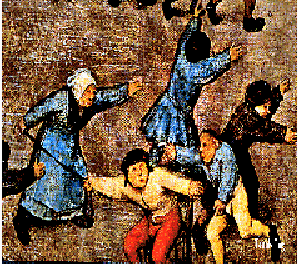
[Image: Children's Games by Pieter Brueghel (including touch-tag)]

Wednesday, 15 November 2006

HELLZAPOPPINS!

With the publication, last week, of Peter Jackson: A Film-maker’s Journey, my authorised biography of New Zealand’s cinematic Lord of the Rings, I fell to thinking how I once got very near --- or, possibly, nowhere near at all --- working with the entertainment industry’s Other Jackson

Of course, it all happened a long time ago: almost twenty years ago, to be precise, in 1987...

For several years, I'd been friends with P L Travers, the author of the Mary Poppins books and, over tea one Sunday afternoon, we were discussing the latest in a long line of requests from Disney that they be allowed to make a sequel to their hugely successful, multi-Oscar winning movie starring Julie Andrews and Dick Van Dyke.

This particular proposal was for a film in which the magical nanny would make a return visit, this time to help the children of either the grown-up Jane or Michael Banks. It was a clever idea, reminiscent of J M Barrie’s idea of having Peter Pan come back to London in order to take Wendy’s daughter - another ‘Jane’ - off to Never Land.

For Pamela Travers, however, it was totally unacceptable, since she resolutely maintained that all she knew about her heroine was whatever was to be found in the published stories. It was pointless asking Pamela who Mary Poppins was or where she went and what she did when she left the Banks family. Her answer was always the same: “I don’t know! I didn’t invent Mary Poppins, I discovered her!”

Knowing that I would be incapable of changing the author’s mind about the Disney offer, I merely observed that there were a great many people who loved the original film and would be incredibly pleased to see Mary Poppins fly back into the cinema one more…

“Well,” said Pamela whose prickly views of the Disney film of her books were widely known, “I would only agree if I was to be completely involved in the process of making the film and if I could work with someone whom I could trust…” Then, after a lengthy pause, she looked at me and said, “But if you want to suggest to Disney that you and I might work on a film story for them, then go ahead and see what they say…”

So I did! I didn't believe for a moment that it would actually happen but I wrote to Walt’s nephew, Roy E Disney whom I had met and interviewed several times, and got an instant, excited response. Within a matter of weeks, Pamela Travers and I were working on a treatment, following which we went on to write developed outline.

By sometime in the middle of 1988, to my enormous astonishment, I found myself in Los Angeles writing a Hollywood screenplay for a film to be called (after the second book in the series) Mary Poppins Comes Back!

The story was to take place a little while after Mary Poppins' first visit. Mrs Banks had now given birth to twins, called (as in Travers’ books) John and Barbara, and during her pregnancy, had given up the cause of women's suffrage - an embellishment in the original film which Pamela had hated.

Mrs B was, nevertheless, as dizzy as ever, and not coping with her enlarged family; while Mr B was very wrapped up in his new position at the Bank and gravely concerned over problems resulting from various imprudent investments that had brought the bank to near ruin.

The children, predictably, were being fractious and troublesome...

One day, in the Park, Jane and Michael were having difficulty with their fly-away kite until - helped by Barney the Ice-Cream-Man - they finally managed to reel it in only to discover that holding on to the other end of the kite-string is the supercalifragilistic Miss Poppins!

Disney were hopeful that Julie Andrews might agree to reprise the title role - and, indeed, at that time she could easily have done that - but there were question-marks over the rest of the cast who were either grown up, too old or - er - dead!

When we began working on the project, P L Travers and I were expecting Bert to remain an important character - although Pamela was adamant that the romantic implications of the first film should not be repeated. However, in an early round of discussions with the Studio they suggested we look for an alternative character to act as "a pointer to Mary Poppins", which was PLT's phrase to describe Bert's function in the story.

We eventually decided to use the Ice-Cream Man, a minor character in the books, named him Barney and made him Bert's younger brother adding, by way of explanation, that Bert had gone on to "'igher things" and was now "sweepin' the chimblies of the rich and famous!"

Every now and again, there were stray conversations about who might play Barney - one of which was quintessentially ‘Hollywood’, by which I mean that it was so typical of Moviedom that it may easily have betokened a genuine cast-iron idea or nothing more than a wild and passing whim...

Anyway, this is what happened...

One day, I'm taken to lunch by a studio executive at a ritzy restaurant on Rodeo Drive and, during the meal, am suddenly confronted with a totally unexpected question:

“So," begins the executive, "is it essential for Barney to be ‘Caucasian’?”

I look blank…

“I mean, does he have to be white?” he translates.

My failure to instantly respond is, of course, not because I don’t know the meaning of the word 'Caucasian', but simply because I can’t imagine why I am being asked…

For one thing, black people in Edwardian London were far and few between and whilst it was just possible, perhaps, to find a black footman serving in some big household, encountering a black ice-cream seller in a London park would have been an extremely unlikely occurrence.

And - apart from anything else - Barney was supposed to pass for Dick Van Dyke's younger brother!

So, I ask, why do they want to know...?

"Well,” comes the reply, “it just so happens that Michael is very keen to work with the Studio on a project..."

I interrupt: “Michael…?

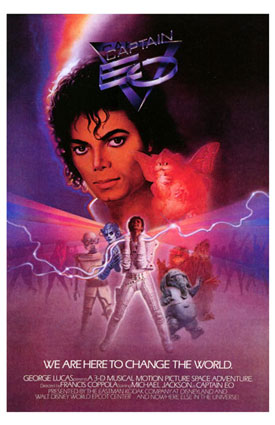
"Yes!" replies the executive, as if dealing with a complete idiot, "Michael JACKSON! Having made Captain Eo for Disneyland, he's now a part of the Disney family..."

I can't help it: I laugh...

The executive is not amused. He becomes emphatic: "Look! He sings! He dances! He'd be PERFECT!"

I stop laughing: he's in earnest!

What's more, he's still enthusing: "Listen! Just think of the marquee-billing: JULIE ANDREWS -- MICHAEL JACKSON -- MARY POPPINS! It’s a BRILLIANT line-up --- AND a hands-down BOX-OFFICE CERT!"

***

As it turned out, Mary Poppins never did come back - at least not on film - but if she had, then it's anyone's guess whether we might also we have seen Captain Eo selling strawberry ices in Cherry Tree Lane…

Monday, 6 November 2006

A SPOONFUL OF CYANIDE?

When Mary Poppins was first released in 1964, there were those who attacked it for what was seen for its cute and cosy charm; indeed, one critic even went so far as to dub it "Lollipoppins"...

Those of us who loved the film, of course, knew better...

And now Chris Rule and YouTube reveals the TRUTH to the world!

So, steel your nerves and watch...


Scary 'Mary Poppins' Trailer

Wednesday, 9 August 2006

PRACTICALLY PERFECT

Today is the 107th anniversary of the birth of Helen Lyndon Goff who was born on 9th August 1899 in Maryborough, Queensland, Australia, and who - under the pen name P L Travers - wrote the series of books that introduced the world to Mary Poppins the magical nanny who, in 1964, became the heroine of the very different - but utterly charming and much-loved - Disney film of the same name…

A defining quality of the books which the film - despite the cumulative talents that helped create it - never entirely succeeded in capturing is a breathtaking sense of the mystical, accompanied by a slightly disturbing feeling that Destiny is following close upon the heels of Mary Poppins' sensible shoes when she arrives - out of the blue - on the front doorstep of 17 Cherry Tree Lane and that, as a result, life for the children, Jane and Michael, will never be quite the same again...
“How did you come?” Jane asked. “It looked just as if the wind blew you here.”

“It did.” Said Mary Poppins briefly. And she proceeded to unwind her muffler from her neck and to take off her hat, which she hung on one of the bedposts…
For Jane and Michael - and the reader - the magic is just beginning…

Visit my ‘Ex Libris’ blog to read more about Miss Poppins and reminiscences of various encounters with her creator, Pamela Travers.