Showing posts with label Pauline Baynes. Show all posts

Monday, 30 October 2023

ONE BOOK TO RULE THEM ALL


I recently unearthed this old paperback copy of The Lord of the Rings (cover art by Pauline Baynes): a volume that was the Bible for the youth of my generation. 

The edition is dated 1971 (when I was 22-years-old); fast-forward a decade, and this would be the copy that i used when adapting Tolkien's epic for the BBC's – now renowned – 1981 radio serialisation.

Wednesday, 10 March 2021

Signed Books: THE ADVENTURES OF TOM BOMBADIL by J R R Tolkien


This would seem to be an appropriate 'signed book' from my library to blog about in the week in which, forty years ago, the BBC's radio serialisation of The Lord of the Rings began transmission on their Radio 4 network. 

Whilst I don't have a signed copy of that book, I do have this...


Tolkien's The Adventures of Tom Bombadil and other verses from The Red Book, illustrated by Pauline Baynes.

One of several criticisms levelled against me for my work on the radio Rings series was (and still is) my excision of those episodes involving Old Man Willow, Tom Bombadil, Goldberry and the Barrow-wights. 

Confronted by the daunting task of compressing The Lord of the Rings into 26 episodes of 30-minutes each I decided that if I were to cut Tom and Co. it would give me two whole episodes to use for other – arguably more urgently needed – sequences later in the story. 

Also, more controversially, I believed that – as I saw it – the 'less-than-essential-hiatus' where Frodo, Sam, Merry and Pippin take what turns out to be a dangerous diversion only served to dull the dramatic pace of the adventure; since, once the Black Riders were known to be pursuing Frodo, that anxiety and danger were – from a dramatist's point of view – the necessary driving impetus of the story and should remain so until the company arrive in Rivendell. Anyway, right or wrong, that is what I chose to do...

However, I hope that (if not a defence of a forty-year-old decision) including this volume in my series on signed books in my library will, at least show my great affection for Tom Bombadil!

It is not, sadly, a first edition, but the third impression from 1968. Frankly, my pocket-money in 1962 (when the book was first published) would not have allowed for an outlay of 15 shillings –– even though, in today's money, that's equal to a mere 75 pence!

I had become infatuated with Tolkien's writing and obsessed with anything and everything to do with Middle-earth and I took it into my head to write a shamelessly fannish letter to the Professor at his publishers (then George Allen & Unwin) telling how much I loved his work and to ask him to sign one of his books for me. The three volumes of The Lord of the Rings seemed too heavyweight a prospect for packing, mailing and returning, whereas Bombadil was slim and light!

I seem to remember creating a border for my letter of Dwarvish runes and, I fancy, I might even have copied out something in Quenya in a totally inadequate facsimile of his own impeccable calligraphy... 

Did I expect to see my book again – and signed? Naturally! The naiveté of youth is, beyond everything, unquestioning!

I was not to be disappointed: the book was returned, duly signed, with an accompanying letter from M. Joy Hill, George Allen & Unwin's Press Officer, advising me that, in addition to signing the book, "on page 60 Professor Tolkien has made a correction to the last line of the poem on that page." 


Eleven years later, in October 1979, I was attending the Narnia Book Fair at Church House Bookshop in Westminster where I met – and interviewed for LBC (then local radio!) – one of the guests: the illustrator of C S Lewis' 'Chronicles of Narnia', Pauline Baynes. This was a truly red-letter day for me – meeting the artist whose career was inextricably linked to Tolkien and Lewis, two of my favourite writers. 

Knowing that I would be meeting Pauline, I had my Tolkien-signed copy of Bombadil with me and asked her is she would add her signature to the title-page; she demurred saying it wouldn't be right for her to sign on the same page as the Professor and, were she to do so, it could only devalue the book's worth.

Rightly, I hope, I insisted and, finally, she acquiesced. More importantly, it was the beginning of many years of happy friendship and collaboration.

So... here is that signed title-page... 


And the Professor's one, single-letter-word, textual correction on page 60 to the last line of the poem, 'The Sea-Bell'... 


And, a last word on poor old Tom: in 1992, eleven years after the BBC radio dramatisation of The Lord of the Rings, I attempted to make my peace with those fans who had been so outraged at the character's omission from the original broadcasts. I created a six-part series for BBC Radio 5, based on Tolkien's shorter fiction and, alongside Farmer Giles of Ham, Smith of Wootton Major and Leaf by Niggle, included The Adventures of Tom Bombadil which was, essentially, the previously-ignored chapters from The Lord of the Rings... 


Wednesday, 5 December 2012

AN ARTIST'S IMAGINATION

She was one of the finest illustrators of the twentieth century who would, this year, have celebrated her 90th birthday.


I am speaking of that wondrous mistress of the the magical realms of Narnia and Middle-earth, Pauline Baynes, whose illustrations, decorations and map-making for the works of C S Lewis and J R R Tolkien are – despite the talented offerings of many successive artists and filmmakers – still indelibly associated with those now classic texts.


The work of this remarkable artist is currently being celebrated with an exhibition, 'An Artist's Imagination' at The Museum of Farnham, appropriately since she trained at the Farnham School of Art and lived much of her life in nearby Dockenfield.

In additions to a display of her books, many of which – for world myths and religious texts – will come as a fascinating surprise to those who only know Baynes' drawings for the Chronicles of Narnia and Tolkien stories like Farmer Giles of Ham and The Adventures of Tom Bombadil.

There are examples of the early illustrations by her (and her talented sister, Angela) as well as cover art for The Tattler and other magazines and commercial art for such companies as biscuit manufacturer, Huntley and Palmer...


This particular image is reproduced on a beautiful Christmas card that can purchased at the museum, price £2.00. A second card shows one of Baynes' stunning seasonal covers for The Tattler.

Several of our pieces are on display including this illustration of Lucy and the Sea People (from The Voyage of the 'Dawn Treader') made for my book, The Land of Narnia...


A wonderful image of Famer Giles confronting Chrysophylax from Tolkien's Stories and Poems...


And a number of illustrations made for my unpublished children's story, Osric the Extraordinary Owl, including this stunning group of peacocks...


There is also this unexpected vision of demons and monsters entitled 'The Final Triunmph of Good over the Devil'...


Photo of Pauline Baynes by David Weeks

The exhibition, An Artist's Imagination, continues until 8 January 2013. Admission free.

The Museum is open Tuesday – Saturday, 10am – 5pm. Closed 23 December–1 January.

The Museum of Farnham
Willmer House
38 West Street
Farnham
Surrey
GU9 7DX
Telephone: 01252 715094

Saturday, 25 December 2010

DAY OF DAYS

CHRISTMAS
Peace, Love & Joy


There is a legend that when the infant Jesus was lying in the manger of the Bethlehem stable, all the animals of the world made their way there to pay homage to the new-born babe. While the ox, ass and sheep bowed in adoration within the stable, the wild creatures were required to remain outside and had to content themselves with hoping for a glimpse of the Holy Child.

It is a legend referenced in P L Travers' fable The Fox at the Manger and in creating the picture above, my friend, the artist and illustrator, Pauline Baynes, chose to give the lion, the camel, the elephant and the others a very special closeness to the Christ and his mother as is fitting for the representatives of Creation gathering to worship the Creator in human form.

According to Wayne G Hammond of The Chapin Library, Pauline made this drawing in 1972 as a Christmas card design for the Cathedral in Washington DC, who, sadly, rejected it as 'too allegorical'.

The original artwork is currently for sale at £2,250 from The Illustration Cupboard.

Tuesday, 3 August 2010

OLD FRIENDSHIP

Two years ago, today, I heard of the death of my friend, the artist and illustrator Pauline Baynes...


She has been much in my thoughts recently and last evening, quite by chance, I picked up a small book entitled Poems of Friendship from one of my bookshelves and, on opening it, found - to my great surprise - that it was a Christmas gift from Pauline in 1996. Curious to have forgotten it for fourteen years; curiouser to have rediscovered it just now...

Anyway, here is a verse from that book: 'Old Friendship' by the American poet, Eunice Tietjens (1889-1944)...

Beautiful and rich is an old friendship,
Grateful to the touch as ancient ivory,
Smooth as aged wine, or sheen of tapestry
Where light has lingered, intimate and long.

Full of tears and warm is an old friendship

That asks no longer deeds of gallantry,
Or any deed at all – save that the friend shall be
Alive and breathing somewhere, like a song.


...or, at least, in our hearts and memories.


Images: Photo: © Brian Sibley 2008; Art: Bookplate designed by Pauline Baynes for her archive, from the collection in The Chapin Library of Rare Books.

You can find more of Eunice Tietjens poetry on the web-site, Old Poetry.

Friday, 10 April 2009

WHAT IS TRUTH?

Today is what Christians the world over refer to as Good Friday...

On this day, according to the Gospel of John, Jesus was brought before the Roman governor, Pontius Pilate, and when he observed that, "Every one who is of the truth hears my voice," Pilate famously asked "What is truth?"

That question came to mind recently when we visited the Byzantium exhibition at the Royal Academy which included, among its amazing hoard of treasures, a ornately decorated 13 Century reliquary said to contain a splinter of the True Cross.


The story of the True Cross is an extraordinary example of world mythology, beginning in 1260 with an account by Jacopo de Voragine, Bishop of Genoa, in his book Golden Legend.

According to the good Bishop, when Adam lay dying, he begged his son, Seth, to go to the Archangel Michael and beg a seed from the Tree of Life that grew in the Garden of Eden. This request having been granted, the seed was placed in Adam's mouth when he died and was buried. The seed subsequently germinated, took root, and grew into a tree.

Centuries later, the story goes on, the tree was cut down and the wood from it was used to build a bridge over which the Queen of Sheba passed on her journey to meet King Solomon. Struck by the symbolism represented by the bridge Her Majesty, allegedly, fell to her knees and worshiped it - as depicted (right) by Piero della Francesca.

During her visit with Solomon, the Queen told him that a piece of wood from the bridge would bring about a new order that would replace God's Covenant with the Jewish people and Solomon, fearful of the eventual destruction of his people, had the timber from the bridge buried. Nevertheless, fourteen generations later, this very wood, it is said, became the cross used at the crucifixion of Jesus.

Jacopo de Voragine went on to describe the subsequent finding of the cross by Helena, mother of the first Christian Emperor, Constantine. This part of the story dates back to the fifth century and the writings of Socrates Scholasticus and other early writers of ecclesiastical histories...

As the tale goes, the site of the Holy Sepulchre, where Jesus had been buried, was now surmounted by a temple to Venus. On a pilgrimage to Jerusalem, Constantine's aged mother had the temple destroyed and the Sepulchre uncovered, whereupon three crosses were also unearthed as depicted (right) in Agnolo Gaddi's 1380 painting.

In order to determine which cross was which, Macarius, Bishop of Jerusalem, had a dying woman placed on all three in turn on and when she recovered from the touch of the third cross this was taken as a sign that this was the specific cross on which Christ had died.

Socrates Scholasticus reports that the nails with which Christ had been fastened to the cross were also found and that Helena had sent these to Constantinople, where they were incorporated into her son's helmet and the bridle of his horse.

Now, whilst I don't personally believe this to be anything other than a legend, I was greatly moved by the reliquary of the True Cross displayed in the Royal Academy: moved because, whatever the truth or fiction might be about the slither of wood within the silver casing, it represents over 800 years of faith and belief.

In C S Lewis' The Voyage of the 'Dawn Treader', the children meet Ramandu who tells them that he is a 'retired' star (of the celestial variety) but Eustace challenges this concept, saying: "In our world, a star is a huge ball of flaming gas."

To which Ramandu replies: "Even in your world, my son, that is not what a star is but only what it's made of."

The curator's label on the reliquary in the Byzantium exhibition prosaically described the item as: "Silver gilt, cloisonné opaque enamels on a silver gilt support, wood, glass paste."

But that, of course, is only what it is made of, not what it is...

And, whatever we believe, that is truth which may be worth pondering...


Images: Crucifixion by Gustav Doré ; Ramandu by Pauline Baynes

Monday, 4 August 2008

PAULINE BAYNES: QUEEN OF NARNIA AND MIDDLE-EARTH


Pauline Baynes
(1922-2008)

It is with deep sadness that I write these few words about our dear friend, Pauline Baynes, who died, on Friday, in the cottage in Dockenfield, Surrey, where she had lived and worked for many years.

There are certain illustrators whose work is so intimately interwoven with the author's text as to rank as the books' co-creators. Sir John Tenniel, for example, the first illustrator of Alice's Adventures in Wonderland and E H Shepard who, with A A Milne, led us into the world of Winnie-the-Pooh.

Similarly, Pauline Baynes' pictures of country and denizens in C S Lewis' seven Chronicles of Narnia are still – despite the recent big-screen movie imagery – the definitive depiction of that extraordinary land beyond the wardrobe...


I can remember, precisely, where I was when I read each of the Narnian Chronicles: for example, I read The Magician's Nephew one winter's day curled up before an open fire while my mother was making cakes and pastry on the kitchen table.

Once glance at the vista on the jacket of the Puffin paperback edition of that book still not only evokes what is, for me, the essence of the land of Narnia – with its seashore, mountains, woods and lakes – but also gives me back a specific day from the tenth year of my life!


I first met Pauline almost thirty years ago, in October 1979, at a 'Narnia Book Fair' held at Church House Bookshop, Westminster. I was carrying one of my most treasured possessions: a copy of Tolkien's The Adventures of Tom Bombadil which the author had signed for me ten years earlier. She added her own signature to the title page, doubling its value to me as a collector.


Following that initial meeting, we kept in touch, collaborated on a book, The Land of Narnia, and, during the past 10 years, became close friends.

After the death of my and David's mothers, she became a kind of adoptive mum and (perhaps because she had no children of her own) interested herself in what we were doing and fussed over and cared for us in the various ups and downs of our lives. We loved her dearly and are deeply aware of how we – and others in her extended adopted family – are going to miss her...

She had a ceaselessly inquiring mind and energetically debated every topic imaginable. She could be sharply critical and quixotically changeable; she never suffered fools gladly, sniffed out cant and hypocrisy in a second and enjoyed nothing better than the kind of conversation which could veer from total seriousness to helpless laughter.

But all these are personal feelings and what I want to do in this posting is remind people of the extraordinary talent possessed by this modest, unassuming woman who created images that define the childhoods of millions...

After producing illustrations for various books of fairy tales, Pauline Baynes' career was established when, in 1949, J R R Tolkien's publishers showed the author of The Hobbit a portfolio of her artwork. Tolkien had written Farmer Giles of Ham, a fanciful novella with a faux-medieval setting, and being dissatisfied with the pictures that had been produced for the book was looking for a new illustrator.


Pauline produced a series of witty line illustrations that perfectly caught the essence of Tolkien's story to an extent that he declared them to be "more than illustrations, they are a collateral theme." He also delighted in reporting that friends had said that the pictures had reduced his text to "a commentary on the drawings"!

Pauline revisited the story of Farmer Giles and his exploits with the somewhat reluctant dragon, Chrysophylax Dives, on several occasions such as for the 50th edition of the story published in 1999...


It was the beginning of a long friendship between author and illustrator with Pauline decorating Tolkien's subsequent books, The Adventures of Tom Bombadil and Smith of Wootton Major.


It had been Tolkien's wish that Pauline should illustrate The Lord of the Rings, but the book grew into a project that rendered that plan impractical although it was her slipcase design for the three volumes that was adapted as a cover for the first one-volume paperback edition: providing what was, for an entire generation, a peek into the essentially English landscape of Middle-earth...


Posthumously Pauline illustrated Tolkien's Poems and Stories (including Leaf by Niggle) and Bilbo's Last Song. She also created that memorable map of Middle-earth that was a feature of thousands of student bedrooms...

Click to enlarge

I remember Pauline telling me that she always wondered whether Tolkien's wife, Edith, had ever actually read her husband's magnum opus. Her doubts stemmed from the day she took her artwork for the Middle-earth map to show the author. Above the map she had drawn the figures of the Nine Walkers – Frodo, Sam, Aragorn, Gandalf, Boromir, Legolas, Gimli, Merry and Pippin – setting out on the Quest of the Ring; beneath the map she had added an array of villains: marauding Orcs, the Nine Black Riders, Gollum and, the bottom right hand corner, Shelob.

Tolkien was pleased with the map – apart from one mis-spelled name that had to be corrected – and called to Edith to come and see. "Look what Pauline's done," said Tolkien. Edith scrutinized the map and the two groups of characters and then - pointing to Shelob - said: "Ooo, look at that horrid spider!"


It was the collaboration with Tolkien that resulted in Pauline's subsequent association with the septet of children's novels by C S Lewis beginning with The Lion, the Witch and the Wardrobe and known, collectively, as The Chronicles of Narnia.


 "Met C S Lewis. Came home. Made rock cakes." That, according to Pauline, was how she recorded in her diary one of the two meetings she had with the author whose work she so memorably embellished. It tells you exactly how she viewed her contribution to books that, for millions, of us were seminal childhood reading.


The illustrations for the Lewis books contributed significantly to their success and now are inseparable from the text, but she illustrated over a hundred other books as well as designing jackets and frontispieces for others and contributing numerous decorative pictures (left) to the illustrated magazines which proliferated in the 1940s and '50s such as The Sphere, The Tattler and The Illustrated London News. Her artistic output was astonishing: designs for inn signs, stained glass, church embroideries and Christmas cards.

Other commissions included pictures for school text books, and fanciful advertisements for a variety of products such as, here (courtesy of her friend, Martin Springett), Huntley and Palmer's biscuits...


Among her finest works (and there are a great many more) should be listed Henri Pourrat's A Treasury of French Tales; Amabel Williams-Ellis' Fairy Tales from the British Isles and The Arabian Nights reflecting her fascination with Persian miniatures.

She also decorated The Puffin Book of Nursery Rhymes, collected by her friends Peter and Iona Opie; and, spectacularly, Grant Uden's A Dictionary of Chivalry which contained a staggering near-600 illustrations in its margins and won the artist the coveted Kate Greenaway Medal.

She illustrated stories by Helen Piers, Rosemary Harris and Rumer Godden  as well as the final volume of Mary Norton's Borrowers saga and produced another iconic images for the cover of the first paperback edition (right) of Richard Adams' Watership Down.

What her work on these and other books show is her tirelessly painstaking research into the detailing of period costume and architecture and, above all, her extraordinary talent for conveying landscape and depicting natural life – especially animals, whether wild or domestic and, in particular, horses and, of course, dogs which were so much a part of her life.

Her later picture books – many on religious subjects such as All Things Bright and Beautiful, The Song of the Three Holy Children, Noah and the Ark In the Beginning and I Believe – demonstrate the artist's talent for design and her superb mastery of fluid line, gem-like colours and the use of negative space.

 There were also an amazing number of drawings done as favours for charitable organisations and friends. For example, in 1977, I was editing Bandersnatch, the newsletter of the Lewis Carroll Society when the discovery of the 'lost' chapter of Through the Looking Glass and what Alice Found There, featuring a Wasp in a Wig reading a newspaper came to light.

The episode had been dropped from the book at proof stage because John Tenniel had said such a bizarre character was beyond his powers to illustrate. But Pauline proved Tenniel wrong by creating this superb miniature (left) which I featured on the mast-head to Bandersnatch for several years.

Pauline remained prolific until the end of her life, illustrating a selection of writings from the Qur'an and the Book of Job (below) which are still to be published...


Pauline's last completed projects was producing 21 full page illustrations for a story of mine, entitled Oscar the Extraordinary Owl. She was disappointed when a succession of publishers declined the book, and concluded that her style was now too old fashioned and out of step with the current trends in children's publishing.


One day, I trust, someone will recognise again her singular talent for composition and publish some of these works which she made towards the end of her life purely for the pleasure of making pictures – so that they may bring pleasure to others just as her illustrations to the books of Lewis and Tolkien have done for fifty years...

When we visited her a few weeks ago, the drawing board facing in the window that looked out onto her pretty cottage garden, was covered with a series of energetic drawings – each a Baynesian mini-masterpiece of design – illustrating Aesop's Fables (right).

Today, that drawing board lies bare.

The artist is gone; but the artwork that she created lives on...


You can read my full obituary to Pauline Baynes here in The Independent.

Other obituaries appeared in The Guardian and The Telegraph; although unsigned they were written by two more of her close friends, respectively, David Henshall and Charlotte Cory. There was also a full obituary in The Times.

Post Script: According to Pauline's executor (who has read her diaries), she didn't write, "Met C S Lewis. Came home. Made rock cakes." However, I've let it stand because the fact that she said that's what she wrote provides an intriguing insight into her complex character.

Images: Photographs of Pauline Baynes and her drawing board © Brian Sibley, 2008; Art: Copyrights in the illustrations and artworks of Pauline Baynes are held and administered by The Chapin Library of Rare Books.

Sunday, 1 October 2006

MAPPING THE IMAGINATION

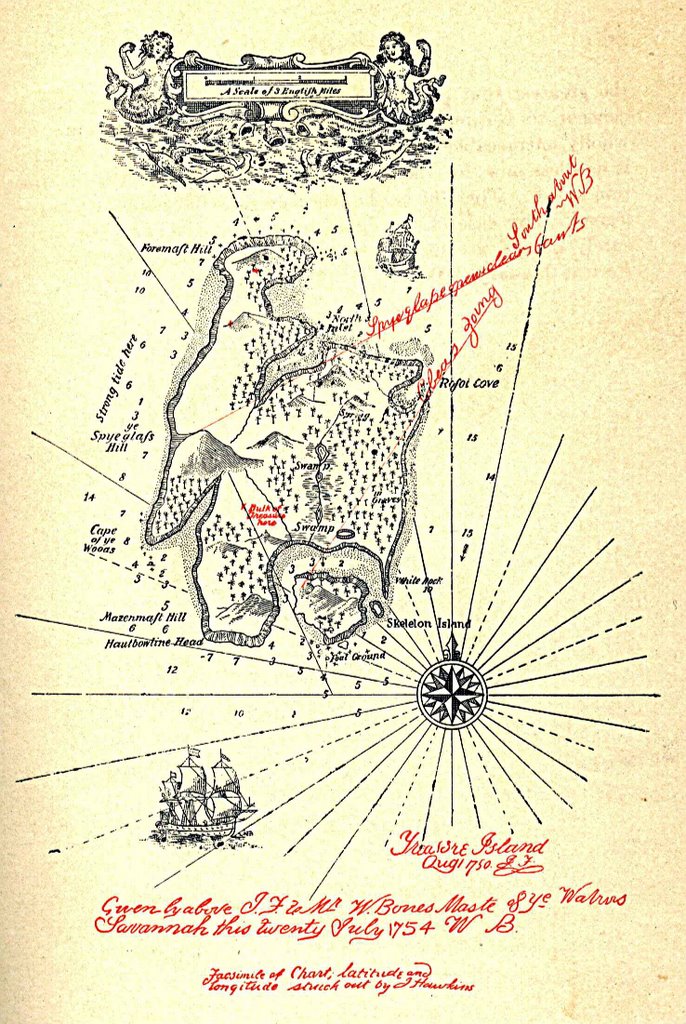
Yesterday's mention of the map of Ambridge, the fictional English village in the BBC radio soap, The Archers, reminded me how much I love maps - and especially maps of imaginary places. After all, whether you are trying to find Brookfield Farm or Treasure Island, a map always comes in handy

There is, of course, something fascinating about every map - perhaps it is the romance of place-names, or the mystery of symbols; maybe its the opportunity to take a bird’s-eye view of some corner of the world, near or far; or, perhaps, the sense of possessing a solution to the puzzle of where things are: the confidence of knowing ‘You Are Here’ or ‘How to Get There’ - or, as a famous map-lover, Mr Bilbo Baggins, would have said: "There and Back Again”.

All maps are a record of a very specific moment in time: the end product of centuries of history, geology and language and every map plots the limits of the mapmaker’s knowledge. That is why, on the earliest maps, those parts as yet unexplored were left blank or marked with such alarming cautions as "Here there be dragons"!

Pretty much ever since men have been making maps of the world around them, they have also been mapping the worlds of the imagination: from Eden to Erewhon, from Hell to Utopia, from Never Land and Oz to Narnia and Discworld, from the dinosaur-infested Lost World to the rabbit-inhabited Watership Down. No place, in fact, is too fantastical for the imaginative cartographer and the moment a map is drawn up - it becomes more tangible, more believable…

My earliest and fondest memory of a fantasy map is the enchanting view of the '100 Aker Wood', allegedly drawn by Christopher Robin (but in truth by E H Shepard) and used as a decoration on the end-papers of A A Milne's Winnie-the-Pooh.

Shepard's depiction takes the form of many fictional maps in being a pictorial as opposed to symbolic representation and includes illustrative depictions of geographical features such as, in this case, Eeyore's Gloomy Place (rather Boggy and Sad, the Pooh Trap for Heffalumps and Where the Woozle Wasn't...


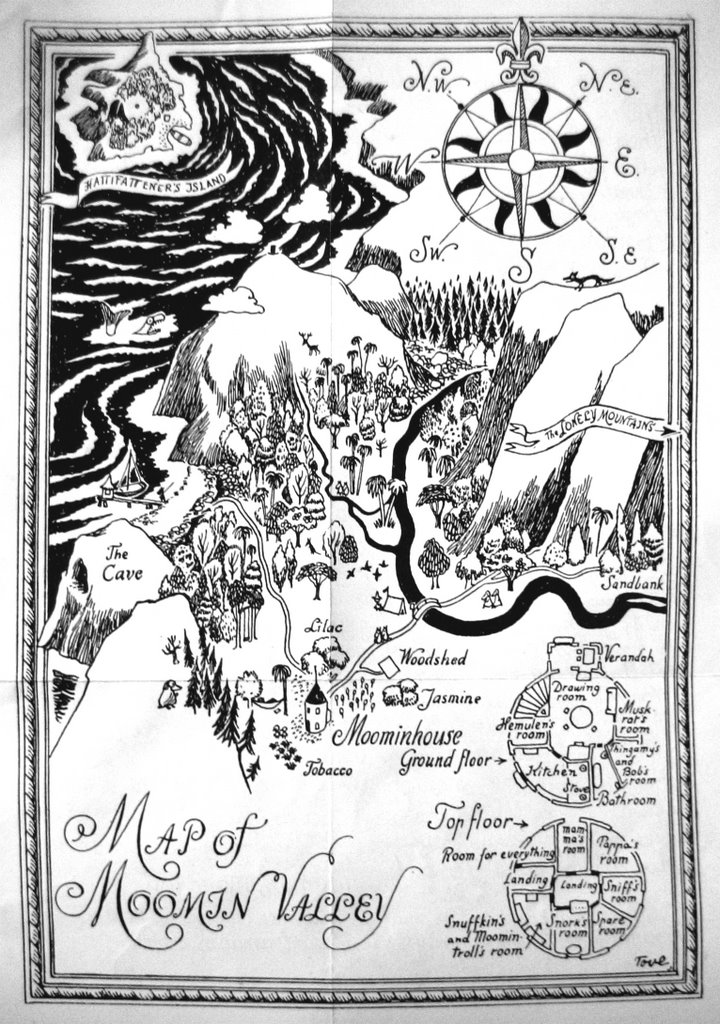
The next fanciful map of which I became aware was the one of Moomin Valley drawn by Tove Jansson for her Finn Family Moomintroll, and which - like a proper map! - folded-out of the book! I was especially intrigued by the fact that it incorporated a detailed plan of the Moomin's fantastical circular house that stands in its garden of lilac, jasmine and tobacco plants.

It also shows the off-shore island populated by the strange and rather scary Hattifatteners that - along with all the other mysterious features of Jansson's remarkable series of books - made the Moomin's world so beguiling, simply because it might not be altogether safe!


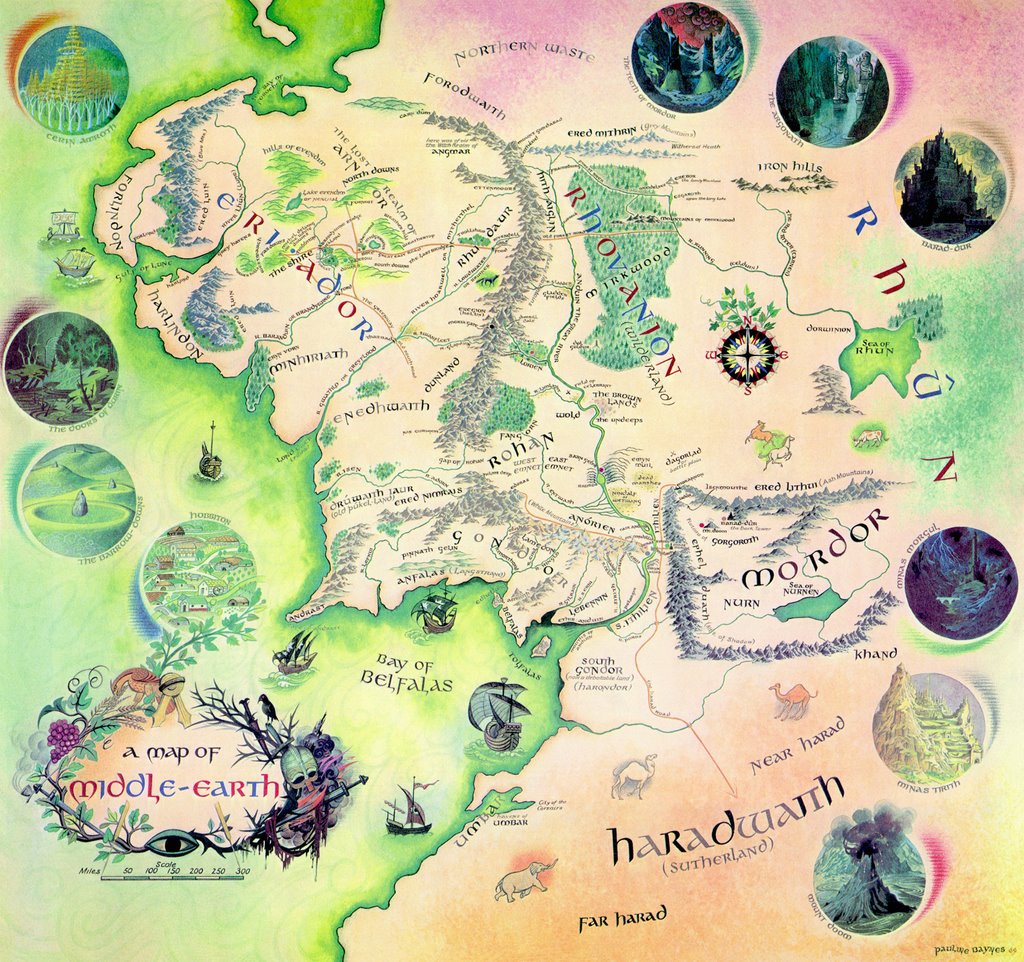
As a young man - having fallen under the spell of J R R Tolkien's The Lord of the Rings - I bought a copy of Pauline Baynes' wonderful poster map of Middle-earth and hung it on my wall where it remained - getting increasingly tattered and pin-holed - for many years and eventually served as a constant reference source when I came to dramatise Tolkien's epic for BBC radio.


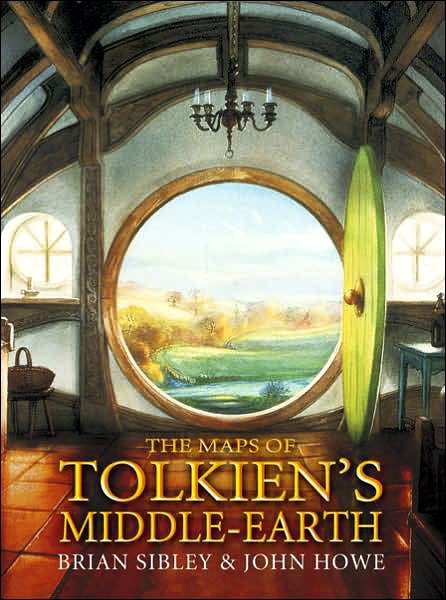
Many years later, I collaborated with another Tolkien artist, John Howe, to create three book-maps based on the Professor's own cartography of Middle-earth for The Hobbit and The Lord of the Rings and Christopher Tolkien's map of Beleriand, the realm described in The Silmarillion.


These individual maps (got up in the fold-out form of O S Maps) were later made into a book-and-map collection, slip-cased together with a fourth map of the lost island of Númenor, the fate of which is also chronicled in The Silmarillion. Mainly because it gave me the opportunity to be associated with Tolkien's fastidious map-making techniques and John's great artwork, The Maps of Tolkien's Middle-earth is a book to which I'm proud to have contributed...

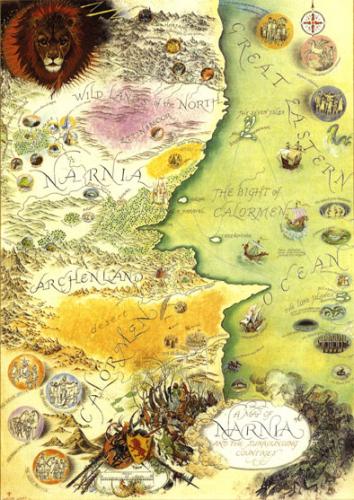
Other favourite maps that caught my youthful imagination were those, drawn again by the wondrously skilful Pauline Baynes, for C S Lewis' The Chronicles of Narnia - and her colour representation of the Land of Narnia ranks in my affections, alongside her visualisation of Middle-earth, for its vivid beauty and immaculate detail...


For many years now, Miss Baynes has been a personal friend and I unashamedly admit to being enslaved by her genius, but even if were not friends, I would still say that it is to the shame of Tolkien and Lewis' publishers, HarperCollins, that these two masterpieces of map-work are no longer in print and available to excite young minds in the way that they did for me and, I'm sure, very many others...

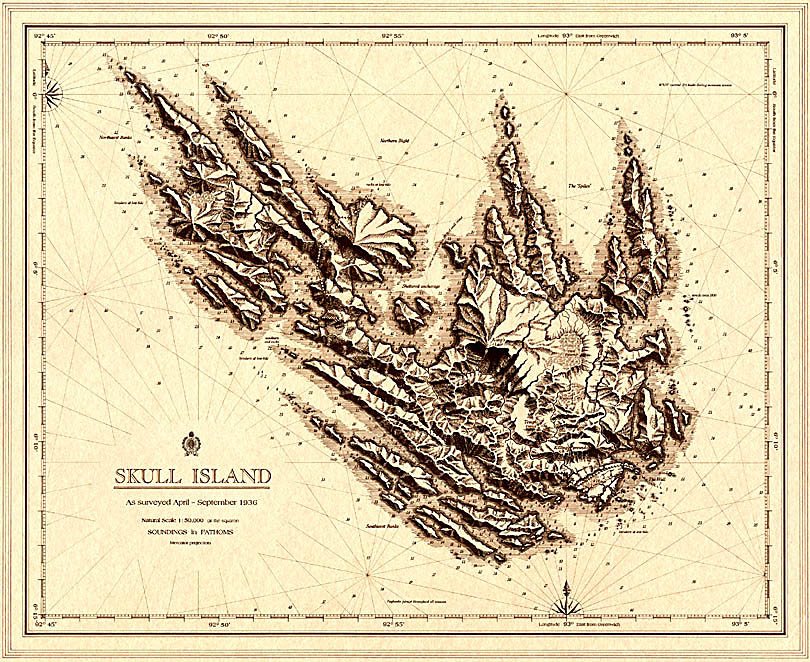
Still on the subject of Narnia and Middle-earth, frequent visitors to those lands may enjoy navigating a course over to the web-site of Daniel Reeve, another of my map-making friends. Daniel was responsible for creating the maps (as well as many books, manuscripts and artefacts) for the Peter Jackson movie trilogy of The Lord of the Rings and subsequently worked on the film, The Chronicles of Narnia: The Lion, the Witch and the Wardrobe as well as mapping Skull Island (in the shape of the skeletal foot of an ape?) for Jackson's King Kong.


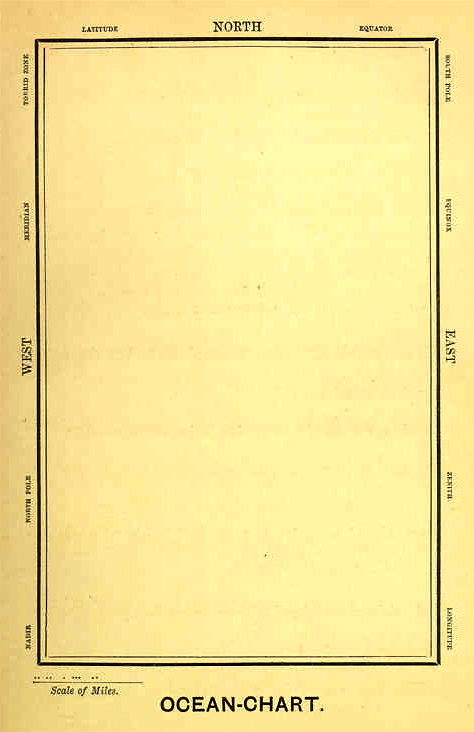
In conclusion, if any or all of these maps seem too demanding for Sunday morning contemplation, then I can offer a simpler example - the chart employed by the Bellman in Lewis Carroll's The Hunting of the Snark:
He had bought a large map representing the sea,
Without the least vestige of land:
And the crew were much pleased when they found it to be
A map they could all understand.

"What's the good of Mercator's North Poles and Equators,
Tropics, Zones, and Meridian Lines?"
So the Bellman would cry: and the crew would reply
"They are merely conventional signs!

"Other maps are such shapes, with their islands and capes!
But we've got our brave Captain to thank:"
(So the crew would protest) "that he's bought us the best --
A perfect and absolute blank!