Showing posts with label illustration. Show all posts

Monday, 3 March 2025

A NIGHT AT THE OPERA


Design by Maurice Sendak (1928–2012) – and famous for Where the Wild Things Are for a theatre scrim for Mozart's The Magic Flute, 1979–1980. Created watercolor and graphite pencil on paper on board. 

© The Maurice Sendak Foundation. The Morgan Library and Museum, Bequest of Maurice Sendak, 2013.104:120. Photo: Janny Chiu.

Saturday, 23 March 2024

EASTER TIMES PAST


It's Eastertide and Radio Times magazine has just unveiled the cover-art for its Easter 2024 Issue. The work of Dawn Cooper, it comprises a bunny, a bird (a red-breasted swallow?), spring flowers and, obviously, a few eggs. What could be nicer? They are, of course, all part of the traditional tropes and trappings of the season, but it sent me off in search of how Radio Times marked Easter in days gone by.
 
For five decades, like a number of other weekly magazines, Radio Times employed artists noted for their skill at working with woodcuts and pen-and-ink illustration and allowed them the time and space to create lavish pieces of decorative art that – for what was nothing more than an ephemeral publication – are astonishing in their unrivaled detail, story-telling and arresting imagery.
 
Many Easter issues of Radio Times contained interior artwork presenting classic or newly-created depictions of the Passion, but the covers – unsurprisingly, perhaps – mostly comprised intensely rural, village-centric scenes from some of the finest illustrators of the age – in all of which the church was either a central feature or at very least an integral element of the design. It may be hard to believe, my children, but that is how it was in Britain during those early All-Things-Bright-and-Beautiful years of the Twentieth Century.


Easter 1934 - John Austen (1886-1948)


 Easter 1948 - J. S. Goodall (1908-1996)


Easter 1949 - [Unidentified artist] 


Easter 1950 - Robin Jacques (1920-1995)

 Easter 1951 - C. F. Tunnicliffe (1901-1979) 


Easter 1952 - S. R. Badmin (1906-1989)


Easter 1954 - S. R. Badmin (1906-1989)

Wednesday, 6 March 2024

THE MILLER'S TALE


Back in print after ten years: a fabulous celebration of fantastic illustration: The Art of Ian Miller; a book crammed with 300 astonishing images of graphic brilliance to which I had the great privilege of contributing an Introduction.

As I wrote (in part) back in 2014, and as I still passionately believe: 


"A good illustrator may capture the essence and detail of author’s work, transforming word into image, but a truly great illustrator transports us into the silences between sentences, evokes the possibilities between paragraphs, illuminates the shadows that lurk in the turning of a page."


Welcome to Ian Miller's amazing and disturbing world of flying fish, walking trees, floating cities, mechanical warriors and creatures from the worlds of Tolkien, Lovecraft, Bradbury and Peake not to mention the darkest recesses of your nightmares!

Wednesday, 14 February 2024

VALENTINE'S DAY

A Short Note on the ART of LOVE…

The brilliant American artist, J. C. Leyendecker (1874-1951), celebrated for his memorable poster and advertising illustrations, spent his career depicting idealized images of the sexes that were redolent of the spirit of the 1920s. That imagery, for his generation, served as archetypes of heterosexual masculinity and femininity. But while a nation adored his work – and sought to emulate the style and glamour of the Leyendecker men and women – the creator lived a closeted life common to so many gay men and women of that era.

Today, his work has undergone a process of homoerotic decoding and, on this Valentine's Day, I'm sharing three of his classic paintings: 'The Butterfly Couple' (1923) and its romantic usage as a magazine advertisement for Kuppheimer Good Clothes, and two covers for The Saturday Evening Post (March 1913 and 1934)...


Alongside these ladies and gents, I give you a re-imagined amalgamation of Leyendecker's craft (together with appropriate Evening Post lettering) made in 2010 by James Blah as a Valentine’s Day card for his boyfriend.


 As the Bard neatly observed:

"Love looks not with the eyes, but with the mind,
And therefore is winged Cupid painted blind." 

– A Midsummer Night's Dream, Act 1, scene 1 

Let's remember J. C. Leyendecker for his astonishing art while celebrating the fact that we live in a time when, for the benefit of all humanity, Cupid is increasingly – and thankfully – being "painted blind". 

Friday, 2 February 2024

CHRISTMAS ISN'T JUST FOR CHRISTMAS

Today, the feast Candlemas, traditionally marks the 40th day of – and conclusion to – the Christmas-Epiphany season; but, maybe, it doesn't need to be... Charles Dickens certainly thought that was an option, as evidenced by Ebenezer Scrooge's declaration towards the end of in A Christmas Carol (1843):
 

“I will honour Christmas in my heart, and try to keep it all the year."


[Illustration: Roberto Innocenti, A Christmas Carol (1990)]

Tuesday, 12 December 2023

GINGERBREAD HOUSE DAY

December 12th: 

HAPPY GINGERBREAD HOUSE DAY!  


Illustration: Kay Nielsen (18886-1957) from Hansel and Gretel and Other Stories by the Brothers Grimm (1925)

The tradition of making decorated edible houses  from gingerbread began in Germany in the early 1800s, allegedly popularised following the publication, in 1812,  the dark fairy-tale of Hansel and Gretel as told by the Brothers Grimm. In the tale, the abandoned children, lost in a wood, discover original the house "built of bread, and roofed with cakes, and the window was of transparent sugar.”  In later tellings, the bread became gingerbread inspiring German bakers to craft small decorated edible houses from lebkuchen, the popular spiced honey biscuits.

"...It was now three mornings since Hansel and Gretel had left their father's house. They began to walk again, but they always came deeper into the forest, and if help did not come soon, they must die of hunger and weariness. When it was mid-day, they saw a beautiful snow-white bird sitting on a bough, which sang so delightfully that they stood still and listened to it. And when its song was over, it spread its wings and flew away before them, and they followed it until they reached a little house, on the roof of which it alighted; and when they approached the little house they saw that it was built of bread and covered with cakes, but that the windows were of clear sugar. 'We will set to work on that,' said Hansel, 'and have a good meal. I will eat a bit of the roof, and you Gretel, can eat some of the window, it will taste sweet.' Hansel reached up above, and broke off a little of the roof to try how it tasted, and Gretel leant against the window and nibbled at the panes. Then a soft voice cried from the parlour:

'Nibble, nibble, gnaw,
Who is nibbling at my little house?'

The children answered:

'The wind, the wind,
The heaven-born wind,'

and went on eating without disturbing themselves. Hansel, who liked the taste of the roof, tore down a great piece of it, and Gretel pushed out the whole of one round window-pane, sat down, and enjoyed herself with it. Suddenly the door opened, and a woman as old as the hills, who supported herself on crutches, came creeping out. Hansel and Gretel were so terribly frightened that they let fall what they had in their hands. The old woman, however, nodded her head, and said: 'Oh, you dear children, who has brought you here? do come in, and stay with me. No harm shall happen to you.' She took them both by the hand, and led them into her little house. Then good food was set before them, milk and pancakes, with sugar, apples, and nuts. Afterwards two pretty little beds were covered with clean white linen, and Hansel and Gretel lay down in them, and thought they were in heaven."

[Read more about the artist here: https://en.wikipedia.org/wiki/Kay_Nielsen ]

Wednesday, 10 August 2022

RAYMOND BRIGGS (1934-2022)


I am so saddened to learn of the passing of that brilliant artist responsible for some of the most beloved 'graphic storybooks' of the last 60 years: Raymond Redvers Briggs CBE.

Twice-winner of the prestigious Kate Greenaway Medal and numerous other awards and honours for being the modest genius who created Fungus the Bogeyman, Father Christmas (and, "Bloomin' 'eck!", Father Christmas Goes on Holiday), When the Wind Blows, Ethel & Ernest: A True Story, Ug: Boy Genius of the Stone Age and, of course (among many other titles), that glorious enduring, text-less classic, The Snowman.

Oh, what great joy and delight you gave us, Raymond. Thank you!


Sunday, 5 September 2021

ERIC FRASER'S 'Radio Times' art for the BBC's THE LORD OF THE RINGS


This post is for all you aficionados of
the BBC 1981 radio serialisation of The Lord of the Rings who have been following my six-monthly Blog and Facebook journey across the original twenty-six weekly episodes as they were first broadcast on Sundays from 8 March to 30 August, forty years ago.

Here, all in one place, is the complete set of Eric Fraser's black-and-white illustrations made to accompany the credits to the weekly episodes in the BBC's listings magazine, Radio Times. 

All images, except that for the second episode ('The Shadow of the Past'), are reproduced from Fraser's original art now in my collection; in this one instance, the image used was scanned from its printed reproduction in Radio Times. (I would, incidentally, be grateful for any information about the ownership of this 'missing' piece!)

The three images made for episodes 15-17 ('The Voice of Saruman', 'The Black Gate is Closed' and 'The Window on the West') are published on this blog for the very first time since, during that three week period, there was an industrial dispute at the print-works responsible for producing Radio Times and the magazine was issued only in an slimmed-down emergency format with few, if any, illustrations. The additional image at the top of this post was a generic design Fraser made featuring Gandalf, Frodo and Sam which was used on the BBC souvenir poster for the series and, subsequently, as a decoration for the box containing the cassette-tape release of the recordings. 


1.  The Long-awaited Party


2.  The Shadow of the Past


3.  The Black Riders


4. Trouble at the Prancing Pony


5. The Knife in the Dark


6. The Council of Elrond


7. The Fellowship of the Ring


8. The Mines of Moria


9. The Mirror of Galadriel


10. The Breaking of the Fellowship


11. The Riders of Rohan


12. Treebeard of Fangorn


13. The King of the Golden Hall


14. Helm’s Deep


15. The Voice of Saruman


16. The Black Gate is Closed 


17. The Window on the West


18. Minas Tirith


19. Shelob’s Lair


20. The Siege of Gondor


21. The Battle of Pelennor Fields


22. The Houses of Healing


23. Mount Doom


24. The Return of the King


25. Homeward Bound


26. The Grey Havens


Sunday, 29 August 2021

FORTY YEARS ON... Eric Fraser's LORD OF THE RINGS radio art: Week 26


I wept writing this final episode of the BBC radio dramatisation of The Lord of the Rings, I wept again as the actors recorded it in the studio and I wept once more when I heard it first transmitted on this Sunday, forty years ago. I still weep every time I hear it...

My plan was always to include 'Bilbo's Last Song' in the final episode as the Ring-bearers sail into the West but – since it did not appear in the novel and Tolkien had gifted the copyright in the poem to Joy Hill, his secretary at George Allen & Unwin – the negotiations for its inclusion were long and tricksy. But it was finally achieved and Stephen Oliver's elegiac setting powered the closing moments of the dramatisation, representing not only the end of Frodo's journey but also that of everyone involved in writing, performing and producing the serial.

Eric Fraser's final illustration for the BBC's weekly listings magazine, Radio Times shows the bittersweet image of Sam, Merry and Pippin watching the boat slip from the harbour into the Firth of Lune...

"And the ship went out into the High Sea and passed into the West, until at last on a night of rain Frodo smelled a sweet fragrance on the air  and heard the sound of singing that came over the water. And then it seemed to him that ... the grey rain-curtain turned all to silver glass and was rolled back, and he beheld white shores and beyond them a far green country under a swift sunrise."

For the moment of Frodo's parting from Sam at the Grey Havens, I transferred a few lines from an earlier conversation in the book as a leave-taking valedictory:

"Do not be too sad, Sam. You cannot always be torn in two. You will have to be one and whole, for many years. You have so much to enjoy and to be, and to do."

Words that I used again, heard by Sam – as an echo in his memory – the moment before opening the door to Bag End and announcing to Rosie and baby Elanor: "Well, I'm back."

Thank you for sharing this pictorial journey with me across the six months and twenty-six illustrations by the magnificent, Eric Fraser. 


Sunday, 22 August 2021

FORTY YEARS ON... Eric Fraser's LORD OF THE RINGS radio art: Week 25


'Homeward Bound' was the title I gave to the penultimate episode of the 1981 BBC radio dramatisation of The Lord of the Rings, originally broadcast on this Sunday, forty years ago. 

The great challenge of the serialisation – after the crisis-after-crisis driven story that reaches its narrative peak in episodes twenty-three and twenty-four with the destruction of the One Ring and Sauron's power and the coronation of Gondor's returning King – is the lengthy and anticlimactic homeward journey with its serial partings and farewells.

All of this textual material had to be ruthlessly compressed to work within the tight structure of weekly half-hour episodes. Despite the demands of condensing Tolkien's rich text, I remained determined that – although heavily edited – the Scouring of the Shire and the Grima's murder of Saruman on the doorstep of Bag End – would be retained since, without those events, the whole drama would be less meaningful.

"The very end of the war, I hope," said Merry.

"I hope so," said Frodo and sighed. The very last stroke. But to think that it should fall here, at the very door of Bag End! Among all my hopes and fears at least I never expected that." 

But Tolkien knew that, in some way or another, battles – large and small – all end at our own front door... 

Eric Fraser's original illustration for Radio Times takes the sober, haunting image of the sadly despoiled Shire found by the heroes on their return from war. 


Sunday, 15 August 2021

FORTY YEARS ON... Eric Fraser's LORD OF THE RINGS radio art: Week 24


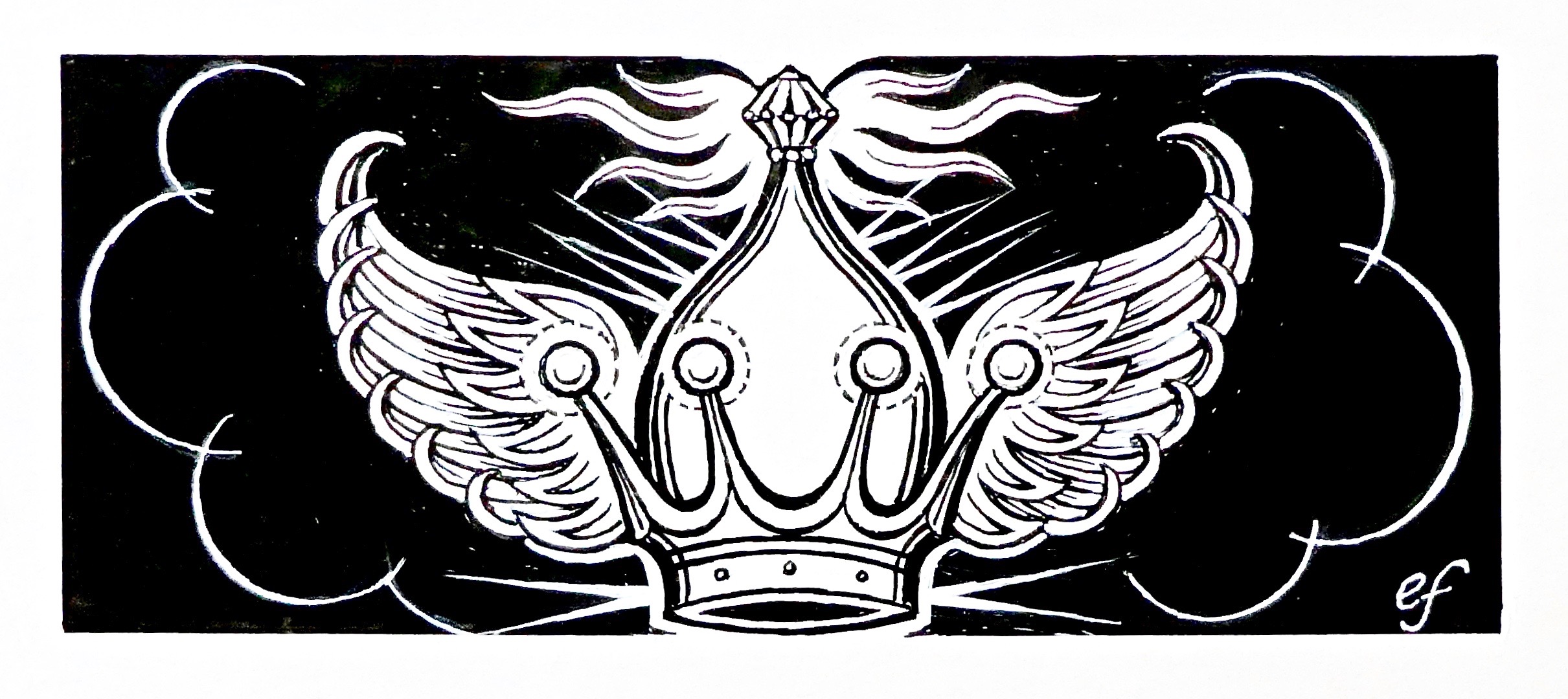
After the epic drama of Sauron's fall comes the triumphant and long-awaited coronation of Aragorn, King Elessar. So, for obvious reasons, the twenty-fourth episode of the BBC's 1981 dramatisation of The Lord of the Rings – first broadcast forty years ago today – was titled 'The Return of the King'.

Equally obvious was Eric Fraser's choice of the Crown of Gondor as the subject for his illustration accompanying the episode-billing in Radio Times with a design based on Tolkien's description in the novel: 

"It was shaped like the helms of the Guards of the Citadel, save that it was loftier, and it was all white, and the wings at either side were wrought of pearl and silver in the likeness of the wings of a sea-bird, for it was the emblem of kings who came over the Sea; and seven gems of adamant were set in the circlet, and upon its summit was set a single jewel the light of which went up like a flame." 


Sunday, 8 August 2021

FORTY YEARS ON... Eric Fraser's LORD OF THE RINGS radio art: Week 23


And so we come to 'Mount Doom', the twenty-third episode of the 1981 BBC serialisation of J R R Tolkien's The Lord of the Rings, originally broadcast forty years ago this Sunday.

In so many ways this is the climax (although not the end) of the quest which began in Episode 6 when, at Rivendell, the Council of Elrond determined that the war with Sauron could only be won if the One Ring were to be returned to fires of Orodruin. 

This episode was the second of the final five episodes that I personally dramatised for the serialisation, taking over from Michael Bakewell's brilliant dramatisation of the epic battles that precede the intense, intimate drama that is played out by Frodo, Sam and Gollum on the very edge of the Cracks of Doom.

As a dramatist, this was one of my favourite episodes to have written and I have unforgettable memories of watching Ian Holm, Peter Woodthorpe and Bill Nighy, gathered around a radio microphone, act out their characters' desperate struggle on Sammath Naur, playing out the narrative device that Tolkien described as a 'eucatastrophe'. Writing in a letter to his son, Christopher, Tolkien explained: "I coined the word 'eucatastrophe': the sudden happy turn in a story which pierces you with a joy that brings tears (which I argued it is the highest function of fairy-stories to produce)."

This original piece of art created by Eric Fraser for the Sunday programme page in the BBC's weekly magazine, Radio Times, is, without question, my favourite of the twenty-six weekly illustrations the artist made to accompany the series: stunningly dramatic and powerfully cataclysmic.


Sunday, 1 August 2021

FORTY YEARS ON... Eric Fraser's LORD OF THE RINGS radio art: Week 22


'The Houses of Healing' was the title of the twenty-second episode of the BBC's 1981 radio dramatisation of The Lord of the Rings, broadcast forty years ago this Sunday. 

In this episode the chatterbox of Ioreth the wise-woman healer (a cameo appearance by Pauline Letts) tells Gandalf of the legend of Gondor that says: "The hands of the king are the hands of a healer, and so shall the rightful king be known," leading to the Christ-like verification of Aragorn as the true King.  

Eric Fraser's original art, created for the programme page in Radio Times shows a pair of leaves of the healing herb called athelas (or 'Kingsfoil') about to be crushed and steeped in boiling water.