Easter 1951 - C. F. Tunnicliffe (1901-1979)
Easter 1952 - S. R. Badmin (1906-1989)
Easter 1951 - C. F. Tunnicliffe (1901-1979)
Easter 1952 - S. R. Badmin (1906-1989)
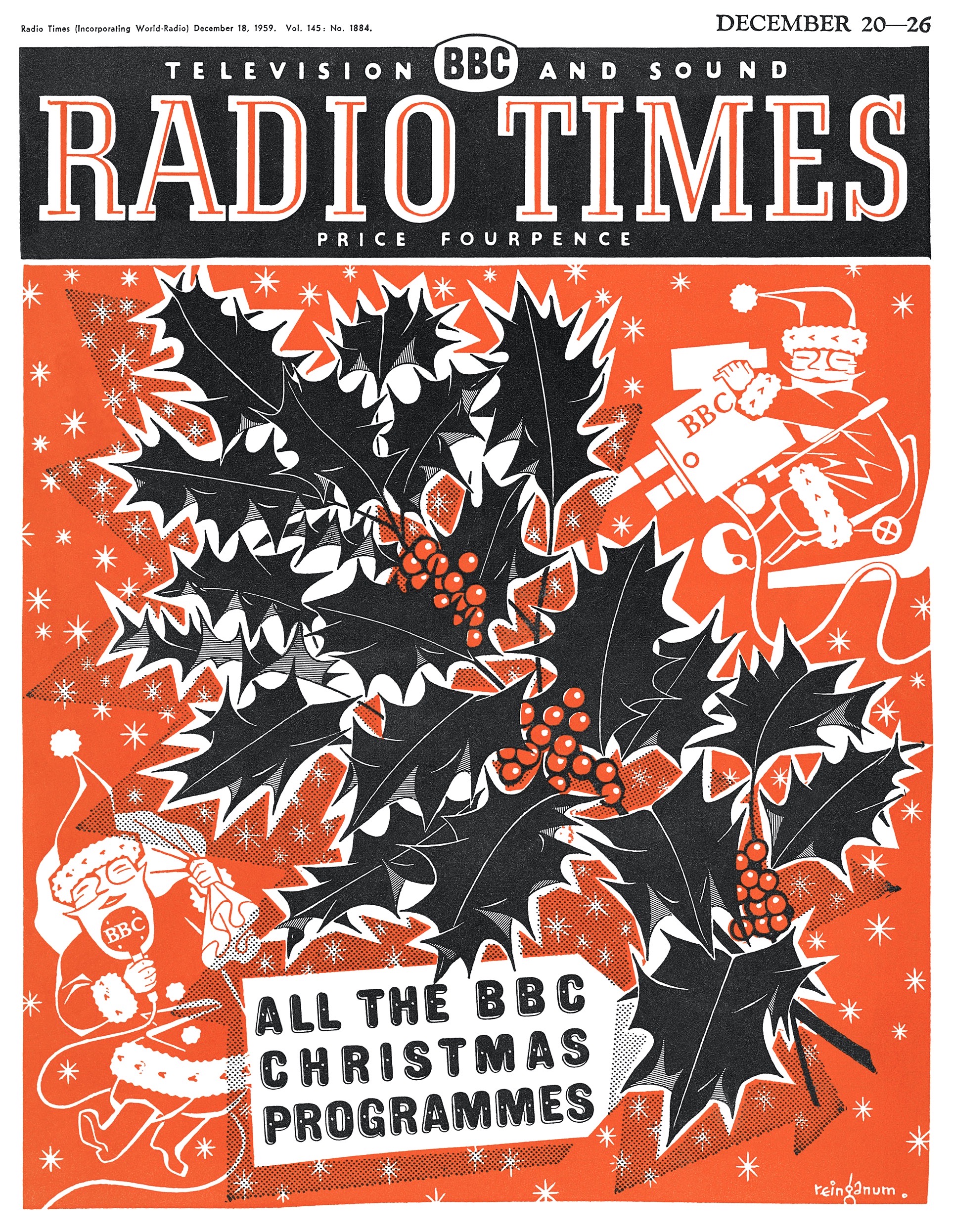
Remember those days in the Twentieth Century when the arrival of the Christmas Issue (later 'Bumper Issue') of Radio Times signaled the true beginning of seasonal festivities?
Historically, Radio Times was always a showcase for the work of some of the finest graphic and illustrative artists of the age and examples of their work is showcased in this very personal selection of classic covers from before-my-time, but by artists whose work I love – John Gilroy (he of the classic Guinness posters), Rex Whistler, Edward Ardizzone and Eric Fraser; from my childhood and adolescent years – C. Walter Hodges, J. S. Goodall, Ronald Searle, Rowland Hilder, Victor Reinganum and, again of course, Eric Fraser; and, lastly, from more recent years – the impeccable art of Tony Meeuwissen and a wonderful cavalcade of Santas and Snowmen by my friend, Mick Brownfield.
Among the later are his Father Christmas and Dalek cover and the alternative variant Strictly Come Dancing version for families with tiny tots who were scared of Doctor Who's inter-galactic, mechanical nemesis!
I am deeply saddened to learn the news of my friend and fellow Disney fanatic, Jim Korkis at the age of 72. How to sum of the life and prolific work of this popular and much-loved Disney historian?
I made an attempt in 2013 in contributing this commendation for the back cover of his then latest book, The Vault of Walt Volume 2: Other Unofficial Disney Stories Never Told. I wrote:
In Disney’s world of mice and ducks, the indefatigable Jim Korkis is a veritable terrier: tracking down juicy stories, sniffing out intriguing incidents and digging up forgotten facts! His encyclopaedic knowledge and dedication to research are matched by an incomparable narrative skill that effortlessly educates and enlightens in the most enthusiastic, engaging and entertaining way.
Of course it would have been better if I'd started by saying: "In Disney’s world of mice ducks and dogs..." but it's too late now.
Jim and I had a long-running correspondence that touched on many matters Disneyesque: specific films and characters obviously, but also Jim's former career within the Company and his, often feisty, commentaries of the changing face of 'Disney Inc.'; mostly however, we corresponded about our shared passion for 'Classic Disney', by which we meant the life and work of the Man Himself.
As I wrote today on the 'Disney History Institute's' Facebook page:
...Jim was a wonderful human being and an indomitable enthusiast; he poured his humanity and enthusiasm into everything he did and wrote. I have read, used and contributed to his many volumes and I have enjoyed them for their diligent research, clarity of storytelling and, most of all, their HUGE sense of fun and delight. Jim had a passionate love of all things Disney and he never wearied of passing on his passion and knowledge with the rest of us who shared that love. Thank you for your work, Jim, and your friendship. I will miss you and whatever your next few books would have been...
Remembering Jim prompts me to share the Foreword I wrote to his 2017 book, The Vault of Walt: Volume 6: Other Unofficial Disney Stories Never Told...
FOREWORD
I have something to get off my chest: despite having spent a disproportionate part of my life collecting and writing about all things Disney, my earliest encounter with the Mousetro’s work proved deeply traumatic for me and acutely embarrassing for my parents.
What ended as a nightmare had begun as a treat for my fourth birthday: a visit to a now-long-gone British institution, the News Theatre on London’s Waterloo Station. Open daily, from 9 a.m. to 11 p.m., the News Theatre screened a continuous program of newsreels, comedy one-reelers and cartoons. On this particular day, the bill featured the vintage 1938 Disney short, Brave Little Tailor, in which Mickey Mouse, in the title role, tackles an enormous Giant in order to win the hand of the Princess Minnie. At a crucial point in this drama, Mickey hides in a cart laden with pumpkins and, when the giant grabs a handful as a snack, Mickey finds himself being hurled into the Giant’s mouth. Dodging the pumpkins as they hurtle by him like bowling balls, he only avoids being swallowed by hanging onto the Giant’s uvular. These antics were, naturally, greeted with hilarity by every other youngster in the cinema – but not, unfortunately, by me! Terrified at the mouse-threatening scenario unfolding before me in the dark, I screamed and screamed until my humiliated parents bundled me out of the theatre and rushed me off to the nearest café to pacify me with tea and buns.
I make this confession as it may help to explain the fixation with Disney that has obsessed me virtually ever since that harrowing day! Without that shock to my young system, that jolt to my nascent psyche, would I have co-authored several books on Disney topics (from Mickey Mouse and Snow White to Mary Poppins) or made several dozen hours of radio programmes for the BBC about Uncle Walt, his company and movies? Probably not.
One of the by-products of this career (of which I’ve only provided the sketchiest of detail since I’m taking up space in somebody else’s book on Disney) is the occasional invitation to write a foreword such as the one I’m just about to get down to writing here.
Within the annals of cinema history there is a small but growing coterie of dedicated scribes who are dubbed Disney Historians. There is an urgent imperative to chronicle the life and times of Walt Disney and the achievements of his studio because it is the story of many people, most of whose contributions have only begun to be recorded in the past 50 years since the death of the man whose internationally recognised signature came to represent the combined talents of an army of artists, writers, musicians and technicians.
Some of us of a certain age can still recall when there were scarcely more than a handful books about the art and industry of Disney. Today there are shelf-loads of such books – representing a wide range of approaches from the academic and authoritative via the critical to the anodyne and scurrilous. Nevertheless, there are still first-hand recollections needing to be recorded and new chapters of the story waiting to be written – not to mention the tedious task of correcting inaccuracies and remedying misconceptions.
One of the most prolific of these Disney historians is the indefatigable Jim Korkis (“At last!” you say, “This Foreword is finally getting to the point!”) whose Disney Vault you are about to enter.
I first met the Vault Keeper sixteen years ago, on 5 December (Walt's birthday) 2001. We were in the VIP lounge of the Norway pavilion in EPCOT and, whilst I no longer recall the reason for that choice of venue, I mention it since the fact that EPCOT has a Norway VIP lounge will be, for some, an irresistible piece of Disney park trivia eagerly learned.
After signing a book of mine for Jim (despite my protestations that the only valuable copies are the unsigned ones) he gave me a cracking interview for one of my radio shows as a result of which I immediately had the measure of Jim’s talent: he was, like Shakespeare’s clown Autolycus, "a snapper-up of unconsidered trifles", by which I mean that he collected a wealth of information that others had overlooked or disregarded and stored it away in his vast memory-bank – or, you could say, vault!
Korkis books are always filled with these discoveries, fashioned together so as to create a series of diverse narratives of varying – but satisfyingly appropriate – length where the whole is always greater than the sum of the parts.
Jim is a born teller of tales, able to engage, excite, intrigue and amuse us with stories that reveal not just his talent for research but also his gift of infectious enthusiasm. If something fascinates Korkis he will make sure we share his fascination. This is not surprising since he has met and talked with dozens of Disney animators and those theme park wizards known as ‘Imagineers’ and has been writing about them and their genius boss for three-and-a-half decades.
Looking through the table of contents I can’t quite decide where I’ll start: maybe with the stories about Walt’s enthralment with Abe Lincoln and Charlie Chaplin; or, perhaps, with the appreciation of Disney Park Dinosaurs; or, possibly, with the articles on the Oscar-winning documentary, Seal Island, and the zany comedy that introduced the world to car 53 – Herbie, the Love Bug. Wherever I start, I can guarantee to be riveted and end up knowing immeasurably more than when I started.
In view of the distressing recollection with which I began this Foreword, I was wondering if an essay on Disney Giants might be on offer; but it really doesn’t matter because Jim can always add it to the possible contents list for his next foray into the Disney Vault; meanwhile (since I’ve detained you far too long already), you can start enjoying this one. Right, then! Off you go…
Well, what are you waiting for? Off you go to your bookseller-of-choice and get your hands on one of Jim's many books on Disney, maybe this one, published last year when he knew he was battling the disease that has finally taken him from us to that enchanted Neverland that created by the Dream-merchant whose work he loved and ceaselessly celebrated.
In 1953, the BBC's official magazine, Radio Times, marked the Coronation of Queen Elizabeth II with an ornately-decorated cover by Eric Fraser, one of Great Masters of line illustration and a regular contributor to the pages of Radio Times, specializing in creating arresting illustrations for audio broadcasts among them productions of Shakespeare's plays, poetry, religious and philosophical topics as well many of the world's most celebrated classics – including towards the end of his career, the BBC's 1981 dramatisation of The Lord of the Rings.
Eric Fraser's cover for the Queen's Coronation features traditional heraldic imagery and is a masterpiece of elegant design...
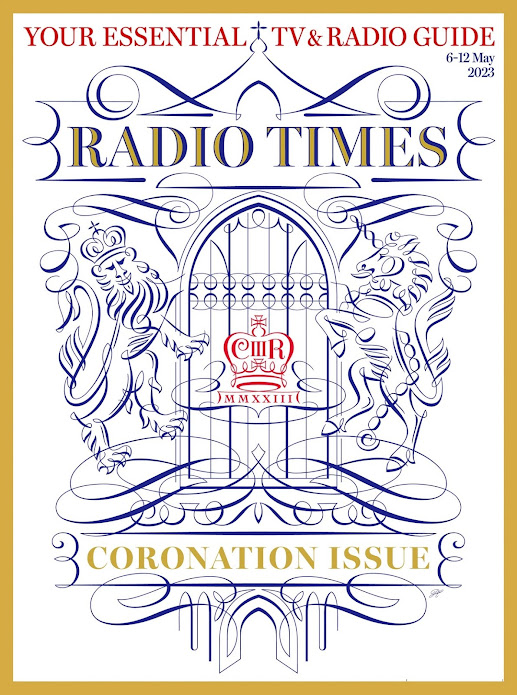
Seventy years on, the current issue of Radio Times marks the Coronation of King Charles III with a design by Peter Horridge clearly is an homage to Fraser in that he uses the same heraldic beasts but which, nevertheless, is much planer, although equally elegant.
Peter is a designer and illustrator with a great gift for calligraphy and calligraphic design. To my mind, this image, with its lightness and airiness, manages to sensitively unite the archaic traditions of ceremonial with the King's desire to be viewed as a 'modern monarch'. The incorporation of a window and, below, arches suggests the venue for the Coronation, Westminster Abbey...
Peter Horridge was also responsible for the rather more formalized image (well, actually, a logo) created as a symbol of the Coronation as a participant in the creative collective of Sir Jony Ive's LoveFrom, [Note: One word, two caps and a terminal comma].
This was one of several Royal commissions, others include the seal of Terra Carta launched by the former Prince of Wales at COP26 in 2021 as a mandate that puts sustainability at the heart of the private sector.
In only a few years, Halloween in Britain has gone from being a totally American and utterly un-British (and therefore inexplicable) holiday to being up there in the UK marketing and merchandising league with Christmas, Easter and Valentine’s Day.
Even though our stores are now annually full of Halloween paraphernalia,
there is precious little cultural knowledge in Britain about the
Catholic feasts of All Hallows (or All Saints) and All Souls celebrated
on 1st and 2nd November, or of the European traditions, superstitions
and amusements that preceded them on October 31, known as All Hallows’
Eve – or Hallowe'en…
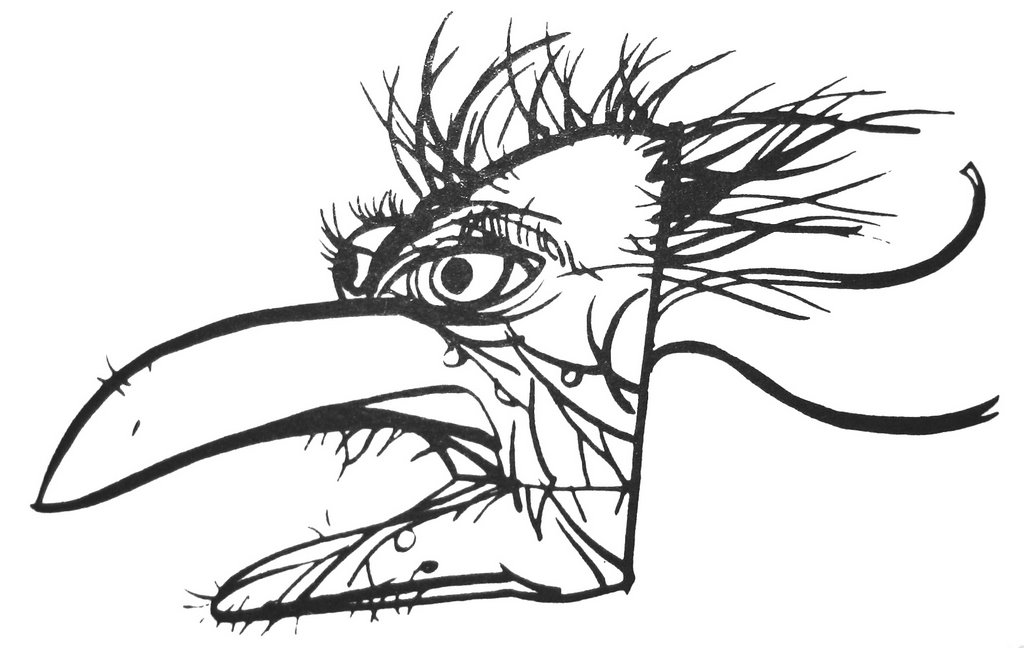
The pumpkins on the Tree were not mere pumpkins. Each had a face sliced in it. Each face was different. Every eye was a stranger eye. Every nose was a weirder nose. Every mouth smiled hideously in some new way.
There must have been a thousand pumpkins on this tree, hung high and on every branch. A thousand smiles. A thousand grimaces. And twice-times-a-thousand glares and winks and blinks and leerings of fresh-cut eyes…
It
is a journey that memorably explains how light and darkness, faith and
fear have shaped a festival now more widely celebrated than understood…The Halloween Tree came about because I had lunch with [legendary Bugs Bunny animator] Chuck Jones forty years ago; he had just become a new friend.
The night before, an animated [Peanuts] film - The Great Pumpkin - had been on TV. My children disliked it so much that they ran over and kicked the TV set, along with me, because the whole idea of the Great Pumpkin supposedly arriving and then not arriving was incorrect to me. It was like shooting Santa Claus on the way down the chimney!
Chuck Jones and I agreed that we didn't like The Great Pumpkin, though we did admire Charlie Schultz, the cartoonist, very much. Then Chuck said, "Why don't we do a really good film on Halloween?" I said, "I think we could. Let me go home and bring something."
So I went home and brought Chuck a large painting of a Halloween Tree that I had painted down in the basement with my daughters a few years before.

Chuck took one look at it and said, "My God, that's the genealogy of the holiday. Will you write a screenplay on this?" I said, "Yes, hire me!" So Chuck Jones and MGM hired me to write a TV script called The Halloween Tree.
Several months down the road, MGM decided to turn its back on animation, so they closed their unit and fired Chuck and me. I had nothing to do then so I took the script and wrote the novel of The Halloween Tree.
Later I wrote a second script for the final animated film, which was done by Hanna-Barbera a few years later, for which I received an Emmy Award for the script.
About three years ago I produced Something Wicked This Way Comes at a theater in Santa Monica and on Halloween night my biographer, Sam Weller, drove me to the play and then home again at around 10:30 at night and on the way, in four different yards we saw that people had placed pumpkins, real ones or papier mache, lit with candles in trees in their front yards.
Now, there are Halloween Trees beginning to appear all over the United States and I realized that with my story and that picture that I painted down in the basement with my daughters more than forty years ago, I've changed the history of Halloween in the entire country.I've discussed this with the Disney people and suggested that they invite me to Disneyland on Halloween night and put up a tree full of papier mache pumpkins and have me there to turn on the whole thing. They would make themselves and me part of the future history of Halloween because no trees existed forty years ago – they began to appear only after my book and my film.The Disney people haven't reacted so far because, I believe, the notice is very short. If we don't do it this year I'm hoping that Disney will invite me out next Halloween and initiate the birth of the Halloween Tree and the history of the holiday.It's been an interesting experience for me and it thrills me to think that 100 years from now there will be Halloween trees all across our world...

Inevitably then, tonight, my thoughts will turn to my late, dear friend.
'Trick or Treat, Ray? ––– What do you say?'
You can read more about Ray Bradbury and his books in my profile of him The Bradbury Machine.
You will also find many pages of information about the author and his work on the excellent internet site, Bradbury Media.
And, if you haven't heard it already, here's a radio programme I made in 1998 featuring an interview with Ray – Encountering the Illustrated Man...