Showing posts with label Wind in the Willows. Show all posts

Sunday, 15 October 2023

MAPPING MY EARLY LIFE


I love maps! By which I mean that I am passionate about them – whether they depict real places or the let's-pretend realms of the imagination.
 

There cannot be anywhere better to write about the maps in my life than where I am now: Venice – or to be absolutely precise in case you want to locate it on a map: 2316 Calle del Pestrin, San Marco, 30124, Venice. You see Venice is both the most intricately and incompetently mapped city in the world.


When my husband, David, and I arrived here first, almost thirty years ago, we came clutching The Illustrated Venice Map by Magnetic North: chosen from Stanfords’ incomparable emporium, ‘Est. 1853’, at a time when it was the largest, and indeed only, map maker and seller in London and is still, today, the best starting point for the ardent traveller. I suspect that I selected this particular map of Venice (there were, at least, a dozen others) because it had little pictorial indicators of likely destinations: the Piazza San Marco – la Piazza (‘the Square’) – the Rialto Bridge, Santa Maria della Salute and Teatro La Fenice.


It was an Italian sitting next to us on the plane, helpfully advising us how best to reach our hotel with minimal chance of getting lost, who expressed, with surprise, his approval of our map, noting as we would soon discover that, unlike most tourist maps, it shows every calle, campo, ponte and fondamenta, mapping the city down to the shortest, narrowest of blind alleyways. However, it is much more than just that: it is also a map of a state of mind, a glorious figment of historical imagination. It has served us well, its folds worn to yawning slits that defy refolding; and, though rarely now referred to, we carry it still out of sentimentality.


The very first map of which I was aware – long before I understood that places, real or fictional, were capable of beingmapped – was of what I fancy must have been some piratical treasure island. It resided within the red (possibly) covers of a large gift book of tales, verses and puzzles selected to delight the younger reader. As I have it no longer (and, despite years of searching, have never found another) my recollections are imprecise: to my three-year-old self it seemed huge – of the proportions of a lectern Bible – and I hauled it around, insisting that any indulgent adult read to me from its pages.


My favourite story was that of Alice’s expedition into Wonderland that was serialised through the volume, chapter by chapter. But there was another story – pictorially told – of some adventurous, perhaps even swashbuckling, kind that featured a double-page spread, printed, my hazy memory thinks, in black and red and showing a map of an island. I believe I can almost make out its contours: its wavy coastline of coves and creeks; its chief attractions being mountains, forests and lagoons and, maybe, a spot significantly marked with an 'X'. I think of this map, existing now only in faulty memory and having never been seen again, as being mine alone. The next map to which I laid personal claim was, some might say, not a map at all – although I must beg to differ.


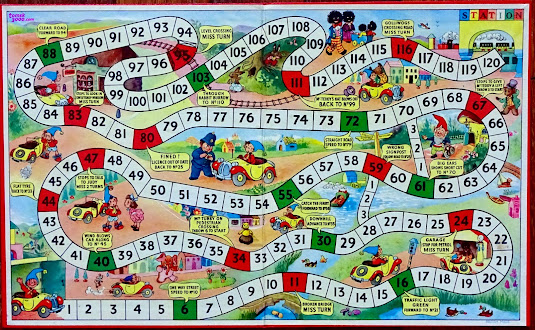
It came folded in half in a box together with a die and four bright plastic cars – green, blue, yellow and red. It was Christmas 1953, I was now four years old, and the radiantly yellow box-lid announced itself as containing ‘Enid Blyton’s LITTLE NODDY CAR GAME. Get to the Station with NODDY and his friends’.  


 CLICK IMAGE to ENLARGE


A snake of numbered squares crawled back and forth across the gaming board – or, as I knew it to be, a map of the route from Noddy’s house (square 1) to the Station (square 120) through a nursery-coloured landscape dotted with toy houses, roads and rivers, bridges, ferries, traffic lights and level crossings.
 

CLICK IMAGE to ENLARGE


Making a journey as Noddy was – like all the great literary journeyings from The Odyssey to The Pilgrim’s Progress to Moby Dick – punctuated with all manner of random incidents leading to advances or retreats, dictated here by the roll of a die: ‘Big Ears shows short cut to No. 70’ or (this was in the politically incorrect ‘50s) ‘Golliwogs crossing road, miss turn’. Some fifty years after my mother had given my Noddy map-game to an undeserving cousin, I bought another in an antique centre and was comforted to find that my childhood memories were still intact, from landing on square 30 (‘Downhill advance to No. 35’) to getting stopped by Mr Plod the Policemen on square 80 (‘Fined! Licence out of date, back to No. 25’).


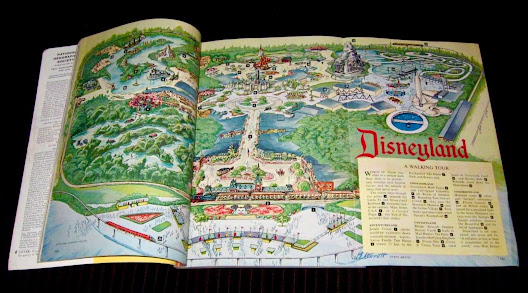
I now jump ten years, to August 1963 when the 14-year old me, now gripped in a passionate obsession with the life and films of Walt Disney, picks up a copy of National Geographic with a lead article (a satisfyingly staggering 50-pages long!) devoted to ‘The Magic Worlds of Walt Disney’ and find that it contains – to my breathless delight – a three-page, foldout pictorial map of Disneyland: a place, like Venice, that is both a reality and a fantasy 


 CLICK IMAGE to ENLARGE


Specially drawn by ‘J E Barrett, Staff Artist’, this is Disneyland before the coming of Pirates of the Caribbean (let alone the unlooked for arrival of Indiana Jones and Star Wars), when pack mules and mine trains still explored Nature’s Wonderland and when it was still possible to ride the Flying Saucers of Tomorrowland.


CLICK IMAGE to ENLARGE


Truthfully, I cannot recall the countless hours in which I pored over that map, drawn back again and again by the pseudo-gothic lettering of ‘Disneyland’ and studying its detail until (had it been possible for me to go to Disneyland) I could have found my way blindfold and without missing a step from the hippo-infested waters of the Jungle Cruise via the blue-roofed towers and turrets of Sleeping Beauty Castle to the helter-skeltering Matterhorn bobsleds.


And when, after an interval of over twenty years, I finally passed through the turnstiles to ‘The Happiest Place On Earth’, I found myself walking, as if in a dream, through those foldout pages of National Geographic: the map and the place metamorphosing into a present experience.


These then were my three ‘personally owned’ maps. My life since has, of course, been crowded with a great many maps with which I have been deeply in love – and about which I have even written books – but which I always knew I shared with others: for example, the puzzling chessboard ‘map’ at the front of Through the Looking-glass; or Moomin Valley with its wolf-topped Lofty Mountains and that enticing off-shore island, home to the enigmatic Hattifatteners; or Bilbo’s Wilderland in The Hobbit with its crooked spine of the Misty Mountains marking the frontier beyond which lay the cobwebbed forest of Mirkwood and greater perils yet. 


Then there have been those cosily reassuring maps made by E H Shepard: of Winnie-the-Pooh’s ‘100 Aker Wood’ and its surroundings (including the best-ever map location: ‘Where the woozle wasn’t’); and the rural home of the inhabitants of The Wind in the Willows with a river–– No! Sorry, Ratty, The River! – curling its way from Toad Hall to Pan Island and the Weir beyond. Or Pauline Baynes’ ornate charts of Narnia and Middle-earth: as evocative as the work of any fifteenth-century cartographer and meticulously embellished with cartouches portraying the various sites in the stories – Cair Paravel or Minas Tirith – realised in gleaming gem-like colours. 


None of these, however, can ever truly supplant those earliest depictions of the ordered middle-class world of Noddy’s 1950s Toyland; or the ever-beckoning pleasures Disney’s Garden of Earthly Delights as it was in the early ‘60s; or, again, that long-lost, foggily-recalled mysterious island map that first lured an unsuspecting three-year-old into succumbing to the unappeasable dreams of Elsewheres and Othertimes.

[Written in Venice, December 2016; Revisited in London,2023]


Thursday, 19 December 2013

GREETINGS FROM TOAD HALL

Here's an old Christmas card which I've put on display amongst this year's current crop of greetings.

Based on a card design by E H Shepard, this scene showing Toad, Rat, Mole and Badger providing seasonal music for two watching children was originally sent to subscribers to the Reprint Society in 1954 to announce the fact that Kenneth Grahame's The Wind in the Willows (illustrated, of course, by Shepard) was their 'Christmas extra volume' for the year.

I really like the idea that, having rescued Toad Hall from the stoats and the weasels, Mr Toad's new 'fad' is nothing more adventurous than playing the tuba in the village band!


Thursday, 30 September 2010

ALPHABOOKS

I just recover from answering one meme (the one asking me to list my frequently watched movies) when, knock me down with a feather, along comes another one: this time courtesy of my friend SCB at Where there are Meadowlarks...

Here are THE RULES (for there must always be RULES) as laid down by SCB:

1. Go through the alphabet, and for each letter, think of a book you've read that starts with that letter (A, An, and The do not count).

2. You must write down the FIRST book you think of for any given letter. This may make for some odd choices, but them's the breaks.

3. You must have actually READ the book. (I thought of lots that started with some letters, but I hadn't read them.)

4. If you think of a more impressive-sounding book for a particular letter, but you've already written your first thought down, you CANNOT change to the more impressive-sounding book. As an example, you have to leave "Fifty Famous Fairy Tales" (the Whitman Publishing pink and white one) on the list, even if you come up with fifty more impressive books afterwards.

5. If you can think of a book for X, you win... my lasting admiration (I can't afford real prizes!)

6. You can then tag as many people as you like. The more the merrier.

So, here's the list I drew up...

Alice's Adventures in Wonderland – Lewis Carroll

Brave New World – Aldous Huxley

A Christmas Carol – Charles Dickens

Doctor Dolittle – Hugh Lofting

The Exploits of Moominpappa – Tove Jansson

Fahrenheit 451 – Ray Bradbury

Gormenghast – Mervyn Peake

The Hobbit – J R R Tolkien

It's Too Late Now – A A Milne
(The autobiography of Pooh's creator)

Just So Stories – Rudyard Kipling

A Kid for Two Farthings – Wolf Mankowitz

The Lord of the Rings – J R R Tolkien

Mary Poppins – P L Travers

Noddy in Toyland – Enid Blyton
(Nostromo by Joseph Conrad would have sounded better, but there it is!)

The Once and Future King – T H White

Peter and Wendy – J M Barrie

Quentin Durwood – Sir Walter Scott

Ring of Bright Water – Gavin Maxwell

Something Wicked This Way Comes – Ray Bradbury

Treasure Island – Robert Louis Stevenson

Utopia - Thomas More

The Voyage of the 'Dawn Treader' – C S Lewis

The Wind in the Willows – Kenneth Graham

EXterminator! – William S Burroughs (Oh, well, it was worth a try!)

Yertle the Turtle and Other Stories – Dr Seuss

Zen in the Art of Writing – Ray Bradbury


I suppose it's not too surprising that there are two titles by Tolkien and three by Bradbury – plus, of course, Carroll, Milne and Peake – but the preponderance of children's books suggests that I have already entered my second childhood which is, I guess, pretty accurate!

I hesitate to tag anyone, but (if they'd like to do it and have the time) then I'll tag Gill, Sheila, Sharon, Suzanne and anyone else who fancies having a go...

Thursday, 10 December 2009

THE MAN WHO DREW POOH (and MOLE)

Today is the 130th birthday of Ernest Howard Shepard, the artist and illustrator who captured in line those now immortal creations of A A Milne and Kenneth Grahame who resided, respectively, in the 100 Acre Wood...


...and along the willow-shaded banks of the Thames...


Shepard died in 1976 in his 96th year and lies at rest in the graveyard of St Peter's Church, West Sussex...

Click on image to enlarge

His simple stone is engraved with a painters palette hanging on a willow tree flanked by Mole and Toady.


Images: Illustrations by E H Shepard; Shepard's grave photographed by Charles for Wikipedia


Sunday, 12 October 2008

WIND-BAG

An article by Danny Buckland in today's Sunday Express about Kenneth Grahame and The Wind in the Willows ('The tragic life of the man who dreamed of the riverbank') quotes some doubtful authority on the subject referred to as "acclaimed author and playwright Brian Sibley". I won't bore you with what he said - I put it rather better myself on yesterday's blog!

Saturday, 11 October 2008

"AN HONEST BOOK..."

"For every honest reader," wrote Kenneth Grahame, "there exist some half-dozen honest books, which he re-reads at regular intervals of six months or thereabouts. Whatever the demands on him, however alarming the arrears that gibber and grin in menacing row, for these he somehow generally manages to find time..."

And the man who wrote those words, himself wrote one of those 'honest books' to which 'honest readers' (like myself and many others) return again and again, and which this week celebrated the 100th anniversary its publication - The Wind in the Willows...

This book is, actually, less of a book and more of a friend - a good friend with whom you simply must keep in touch, whose company always makes you feel a little more content with life, a tad more safe in uncertain times.

For me that friendship began when I was nine years old and my parents gave me a thin, pocket-sized edition with small print and none of those wonderful E H Shepard pictures that were not the first, but certainly the definitive illustrations. In fact, the only decoration to my copy was a line drawing - stamped on the pale green cover - of two gnarled willow trees bending in the wind.

Nevertheless, as an only, sickly child, I read the book in one day and claimed the characters - gentle-natured Mole, good-hearted Ratty, no-nonsense Badger and the one-and-only, never-to be-forgotten, utterly outrageous, Mr Toad - for an extended family.

I fell under the the spell of the chattering, babbling river so beloved of the Water Rat: "It's my world, and I don't want any other. What is it hasn't got is not worth having, and what it doesn't know is not worth knowing..."

And, of course, I was captivated by the roar and rattle of Toad's errant motor car as it thundered down the open, dusty, highway ever in search of someplace new: "Here to-day - in next week to-morrow! Villages skipped, towns and cities jumped - always somebody else's horizon! O bliss! O poop-poop! O my! O my!"

The Wind in the Willows became one of the best-loved books on my childhood bookshelf. Some of the volumes that stood alongside it in those far off days have long been discarded and forgotten; others are still respected, still capable of evoking affectionate memories, but now seldom read. The Wind in the Willows, on the other hand, has remained a constant companion across the changing years.

So, what was it about the book that captured my youthful imagination and still captures the fancy of the older, more worldly-wise adult? What I adored, when young, was Kenneth Grahame's ability to spin a yarn full of lovable characters and comic escapades: Toad the daredevil adventurer, stealing cars, escaping from gaol, commandeering railway engines.

What intrigues me now is the daring with which the storyteller interweaves the fun and frolic with episodes of rare and mysterious beauty: Mole yearning for his little, abandoned home; Rat listening to tales of the wide world from an old seafaring rat and the mystical encounter with the great god Pan in that curious chapter entitled 'The Piper at the Gates of Dawn'.


The resulting mix oughtn't to work - indeed when the book was first published, a lot of very grown-up people (critics and the like) said that it didn't work. The humorous magazine Punch (with singular lack of humour) described it as "a sort of irresponsible holiday story in which the chief characters are woodland animals, who are represented as enjoying most of the advantages of civilization."

Even more glorious is the pompous pronouncement in The Times Literary Supplement that "as a contribution to natural history the work is negligible" before going on to point out that a water rat would "never use a boat to navigate a stream" and pondered on the subject of a mole doing whitewashing: "no doubt moles like their abodes to be clean; but whitewashing? Are we very stupid or is this joke really inferior?"

The answer to which, of course - we now know - is obvious: yes, the critic of the TLS was indeed very stupid!

Young readers, of course, knew better: they made the book their own and then persuaded the adults to change their minds. As Grahame wrote, years afterwards: "It is the special charm of the child's point of view, that the dual nature of these characters does not present the slightest difficulty to them. It is only the old fogies who are apt to begin 'Well, but...' and so on. To the child it is all entirely natural and as it should be."

And - child or adult - we will return again and again to this miraculous book because woven through its entire length is an overwhelmingly reassuring sense of security and cosiness: of summer picnics on the river bank, walks across country fields in the frosty air of winter and afternoon tea snuggled around the fire...

Like the ancient willow trees that grow along the banks of the Thames and which gave the book its title, The Wind in the Willows has a time-enduring quality: it remains one of the most haunting evocative, boisterously funny and endlessly enchanting book ever written...

And if my recommendation won't suffice, let me leave you with the words of another admirer of The Wind in the Willows - and the man who dramatised the book and made it into what was, for many years, one of London' annual theatrical treats, Toad of Toad Hall - A A Milne:

For the last ten or twelve years I have been recommending it. Usually I speak about at my first meeting with a stranger. It is my opening remark, just as yours is something futile about the weather. If I don't get it in at the beginning, I squeeze it in at the end. The stranger has got to have it sometime.

Should I ever find myself in the dock, and one never knows, my answer to the question whether I have anything to say would be, 'Well, my lord, if I might just recommend a book to the jury before leaving...'


Happy Birthday,
Toady, Ratty, Moley and Badger!

And may you live for at least another hundred years!

Images: © Estate of Ernest H Shepard


Thursday, 4 January 2007

10 THINGS (3)

Well, as Sam Gamgee observed, I'm back!

Yesterday morning David and I were sitting having coffee and a sandwich outside Quadri Grand Caffe in St Mark's Square, Venice. It was crisply cold, but the sky was a clear blue and the sun was scattering the lagoon with flashes of diamond light...

And now it's back to the wind and the rain!

Back to blogging, too! And I'm starting the New Year (no, NOT with a list of broken resolutions!) but with another in my occasional series of TEN THINGS that have made my life richer than it might otherwise have been.

On this occasion I’ve selected----

Ten Things That Have Made My Life More EMOTIONAL...


Arriving in Venice

Looking at the stars

Looking back

Snow falling at night


Reading The Wind in the Willows

Watching It’s a Wonderful Life

Listening to Tchaikovsky’s 6th Symphony

Old letters

Fireworks

Leaving Venice

Saturday, 18 November 2006

"I'VE GOT A LITTLE LIST"

Maybe it is something to do with an awareness of the transience of life, but we are as a species, list-makers!

Just think how many folk songs contain iventories: "Parsley, sage, rosemary and thyme"; itineries: "There was an old woman who swallowed a fly..."; and much-repeated lists of Things ("This is the cow with the crumpled horn that tossed the dog, that worried the cat, that killed the rat that ate the malt that lay in the house that Jack built") and/or People:
Tom Pearce, Tom Pearce, lend me your grey mare,
All along, down along, out along lee,
Us wants to go to Widdecombe Fair


Wi' Bill Brewer, Jan Stewer,
Peter Gurney, Peter Davey,
Dan'l Whiddon, Harry Hawke,
Old Uncle Tom Cobleigh and all,
Old Uncle Tom Cobleigh and all...

My fascination with lists is such that, for some time now, I've been vaguely collecting literary lists and - if one includes Gilbert & Sullivan (and I don’t see why one shouldn’t) - lyrical lists…

I mention G&S because they were always listing things - especially in their infamous "patter songs" such as 'I've Got A little List", the schedule of possible victims-for-the-chop drawn up by Ko Ko (The Lord High Executioner) in their comic opera, The Mikado...

As some day it may happen that a victim must be found,
I've got a little list -- I've got a little list
Of society offenders who might well be underground,
And who never would be missed -- who never would be missed!

There's the banjo serenader, and the others of his race,
And the piano-organist -- I've got him on the list!
And the people who eat peppermint and puff it in your face,
They never would be missed -- they never would be missed!
Then the idiot who praises, with enthusiastic tone,
All centuries but this, and every country but his own;
And the lady from the provinces, who dresses like a guy,
And who "doesn't think she waltzes, but would rather like to try";
And that singular anomaly, the lady novelist--
I don't think she'd be missed -- I'm sure she'd not he missed!

And in their lesser-known operetta, The Sorcerer, the eponymous character - John Wellington Wells - has a formidable catalogue of services on offer...
Oh, my name is John Wellington Wells
I'm a dealer in magic and spells

In blessings and curses

And ever-filled purses

In prophecies, witches, and knells...

We've a first-class assortment of magic
And for raising a posthumous shade

With effects that are comic or tragic

There's no cheaper house in the trade...


Love-philtre, we've quantities of it

And for knowledge if any one burns

We keep an extremely small prophet,

Who brings us unbounded returns

For he can prophesy with a wink of his eye

Peep with security into futurity

Sum up your history, clear up a mystery

Humour proclivity for a nativity

With mirrors so magical, tetrapods tragical

Bogies spectacular, answers oracular

Facts astronomical, solemn or comical...

W S Gilbert's contemporary, Lewis Carroll, also went in for lists and none of his books have more of them than The Hunting of the Snark, of which this is one of the shorter ones - albeit repeated several times!

They sought it with thimbles, they sought it with care;
They pursued it with forks and hope;
They threatened its life with a railway-share;
They charmed it with smiles and soap.


Of course, we’re all very familiar with the process of making lists ("Milk, eggs, bread, low-fat- low-salt-low-taste spread…" etc), but when I talk about lists I’m talking about inventories of sheer, stunning inventiveness!

For eample, how can any humble shopping-list for Tesco’s hope to compete with Ratty’s luncheon basket in (sorry to mention this book yet again) The Wind in the Willows:
"What’s inside it?” asked the Mole, wriggling with curiosity.

"There’s cold chicken inside it,” replied the Rat briefly; “cold chickencoldtonguecoldbeefpickledgherkinssaladfrenchrollscress sandwichespottedmeatgingerbeerlemonadesodawater…”’

And here, to conclude, is another list, this time from that incomparable nabob of nonsense, Mr Edward Lear, and his account of the travels of ‘The Jumblies’...

Far and few, far and few,
Are the lands where the Jumblies live;
Their heads are green, and their hands are blue,
And they went to sea in a Sieve.

They sailed to the Western Sea, they did,
To a land all covered with trees,
And they bought an Owl, and a useful Cart,
And a pound of Rice, and a Cranberry Tart,
And a hive of silvery Bees.
And they bought a Pig, and some green Jack-daws,
And a lovely Monkey with lollipop paws,
And forty bottles of Ring-Bo-Ree,
And no end of Stilton Cheese.

Now that is what I call a serious shopping expedition!

[Images: Widdecombe Fair-goers by Alan Young Pottery; Stephen Quint as Ko Ko (photograph: Michael Nemeth) in the New York Gilbert & Sullivan Players' production of The Mikado; illustrations to The Hunting of the Snark by Henry Holiday, The Wind in the Willows by E H Shepard and The Jumblies by Ian Beck]

Sunday, 6 August 2006

TOP TEN TOMES

Following my recent rant about Penguin’s list of 100 Greatest Books, Cafrine of the wonky comma commented:
I'd be interested to hear, Brian, what, say, your top ten greatest books of all time would be. We'll even let you pick books from every publisher and not limit you to simply Penguin Books!
As I remarked in reply, any listing by me of 'The Ten Greatest Books of All Time' would be totally meaningless, since I know that there are a very many (very probably GREAT) books that I've still not read - and which, looking at the up-coming schedule of life, I will probably never will get around to reading...


But, yes, I decided, I would submit my personal 'Top Ten Tomes', on the strict understanding that Somebody Out There joins in and puts forward their Top Ten -- and that includes you, Cafrine!

The criteria (for me): books that have seized and held my imagination and - in some cases - changed my life or at least the way I look at it…

So here they are (in alphabetical order):


A Christmas Carol - Charles Dickens

Alice’s Adventures in Wonderland - Lewis Carroll

Animal Farm - George Orwell

Moby-Dick - Herman Melville


Something Wicked This Way Comes - Ray Bradbury

The Lion, the Witch and the Wardrobe - C S Lewis

The Lord of the Rings - J R R Tolkien

The Sword in the Stone - T H White

The Wind in the Willows - Kenneth Grahame

Titus Groan - Mervyn Peake


And what do you know? They’re all fantasies, fables or fairy-tales!

How revealing is that?!

Friday, 9 June 2006

TASTEFUL WRITING

In my book, the test of a good writer is his or her ability to write about food so that I can actually TASTE it!

Enid Blyton, for example, was constantly hauling out the picnic basket and dispensing the proverbial lashings of ginger beer and the books of Roald Dahl, Beatrix Potter, Edward Lear, Lewis Carroll, A A Milne, J R R Tolkien and C S Lewis are FULL of nosh and noshing! And for ever book I mention, you could probably suggest a dozen more...

Of my many favourites, the one I savour the most is in Kenneth Grahame’s incomparable ‘The Wind in the Willows’.

I read it first - and in one day! - when I was nine years old. Grahame clearly loved his food and the book contains several substantial meals. But it is the simple snack that the Gaoler’s Daughter takes to the hapless Toad when he finds himself incarcerated in “a dank and noisome dungeon” that sets my taste buds dancing:

“She carried a tray, with a cup of fragrant tea steaming on it; and a plate piled high with very hot buttered toast, cut thick, very brown on both sides, with butter running through the holes in it in great golden drops, like honey from the honeycomb. The smell of that buttered toast simply talked to Toad, and with no uncertain voice; talked of warm kitchens, of breakfasts on bright frosty mornings, of cosy parlour firesides on winter evenings, when one’s ramble was over and slippered feet were propped on the fender; of the purring of contented cats and the twitter of sleepy canaries…”

Now, that’s how toast ought to be! If only Mr Russell Hobbs had read ‘The Wind in the Willows’…

[Illustration © Ernest H Shepard]